LESSON 2
THE SCIENTIFIC
METHOD
SCIENTISTS TEST IDEAS
•Scientists examine how the world works by observing, measuring, and
testing
- Involves critical thinking and skepticism
•Observational (descriptive) science: scientists gather information about
something not well known or that cannot be manipulated in experiments
-Astronomy, paleontology, taxonomy, molecular biology Hypothesis-
driven science: research that proceeds in a structured manner using
experiments to test hypotheses through the scientific method
THE SCIENTIFIC METHOD
• A technique for testing ideas
• A scientist makes an observation and
asks questions of some phenomenon.
• The scientist formulates a hypothesis, a
statement that attempts to answer the
question.
• The hypothesis is used to generate
predictions: specific statements that can be
tested.
• The results support or reject the
hypothesis.
TESTING PREDICTIONS
•Experiment: an activity that tests the validity of a hypothesis
•Variables: conditions that can be manipulated and/or measured
- Independent variable: a condition that is manipulated
- Dependent variable: a variable that is affected by the manipulation of the
independent variable
•Controlled experiment: one in which all variables are controlled
- Control: the unmanipulated point of comparison
- Treatment: the manipulated point of comparison
•Data: information that is generally quantitative (numerical)
EXPERIMENTS TEST THE VALIDITY OF A
HYPOTHESIS
• Manipulative experiments yield the strongest evidence
- Provides the strongest type of evidence
- Reveal causal relationships: changes in independent variables cause changes in
dependent variables
- But many things can’t be manipulated: long-term or large- scale questions (i.e.,
global climate change)
• Natural experiments show real-world complexity
- Only feasible approach for ecosystem or planet-scale
- Results are not so neat and clean, so answers aren’t simply black and white
THE SCIENTIFIC PROCESS IS PART OF A LARGER
PROCESS
•Peer-review: other scientists provide comments and criticism
• Guards against faulty science
• Conference presentations improve the quality of the science
• Scientists interact with their colleagues
• Grants and funding come from private or government agencies.
• Can lead to conflict of interest if the data show the funding source in an
unfavorable light
• The scientist may be reluctant to publish or doctor the results.
THE SCIENTIFIC COMMUNITY
THEORIES AND PARADIGMS
• A consistently supported hypothesis becomes a theory, a widely accepted
explanation of one or more cause-and-effect relationships
• Has been extensively and rigorously tested, so confidence in a theory is
extremely strong
• Darwin’s theory of evolution, atomic theory, cell theory, big bang
theory, plate tectonics, general relativity
• Differs from the popular meaning of theory, which suggests a speculative
idea without much substance
• With enough data, a paradigm shift — a change in the dominant view — can
occur.
ETHICS
• Ethics: the study of good and bad, right and wrong
- The set of moral principles or values held by a person or society that tells us how
we ought to behave
- People use criteria, standards, or rules when making judgments.
- Different cultures or worldviews lead to different values, which lead to
different actions.
• Relativists: ethics vary with social context
• Universalists: right and wrong remains the same across cultures and situations
ETHICAL STANDARDS
• Ethical standards: criteria that help differentiate right from
wrong
- Classical standard = virtue
- The golden rule: treat others as you want to be treated
- Utility: something right produces the most benefits for the
most people
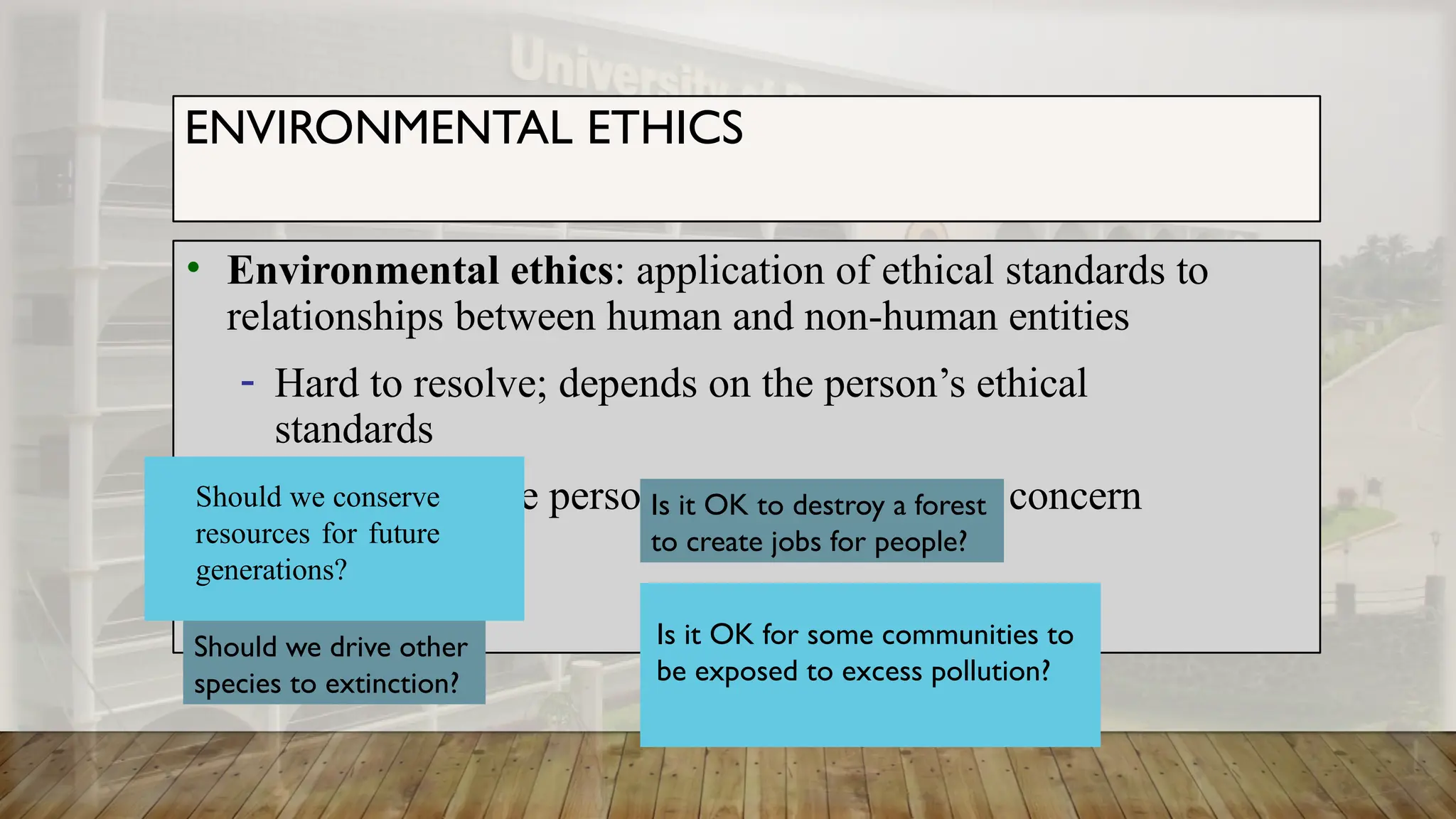
ENVIRONMENTAL ETHICS
• Environmental ethics: application of ethical standards to
relationships between human and non-human entities
- Hard to resolve; depends on the person’s ethical
standards
- Depends on the person’s domain of ethical concern
Should we conserve
resources for future
generations?
Is it OK to destroy a forest
to create jobs for people?
Should we drive other
species to extinction?
Is it OK for some communities to
be exposed to excess pollution?
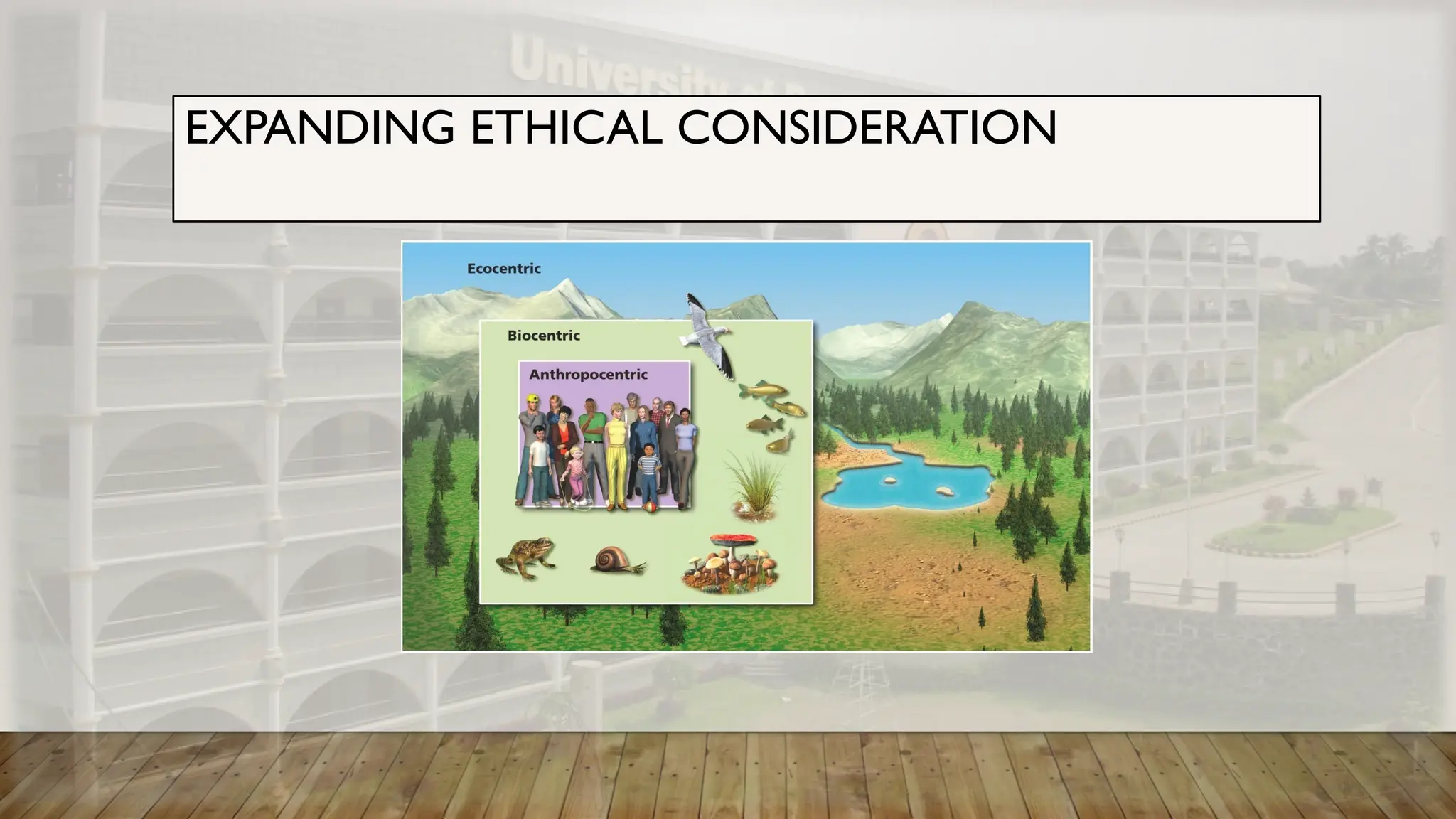
THREE ETHICAL PERSPECTIVES
•Anthropocentrism: only humans have rights
- Costs and benefits are measured only according to their impact on people
- Anything not providing benefit to people has no value
•Biocentrism: certain living things also have value
- All life has ethical standing
- Development is opposed if it destroys life, even if it creates jobs
•Ecocentrism: whole ecological systems have value
- Values the well-being of species, communities, or ecosystems
- Holistic perspective, stresses preserving connections
EXPANDING ETHICAL CONSIDERATION
THE PRESERVATION ETHIC
•Unspoiled nature should be protected
for its own inherent value.
• We should protect our environment in
a pristine state, because it promotes
human happiness and fulfillment.
• John Muir (right, with President
Roosevelt at Yosemite National Park)
had an ecocentric viewpoint.
THE CONSERVATION ETHIC
•Use natural resources wisely for the greatest
good for the most people
• A utilitarian standard that calls for
prudent, efficient, and sustainable
resource extraction and use
• Gifford Pinchot had an anthropocentric
viewpoint.
THE LAND ETHIC
•Healthy ecological systems depend on
protecting all parts.
• Aldo Leopold believed that humans should
view themselves and the land as members of
the same community.
• We are obligated to treat the land ethically.
• The land ethic will help guide decision
making.
ECOFEMINISM
• In the 1960s and 1970s, feminist scholars saw parallels in how people
treated nature and how men treated women.
• Degradation, social oppression
• Ecofeminism: a patriarchal (male-dominated) society is a root cause of
both social and environmental problems
• Female worldview: interrelationships and cooperation
• Male worldview: hierarchies, competition, domination, and conquest
ENVIRONMENTAL JUSTICE (EJ)
• Involves the fair treatment of all people with respect to the environment,
regardless of race, income, or ethnicity
• The poor and minorities are exposed to more pollution, hazards, and
environmental degradation.
• Despite progress, significant inequalities remain.
• The U.S. has still not ratified the Basel
Convention, which prohibits the international
export of waste, particularly to poor nations.
SUSTAINABILITY
• A guiding principle of environmental science
• Living within our planet’s means
- The Earth can sustain humans AND other organisms for the
future
- Leaving our descendants with a rich, full world
- Developing solutions that work in the long term
- Requires keeping fully functioning ecological systems
SUSTAINABILITY
• We are increasing our burden on the planet each year.
- Population growth, affluence, consumption
• Natural capital: the accumulated wealth of Earth
- We are withdrawing our planet’s natural capital 30% faster than it is
being produced
• Natural capital = the accumulated wealth of Earth
- We are withdrawing our planet’s natural capital 30% faster than it is
being produced.
WE ARE INCREASING OUR BURDEN ON THE
PLANET
• Human population growth amplifies all environmental problems
- The growth rate has slowed, but we still add over 200,000 people to the
planet each day.
• Our consumption of resources has risen even faster.
- Life has become more pleasant for us so far.
- However, rising consumption increases the demands we make on our
environment.
- The rise in affluence has not been equal. The gap between rich and poor
has doubled in the past 40 years.
ECOLOGICAL FOOTPRINTS ARE NOT ALL EQUAL
• The ecological footprints
of countries vary greatly.
- The U.S. footprint is
much greater than the
world’s average.
- Developing countries
have much smaller
footprints than
developed countries.
THE MILLENNIUM ECOSYSTEM ASSESSMENT
• The most comprehensive scientific assessment of the condition of the world’s
ecological systems
• Major findings:
•Humans have drastically altered ecosystems.
•These changes have contributed to human well- being and economic
development, but at a cost.
•Environmental degradation could get much worse. Degradation can be reversed,
but it requires work.
SUSTAINABLE SOLUTIONS ABOUND
• Sustainable development: using resources to satisfy current needs without compromising
future availability of resources
• Sustainability involves:
- Renewable energy sources
- Soil conservation, high-efficiency irrigation, organic agriculture
- Pollution reduction
- Habitat and species protection
- Recycling
- Fighting global climate change
• Humanity’s challenge is to develop solutions that further our quality of life while
protecting and restoring the environment.
WILLWE DEVELOP IN A SUSTAINABLE WAY?
• Sustainable solutions must meet:
- Environmental goals
- Economic goals
- Social goals
• Requires that humans limit our impact while promoting
economic well-being and social equity
- Apply science to solve problems
• The single most important question we face is: "Will we
• develop sustainably?”
CONCLUSION
• Finding ways to live sustainably on Earth requires a solid ethical grounding and scientific
understanding of our natural and social systems.
• Environmental science helps us understand our relationship with the environment
and informs our attempts to solve and prevent problems.
• Identifying a problem is the first step in solving it.
• Solving environmental problems can move us toward health, longevity, peace, and
prosperity.
• - Environmental science can help find balanced solutions to
environmental problems.
END
ASSIGNMENT
• Write the following in a whole bond paper.
• Surname, Section
• Write an application of the Scientific method in relation to your course.
Research a common problem that occurs in the field of your chosen
profession. Come up with the Solution using the steps of scientific
method: Observations, questions, hypothesis, predictions, test, results.
END
QUIZ #1
•Review for your quiz next
meeting, 30 items multiple
choice.

Envisci 2Envisci 2Envisci 2Envisci 2Envisci 2.pptx

  • 1.
  • 2.
    SCIENTISTS TEST IDEAS •Scientistsexamine how the world works by observing, measuring, and testing - Involves critical thinking and skepticism •Observational (descriptive) science: scientists gather information about something not well known or that cannot be manipulated in experiments -Astronomy, paleontology, taxonomy, molecular biology Hypothesis- driven science: research that proceeds in a structured manner using experiments to test hypotheses through the scientific method
  • 3.
    THE SCIENTIFIC METHOD •A technique for testing ideas • A scientist makes an observation and asks questions of some phenomenon. • The scientist formulates a hypothesis, a statement that attempts to answer the question. • The hypothesis is used to generate predictions: specific statements that can be tested. • The results support or reject the hypothesis.
  • 4.
    TESTING PREDICTIONS •Experiment: anactivity that tests the validity of a hypothesis •Variables: conditions that can be manipulated and/or measured - Independent variable: a condition that is manipulated - Dependent variable: a variable that is affected by the manipulation of the independent variable •Controlled experiment: one in which all variables are controlled - Control: the unmanipulated point of comparison - Treatment: the manipulated point of comparison •Data: information that is generally quantitative (numerical)
  • 5.
    EXPERIMENTS TEST THEVALIDITY OF A HYPOTHESIS • Manipulative experiments yield the strongest evidence - Provides the strongest type of evidence - Reveal causal relationships: changes in independent variables cause changes in dependent variables - But many things can’t be manipulated: long-term or large- scale questions (i.e., global climate change) • Natural experiments show real-world complexity - Only feasible approach for ecosystem or planet-scale - Results are not so neat and clean, so answers aren’t simply black and white
  • 6.
    THE SCIENTIFIC PROCESSIS PART OF A LARGER PROCESS •Peer-review: other scientists provide comments and criticism • Guards against faulty science • Conference presentations improve the quality of the science • Scientists interact with their colleagues • Grants and funding come from private or government agencies. • Can lead to conflict of interest if the data show the funding source in an unfavorable light • The scientist may be reluctant to publish or doctor the results.
  • 7.
  • 8.
    THEORIES AND PARADIGMS •A consistently supported hypothesis becomes a theory, a widely accepted explanation of one or more cause-and-effect relationships • Has been extensively and rigorously tested, so confidence in a theory is extremely strong • Darwin’s theory of evolution, atomic theory, cell theory, big bang theory, plate tectonics, general relativity • Differs from the popular meaning of theory, which suggests a speculative idea without much substance • With enough data, a paradigm shift — a change in the dominant view — can occur.
  • 9.
    ETHICS • Ethics: thestudy of good and bad, right and wrong - The set of moral principles or values held by a person or society that tells us how we ought to behave - People use criteria, standards, or rules when making judgments. - Different cultures or worldviews lead to different values, which lead to different actions. • Relativists: ethics vary with social context • Universalists: right and wrong remains the same across cultures and situations
  • 10.
    ETHICAL STANDARDS • Ethicalstandards: criteria that help differentiate right from wrong - Classical standard = virtue - The golden rule: treat others as you want to be treated - Utility: something right produces the most benefits for the most people
  • 11.
    ENVIRONMENTAL ETHICS • Environmentalethics: application of ethical standards to relationships between human and non-human entities - Hard to resolve; depends on the person’s ethical standards - Depends on the person’s domain of ethical concern Should we conserve resources for future generations? Is it OK to destroy a forest to create jobs for people? Should we drive other species to extinction? Is it OK for some communities to be exposed to excess pollution?
  • 12.
    THREE ETHICAL PERSPECTIVES •Anthropocentrism:only humans have rights - Costs and benefits are measured only according to their impact on people - Anything not providing benefit to people has no value •Biocentrism: certain living things also have value - All life has ethical standing - Development is opposed if it destroys life, even if it creates jobs •Ecocentrism: whole ecological systems have value - Values the well-being of species, communities, or ecosystems - Holistic perspective, stresses preserving connections
  • 13.
  • 14.
    THE PRESERVATION ETHIC •Unspoilednature should be protected for its own inherent value. • We should protect our environment in a pristine state, because it promotes human happiness and fulfillment. • John Muir (right, with President Roosevelt at Yosemite National Park) had an ecocentric viewpoint.
  • 15.
    THE CONSERVATION ETHIC •Usenatural resources wisely for the greatest good for the most people • A utilitarian standard that calls for prudent, efficient, and sustainable resource extraction and use • Gifford Pinchot had an anthropocentric viewpoint.
  • 16.
    THE LAND ETHIC •Healthyecological systems depend on protecting all parts. • Aldo Leopold believed that humans should view themselves and the land as members of the same community. • We are obligated to treat the land ethically. • The land ethic will help guide decision making.
  • 17.
    ECOFEMINISM • In the1960s and 1970s, feminist scholars saw parallels in how people treated nature and how men treated women. • Degradation, social oppression • Ecofeminism: a patriarchal (male-dominated) society is a root cause of both social and environmental problems • Female worldview: interrelationships and cooperation • Male worldview: hierarchies, competition, domination, and conquest
  • 18.
    ENVIRONMENTAL JUSTICE (EJ) •Involves the fair treatment of all people with respect to the environment, regardless of race, income, or ethnicity • The poor and minorities are exposed to more pollution, hazards, and environmental degradation. • Despite progress, significant inequalities remain. • The U.S. has still not ratified the Basel Convention, which prohibits the international export of waste, particularly to poor nations.
  • 19.
    SUSTAINABILITY • A guidingprinciple of environmental science • Living within our planet’s means - The Earth can sustain humans AND other organisms for the future - Leaving our descendants with a rich, full world - Developing solutions that work in the long term - Requires keeping fully functioning ecological systems
  • 20.
    SUSTAINABILITY • We areincreasing our burden on the planet each year. - Population growth, affluence, consumption • Natural capital: the accumulated wealth of Earth - We are withdrawing our planet’s natural capital 30% faster than it is being produced • Natural capital = the accumulated wealth of Earth - We are withdrawing our planet’s natural capital 30% faster than it is being produced.
  • 21.
    WE ARE INCREASINGOUR BURDEN ON THE PLANET • Human population growth amplifies all environmental problems - The growth rate has slowed, but we still add over 200,000 people to the planet each day. • Our consumption of resources has risen even faster. - Life has become more pleasant for us so far. - However, rising consumption increases the demands we make on our environment. - The rise in affluence has not been equal. The gap between rich and poor has doubled in the past 40 years.
  • 22.
    ECOLOGICAL FOOTPRINTS ARENOT ALL EQUAL • The ecological footprints of countries vary greatly. - The U.S. footprint is much greater than the world’s average. - Developing countries have much smaller footprints than developed countries.
  • 23.
    THE MILLENNIUM ECOSYSTEMASSESSMENT • The most comprehensive scientific assessment of the condition of the world’s ecological systems • Major findings: •Humans have drastically altered ecosystems. •These changes have contributed to human well- being and economic development, but at a cost. •Environmental degradation could get much worse. Degradation can be reversed, but it requires work.
  • 24.
    SUSTAINABLE SOLUTIONS ABOUND •Sustainable development: using resources to satisfy current needs without compromising future availability of resources • Sustainability involves: - Renewable energy sources - Soil conservation, high-efficiency irrigation, organic agriculture - Pollution reduction - Habitat and species protection - Recycling - Fighting global climate change • Humanity’s challenge is to develop solutions that further our quality of life while protecting and restoring the environment.
  • 25.
    WILLWE DEVELOP INA SUSTAINABLE WAY? • Sustainable solutions must meet: - Environmental goals - Economic goals - Social goals • Requires that humans limit our impact while promoting economic well-being and social equity - Apply science to solve problems • The single most important question we face is: "Will we • develop sustainably?”
  • 26.
    CONCLUSION • Finding waysto live sustainably on Earth requires a solid ethical grounding and scientific understanding of our natural and social systems. • Environmental science helps us understand our relationship with the environment and informs our attempts to solve and prevent problems. • Identifying a problem is the first step in solving it. • Solving environmental problems can move us toward health, longevity, peace, and prosperity. • - Environmental science can help find balanced solutions to environmental problems.
  • 27.
  • 28.
    ASSIGNMENT • Write thefollowing in a whole bond paper. • Surname, Section • Write an application of the Scientific method in relation to your course. Research a common problem that occurs in the field of your chosen profession. Come up with the Solution using the steps of scientific method: Observations, questions, hypothesis, predictions, test, results.
  • 29.
  • 30.
    QUIZ #1 •Review foryour quiz next meeting, 30 items multiple choice.