General Principles 
of Taxation 
Tax 111 – Income Taxation 
Ferdinand C. Importado 
CPA, MBA
Objectives 
At the end of this lecture, the students shall 
be able to: 
• Define taxation. 
• Discuss the purposes of taxation. 
• Identify the theory and basis of taxation. 
• Describe the principles of a sound tax 
system. 
• List the nature of taxation.
Objectives 
At the end of this lecture, the students shall 
be able to: 
• Explain the limitations of taxation 
(constitutional and inherent). 
• Identify the aspects of taxation.
What is taxation? 
Taxation is the process or means by which 
the sovereign, through its lawmaking 
body, raises income to defray the 
necessary expenses of the government.
Purpose of taxation 
Primary purpose 
• To provide funds or property with which 
to promote the general welfare of its 
citizens and to enable it to finance its 
multifarious activities.
Purpose of taxation 
Secondary purposes 
• To strengthen anemic enterprises by 
giving tax exemptions. 
• To protect local industries against 
foreign competition through imposition of 
high customs duties on imported 
goods.
Purpose of taxation 
Secondary purposes 
• To reduce inequalities in wealth and 
income by imposing progressively 
higher taxes. 
• To prevent inflation by increasing taxes 
or ward off depression by decreasing 
taxes.
Theory and basis of taxation 
• Theory 
– The existence of the government is a 
necessity. 
– The government cannot continue without a 
means to pay its expenses. 
– The government has the rights to compel its 
citizens and property within its limits to 
contribute.
Theory and basis of taxation 
• Basis 
– Taxation is based on the reciprocal duties of 
protection and support between the 
government and its people. 
– Government receives taxes from the people 
which is used to perform functions of 
government and other benefits. 
– Benefit-received theory.
Basic principles of sound tax 
system 
• Fiscal adequacy 
• Equality or theoretical justice 
• Administrative feasibility
Fiscal adequacy 
• The source of government revenue should 
be efficient to demand the needs of public 
expenditure. 
• Creating new taxes or new tax machinery 
or by merely changing the rates applicable 
to existing taxes.
Equality or theoretical justice 
• The tax burden should be proportionate to 
the taxpayer’s ability to pay. 
• Ability-to-pay principle
Administrative feasibility 
• The tax laws should be capable of 
convenient, just and effective administration. 
• Each tax should be: 
– Clear and plain to the taxpayer. 
– Capable of uniform enforcement 
– Convenient as to time, place and manner of 
payment. 
– Not unduly burdensome upon or discouraging to 
business activity
Nature of taxation 
• It is inherent in sovereignty. 
• Legislative in character. 
• Subject to constitutional and inherent 
limitations.
Limitations of taxation 
• Inherent limitations – restrictions on the 
power exists from the very nature of the 
power of taxation itself. 
• Constitutional limitations – restrictions 
in the exercise of the power of taxation as 
expressly provided in the Philippine 
Constitution.
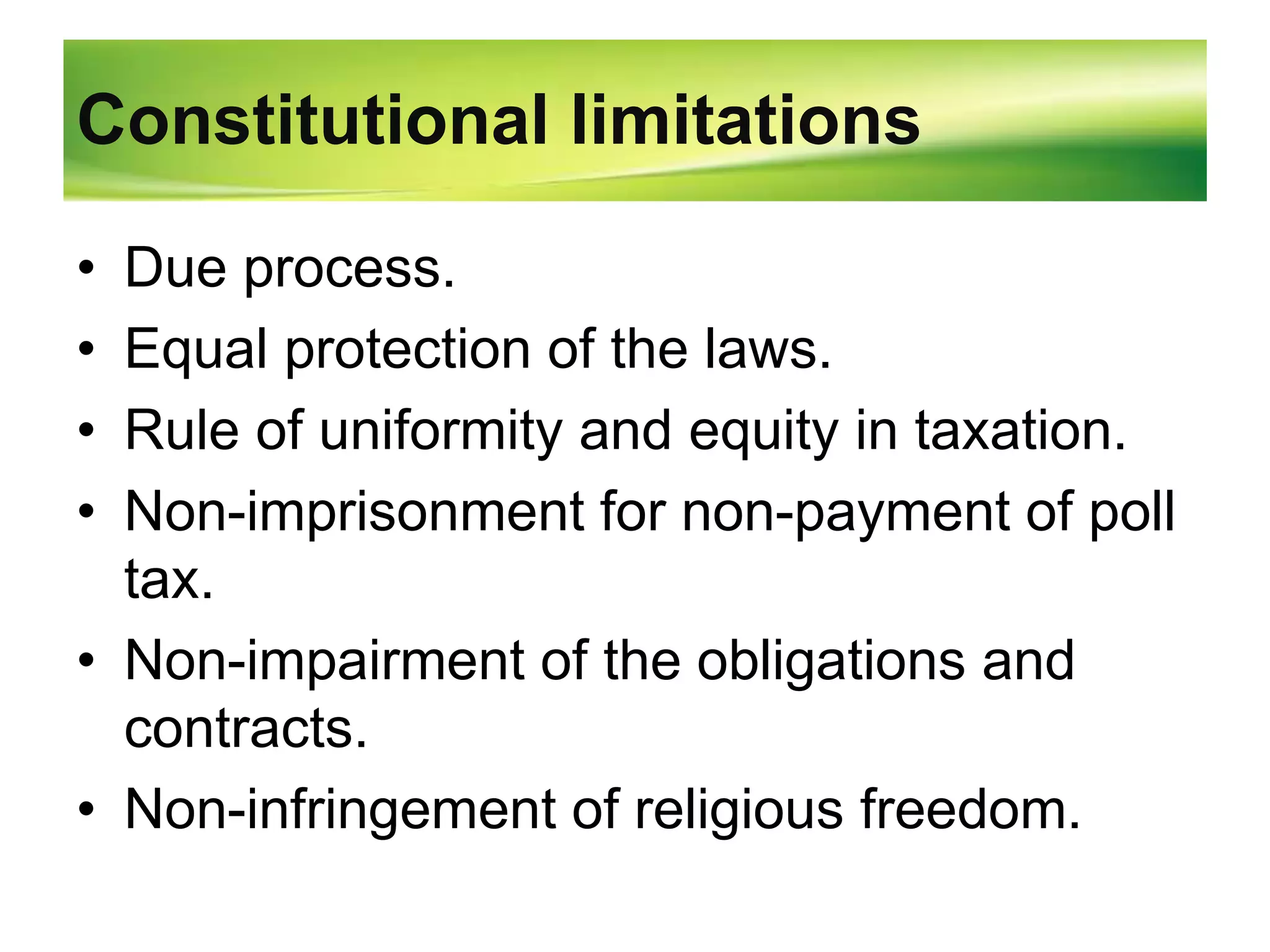
Constitutional limitations 
• Due process. 
• Equal protection of the laws. 
• Rule of uniformity and equity in taxation. 
• Non-imprisonment for non-payment of poll 
tax. 
• Non-impairment of the obligations and 
contracts. 
• Non-infringement of religious freedom.
Constitutional limitations 
• No appropriation for religious purposes. 
• Exemption of religious, charitable or 
educational entities, non-profit cemeteries, 
and churches from taxation. 
• Exemption of revenues and assets of non-stock, 
non-profit educational institutions 
and donations for educational purposes 
from taxation.
Constitutional limitations 
• Concurrence by a majority of all members 
of the Congress for the passage of a law 
granting any tax exemption. 
• Power of the President to veto any 
particular item or items in a revenue or 
tariff bill. 
• Non-impairment of the jurisdiction of the 
Supreme Court in tax cases.
Inherent limitations 
• Requirement that levy must be for a public 
purpose. 
• Non-delegation of the legislative power to 
tax, except: 
– Delegation to the President 
– Delegation to local governments 
– Delegation to administrative bodies
Inherent limitations 
• Exemption from taxation of government 
entities. 
• International comity 
• Territorial jurisdiction
Aspects of taxation 
• Levy – deals with the provisions of law 
which determines: 
– The person or property to be taxed 
– The sum or sums to be raised 
– The rate of the tax 
– The time and manner of levying, receiving 
and collection the tax.
Aspects of taxation 
• Collections – constituted of the provisions 
of law which prescribe the manner of 
enforcing the obligation on the part of 
those taxes to pay the demand thus 
created.

General principles of taxation

  • 1.
    General Principles ofTaxation Tax 111 – Income Taxation Ferdinand C. Importado CPA, MBA
  • 2.
    Objectives At theend of this lecture, the students shall be able to: • Define taxation. • Discuss the purposes of taxation. • Identify the theory and basis of taxation. • Describe the principles of a sound tax system. • List the nature of taxation.
  • 3.
    Objectives At theend of this lecture, the students shall be able to: • Explain the limitations of taxation (constitutional and inherent). • Identify the aspects of taxation.
  • 4.
    What is taxation? Taxation is the process or means by which the sovereign, through its lawmaking body, raises income to defray the necessary expenses of the government.
  • 5.
    Purpose of taxation Primary purpose • To provide funds or property with which to promote the general welfare of its citizens and to enable it to finance its multifarious activities.
  • 6.
    Purpose of taxation Secondary purposes • To strengthen anemic enterprises by giving tax exemptions. • To protect local industries against foreign competition through imposition of high customs duties on imported goods.
  • 7.
    Purpose of taxation Secondary purposes • To reduce inequalities in wealth and income by imposing progressively higher taxes. • To prevent inflation by increasing taxes or ward off depression by decreasing taxes.
  • 8.
    Theory and basisof taxation • Theory – The existence of the government is a necessity. – The government cannot continue without a means to pay its expenses. – The government has the rights to compel its citizens and property within its limits to contribute.
  • 9.
    Theory and basisof taxation • Basis – Taxation is based on the reciprocal duties of protection and support between the government and its people. – Government receives taxes from the people which is used to perform functions of government and other benefits. – Benefit-received theory.
  • 10.
    Basic principles ofsound tax system • Fiscal adequacy • Equality or theoretical justice • Administrative feasibility
  • 11.
    Fiscal adequacy •The source of government revenue should be efficient to demand the needs of public expenditure. • Creating new taxes or new tax machinery or by merely changing the rates applicable to existing taxes.
  • 12.
    Equality or theoreticaljustice • The tax burden should be proportionate to the taxpayer’s ability to pay. • Ability-to-pay principle
  • 13.
    Administrative feasibility •The tax laws should be capable of convenient, just and effective administration. • Each tax should be: – Clear and plain to the taxpayer. – Capable of uniform enforcement – Convenient as to time, place and manner of payment. – Not unduly burdensome upon or discouraging to business activity
  • 14.
    Nature of taxation • It is inherent in sovereignty. • Legislative in character. • Subject to constitutional and inherent limitations.
  • 15.
    Limitations of taxation • Inherent limitations – restrictions on the power exists from the very nature of the power of taxation itself. • Constitutional limitations – restrictions in the exercise of the power of taxation as expressly provided in the Philippine Constitution.
  • 16.
    Constitutional limitations •Due process. • Equal protection of the laws. • Rule of uniformity and equity in taxation. • Non-imprisonment for non-payment of poll tax. • Non-impairment of the obligations and contracts. • Non-infringement of religious freedom.
  • 17.
    Constitutional limitations •No appropriation for religious purposes. • Exemption of religious, charitable or educational entities, non-profit cemeteries, and churches from taxation. • Exemption of revenues and assets of non-stock, non-profit educational institutions and donations for educational purposes from taxation.
  • 18.
    Constitutional limitations •Concurrence by a majority of all members of the Congress for the passage of a law granting any tax exemption. • Power of the President to veto any particular item or items in a revenue or tariff bill. • Non-impairment of the jurisdiction of the Supreme Court in tax cases.
  • 19.
    Inherent limitations •Requirement that levy must be for a public purpose. • Non-delegation of the legislative power to tax, except: – Delegation to the President – Delegation to local governments – Delegation to administrative bodies
  • 20.
    Inherent limitations •Exemption from taxation of government entities. • International comity • Territorial jurisdiction
  • 21.
    Aspects of taxation • Levy – deals with the provisions of law which determines: – The person or property to be taxed – The sum or sums to be raised – The rate of the tax – The time and manner of levying, receiving and collection the tax.
  • 22.
    Aspects of taxation • Collections – constituted of the provisions of law which prescribe the manner of enforcing the obligation on the part of those taxes to pay the demand thus created.