English Classes
An Introduction for Intermediate-Advanced Students
1
What You Must Manage Well
Structure
Phrase
Clause
Sentence
Tenses
•Meaning
•Auxiliaries
•Time Markers
Three basic Sentence formulas
Active Sentence
Passive Sentence
Question
Modals
•What are “true” modals
•What are their characteristics?
2
The Anatomy of a Sentence
Structure
3
Phrase
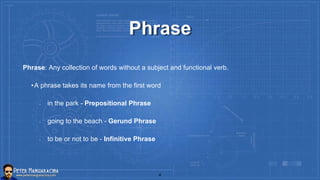
Phrase: Any collection of words without a subject and functional verb.
•A phrase takes its name from the first word
• in the park - Prepositional Phrase
• going to the beach - Gerund Phrase
• to be or not to be - Infinitive Phrase
4
Clause
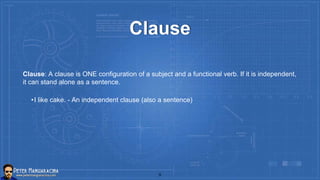
Clause: A clause is ONE configuration of a subject and a functional verb. If it is independent,
it can stand alone as a sentence.
•I like cake. - An independent clause (also a sentence)
5
Sentence
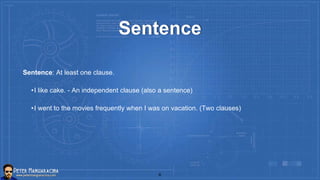
Sentence: At least one clause.
•I like cake. - An independent clause (also a sentence)
•I went to the movies frequently when I was on vacation. (Two clauses)
6
The Structure of English
Formulas
7
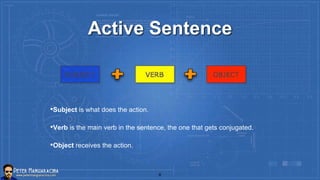
Active Sentence
•Subject is what does the action.
•Verb is the main verb in the sentence, the one that gets conjugated.
•Object receives the action.
8
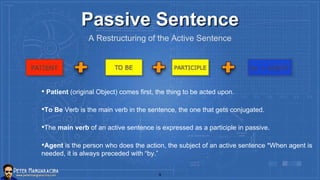
Passive Sentence
• Patient (original Object) comes first, the thing to be acted upon.
•To Be Verb is the main verb in the sentence, the one that gets conjugated.
•The main verb of an active sentence is expressed as a participle in passive.
•Agent is the person who does the action, the subject of an active sentence *When agent is
needed, it is always preceded with “by.”
A Restructuring of the Active Sentence
9
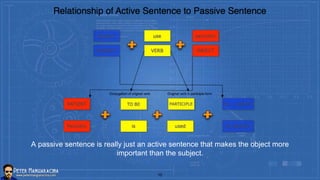
A passive sentence is really just an active sentence that makes the object more
important than the subject.
10
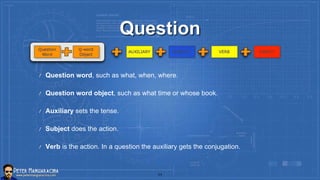
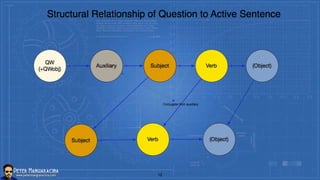
Question
Question word, such as what, when, where.
Question word object, such as what time or whose book.
Auxiliary sets the tense.
Subject does the action.
Verb is the action. In a question the auxiliary gets the conjugation.
11
12
Tenses
The Three Skills You Need to Master
13
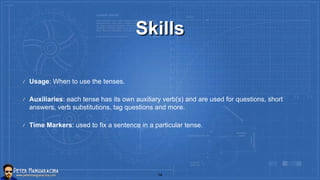
Skills
Usage: When to use the tenses.
Auxiliaries: each tense has its own auxiliary verb(s) and are used for questions, short
answers, verb substitutions, tag questions and more.
Time Markers: used to fix a sentence in a particular tense.
14
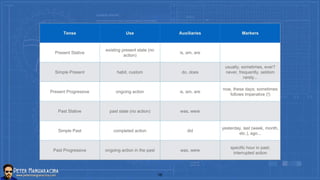
A Chart of the Tenses
15
Tense Use Auxiliaries Markers
Present Stative
existing present state (no
action)
is, am, are
Simple Present habit, custom do, does
usually, sometimes, ever?
never, frequently, seldom
rarely...
Present Progressive ongoing action is, am, are
now, these days; sometimes
follows imperative (!)
Past Stative past state (no action) was, were
Simple Past completed action did
yesterday, last (week, month,
etc.), ago...
Past Progressive ongoing action in the past was, were
specific hour in past;
interrupted action
16
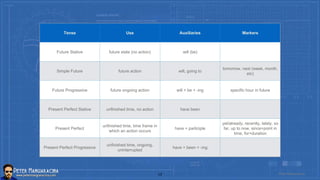
Tense Use Auxiliaries Markers
Future Stative future state (no action) will (be)
Simple Future future action will, going to
tomorrow, next (week, month,
etc)
Future Progressive future ongoing action will + be + -ing specific hour in future
Present Perfect Stative unfinished time, no action have been
Present Perfect
unfinished time, time frame in
which an action occurs
have + participle
yet/already, recently, lately, so
far, up to now, since+point in
time, for+duration
Present Perfect Progressive
unfinished time, ongoing,
uninterrupted
have + been + -ing
Peter Mangiaracina17
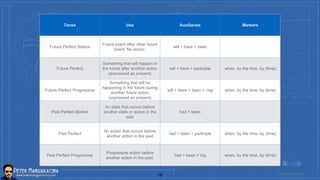
Tense Use Auxiliaries Markers
Future Perfect Stative
Future event after other future
event. No action.
will + have + been
Future Perfect
Something that will happen in
the future after another action
(expressed as present)
will + have + participle when, by the time, by (time)
Future Perfect Progressive
Something that will be
happening in the future during
another future action
(expressed as present)
will + have + been + -ing when, by the time, by (time)
Past Perfect Stative
An state that occurs before
another state or action in the
past
had + been
Past Perfect
An action that occurs before
another action in the past
had + been + participle when, by the time, by (time)
Past Perfect Progressive
Progressive action before
another action in the past.
had + been + ing when, by the time, by (time)
Peter Mangiaracina18
Modals
19
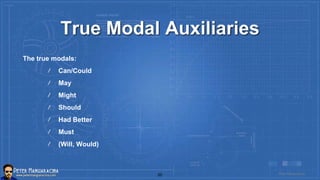
True Modal Auxiliaries
The true modals:
Can/Could
May
Might
Should
Had Better
Must
(Will, Would)
Peter Mangiaracina20
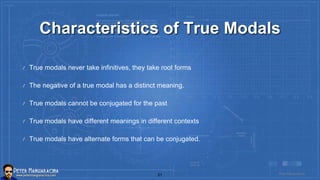
Characteristics of True Modals
True modals never take infinitives, they take root forms
The negative of a true modal has a distinct meaning.
True modals cannot be conjugated for the past
True modals have different meanings in different contexts
True modals have alternate forms that can be conjugated.
Peter Mangiaracina21
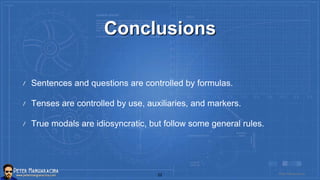
Conclusions
Sentences and questions are controlled by formulas.
Tenses are controlled by use, auxiliaries, and markers.
True modals are idiosyncratic, but follow some general rules.
Peter Mangiaracina22
Contact Me
23Play Again
www.petermangiaracina.com

Introduction to English Classes

  • 1.
    English Classes An Introductionfor Intermediate-Advanced Students 1
  • 2.
    What You MustManage Well Structure Phrase Clause Sentence Tenses •Meaning •Auxiliaries •Time Markers Three basic Sentence formulas Active Sentence Passive Sentence Question Modals •What are “true” modals •What are their characteristics? 2
  • 3.
    The Anatomy ofa Sentence Structure 3
  • 4.
    Phrase Phrase: Any collectionof words without a subject and functional verb. •A phrase takes its name from the first word • in the park - Prepositional Phrase • going to the beach - Gerund Phrase • to be or not to be - Infinitive Phrase 4
  • 5.
    Clause Clause: A clauseis ONE configuration of a subject and a functional verb. If it is independent, it can stand alone as a sentence. •I like cake. - An independent clause (also a sentence) 5
  • 6.
    Sentence Sentence: At leastone clause. •I like cake. - An independent clause (also a sentence) •I went to the movies frequently when I was on vacation. (Two clauses) 6
  • 7.
    The Structure ofEnglish Formulas 7
  • 8.
    Active Sentence •Subject iswhat does the action. •Verb is the main verb in the sentence, the one that gets conjugated. •Object receives the action. 8
  • 9.
    Passive Sentence • Patient(original Object) comes first, the thing to be acted upon. •To Be Verb is the main verb in the sentence, the one that gets conjugated. •The main verb of an active sentence is expressed as a participle in passive. •Agent is the person who does the action, the subject of an active sentence *When agent is needed, it is always preceded with “by.” A Restructuring of the Active Sentence 9
  • 10.
    A passive sentenceis really just an active sentence that makes the object more important than the subject. 10
  • 11.
    Question Question word, suchas what, when, where. Question word object, such as what time or whose book. Auxiliary sets the tense. Subject does the action. Verb is the action. In a question the auxiliary gets the conjugation. 11
  • 12.
  • 13.
    Tenses The Three SkillsYou Need to Master 13
  • 14.
    Skills Usage: When touse the tenses. Auxiliaries: each tense has its own auxiliary verb(s) and are used for questions, short answers, verb substitutions, tag questions and more. Time Markers: used to fix a sentence in a particular tense. 14
  • 15.
    A Chart ofthe Tenses 15
  • 16.
    Tense Use AuxiliariesMarkers Present Stative existing present state (no action) is, am, are Simple Present habit, custom do, does usually, sometimes, ever? never, frequently, seldom rarely... Present Progressive ongoing action is, am, are now, these days; sometimes follows imperative (!) Past Stative past state (no action) was, were Simple Past completed action did yesterday, last (week, month, etc.), ago... Past Progressive ongoing action in the past was, were specific hour in past; interrupted action 16
  • 17.
    Tense Use AuxiliariesMarkers Future Stative future state (no action) will (be) Simple Future future action will, going to tomorrow, next (week, month, etc) Future Progressive future ongoing action will + be + -ing specific hour in future Present Perfect Stative unfinished time, no action have been Present Perfect unfinished time, time frame in which an action occurs have + participle yet/already, recently, lately, so far, up to now, since+point in time, for+duration Present Perfect Progressive unfinished time, ongoing, uninterrupted have + been + -ing Peter Mangiaracina17
  • 18.
    Tense Use AuxiliariesMarkers Future Perfect Stative Future event after other future event. No action. will + have + been Future Perfect Something that will happen in the future after another action (expressed as present) will + have + participle when, by the time, by (time) Future Perfect Progressive Something that will be happening in the future during another future action (expressed as present) will + have + been + -ing when, by the time, by (time) Past Perfect Stative An state that occurs before another state or action in the past had + been Past Perfect An action that occurs before another action in the past had + been + participle when, by the time, by (time) Past Perfect Progressive Progressive action before another action in the past. had + been + ing when, by the time, by (time) Peter Mangiaracina18
  • 19.
  • 20.
    True Modal Auxiliaries Thetrue modals: Can/Could May Might Should Had Better Must (Will, Would) Peter Mangiaracina20
  • 21.
    Characteristics of TrueModals True modals never take infinitives, they take root forms The negative of a true modal has a distinct meaning. True modals cannot be conjugated for the past True modals have different meanings in different contexts True modals have alternate forms that can be conjugated. Peter Mangiaracina21
  • 22.
    Conclusions Sentences and questionsare controlled by formulas. Tenses are controlled by use, auxiliaries, and markers. True modals are idiosyncratic, but follow some general rules. Peter Mangiaracina22
  • 23.

Editor's Notes

  • #2 I’m going to give you some information about what an intermediate/advanced student needs to know in order to communicate better. These will not be the only things you’ll need to learn, but if you use this information as a foundation for learning, you will find that the whole process will go easier for you. At your level the process isn’t so much about learning vocabulary or grammar, it’s about communicating effectively with the English you already know. Here I will go into three important elements to help you achieve that end.
  • #3 First, communicating well in English requires that you structure your sentences and questions well. I’m going to teach you two formulas that will help you with that. Secondly, you have to have a good handle on tenses. You should know what each tense means, what their auxiliaries are, and which time markers signal which tenses. I’ve got some tools you will find very useful for that. Finally, it seems to me after many years as an instructor, that students don’t learn modals well, and wind up using the modal auxiliary “must” too often when there are many more, and many more appropriate options available. Modal auxiliaries are very idiosyncratic, which probably explains why most students fail to use them properly. I’m going to touch on the weird world of modals and tell you where to go to get more info about them. During this presentation I will go through these three main points and give you some rules, tips, and charts. If you master this information, you will find that speaking and comprehension will be much easier.
  • #8  Because English does not have verb endings that express the person who does an action - except in the case of the third person singular - he goes, he works, etc, English relies on structure to express who does an action. Most sentences, therefore, must have a set structure to convey that meaning and to separate them from questions, which have a different form. We can express nearly every sentence and every question in English as two formulas. These formulas can be repeated multiple times to create a very long sentence. No matter how long the sentence is, it will almost always fit in one of the two formulas. With a little adjustment we can create another, special sentence, which I will include here because it is important for medical professionals.
  • #9 This is the most basic sentence. Here we see that the person who does the action in the sentence comes first. We call it the Subject. Then, the action is expressed as a conjugated verb and finally, in the event that the verb is transitive, the object follows. The object is what receives the action Note that I said immediately after. Normally, you cannot put things after the verb unless they are objects. For example, you cannot say "I went with my friend to the store," because the object of where you go is the place you go. You say "I went to the store with my friend." Another common mistake is when you say, "Tomorrow comes my friend." I've heard that so many times, and it is wrong in so many ways! First of all, where's the subject? it's not "tomorrow." Tomorrow is an adverb (except in sentences like that). Also, the object of the verb (comes) in that sentence (my friend) is the person who does the action, so it's in the wrong place. The correct way to say it would be, "My friend comes tomorrow," or even better, "My friend will come (is going to come) tomorrow," because we're dealing with a future event here. When you are speaking, try to start with a subject for now. Don’t put words in front of the subject. For example, Put time expressions on the end of the sentence (tomorrow, next week, etc.) to avoid confusion and to conceptualize the relationship between subjects and verbs better.
  • #10 I am including this structure in my introduction because it is important for medical professionals. It is a kind of sentence you will always see in medical journals.
  • #11 Let me show you how this looks graphically. Here is a standard sentence. We talked about this already. The subject comes 1st, followed by the verb. In this particular sentence the verb is conjugated for the past tense. After the verb, comes the object. The passive begins with the object of the sentence. That is followed by the “to be” verb, which is the verb that gets conjugated. In this case, the verb is conjugated for the past tense, because it was past in the original standard sentence. The “to be” verb is always followed by a participle. The participle was the original verb in the standard sentence. The actual subject of the sentence goes on the end, and is preceded by the word “by.” We call it “the agent.”
  • #12 This is the structure of a question in English. At 1st glance, it may seem a little complicated, but take a look at the 2 elements that are not in parentheses. The 1st element is the auxiliary, which sets the tense of the question. This always appears 1st if the question requires only a yes or no answer (Do you speak English?), and will appear 2nd if there is a question word involved with a few exceptions (when do you speak English?). The auxiliary is followed by the subject, and the subject is how you will begin when you answer the question. At the very beginning of the question we have a question word, if you need a particular piece of information (what, when, where). A question word may be followed by a question word object (what time, which book). Don’t confuse question word objects with subjects. In the sentence what time is it? The subject is it. It is 5 o’clock. Finally, after the subject in a question there is frequently a verb. The verb does not get conjugated (where do you go, where did you go), except in the perfect tenses (where have you gone?). Now, there is much more to this, but those are the basics. We will go deeper into this class.
  • #15 Students do not learn the tenses very well because they lack a way to organize the many and often contradictory rules governing their use. In effect, they lack a system for organizing what they learn. When you learn a tense, you need to keep three aspects of the tenses in mind: - You need a clear idea of when to use the tense. for example, the present tense is used for habit and custom. The past tense is used for completed actions in the past. – Each tense has its own auxiliaries. the auxiliaries for the present tense are “do” and “does”. The auxiliary for the past tense is “did” – Every tense is associated with several adverbs of time. When you see these adverbs, they tend to fix a sentence in a particular tense. “Usually” is used for the present tense, “yesterday” is used for the past tense, however, “since yesterday” or “since 5 o’clock” is used with the present perfect.
  • #16 I’m going to play through a few slides which comprise a chart of the tenses. This is a work in progress, so it’s not complete. If you are watching the video of this presentation, you can stop the video on each page to get a better look. The simple and compound tenses are included.
  • #20 Modals are very complicated to learn; in fact, they are actually modal auxiliaries, which means they have more in common with auxiliaries like “do” “did” and “will” then they do with verbs. One of the things that complicates learning models is the fact that every modal also has an alternative, for example the alternative of “can” is “to be able to”
  • #21 So, in order to sort out what is a modal and what isn’t, we separate things that can act like a modal from things which are true modals.
  • #22 So that you can identify a modal, here’s a list of characteristics which true modals share. True modals never take infinitives, they use the root form of the auxiliary. We say I must go and not I must to go. Frequently the negative of the true modal is not the opposite of its meaning. If I say please go, it means you should leave. If I say don’t go, it means you shouldn’t leave. However, if I say you must stop, you are obligated to stop. If I say you must not stop, it does not mean that you are not obligated to stop. It means you are prohibited from stopping. I hope you can see the difference. The actual opposite of “you must stop” is “you don’t have to stop.” This is a subtlety which I hope to teach you during our time together. True modals cannot be conjugated for the past - with one notable exception, “can.” Can is conjugated as could in the past. But that’s it. The past tense of must is not “musted” True modals have different meanings in different contexts. For example, if I say you must see a doctor, it means that it is a necessity, an obligation. But if you walk into my class and your clothes are wet, I might say, “Oh! It must be raining.” In this case, must is not an obligation or necessity, it is a conclusion that I draw from available evidence. Other examples: You must be tired after being on call all night (conclusion). You must eat healthy foods if you don’t want to get sick (obligation, necessity). True models have alternate forms that can be conjugated. I can’t conjugate can for the future, “I will can see you tomorrow.” I can, however, say, “I will be able to see you tomorrow.” I realize that all of this is quite a bit to take in all at once. We will get to the strange world of modals in due time. If you want to take a look at a presentation that’s a little bit more in depth, you can go to my website, in the presentation section, and look for a presentation called “introduction to moguls”.
  • #23 In conclusion, it boils down to 3 things: Sentences and questions are controlled by formula. Tensions are controlled by use, auxiliaries, and time markers. True models are idiosyncratic, but do follow some general rules.
  • #24 Number started for this presentation. I hope you have a little better idea of how to think about English, and what to expect to be taught during our time together. For more information about me and my classes, you can contact me on the web, subscribe to my twitter account, or go directly to my presentation area, why have short presentations introducing different grammar points. Thank you, and I’ll see you in class.