
Copyright © Terry Felke-Morris http://terrymorris.net
Web Development & Design
Foundations with HTML5
8th
Edition
CHAPTER 9
KEY CONCEPTS
1
Copyright © Terry Felke-Morris http://terrymorris.net
Learning Outcomes
In this chapter, you will learn how to ...
◦ Describe common uses of forms on web pages
◦ Create forms on web pages using the form, input, textarea, and select elements
◦ Create forms that provide additional accessibility features using the accesskey and
tabindex attributes
◦ Associate form controls and groups using the label, fieldset, and legend elements
◦ Create custom image buttons and use the button element
◦ Use CSS to style a form
◦ Configure new HTML5 form controls including the email, URL, datalist, range, spinner,
calendar, and color controls
◦ Describe the features and common uses of server-side processing
◦ Invoke server-side processing to handle form data
◦ Find free server-side processing resources on the Web
2
Copyright © Terry Felke-Morris http://terrymorris.net
Overview of Forms
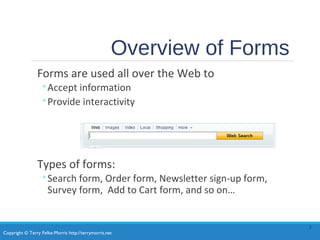
Forms are used all over the Web to
◦Accept information
◦Provide interactivity
Types of forms:
◦Search form, Order form, Newsletter sign-up form,
Survey form, Add to Cart form, and so on…
3
Copyright © Terry Felke-Morris http://terrymorris.net
Overview of Forms (2)
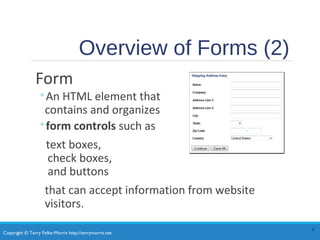
Form
◦An HTML element that
contains and organizes
◦form controls such as
text boxes,
check boxes,
and buttons
that can accept information from website
visitors.
4
Copyright © Terry Felke-Morris http://terrymorris.net
Two Components of Using
Forms
1. The HTML form
the web page user interface
and
2. The server-side processing
Server-side processing works with the
form data and sends e-mail, writes to a
text file, updates a database, or performs
some other type of processing on the
server.
5
Copyright © Terry Felke-Morris http://terrymorris.net
HTML Using Forms
<form>
◦ Contains the form elements on a web page
◦ Container tag
<input>
◦ Configures a variety of form elements including
text boxes, radio buttons, check boxes, and buttons
◦ Stand alone tag
<textarea>
◦ Configures a scrolling text box
◦ Container tag
<select>
◦ Configures a select box (drop down list)
◦ Container tag
<option>
◦ Configures an option in the select box
◦ Container tag
6
Copyright © Terry Felke-Morris http://terrymorris.net
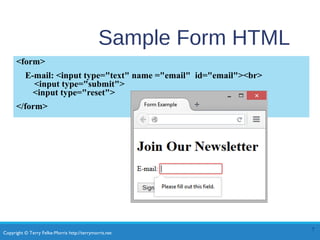
<form>
E-mail: <input type="text" name ="email" id="email"><br>
<input type="submit">
<input type="reset">
</form>
Sample Form HTML
7
Copyright © Terry Felke-Morris http://terrymorris.net
HTML form element
The form element attributes:
◦ action
 Specifies the server-side program or script that will process your form data
◦ method
 get – default value,
form data passed in URL
 post – more secure,
form data passed in HTTP Entity Body
◦ name
 Identifies the form
◦ id
 Identifies the form
8
Copyright © Terry Felke-Morris http://terrymorris.net
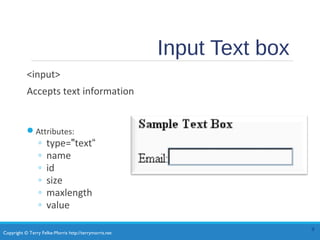
Input Text box
<input>
Accepts text information
Attributes:
◦ type="text“
◦ name
◦ id
◦ size
◦ maxlength
◦ value
9
Copyright © Terry Felke-Morris http://terrymorris.net
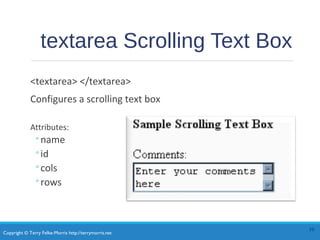
textarea Scrolling Text Box
<textarea> </textarea>
Configures a scrolling text box
Attributes:
◦name
◦id
◦cols
◦rows
10
Copyright © Terry Felke-Morris http://terrymorris.net
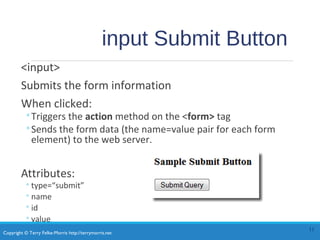
input Submit Button
<input>
Submits the form information
When clicked:
◦Triggers the action method on the <form> tag
◦Sends the form data (the name=value pair for each form
element) to the web server.
Attributes:
◦type=“submit”
◦name
◦id
◦value
11
Copyright © Terry Felke-Morris http://terrymorris.net
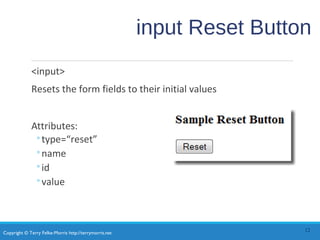
input Reset Button
<input>
Resets the form fields to their initial values
Attributes:
◦type=“reset”
◦name
◦id
◦value
12
Copyright © Terry Felke-Morris http://terrymorris.net
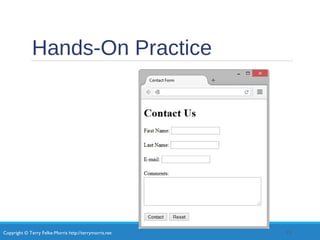
Hands-On Practice
13
Copyright © Terry Felke-Morris http://terrymorris.net
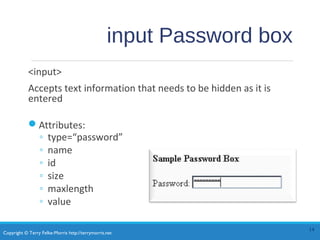
input Password box
<input>
Accepts text information that needs to be hidden as it is
entered
Attributes:
◦ type=“password”
◦ name
◦ id
◦ size
◦ maxlength
◦ value
14
Copyright © Terry Felke-Morris http://terrymorris.net
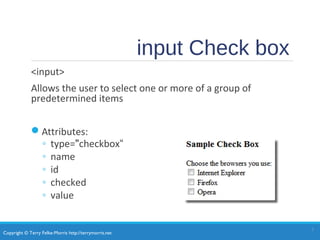
input Check box
<input>
Allows the user to select one or more of a group of
predetermined items
Attributes:
◦ type="checkbox“
◦ name
◦ id
◦ checked
◦ value
1
Copyright © Terry Felke-Morris http://terrymorris.net
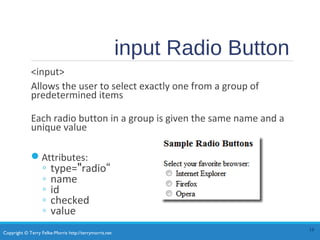
input Radio Button
<input>
Allows the user to select exactly one from a group of
predetermined items
Each radio button in a group is given the same name and a
unique value
Attributes:
◦ type="radio“
◦ name
◦ id
◦ checked
◦ value
16
Copyright © Terry Felke-Morris http://terrymorris.net
input Hidden form data
<input>
This form control is not displayed on the web page.
Hidden form fields
◦Can be accessed by both client-side and server-side scripting
◦Sometimes used to contain information needed as the visitor moves from
page to page.
Attributes:
◦type="hidden“
◦name
◦id
◦value
17
Copyright © Terry Felke-Morris http://terrymorris.net
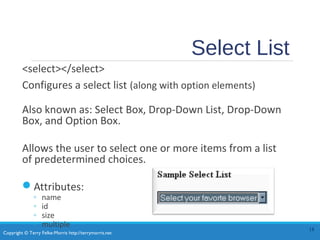
Select List
<select></select>
Configures a select list (along with option elements)
Also known as: Select Box, Drop-Down List, Drop-Down
Box, and Option Box.
Allows the user to select one or more items from a list
of predetermined choices.
Attributes:
◦ name
◦ id
◦ size
◦ multiple
18
Copyright © Terry Felke-Morris http://terrymorris.net
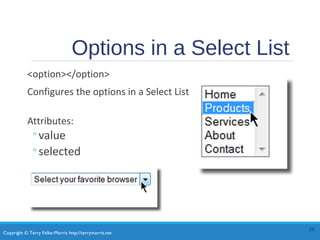
Options in a Select List
<option></option>
Configures the options in a Select List
Attributes:
◦value
◦selected
19
Copyright © Terry Felke-Morris http://terrymorris.net
Checkpoint
1. You are designing a web site for a client who sells items in
a retail store.
They want to create a customer list for e-mail marketing
purposes. Your client sells to consumers and needs a form
that accepts their customer’s name and e-mail address.
Would you recommend using two input boxes
(one for the name and one for the e-mail)
or three input boxes
(for the first name, last name, and email address)?
Explain your answer.
20
Copyright © Terry Felke-Morris http://terrymorris.net
Checkpoint
2. You are designing a survey form for a client. One of
the questions has 10 possible responses.
Only one response can be selected per question.
What type of form control would you use to configure
this question on the web page?
3. True or False.
In a radio button group, the value attribute is used by
the browser to process the radio buttons as a group.
21
Copyright © Terry Felke-Morris http://terrymorris.net
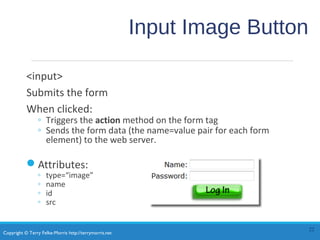
Input Image Button
<input>
Submits the form
When clicked:
◦ Triggers the action method on the form tag
◦ Sends the form data (the name=value pair for each form
element) to the web server.
Attributes:
◦ type=“image”
◦ name
◦ id
◦ src
22
Copyright © Terry Felke-Morris http://terrymorris.net
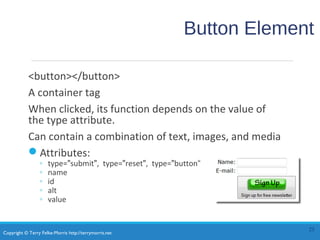
Button Element
<button></button>
A container tag
When clicked, its function depends on the value of
the type attribute.
Can contain a combination of text, images, and media
Attributes:
◦ type="submit", type="reset", type="button“
◦ name
◦ id
◦ alt
◦ value
23
Copyright © Terry Felke-Morris http://terrymorris.net
Accessibility & Forms
Label Element
Fieldset Element
Legend Element
Tabindex Attribute
Accesskey Attribute
24
Copyright © Terry Felke-Morris http://terrymorris.net
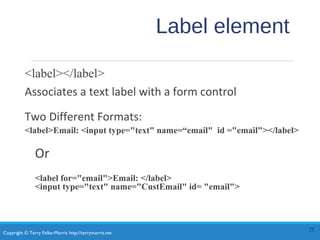
Label element
<label></label>
Associates a text label with a form control
Two Different Formats:
<label>Email: <input type="text" name=“email" id ="email"></label>
Or
<label for="email">Email: </label>
<input type="text" name="CustEmail" id= "email">
25
Copyright © Terry Felke-Morris http://terrymorris.net
Fieldset and Legend
Elements
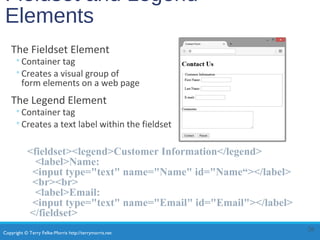
The Fieldset Element
◦Container tag
◦Creates a visual group of
form elements on a web page
The Legend Element
◦Container tag
◦Creates a text label within the fieldset
26
<fieldset><legend>Customer Information</legend>
<label>Name:
<input type="text" name="Name" id="Name“></label>
<br><br>
<label>Email:
<input type="text" name="Email" id="Email"></label>
</fieldset>
Copyright © Terry Felke-Morris http://terrymorris.net
tabindex attribute
Attribute that can be used on form controls and anchor
tags
Modifies the default tab order
Assign a numeric value
<input type="text" name="CustEmail" id="CustEmail"
tabindex="1">
27
Copyright © Terry Felke-Morris http://terrymorris.net
accesskey attribute
Attribute that can be used on form controls and
anchor tags
Create a “hot-key” combination to place the
focus on the component
Assign a value of a keyboard letter
On Windows use the CTRL and the “hot-key” to
move the cursor
<input type="text" name="CustEmail"
id="CustEmail" accesskey="E">
28
Copyright © Terry Felke-Morris http://terrymorris.net
Checkpoint
1. Describe the purpose of the fieldset and legend
elements.
2. Describe the purpose of the accesskey attribute and
how it supports accessibility.
3. When designing a form, should you use the standard
submit button, an image button, or a button tag? Are
these different in the way that they provide for
accessibility? Explain your answer.
29
Copyright © Terry Felke-Morris http://terrymorris.net
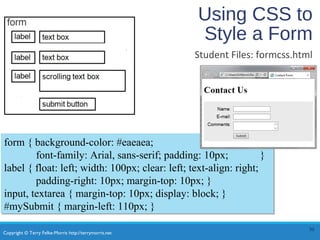
Using CSS to
Style a Form
Student Files: formcss.html
30
form { background-color: #eaeaea;
font-family: Arial, sans-serif; padding: 10px; }
label { float: left; width: 100px; clear: left; text-align: right;
padding-right: 10px; margin-top: 10px; }
input, textarea { margin-top: 10px; display: block; }
#mySubmit { margin-left: 110px; }
form { background-color: #eaeaea;
font-family: Arial, sans-serif; padding: 10px; }
label { float: left; width: 100px; clear: left; text-align: right;
padding-right: 10px; margin-top: 10px; }
input, textarea { margin-top: 10px; display: block; }
#mySubmit { margin-left: 110px; }
Copyright © Terry Felke-Morris http://terrymorris.net
Server-Side
Processing
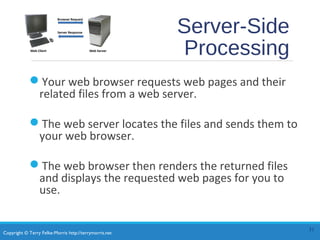
Your web browser requests web pages and their
related files from a web server.
The web server locates the files and sends them to
your web browser.
The web browser then renders the returned files
and displays the requested web pages for you to
use.
31
Copyright © Terry Felke-Morris http://terrymorris.net
CGI
Common Gateway
Interface
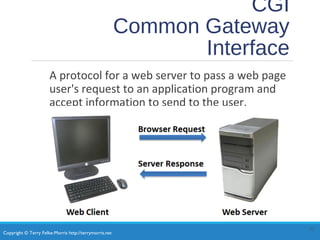
A protocol for a web server to pass a web page
user's request to an application program and
accept information to send to the user.
32
Copyright © Terry Felke-Morris http://terrymorris.net
Server-Side Scripting
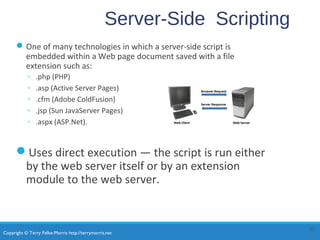
One of many technologies in which a server-side script is
embedded within a Web page document saved with a file
extension such as:
◦ .php (PHP)
◦ .asp (Active Server Pages)
◦ .cfm (Adobe ColdFusion)
◦ .jsp (Sun JavaServer Pages)
◦ .aspx (ASP.Net).
Uses direct execution — the script is run either
by the web server itself or by an extension
module to the web server.
33
Copyright © Terry Felke-Morris http://terrymorris.net
Steps in Utilizing Server-Side
Processing
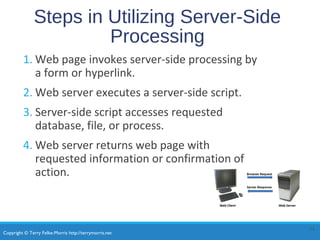
1. Web page invokes server-side processing by
a form or hyperlink.
2. Web server executes a server-side script.
3. Server-side script accesses requested
database, file, or process.
4. Web server returns web page with
requested information or confirmation of
action.
34
Copyright © Terry Felke-Morris http://terrymorris.net
Common Uses of Server-Side
Scripting
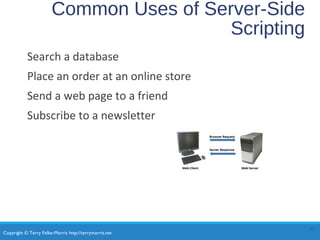
Search a database
Place an order at an online store
Send a web page to a friend
Subscribe to a newsletter
35
Copyright © Terry Felke-Morris http://terrymorris.net
Sending information to
a Server-side Script
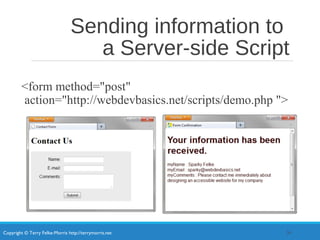
<form method="post"
action="http://webdevbasics.net/scripts/demo.php ">
36
Copyright © Terry Felke-Morris http://terrymorris.net
Sources of Free
Server-Side Processing
Many web host providers offer free scripts for their clients.
Contact their support area or FAQ to learn more about their
services.
Some web sites that offer FREE remotely hosted scripts (in return
for displaying an ad).
◦http://formbuddy.com
◦http://response-o-matic.com
◦http://master.com
◦http://www.formmail.com
◦http://wufoo.com
◦http://formassembly.com
37
Copyright © Terry Felke-Morris http://terrymorris.net
Server-Side Scripting
Technologies
JavaServer Pages
http://www.oracle.com/technetwork/java/javaee/jsp
ColdFusion
http://www.adobe.com/products/coldfusion
 PHP
http://www.php.net
 Ruby on Rails
http://www.rubyonrails.org
 Microsoft’s .NET Framework
http://www.microsoft.com/net
Microsoft Active Server Pages
http://msdn.microsoft.com/en-us/library/ms972337.aspx
38
Copyright © Terry Felke-Morris http://terrymorris.net
Checkpoint
1. Describe server-side processing.
2. Describe why communication is needed
between the developer of a server-side script
and the web page designer.
39
Copyright © Terry Felke-Morris http://terrymorris.net
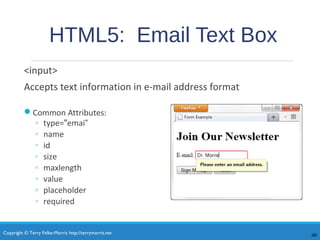
HTML5: Email Text Box
<input>
Accepts text information in e-mail address format
Common Attributes:
◦ type="emai“
◦ name
◦ id
◦ size
◦ maxlength
◦ value
◦ placeholder
◦ required
40
Copyright © Terry Felke-Morris http://terrymorris.net
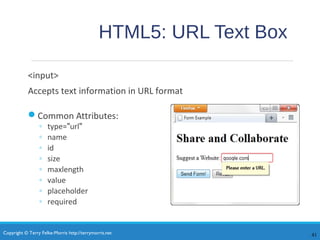
HTML5: URL Text Box
<input>
Accepts text information in URL format
Common Attributes:
◦ type="url"
◦ name
◦ id
◦ size
◦ maxlength
◦ value
◦ placeholder
◦ required
41
Copyright © Terry Felke-Morris http://terrymorris.net
HTML5: Telephone Number Text
Box
<input>
Accepts text information in telephone number format
Common Attributes:
◦ type="tel“
◦ name
◦ id
◦ size
◦ maxlength
◦ value
◦ placeholder
◦ required
42
Copyright © Terry Felke-Morris http://terrymorris.net
HTML5: Search Text Box
<input>
Accepts search terms
Common Attributes:
◦ type="search"
◦ name
◦ id
◦ size
◦ maxlength
◦ value
◦ placeholder
◦ required
43
Copyright © Terry Felke-Morris http://terrymorris.net
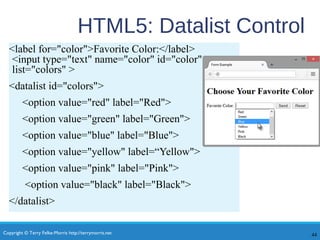
HTML5: Datalist Control
<label for="color">Favorite Color:</label>
<input type="text" name="color" id="color"
list="colors" >
<datalist id="colors">
<option value="red" label="Red">
<option value="green" label="Green">
<option value="blue" label="Blue">
<option value="yellow" label=“Yellow">
<option value="pink" label="Pink">
<option value="black" label="Black">
</datalist>
44
Copyright © Terry Felke-Morris http://terrymorris.net
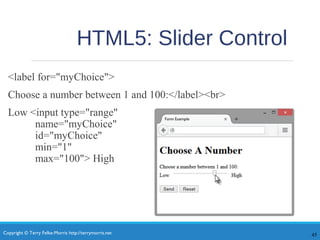
HTML5: Slider Control
<label for="myChoice">
Choose a number between 1 and 100:</label><br>
Low <input type="range"
name="myChoice"
id="myChoice"
min="1"
max="100"> High
45
Copyright © Terry Felke-Morris http://terrymorris.net
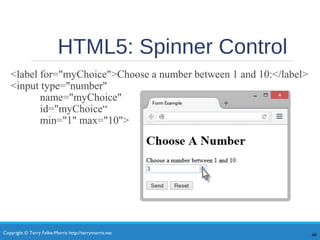
HTML5: Spinner Control
<label for="myChoice">Choose a number between 1 and 10:</label>
<input type="number"
name="myChoice"
id="myChoice“
min="1" max="10">
46
Copyright © Terry Felke-Morris http://terrymorris.net
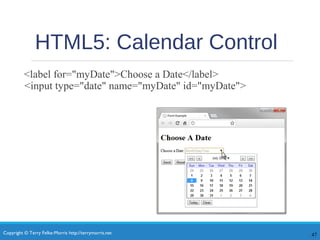
HTML5: Calendar Control
<label for="myDate">Choose a Date</label>
<input type="date" name="myDate" id="myDate">
47
Copyright © Terry Felke-Morris http://terrymorris.net
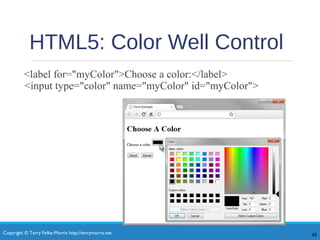
HTML5: Color Well Control
<label for="myColor">Choose a color:</label>
<input type="color" name="myColor" id="myColor">
48
Copyright © Terry Felke-Morris http://terrymorris.net
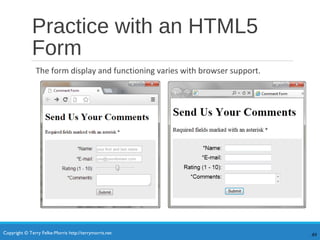
Practice with an HTML5
Form
The form display and functioning varies with browser support.
49
Copyright © Terry Felke-Morris http://terrymorris.net
Summary
This chapter introduced the use of forms on web
pages.
You learned about how to configure form elements
and provide for accessibility.
You also learned how to configure a form to access
server-side processing.
In addition, you learned about new HTML5 form
controls.
50

Chapter9

  • 1.
    Copyright © TerryFelke-Morris http://terrymorris.net Web Development & Design Foundations with HTML5 8th Edition CHAPTER 9 KEY CONCEPTS 1
  • 2.
    Copyright © TerryFelke-Morris http://terrymorris.net Learning Outcomes In this chapter, you will learn how to ... ◦ Describe common uses of forms on web pages ◦ Create forms on web pages using the form, input, textarea, and select elements ◦ Create forms that provide additional accessibility features using the accesskey and tabindex attributes ◦ Associate form controls and groups using the label, fieldset, and legend elements ◦ Create custom image buttons and use the button element ◦ Use CSS to style a form ◦ Configure new HTML5 form controls including the email, URL, datalist, range, spinner, calendar, and color controls ◦ Describe the features and common uses of server-side processing ◦ Invoke server-side processing to handle form data ◦ Find free server-side processing resources on the Web 2
  • 3.
    Copyright © TerryFelke-Morris http://terrymorris.net Overview of Forms Forms are used all over the Web to ◦Accept information ◦Provide interactivity Types of forms: ◦Search form, Order form, Newsletter sign-up form, Survey form, Add to Cart form, and so on… 3
  • 4.
    Copyright © TerryFelke-Morris http://terrymorris.net Overview of Forms (2) Form ◦An HTML element that contains and organizes ◦form controls such as text boxes, check boxes, and buttons that can accept information from website visitors. 4
  • 5.
    Copyright © TerryFelke-Morris http://terrymorris.net Two Components of Using Forms 1. The HTML form the web page user interface and 2. The server-side processing Server-side processing works with the form data and sends e-mail, writes to a text file, updates a database, or performs some other type of processing on the server. 5
  • 6.
    Copyright © TerryFelke-Morris http://terrymorris.net HTML Using Forms <form> ◦ Contains the form elements on a web page ◦ Container tag <input> ◦ Configures a variety of form elements including text boxes, radio buttons, check boxes, and buttons ◦ Stand alone tag <textarea> ◦ Configures a scrolling text box ◦ Container tag <select> ◦ Configures a select box (drop down list) ◦ Container tag <option> ◦ Configures an option in the select box ◦ Container tag 6
  • 7.
    Copyright © TerryFelke-Morris http://terrymorris.net <form> E-mail: <input type="text" name ="email" id="email"><br> <input type="submit"> <input type="reset"> </form> Sample Form HTML 7
  • 8.
    Copyright © TerryFelke-Morris http://terrymorris.net HTML form element The form element attributes: ◦ action  Specifies the server-side program or script that will process your form data ◦ method  get – default value, form data passed in URL  post – more secure, form data passed in HTTP Entity Body ◦ name  Identifies the form ◦ id  Identifies the form 8
  • 9.
    Copyright © TerryFelke-Morris http://terrymorris.net Input Text box <input> Accepts text information Attributes: ◦ type="text“ ◦ name ◦ id ◦ size ◦ maxlength ◦ value 9
  • 10.
    Copyright © TerryFelke-Morris http://terrymorris.net textarea Scrolling Text Box <textarea> </textarea> Configures a scrolling text box Attributes: ◦name ◦id ◦cols ◦rows 10
  • 11.
    Copyright © TerryFelke-Morris http://terrymorris.net input Submit Button <input> Submits the form information When clicked: ◦Triggers the action method on the <form> tag ◦Sends the form data (the name=value pair for each form element) to the web server. Attributes: ◦type=“submit” ◦name ◦id ◦value 11
  • 12.
    Copyright © TerryFelke-Morris http://terrymorris.net input Reset Button <input> Resets the form fields to their initial values Attributes: ◦type=“reset” ◦name ◦id ◦value 12
  • 13.
    Copyright © TerryFelke-Morris http://terrymorris.net Hands-On Practice 13
  • 14.
    Copyright © TerryFelke-Morris http://terrymorris.net input Password box <input> Accepts text information that needs to be hidden as it is entered Attributes: ◦ type=“password” ◦ name ◦ id ◦ size ◦ maxlength ◦ value 14
  • 15.
    Copyright © TerryFelke-Morris http://terrymorris.net input Check box <input> Allows the user to select one or more of a group of predetermined items Attributes: ◦ type="checkbox“ ◦ name ◦ id ◦ checked ◦ value 1
  • 16.
    Copyright © TerryFelke-Morris http://terrymorris.net input Radio Button <input> Allows the user to select exactly one from a group of predetermined items Each radio button in a group is given the same name and a unique value Attributes: ◦ type="radio“ ◦ name ◦ id ◦ checked ◦ value 16
  • 17.
    Copyright © TerryFelke-Morris http://terrymorris.net input Hidden form data <input> This form control is not displayed on the web page. Hidden form fields ◦Can be accessed by both client-side and server-side scripting ◦Sometimes used to contain information needed as the visitor moves from page to page. Attributes: ◦type="hidden“ ◦name ◦id ◦value 17
  • 18.
    Copyright © TerryFelke-Morris http://terrymorris.net Select List <select></select> Configures a select list (along with option elements) Also known as: Select Box, Drop-Down List, Drop-Down Box, and Option Box. Allows the user to select one or more items from a list of predetermined choices. Attributes: ◦ name ◦ id ◦ size ◦ multiple 18
  • 19.
    Copyright © TerryFelke-Morris http://terrymorris.net Options in a Select List <option></option> Configures the options in a Select List Attributes: ◦value ◦selected 19
  • 20.
    Copyright © TerryFelke-Morris http://terrymorris.net Checkpoint 1. You are designing a web site for a client who sells items in a retail store. They want to create a customer list for e-mail marketing purposes. Your client sells to consumers and needs a form that accepts their customer’s name and e-mail address. Would you recommend using two input boxes (one for the name and one for the e-mail) or three input boxes (for the first name, last name, and email address)? Explain your answer. 20
  • 21.
    Copyright © TerryFelke-Morris http://terrymorris.net Checkpoint 2. You are designing a survey form for a client. One of the questions has 10 possible responses. Only one response can be selected per question. What type of form control would you use to configure this question on the web page? 3. True or False. In a radio button group, the value attribute is used by the browser to process the radio buttons as a group. 21
  • 22.
    Copyright © TerryFelke-Morris http://terrymorris.net Input Image Button <input> Submits the form When clicked: ◦ Triggers the action method on the form tag ◦ Sends the form data (the name=value pair for each form element) to the web server. Attributes: ◦ type=“image” ◦ name ◦ id ◦ src 22
  • 23.
    Copyright © TerryFelke-Morris http://terrymorris.net Button Element <button></button> A container tag When clicked, its function depends on the value of the type attribute. Can contain a combination of text, images, and media Attributes: ◦ type="submit", type="reset", type="button“ ◦ name ◦ id ◦ alt ◦ value 23
  • 24.
    Copyright © TerryFelke-Morris http://terrymorris.net Accessibility & Forms Label Element Fieldset Element Legend Element Tabindex Attribute Accesskey Attribute 24
  • 25.
    Copyright © TerryFelke-Morris http://terrymorris.net Label element <label></label> Associates a text label with a form control Two Different Formats: <label>Email: <input type="text" name=“email" id ="email"></label> Or <label for="email">Email: </label> <input type="text" name="CustEmail" id= "email"> 25
  • 26.
    Copyright © TerryFelke-Morris http://terrymorris.net Fieldset and Legend Elements The Fieldset Element ◦Container tag ◦Creates a visual group of form elements on a web page The Legend Element ◦Container tag ◦Creates a text label within the fieldset 26 <fieldset><legend>Customer Information</legend> <label>Name: <input type="text" name="Name" id="Name“></label> <br><br> <label>Email: <input type="text" name="Email" id="Email"></label> </fieldset>
  • 27.
    Copyright © TerryFelke-Morris http://terrymorris.net tabindex attribute Attribute that can be used on form controls and anchor tags Modifies the default tab order Assign a numeric value <input type="text" name="CustEmail" id="CustEmail" tabindex="1"> 27
  • 28.
    Copyright © TerryFelke-Morris http://terrymorris.net accesskey attribute Attribute that can be used on form controls and anchor tags Create a “hot-key” combination to place the focus on the component Assign a value of a keyboard letter On Windows use the CTRL and the “hot-key” to move the cursor <input type="text" name="CustEmail" id="CustEmail" accesskey="E"> 28
  • 29.
    Copyright © TerryFelke-Morris http://terrymorris.net Checkpoint 1. Describe the purpose of the fieldset and legend elements. 2. Describe the purpose of the accesskey attribute and how it supports accessibility. 3. When designing a form, should you use the standard submit button, an image button, or a button tag? Are these different in the way that they provide for accessibility? Explain your answer. 29
  • 30.
    Copyright © TerryFelke-Morris http://terrymorris.net Using CSS to Style a Form Student Files: formcss.html 30 form { background-color: #eaeaea; font-family: Arial, sans-serif; padding: 10px; } label { float: left; width: 100px; clear: left; text-align: right; padding-right: 10px; margin-top: 10px; } input, textarea { margin-top: 10px; display: block; } #mySubmit { margin-left: 110px; } form { background-color: #eaeaea; font-family: Arial, sans-serif; padding: 10px; } label { float: left; width: 100px; clear: left; text-align: right; padding-right: 10px; margin-top: 10px; } input, textarea { margin-top: 10px; display: block; } #mySubmit { margin-left: 110px; }
  • 31.
    Copyright © TerryFelke-Morris http://terrymorris.net Server-Side Processing Your web browser requests web pages and their related files from a web server. The web server locates the files and sends them to your web browser. The web browser then renders the returned files and displays the requested web pages for you to use. 31
  • 32.
    Copyright © TerryFelke-Morris http://terrymorris.net CGI Common Gateway Interface A protocol for a web server to pass a web page user's request to an application program and accept information to send to the user. 32
  • 33.
    Copyright © TerryFelke-Morris http://terrymorris.net Server-Side Scripting One of many technologies in which a server-side script is embedded within a Web page document saved with a file extension such as: ◦ .php (PHP) ◦ .asp (Active Server Pages) ◦ .cfm (Adobe ColdFusion) ◦ .jsp (Sun JavaServer Pages) ◦ .aspx (ASP.Net). Uses direct execution — the script is run either by the web server itself or by an extension module to the web server. 33
  • 34.
    Copyright © TerryFelke-Morris http://terrymorris.net Steps in Utilizing Server-Side Processing 1. Web page invokes server-side processing by a form or hyperlink. 2. Web server executes a server-side script. 3. Server-side script accesses requested database, file, or process. 4. Web server returns web page with requested information or confirmation of action. 34
  • 35.
    Copyright © TerryFelke-Morris http://terrymorris.net Common Uses of Server-Side Scripting Search a database Place an order at an online store Send a web page to a friend Subscribe to a newsletter 35
  • 36.
    Copyright © TerryFelke-Morris http://terrymorris.net Sending information to a Server-side Script <form method="post" action="http://webdevbasics.net/scripts/demo.php "> 36
  • 37.
    Copyright © TerryFelke-Morris http://terrymorris.net Sources of Free Server-Side Processing Many web host providers offer free scripts for their clients. Contact their support area or FAQ to learn more about their services. Some web sites that offer FREE remotely hosted scripts (in return for displaying an ad). ◦http://formbuddy.com ◦http://response-o-matic.com ◦http://master.com ◦http://www.formmail.com ◦http://wufoo.com ◦http://formassembly.com 37
  • 38.
    Copyright © TerryFelke-Morris http://terrymorris.net Server-Side Scripting Technologies JavaServer Pages http://www.oracle.com/technetwork/java/javaee/jsp ColdFusion http://www.adobe.com/products/coldfusion  PHP http://www.php.net  Ruby on Rails http://www.rubyonrails.org  Microsoft’s .NET Framework http://www.microsoft.com/net Microsoft Active Server Pages http://msdn.microsoft.com/en-us/library/ms972337.aspx 38
  • 39.
    Copyright © TerryFelke-Morris http://terrymorris.net Checkpoint 1. Describe server-side processing. 2. Describe why communication is needed between the developer of a server-side script and the web page designer. 39
  • 40.
    Copyright © TerryFelke-Morris http://terrymorris.net HTML5: Email Text Box <input> Accepts text information in e-mail address format Common Attributes: ◦ type="emai“ ◦ name ◦ id ◦ size ◦ maxlength ◦ value ◦ placeholder ◦ required 40
  • 41.
    Copyright © TerryFelke-Morris http://terrymorris.net HTML5: URL Text Box <input> Accepts text information in URL format Common Attributes: ◦ type="url" ◦ name ◦ id ◦ size ◦ maxlength ◦ value ◦ placeholder ◦ required 41
  • 42.
    Copyright © TerryFelke-Morris http://terrymorris.net HTML5: Telephone Number Text Box <input> Accepts text information in telephone number format Common Attributes: ◦ type="tel“ ◦ name ◦ id ◦ size ◦ maxlength ◦ value ◦ placeholder ◦ required 42
  • 43.
    Copyright © TerryFelke-Morris http://terrymorris.net HTML5: Search Text Box <input> Accepts search terms Common Attributes: ◦ type="search" ◦ name ◦ id ◦ size ◦ maxlength ◦ value ◦ placeholder ◦ required 43
  • 44.
    Copyright © TerryFelke-Morris http://terrymorris.net HTML5: Datalist Control <label for="color">Favorite Color:</label> <input type="text" name="color" id="color" list="colors" > <datalist id="colors"> <option value="red" label="Red"> <option value="green" label="Green"> <option value="blue" label="Blue"> <option value="yellow" label=“Yellow"> <option value="pink" label="Pink"> <option value="black" label="Black"> </datalist> 44
  • 45.
    Copyright © TerryFelke-Morris http://terrymorris.net HTML5: Slider Control <label for="myChoice"> Choose a number between 1 and 100:</label><br> Low <input type="range" name="myChoice" id="myChoice" min="1" max="100"> High 45
  • 46.
    Copyright © TerryFelke-Morris http://terrymorris.net HTML5: Spinner Control <label for="myChoice">Choose a number between 1 and 10:</label> <input type="number" name="myChoice" id="myChoice“ min="1" max="10"> 46
  • 47.
    Copyright © TerryFelke-Morris http://terrymorris.net HTML5: Calendar Control <label for="myDate">Choose a Date</label> <input type="date" name="myDate" id="myDate"> 47
  • 48.
    Copyright © TerryFelke-Morris http://terrymorris.net HTML5: Color Well Control <label for="myColor">Choose a color:</label> <input type="color" name="myColor" id="myColor"> 48
  • 49.
    Copyright © TerryFelke-Morris http://terrymorris.net Practice with an HTML5 Form The form display and functioning varies with browser support. 49
  • 50.
    Copyright © TerryFelke-Morris http://terrymorris.net Summary This chapter introduced the use of forms on web pages. You learned about how to configure form elements and provide for accessibility. You also learned how to configure a form to access server-side processing. In addition, you learned about new HTML5 form controls. 50