INTRODUCTION TO
MICROECONOMICS
By Satya Prakash Joshi
WHAT IS ECONOMICS?
• The study of how individual and society choose to
utilize scare resources to satisfy unlimited human
wants.
• These wants encompass all goods and services that
individual desire, including food clothing, shelter
and anything else that enhance the quality of life.
WHAT IS MICROECONOMICS?
• The term micro has been derived from Greek word “mikros”,
which means small.
• Microeconomics is the study of the economy at the level of
the individual.
• It also analyze the behavior of individual household,
industries, markets, labor unions or trade associations.
INTRODUCTION CONTINUE…
• According to K.E Boulding, “ Microeconomics is the study of
particular firms particular household, individual prices,
wages, incomes, individual industries, particular
commodities.
• Since microeconomics splits up the entire economy into
smaller parts for the purpose of intensive study, it is also
known as “Slicing Method”
FEATURES OF MICROECONOMICS
• It is individualistic economics
• It is concerned with the behavior of individual economics entities such
as household, firms, market etc.
• It analyses economics phenomena under the ceteris paribus
assumption and hence is a method of partial equilibrium analysis.
• It is also called “price theory” or “value theory”
• It’s objective is to analyze the process by which scare resources are
allocated among alternative uses.
SCOPE OF MICROECONOMICS
• Theory of demand
• Theory of production
• Theory of product pricing
• Theory of factor pricing
• Theory of economics welfare
TYPES OF MICROECONOMICS
• Micro Static
• Comparative Micro Static
• Micro Dynamic
MICRO STATIC
• Micro static is the study of static
relationship between different
microeconomic variables.
• It deals with the final position of the
equilibrium of these variables at
particular point of time.
• i.e micro static analyses the
condition of equilibrium price of a
commodity at a particular point of
Y
X
S
S
D
D
0 Q
P
Price
Quantity
E
COMPARATIVE MICRO STATIC
• Is concerned with a comparative
study of different equilibrium
positions at different points of
time.
• It does not deals with the
transitional period involved in
the movement from one
equilibrium position to the other.
Y
X
S
S
D
D
0 Q
P
Price
Quantity
E
E1
P1
D1
D1
Q1
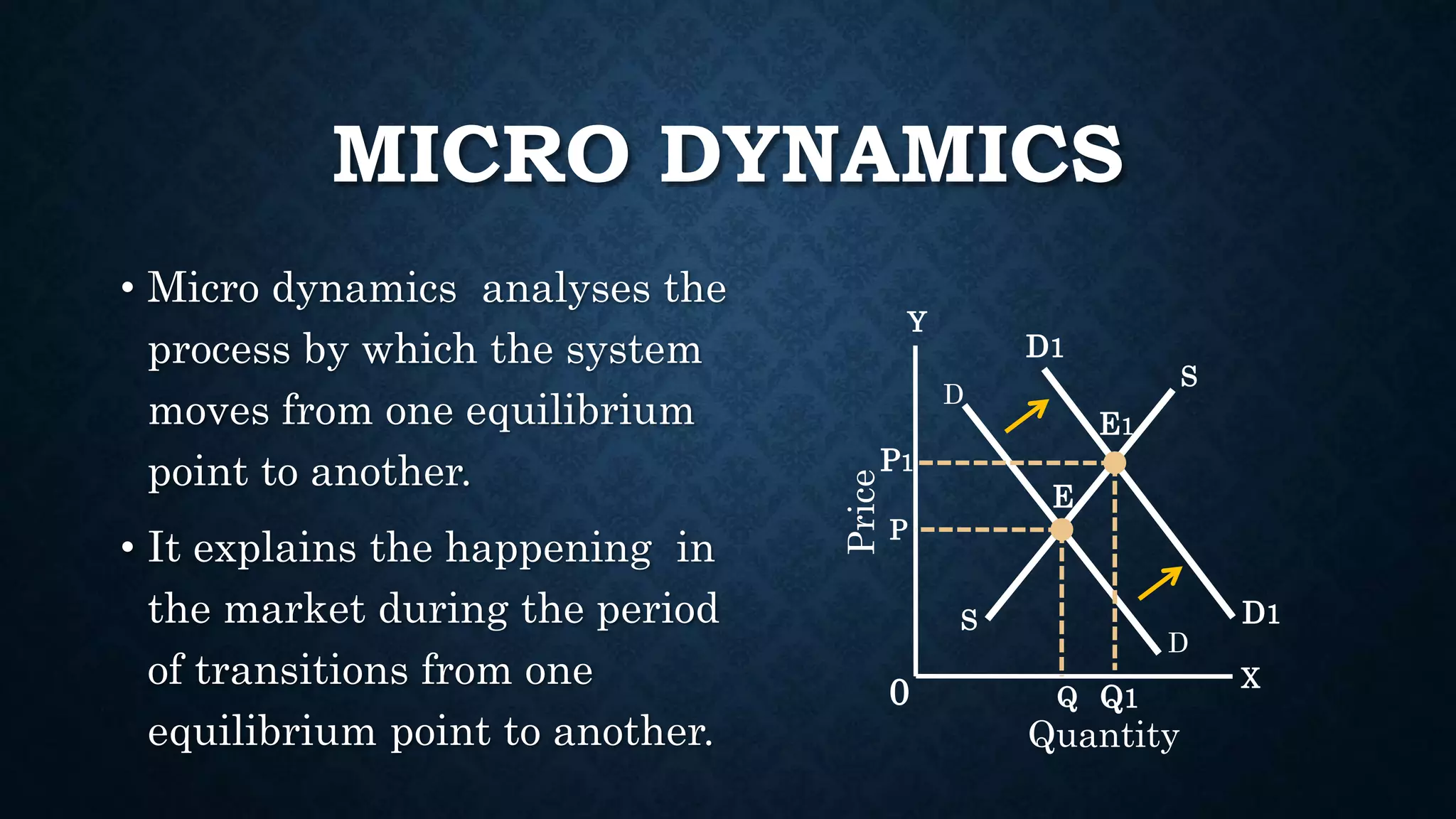
MICRO DYNAMICS
• Micro dynamics analyses the
process by which the system
moves from one equilibrium
point to another.
• It explains the happening in
the market during the period
of transitions from one
equilibrium point to another.
Y
X
S
S
D
D
0 Q
P
Price
Quantity
E
E1
P1
D1
D1
Q1
USAGES OF MICROECONOMICS
• Helpful to understand the working of the economy
• Helpful to provide tools for economics policies
• Helpful in formulating sectorial policies
• Helpful in efficient allocation of resources
• Helpful in the study of human behavior
• Helpful in business decisions
• Optimal resource allocation, Demand analysis, Cost Analysis,
Pricing policy, Optimal production decision

introduction to economics and microeconomics

  • 1.
  • 2.
    WHAT IS ECONOMICS? •The study of how individual and society choose to utilize scare resources to satisfy unlimited human wants. • These wants encompass all goods and services that individual desire, including food clothing, shelter and anything else that enhance the quality of life.
  • 3.
    WHAT IS MICROECONOMICS? •The term micro has been derived from Greek word “mikros”, which means small. • Microeconomics is the study of the economy at the level of the individual. • It also analyze the behavior of individual household, industries, markets, labor unions or trade associations.
  • 4.
    INTRODUCTION CONTINUE… • Accordingto K.E Boulding, “ Microeconomics is the study of particular firms particular household, individual prices, wages, incomes, individual industries, particular commodities. • Since microeconomics splits up the entire economy into smaller parts for the purpose of intensive study, it is also known as “Slicing Method”
  • 5.
    FEATURES OF MICROECONOMICS •It is individualistic economics • It is concerned with the behavior of individual economics entities such as household, firms, market etc. • It analyses economics phenomena under the ceteris paribus assumption and hence is a method of partial equilibrium analysis. • It is also called “price theory” or “value theory” • It’s objective is to analyze the process by which scare resources are allocated among alternative uses.
  • 6.
    SCOPE OF MICROECONOMICS •Theory of demand • Theory of production • Theory of product pricing • Theory of factor pricing • Theory of economics welfare
  • 7.
    TYPES OF MICROECONOMICS •Micro Static • Comparative Micro Static • Micro Dynamic
  • 8.
    MICRO STATIC • Microstatic is the study of static relationship between different microeconomic variables. • It deals with the final position of the equilibrium of these variables at particular point of time. • i.e micro static analyses the condition of equilibrium price of a commodity at a particular point of Y X S S D D 0 Q P Price Quantity E
  • 9.
    COMPARATIVE MICRO STATIC •Is concerned with a comparative study of different equilibrium positions at different points of time. • It does not deals with the transitional period involved in the movement from one equilibrium position to the other. Y X S S D D 0 Q P Price Quantity E E1 P1 D1 D1 Q1
  • 10.
    MICRO DYNAMICS • Microdynamics analyses the process by which the system moves from one equilibrium point to another. • It explains the happening in the market during the period of transitions from one equilibrium point to another. Y X S S D D 0 Q P Price Quantity E E1 P1 D1 D1 Q1
  • 11.
    USAGES OF MICROECONOMICS •Helpful to understand the working of the economy • Helpful to provide tools for economics policies • Helpful in formulating sectorial policies • Helpful in efficient allocation of resources • Helpful in the study of human behavior • Helpful in business decisions • Optimal resource allocation, Demand analysis, Cost Analysis, Pricing policy, Optimal production decision