What is Microeconomics ? Meaning & Definition

Micro means small. Thus, micro economics analyses individualistic behaviour. It studies an
individual consumer, producer, price of a particular commodity, household, etc.

According to Prof. K. E. Boulding, "Micro Economics is the study of particular firm, particular
household, individual prices, wages, incomes, individual industries and particular commodities."


Scope of Microeconomics


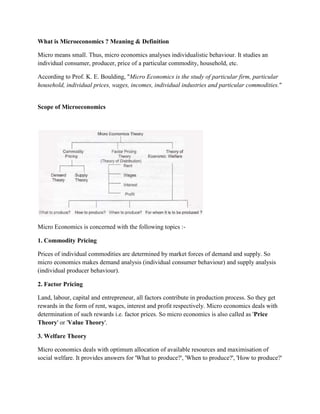
Micro Economics is concerned with the following topics :-

1. Commodity Pricing

Prices of individual commodities are determined by market forces of demand and supply. So
micro economics makes demand analysis (individual consumer behaviour) and supply analysis
(individual producer behaviour).

2. Factor Pricing

Land, labour, capital and entrepreneur, all factors contribute in production process. So they get
rewards in the form of rent, wages, interest and profit respectively. Micro economics deals with
determination of such rewards i.e. factor prices. So micro economics is also called as 'Price
Theory' or 'Value Theory'.

3. Welfare Theory

Micro economics deals with optimum allocation of available resources and maximisation of
social welfare. It provides answers for 'What to produce?', 'When to produce?', 'How to produce?'
and 'For whom it is to be produced?'. In short, Micro economics guides for utilizing scarce
resources of economy to maximize public welfare.

Characteristics / Features of Microeconomics

Classical economists always insisted on micro economics because they believed that it is better
to understand concept at individual level and then go for general (or macro) level. E.g. first
understanding individual consumer behaviour and then analyzing the behaviour of entire market.

1. Nature of Analysis

In micro economics, the behaviour of individual consumers and producers in detail is analysed. It
is study of subject matter from particular to general.

2. Method

Micro economics divides the economy into various small units and every unit is analysed in
detail. It is a slicing method.

3. Scope

Micro economic analysis involves product pricing, factor pricing and theory of welfare.

4. Application

Both theoretically and practically, micro economics is useful in formulating various policies,
resource allocation, public finance, international trade, etc.

5. Nature of Assumptions

Assumption of Ceteris Paribus is always made in every micro economic theory. It means theory
is applicable only when 'other things being same'.

Uses / Importance / Advantages of Microeconomics

1. Individual Behaviour Analysis

Micro economics studies behaviour of individual consumer or producer in a particular situation.

2. Resource Allocation

Resources are already scare i.e less in quantity. Micro economics helps in proper allocation and
utilization of resources to produce various types of goods and services.

3. Price Mechanization
Micro economics decides prices of various goods and services on the basis of 'Demand-Supply
Analysis'.

4. Economic Policy

Micro economics helps in formulating various economic policies and economic plans to promote
all round economic development.

5. Free Enterprise Economy

Micro economics explain operating of a free enterprise economy where individual has freedom
to take his own economic decisions.

6. Public Finance

It helps the government in fixing the tax rate and the type of tax as well as the amount of tax to
be charged to the buyer and the seller.

7. Foreign Trade

It helps in explaining and fixing international trade and tariff rules, causes of disequilibrium in
BOP, effects of factors deciding exchange rate, etc.

8. Social Welfare

It not only analyse economic conditions but also studies the social needs under different market
conditions like monopoly, oligopoly, etc.


Disadvantages / Limitations of Microeconomics

1. Unrealistic Assumptions

Micro economics is based on unrealistic assumptions, especially in case of full employment
assumption which does not exist practically. Even behaviour of one individual can not be
generalised as the behaviour of all.

2. Inadequate Data

Micro economics is based on the information dealing with individual behaviour, individual
customers. Hence, it is difficult to get correct information. So because of incorrect data Micro
Economics may provide inaccurate results.

3. Ceteris Paribus

It assumes that all other things being equal (same) but actually it is not so.

Microeconomics

  • 1.
    What is Microeconomics? Meaning & Definition Micro means small. Thus, micro economics analyses individualistic behaviour. It studies an individual consumer, producer, price of a particular commodity, household, etc. According to Prof. K. E. Boulding, "Micro Economics is the study of particular firm, particular household, individual prices, wages, incomes, individual industries and particular commodities." Scope of Microeconomics Micro Economics is concerned with the following topics :- 1. Commodity Pricing Prices of individual commodities are determined by market forces of demand and supply. So micro economics makes demand analysis (individual consumer behaviour) and supply analysis (individual producer behaviour). 2. Factor Pricing Land, labour, capital and entrepreneur, all factors contribute in production process. So they get rewards in the form of rent, wages, interest and profit respectively. Micro economics deals with determination of such rewards i.e. factor prices. So micro economics is also called as 'Price Theory' or 'Value Theory'. 3. Welfare Theory Micro economics deals with optimum allocation of available resources and maximisation of social welfare. It provides answers for 'What to produce?', 'When to produce?', 'How to produce?'
  • 2.
    and 'For whomit is to be produced?'. In short, Micro economics guides for utilizing scarce resources of economy to maximize public welfare. Characteristics / Features of Microeconomics Classical economists always insisted on micro economics because they believed that it is better to understand concept at individual level and then go for general (or macro) level. E.g. first understanding individual consumer behaviour and then analyzing the behaviour of entire market. 1. Nature of Analysis In micro economics, the behaviour of individual consumers and producers in detail is analysed. It is study of subject matter from particular to general. 2. Method Micro economics divides the economy into various small units and every unit is analysed in detail. It is a slicing method. 3. Scope Micro economic analysis involves product pricing, factor pricing and theory of welfare. 4. Application Both theoretically and practically, micro economics is useful in formulating various policies, resource allocation, public finance, international trade, etc. 5. Nature of Assumptions Assumption of Ceteris Paribus is always made in every micro economic theory. It means theory is applicable only when 'other things being same'. Uses / Importance / Advantages of Microeconomics 1. Individual Behaviour Analysis Micro economics studies behaviour of individual consumer or producer in a particular situation. 2. Resource Allocation Resources are already scare i.e less in quantity. Micro economics helps in proper allocation and utilization of resources to produce various types of goods and services. 3. Price Mechanization
  • 3.
    Micro economics decidesprices of various goods and services on the basis of 'Demand-Supply Analysis'. 4. Economic Policy Micro economics helps in formulating various economic policies and economic plans to promote all round economic development. 5. Free Enterprise Economy Micro economics explain operating of a free enterprise economy where individual has freedom to take his own economic decisions. 6. Public Finance It helps the government in fixing the tax rate and the type of tax as well as the amount of tax to be charged to the buyer and the seller. 7. Foreign Trade It helps in explaining and fixing international trade and tariff rules, causes of disequilibrium in BOP, effects of factors deciding exchange rate, etc. 8. Social Welfare It not only analyse economic conditions but also studies the social needs under different market conditions like monopoly, oligopoly, etc. Disadvantages / Limitations of Microeconomics 1. Unrealistic Assumptions Micro economics is based on unrealistic assumptions, especially in case of full employment assumption which does not exist practically. Even behaviour of one individual can not be generalised as the behaviour of all. 2. Inadequate Data Micro economics is based on the information dealing with individual behaviour, individual customers. Hence, it is difficult to get correct information. So because of incorrect data Micro Economics may provide inaccurate results. 3. Ceteris Paribus It assumes that all other things being equal (same) but actually it is not so.