MARKET STRUCTURE
  MANAGERIAL ECONOMICS
     MBA SEMESTER 1


              -PAYEL GHOSH
MARKET STRUCTURE
• Market structure is the interconnected characteristics of
  a market, such as the number and relative strength of
  buyers and sellers, degree of freedom in determining the
  price, level and forms of competition, extent of product
  differentiation and ease of entry into and exit from the
  market
• The types of market structures include- Perfect
  Competition, Monopoly, Monopolistic
  Competition, Oligopoly, Duopoly.
• Market structure is best defined as the organizational
  and other characteristics of a market.
PERFECT COMPETITION
1. All firms sell an identical product.
2. All firms are price takers.
3. All firms have a relatively small market share.
4. Buyers know the nature of the product being sold and
    the prices charged by each firm.
5. The industry is characterized by freedom of entry and
    exit.
It is also referred as “PURE COMPETITION”.
PERFECT COMPETITION
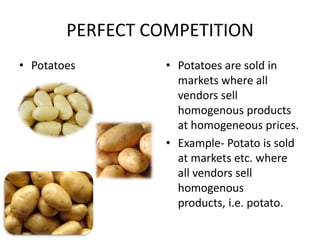
• Potatoes        • Potatoes are sold in
                    markets where all
                    vendors sell
                    homogenous products
                    at homogeneous prices.
                  • Example- Potato is sold
                    at markets etc. where
                    all vendors sell
                    homogenous
                    products, i.e. potato.
MONOPOLY
• A Monopoly is a market structure in which
  there is only one producer/seller for a
  product. In other words, the single business is
  the industry.
• Entry into such a market is restricted due to
  high costs or other impediments, which may
  be economic, social or political.
MONOPOLY
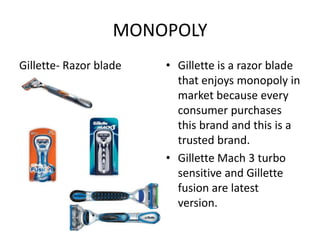
Gillette- Razor blade   • Gillette is a razor blade
                          that enjoys monopoly in
                          market because every
                          consumer purchases
                          this brand and this is a
                          trusted brand.
                        • Gillette Mach 3 turbo
                          sensitive and Gillette
                          fusion are latest
                          version.
MONOPOLISTIC COMPETITION
• Monopolistic competition is a type of imperfect
  competition such that one or two producers sell
  products that are differentiated from one another as
  goods but not perfect substitutes (such as from
  branding, quality, or location).
• In monopolistic competition, a firm takes the prices
  charged by its rivals as given and ignores the impact
  of its own prices on the prices of other firms.
• Consumers may like some special thing in the
  particular brand.
MONOPOLISTIC COMPETITION
Shoes          • Shoes are produced by
                 many producers but
                 consumers may feel that a
                 particular company is
                 branded or the quality
                 produced by one company
                 is better than the other.
               • Different company’s shoes
                 can be easily differentiated
                 and despite differentiation
                 each product remains close
                 substitute for the rival
                 product.
MONOPOLISTIC COMPETITION
            • There is no pure
              competition
            • Shoes come under
              monopolistic competition
              because there are many
              producers and consumers
              choose according to the
              brand, quality, location,
              trademark, design, colour,
              packaging, etc. and not
              on the basis of price only.
DUOPOLY
• A situation in which two companies own all or
  nearly all of the market for a given product or
  service.
• It is a specific type of oligopoly where only two
  producers exist in one market. In reality, this
  definition is generally used where only two firms
  have dominant control over a market.
• In the field of industrial organization, it is the
  most commonly studied form of oligopoly due to
  its simplicity.
DUOPOLY
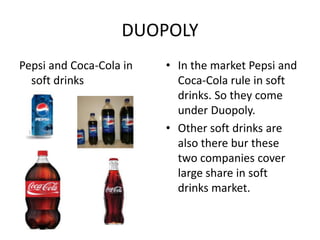
Pepsi and Coca-Cola in   • In the market Pepsi and
  soft drinks              Coca-Cola rule in soft
                           drinks. So they come
                           under Duopoly.
                         • Other soft drinks are
                           also there bur these
                           two companies cover
                           large share in soft
                           drinks market.
OLIGOPOLY
• It is a situation in which a particular market is
  controlled by a small group of firms.
• An oligopoly is a market form in which a market
  or industry is dominated by a small number of
  sellers (oligopolists). Because there are few
  sellers, each oligopolist is likely to be aware of the
  actions of the others.
• The decisions of one firm influence, and are
  influenced by, the decisions of other firms.
OLIGOPOLY
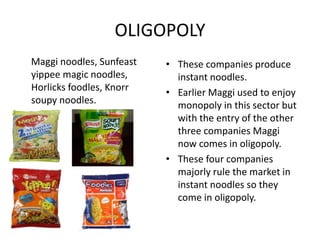
Maggi noodles, Sunfeast   • These companies produce
yippee magic noodles,       instant noodles.
Horlicks foodles, Knorr   • Earlier Maggi used to enjoy
soupy noodles.              monopoly in this sector but
                            with the entry of the other
                            three companies Maggi
                            now comes in oligopoly.
                          • These four companies
                            majorly rule the market in
                            instant noodles so they
                            come in oligopoly.
THANK YOU

Market structure

  • 1.
    MARKET STRUCTURE MANAGERIAL ECONOMICS MBA SEMESTER 1 -PAYEL GHOSH
  • 2.
    MARKET STRUCTURE • Marketstructure is the interconnected characteristics of a market, such as the number and relative strength of buyers and sellers, degree of freedom in determining the price, level and forms of competition, extent of product differentiation and ease of entry into and exit from the market • The types of market structures include- Perfect Competition, Monopoly, Monopolistic Competition, Oligopoly, Duopoly. • Market structure is best defined as the organizational and other characteristics of a market.
  • 3.
    PERFECT COMPETITION 1. Allfirms sell an identical product. 2. All firms are price takers. 3. All firms have a relatively small market share. 4. Buyers know the nature of the product being sold and the prices charged by each firm. 5. The industry is characterized by freedom of entry and exit. It is also referred as “PURE COMPETITION”.
  • 4.
    PERFECT COMPETITION • Potatoes • Potatoes are sold in markets where all vendors sell homogenous products at homogeneous prices. • Example- Potato is sold at markets etc. where all vendors sell homogenous products, i.e. potato.
  • 5.
    MONOPOLY • A Monopolyis a market structure in which there is only one producer/seller for a product. In other words, the single business is the industry. • Entry into such a market is restricted due to high costs or other impediments, which may be economic, social or political.
  • 6.
    MONOPOLY Gillette- Razor blade • Gillette is a razor blade that enjoys monopoly in market because every consumer purchases this brand and this is a trusted brand. • Gillette Mach 3 turbo sensitive and Gillette fusion are latest version.
  • 7.
    MONOPOLISTIC COMPETITION • Monopolisticcompetition is a type of imperfect competition such that one or two producers sell products that are differentiated from one another as goods but not perfect substitutes (such as from branding, quality, or location). • In monopolistic competition, a firm takes the prices charged by its rivals as given and ignores the impact of its own prices on the prices of other firms. • Consumers may like some special thing in the particular brand.
  • 8.
    MONOPOLISTIC COMPETITION Shoes • Shoes are produced by many producers but consumers may feel that a particular company is branded or the quality produced by one company is better than the other. • Different company’s shoes can be easily differentiated and despite differentiation each product remains close substitute for the rival product.
  • 9.
    MONOPOLISTIC COMPETITION • There is no pure competition • Shoes come under monopolistic competition because there are many producers and consumers choose according to the brand, quality, location, trademark, design, colour, packaging, etc. and not on the basis of price only.
  • 10.
    DUOPOLY • A situationin which two companies own all or nearly all of the market for a given product or service. • It is a specific type of oligopoly where only two producers exist in one market. In reality, this definition is generally used where only two firms have dominant control over a market. • In the field of industrial organization, it is the most commonly studied form of oligopoly due to its simplicity.
  • 11.
    DUOPOLY Pepsi and Coca-Colain • In the market Pepsi and soft drinks Coca-Cola rule in soft drinks. So they come under Duopoly. • Other soft drinks are also there bur these two companies cover large share in soft drinks market.
  • 12.
    OLIGOPOLY • It isa situation in which a particular market is controlled by a small group of firms. • An oligopoly is a market form in which a market or industry is dominated by a small number of sellers (oligopolists). Because there are few sellers, each oligopolist is likely to be aware of the actions of the others. • The decisions of one firm influence, and are influenced by, the decisions of other firms.
  • 13.
    OLIGOPOLY Maggi noodles, Sunfeast • These companies produce yippee magic noodles, instant noodles. Horlicks foodles, Knorr • Earlier Maggi used to enjoy soupy noodles. monopoly in this sector but with the entry of the other three companies Maggi now comes in oligopoly. • These four companies majorly rule the market in instant noodles so they come in oligopoly.
  • 14.