BASIC CONCEPT OF
MACRO ECONOMICS
Unit 1
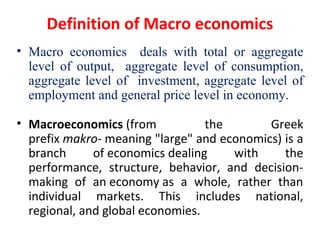
Definition of Macro economics
• Macro economics deals with total or aggregate
level of output, aggregate level of consumption,
aggregate level of investment, aggregate level of
employment and general price level in economy.
• Macroeconomics (from  the  Greek 
prefix makro- meaning "large" and economics) is a 
branch  of economics dealing  with  the 
performance,  structure,  behavior,  and  decision-
making  of  an economy as  a  whole,  rather  than 
individual  markets.  This  includes  national, 
regional, and global economies.
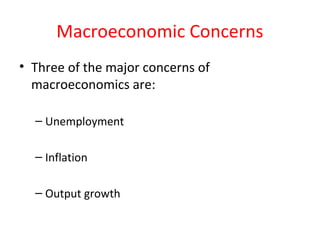
Macroeconomic Concerns
• Three of the major concerns of 
macroeconomics are:
– Unemployment
– Inflation
– Output growth
1. Unemployment
      Unemployment refers to the  situation where the population of a 
country do not find work to earn their livelihood.   
• Unemployment represents that ratio of labor force which fails to get 
employment. 
• The currently  40% of Afghanistan population is  unemployed.
• The unemployment rate is a key indicator of the economy’s health.
• The existence of unemployment seems to imply that the aggregate      
labor market is not in equilibrium.  
Problem of Unemployment:
      Classical economist believed in full employment i.e. all recourses of 
economy are fully employed and there is no possibility of 
unemployment.  But 
Great depression of 1930 brought a lot of miseries in form of slump 
and vast unemployment. So Keynes wrote a book in 1936 “General 
theory” in which he rejected the philosophy of full employment .
2. Inflation
• Inflation is an increase in the overall price level.
• Hyperinflation is a period of very rapid increases in the 
overall price level.  Hyperinflations is a rare phenomenon.
• Deflation is a decrease in the overall price level. Prolonged 
periods of deflation can be just as damaging for the 
economy as sustained inflation.
Problem of Unemployment:
• During 1930 the phenomena of unemployment got a lot of 
attractions. Policy makers presented their ideas to remove 
unemployment .
• So Government tried to provide better social and economic 
service due  to which Government expenditures went on 
increasing.
3. Output and Growth
• Growth refers to change in the level of economic 
activity from one year to another year.
• Growth means that poor and developing countries 
wish to attain a rise in their national income and per 
capita income.
• Aggregate output is the total quantity of goods and 
services produced in an economy in a given period.
• The aggregate output  is the main measure to see 
how well an economy is doing.
3. Problem of growth
• It is of a great concern for economists that what should 
be the level of rise in investment that the economy can 
achieve its desired level of income and employment 
without inflation and deflation. Such a situation will 
result the full utilization of resources.
• Full employment means the maximization of output & 
employment in presence of existing recourses while 
growth  is attach with increase in output & employment
NATURE & SCOPE OF
MACROECONOMICS
• Macroeconomics is the study of aggregates or averages 
covering the entire economy, such as total employment, 
national income, national output, total investment, total 
consumption, total savings, aggregate supply, aggregate 
demand, and general price level, wage level, and cost 
structure.
• Macroeconomics is also known as the theory of income and 
employment, or simply income analysis. It is concerned 
with the problems of unemployment, economic 
fluctuations, inflation or deflation, international trade and 
economic growth. It is the study of the causes of 
unemployment, and the various determinants of 
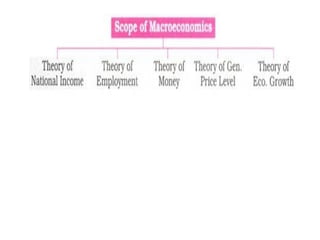
Scope of macroeconomics
As a method of economic analysis
macroeconomics is of much theoretical and
practical importance.
(1)To Understand the Working of the Economy:
The study of macroeconomic variables is
indispensable for understanding the working of
the economy. Our main economic problems are
related to the behaviour of total income, output,
employment and the general price level in the
economy.
(ii) In National Income:
The study of macroeconomics is very important for
evaluating the overall performance of the economy in
terms of national income. With the advent of the Great
Depression of the 1930s, it became necessary to analyze
the causes of general overproduction and general
unemployment.
(iii) In Economic Growth:
The economics of growth is also a study in
macroeconomics. It is on the basis of
macroeconomics that the resources and
capabilities of an economy are evaluated. Plans
for the overall increase in national income,
output, and employment are framed and
implemented so as to raise the level of economic
development of the economy as a whole.
(iv) In Monetary Problems:
It is in terms of macroeconomics that monetary
problems can be analysed and understood
properly. Frequent changes in the value of
money, inflation or deflation, affect the economy
adversely. They can be counteracted by adopting
monetary, fiscal and direct control measures for
the economy as a whole.
(v) In Business Cycles:
Further macroeconomics as an approach to
economic problems started after the Great
Depression. Thus its importance lies in analyzing
the causes of economic fluctuations and in
providing remedies.
(3) For Understanding the Behaviour of
Individual Units:
For understanding the behaviour of individual units,
the study of macroeconomics is imperative. Demand
for individual products depends upon aggregate
demand in the economy. Unless the causes of
deficiency in aggregate demand are analyzed, it is
not possible to understand fully the reasons for a fall
in the demand of individual products.
Key Macro Economic Variables
1. National Income and GDP
2. Unemployment
3. Economic growth
4. Inflation
5. International Trade
6. Balance of Payment
7. Monetary & Fiscal Policy
8. Interest Rate
9. Stock Market
10.Business Cycle
11.Exchange Rate
1. Gross Domestic Product & National
Income
• GDP refers to the monetary value of all the finished goods
and services produced within a country's borders in a
specific time period, though GDP is usually calculated on an
annual basis.
• It includes all of private and public consumption,
government outlays, investments and exports less imports
that occur within a defined territory.
• The gross domestic product (GDP) is one the
primary indicators used to gauge the health of a
country's economy.
National Income
• National Income is the total value of all goods
and services produced within a nation over a
specified period of time, representing the sum
of wages, profits, rents, interest and pension
payments to residents of the nation.
• It gives correct picture of the economy and
purchasing power of people in the country.
2. Unemployment
• The Unemployment Rate:
– to be unemployed, a person must want to work and
be actively looking for a job (but have not yet found
one)
– the labor force consists of those who are employed
and those who are unemployed
– the unemployment rate is equal to the number of
unemployed people divided by the labor force
3. Economic Growth
• Economic growth is the increase in
the market value of the goods and services
produced by an economy over time.
• Also, economic growth is the increase in the
capacity of an economy to produce goods and
services, compared from one period of time to
another.
4. Inflation
• In economics inflation means, a rise in general level of prices
of goods and services in a economy over a period of time.
When the general price level rises, each unit of currency
buys fewer goods and services. Thus, inflation results in loss
of value of money. Another popular way of looking at
inflation is "too much money chasing too few goods".
• Inflation is caused when goods and services are in high
demand, creating a drop in availability. Consumers are
willing to pay more for the items they want, causing
manufacturers and service providers to charge more.
Supplies can decrease for many reasons: A natural disaster
can wipe out a food crop or a housing boom can exhaust
building supplies, among other situations.
5. International trade
• International trade is the exchange of goods and
services between countries. This type of trade gives
rise to a world economy, in which prices, or supply and
demand , affect and are affected by global events.
• International trade allows to expand markets for both
goods and services that otherwise may not have been
available to all. It is the reason why you can pick
between a Japanese, German or American car.
• As a result of international trade, the market contains
greater competition and therefore more competitive
prices, which brings a cheaper product home to the
consumer.
6. Balance Of Payments (BOP)
• The balance of payments (BOP) of a country is the
record of all economic transactions between the
residents of a country and the rest of the world in a
particular period (over a quarter of a year or more
commonly over a year).
• These transactions are made by individuals, firms and
government bodies. Thus the balance of payments
includes all external visible and non-visible transactions
of a country during a given period, usually a year.
• It represents a summation of country's current demand
and supply of the claims on foreign currencies and of
foreign claims on its currency.
7. Monetary policy
• Monetary policy is the process by which
the monetary authority of a currency controls
the supply of money, often targeting an inflation
rate or interest rate to ensure price stability and
general trust in the currency.
• Further goals of a monetary policy are usually to
contribute to economic growth and stability, to
low unemployment, and to predictable exchange
rates with other currencies.
7. Fiscal Policy
• Fiscal policy is the means by which a
government adjusts its spending levels and tax
rates to monitor and influence a nation's
economy.
• It is the sister strategy to monetary policy
through which a central bank influences a
nation's money supply. These two policies are
used in various combinations to direct a
country's economic goals.
8. Interest Rate
• An interest rate is the rate at which interest is paid by
borrowers (debtors) for the use of money that they
borrow from lenders (creditors). Specifically, the
interest rate is a percentage of principal paid a
certain number of times per period for all periods
during the total term of the loan or credit.
• Many different interest rates in the economy vary by
duration and degree of risk.
9. Stock market
• A stock market or equity market is the aggregation of buyers and 
sellers (a loose network of economic transactions, not a physical 
facility or discrete entity) of stocks (also called shares); these may 
include securities listed on a stock exchange as well as those only 
traded privately.
• History has shown that the price of stocks and other assets is an 
important  part  of  the  dynamics  of  economic  activity,  and  can 
influence or be an indicator of social mood. 
• An economy where the stock market is on the rise is considered 
to  be  an  up-and-coming  economy.  In  fact,  the  stock  market  is 
often considered the primary indicator of a country's economic 
strength and development.
10. Business cycle
• The term business cycle (or economic cycle or boom–bust
cycle) refers to fluctuations in aggregate production, trade 
and activity over several months or years in a market 
economy.
• The business cycle is the downward and upward movement 
of levels of gross domestic product (GDP) and refers to the 
period of expansions and contractions in the level of 
economic activities (business fluctuations) around its long-
term growth trend.
• These fluctuations occur around a long-term growth trend, 
and typically involve shifts over time between periods of 
relatively rapid economic growth (an expansion or boom), 
and periods of relative stagnation or decline (a contraction 
or recession).
11. Exchange Rate
• The Exchange Rate between two currencies is the 
rate at which one currency will be exchanged for 
another.
•  It is also regarded as the value of one country’s 
currency in terms of another currency.
– governs the terms on which international trade 
and investment take place
– nominal exchange rate is the rate at which 
monies of different countries can be exchanged 
for one another
– real exchange rate is the rate at which the goods 
and services produced in different countries can 
be exchanged for one another
Importance of Macroeconomics
• It helps us understand the functioning of a complicated 
modern economic system. It describes how the 
economy as a whole functions and how the level of 
national income and employment is determined on the 
basis of aggregate demand and aggregate supply.
• It helps to achieve the goal of economic growth, a 
higher GDP level, and higher level of employment. It 
analyses the forces which determine economic growth 
of a country and explains how to reach the highest 
state of economic growth and sustain it.
• It helps to bring stability in price level and analyses 
fluctuations in business activities. It suggests policy 
measures to control inflation and deflation.
Contd….
• It explains factors which determine balance of payments. At 
the  same  time,  it  identifies  causes  of  deficit  in  balance  of 
payments and suggests remedial measures.
• It  helps  to  solve  economic  problems  like  poverty, 
unemployment,  inflation,  deflation  etc.,  whose  solution  is 
possible at macro level only (in other words, at the level of 
the whole economy).
• With a detailed knowledge of the functioning of an economy 
at  macro  level,  it  has  been  possible  to  formulate  correct 
economic  policies  and  also  coordinate  international 
economic policies.
• Last but not least, macroeconomic theory has saved us from 
the  dangers  of  application  of  microeconomic  theory  to the 
problems that require us to look at the economy as a whole.
Limitation of Macroeconomics
• 1. Excessive Generalization:
• As hinted above, generalization of individual observation to the system as 
a whole may lead to erratic inferences about the system as a whole. For 
instance, a loss incurred by one firm in an industry does not necessarily 
imply  losses  to  all  other  firms  in  it.  Likewise,  hospitality  shown  by  one 
Indian does not imply that each and every Indian will show the gesture.
• 2. Obsession of Aggregative Approaches:
• Excessive thinking in terms of lumping the individual units together may 
lead  to  erratic  inferences.  Individual  units  possess  individualistic  traits. 
They  are  non-homogeneous  in  character.  One  can’t  add  up  two  apples 
and three oranges to make any meaningful aggregate.
• 3. Fallacy of Deductive Inferences:
• Inferences deduced about individual units from the aggregative tendency 
may not always be true in respect of individual units as well. For instance, 
a general rise in prices may not affect all the sections of the community in 
the  same  manner.  A  consumer  suffers  from  rising  price  level  while  a 
producer benefits from it.
4. Inconsistency between Overall and Individual Changes:
     A hike in prices of industrial output and a fall in prices of the 
agricultural products may offset each other to lead to no rise in 
the general price level. On the basis of stability of the general 
price level, one who believes that no policy change is called for 
in the circumstances would certainly jeopardize the cultivators’ 
interests.
5. Problems of Measurement of Aggregates:
     In many cases measurement of aggregates involves serious 
problems. You will learn more about such problems in higher 
classes.
     
          To  conclude,  macroeconomic  analysis,  by  itself,  may  not 
provide a true picture of an economy. It may appear like the 
top  surface  of  an  ocean  appearing  calm  and  unruffled  from 
above  yet  harbouring  quite  a  few  storms  underneath.  To 
locate  the  trouble  spots,  it  is  microeconomic  analysis  that  is 
called for.

Basic concept of macro economics

  • 1.
    BASIC CONCEPT OF MACROECONOMICS Unit 1
  • 2.
    Definition of Macroeconomics • Macro economics deals with total or aggregate level of output, aggregate level of consumption, aggregate level of investment, aggregate level of employment and general price level in economy. • Macroeconomics (from  the  Greek  prefix makro- meaning "large" and economics) is a  branch  of economics dealing  with  the  performance,  structure,  behavior,  and  decision- making  of  an economy as  a  whole,  rather  than  individual  markets.  This  includes  national,  regional, and global economies.
  • 3.
  • 4.
    1. Unemployment       Unemployment refers to the  situation where the population of a  country do not find work to earn their livelihood.    • Unemployment represents that ratio of labor force which fails to get  employment.  •The currently  40% of Afghanistan population is  unemployed. • The unemployment rate is a key indicator of the economy’s health. • The existence of unemployment seems to imply that the aggregate       labor market is not in equilibrium.   Problem of Unemployment:       Classical economist believed in full employment i.e. all recourses of  economy are fully employed and there is no possibility of  unemployment.  But  Great depression of 1930 brought a lot of miseries in form of slump  and vast unemployment. So Keynes wrote a book in 1936 “General  theory” in which he rejected the philosophy of full employment .
  • 5.
    2. Inflation • Inflation is an increase in the overall price level. •Hyperinflation is a period of very rapid increases in the  overall price level.  Hyperinflations is a rare phenomenon. • Deflation is a decrease in the overall price level. Prolonged  periods of deflation can be just as damaging for the  economy as sustained inflation. Problem of Unemployment: • During 1930 the phenomena of unemployment got a lot of  attractions. Policy makers presented their ideas to remove  unemployment . • So Government tried to provide better social and economic  service due  to which Government expenditures went on  increasing.
  • 6.
    3. Output andGrowth • Growth refers to change in the level of economic  activity from one year to another year. • Growth means that poor and developing countries  wish to attain a rise in their national income and per  capita income. • Aggregate output is the total quantity of goods and  services produced in an economy in a given period. • The aggregate output  is the main measure to see  how well an economy is doing.
  • 7.
    3. Problem ofgrowth • It is of a great concern for economists that what should  be the level of rise in investment that the economy can  achieve its desired level of income and employment  without inflation and deflation. Such a situation will  result the full utilization of resources. • Full employment means the maximization of output &  employment in presence of existing recourses while  growth  is attach with increase in output & employment
  • 8.
    NATURE & SCOPEOF MACROECONOMICS • Macroeconomics is the study of aggregates or averages  covering the entire economy, such as total employment,  national income, national output, total investment, total  consumption, total savings, aggregate supply, aggregate  demand, and general price level, wage level, and cost  structure. • Macroeconomics is also known as the theory of income and  employment, or simply income analysis. It is concerned  with the problems of unemployment, economic  fluctuations, inflation or deflation, international trade and  economic growth. It is the study of the causes of  unemployment, and the various determinants of 
  • 9.
    Scope of macroeconomics Asa method of economic analysis macroeconomics is of much theoretical and practical importance. (1)To Understand the Working of the Economy: The study of macroeconomic variables is indispensable for understanding the working of the economy. Our main economic problems are related to the behaviour of total income, output, employment and the general price level in the economy.
  • 11.
    (ii) In NationalIncome: The study of macroeconomics is very important for evaluating the overall performance of the economy in terms of national income. With the advent of the Great Depression of the 1930s, it became necessary to analyze the causes of general overproduction and general unemployment. (iii) In Economic Growth: The economics of growth is also a study in macroeconomics. It is on the basis of macroeconomics that the resources and capabilities of an economy are evaluated. Plans for the overall increase in national income, output, and employment are framed and implemented so as to raise the level of economic development of the economy as a whole.
  • 12.
    (iv) In MonetaryProblems: It is in terms of macroeconomics that monetary problems can be analysed and understood properly. Frequent changes in the value of money, inflation or deflation, affect the economy adversely. They can be counteracted by adopting monetary, fiscal and direct control measures for the economy as a whole. (v) In Business Cycles: Further macroeconomics as an approach to economic problems started after the Great Depression. Thus its importance lies in analyzing the causes of economic fluctuations and in providing remedies.
  • 13.
    (3) For Understandingthe Behaviour of Individual Units: For understanding the behaviour of individual units, the study of macroeconomics is imperative. Demand for individual products depends upon aggregate demand in the economy. Unless the causes of deficiency in aggregate demand are analyzed, it is not possible to understand fully the reasons for a fall in the demand of individual products.
  • 14.
    Key Macro EconomicVariables 1. National Income and GDP 2. Unemployment 3. Economic growth 4. Inflation 5. International Trade 6. Balance of Payment 7. Monetary & Fiscal Policy 8. Interest Rate 9. Stock Market 10.Business Cycle 11.Exchange Rate
  • 15.
    1. Gross DomesticProduct & National Income • GDP refers to the monetary value of all the finished goods and services produced within a country's borders in a specific time period, though GDP is usually calculated on an annual basis. • It includes all of private and public consumption, government outlays, investments and exports less imports that occur within a defined territory. • The gross domestic product (GDP) is one the primary indicators used to gauge the health of a country's economy.
  • 16.
    National Income • NationalIncome is the total value of all goods and services produced within a nation over a specified period of time, representing the sum of wages, profits, rents, interest and pension payments to residents of the nation. • It gives correct picture of the economy and purchasing power of people in the country.
  • 17.
    2. Unemployment • TheUnemployment Rate: – to be unemployed, a person must want to work and be actively looking for a job (but have not yet found one) – the labor force consists of those who are employed and those who are unemployed – the unemployment rate is equal to the number of unemployed people divided by the labor force
  • 18.
    3. Economic Growth •Economic growth is the increase in the market value of the goods and services produced by an economy over time. • Also, economic growth is the increase in the capacity of an economy to produce goods and services, compared from one period of time to another.
  • 19.
    4. Inflation • Ineconomics inflation means, a rise in general level of prices of goods and services in a economy over a period of time. When the general price level rises, each unit of currency buys fewer goods and services. Thus, inflation results in loss of value of money. Another popular way of looking at inflation is "too much money chasing too few goods". • Inflation is caused when goods and services are in high demand, creating a drop in availability. Consumers are willing to pay more for the items they want, causing manufacturers and service providers to charge more. Supplies can decrease for many reasons: A natural disaster can wipe out a food crop or a housing boom can exhaust building supplies, among other situations.
  • 20.
    5. International trade •International trade is the exchange of goods and services between countries. This type of trade gives rise to a world economy, in which prices, or supply and demand , affect and are affected by global events. • International trade allows to expand markets for both goods and services that otherwise may not have been available to all. It is the reason why you can pick between a Japanese, German or American car. • As a result of international trade, the market contains greater competition and therefore more competitive prices, which brings a cheaper product home to the consumer.
  • 21.
    6. Balance OfPayments (BOP) • The balance of payments (BOP) of a country is the record of all economic transactions between the residents of a country and the rest of the world in a particular period (over a quarter of a year or more commonly over a year). • These transactions are made by individuals, firms and government bodies. Thus the balance of payments includes all external visible and non-visible transactions of a country during a given period, usually a year. • It represents a summation of country's current demand and supply of the claims on foreign currencies and of foreign claims on its currency.
  • 22.
    7. Monetary policy •Monetary policy is the process by which the monetary authority of a currency controls the supply of money, often targeting an inflation rate or interest rate to ensure price stability and general trust in the currency. • Further goals of a monetary policy are usually to contribute to economic growth and stability, to low unemployment, and to predictable exchange rates with other currencies.
  • 23.
    7. Fiscal Policy •Fiscal policy is the means by which a government adjusts its spending levels and tax rates to monitor and influence a nation's economy. • It is the sister strategy to monetary policy through which a central bank influences a nation's money supply. These two policies are used in various combinations to direct a country's economic goals.
  • 24.
    8. Interest Rate •An interest rate is the rate at which interest is paid by borrowers (debtors) for the use of money that they borrow from lenders (creditors). Specifically, the interest rate is a percentage of principal paid a certain number of times per period for all periods during the total term of the loan or credit. • Many different interest rates in the economy vary by duration and degree of risk.
  • 25.
    9. Stock market •A stock market or equity market is the aggregation of buyers and  sellers (a loose network of economic transactions, not a physical  facility or discrete entity) of stocks (also called shares); these may  include securities listed on a stock exchange as well as those only  traded privately. • History has shown that the price of stocks and other assets is an  important  part  of  the  dynamics  of  economic  activity,  and  can  influence or be an indicator of social mood.  • An economy where the stock market is on the rise is considered  to  be  an  up-and-coming  economy.  In  fact,  the  stock  market  is  often considered the primary indicator of a country's economic  strength and development.
  • 26.
    10. Business cycle •The term business cycle (or economic cycle or boom–bust cycle) refers to fluctuations in aggregate production, trade  and activity over several months or years in a market  economy. • The business cycle is the downward and upward movement  of levels of gross domestic product (GDP) and refers to the  period of expansions and contractions in the level of  economic activities (business fluctuations) around its long- term growth trend. • These fluctuations occur around a long-term growth trend,  and typically involve shifts over time between periods of  relatively rapid economic growth (an expansion or boom),  and periods of relative stagnation or decline (a contraction  or recession).
  • 27.
    11. Exchange Rate • The Exchange Rate between two currencies is the  rate at which one currency will be exchanged for  another. •  It is also regarded as the value of one country’s  currency in terms of another currency. –governs the terms on which international trade  and investment take place – nominal exchange rate is the rate at which  monies of different countries can be exchanged  for one another – real exchange rate is the rate at which the goods  and services produced in different countries can  be exchanged for one another
  • 28.
    Importance of Macroeconomics •It helps us understand the functioning of a complicated  modern economic system. It describes how the  economy as a whole functions and how the level of  national income and employment is determined on the  basis of aggregate demand and aggregate supply. • It helps to achieve the goal of economic growth, a  higher GDP level, and higher level of employment. It  analyses the forces which determine economic growth  of a country and explains how to reach the highest  state of economic growth and sustain it. • It helps to bring stability in price level and analyses  fluctuations in business activities. It suggests policy  measures to control inflation and deflation.
  • 29.
    Contd…. • It explains factors which determine balance of payments. At  the  same time,  it  identifies  causes  of  deficit  in  balance  of  payments and suggests remedial measures. • It  helps  to  solve  economic  problems  like  poverty,  unemployment,  inflation,  deflation  etc.,  whose  solution  is  possible at macro level only (in other words, at the level of  the whole economy). • With a detailed knowledge of the functioning of an economy  at  macro  level,  it  has  been  possible  to  formulate  correct  economic  policies  and  also  coordinate  international  economic policies. • Last but not least, macroeconomic theory has saved us from  the  dangers  of  application  of  microeconomic  theory  to the  problems that require us to look at the economy as a whole.
  • 30.
    Limitation of Macroeconomics •1. Excessive Generalization: • As hinted above, generalization of individual observation to the system as  a whole may lead to erratic inferences about the system as a whole. For  instance, a loss incurred by one firm in an industry does not necessarily  imply  losses  to  all  other  firms  in  it.  Likewise,  hospitality  shown  by  one  Indian does not imply that each and every Indian will show the gesture. • 2. Obsession of Aggregative Approaches: • Excessive thinking in terms of lumping the individual units together may  lead  to  erratic  inferences.  Individual  units  possess  individualistic  traits.  They  are  non-homogeneous  in  character.  One  can’t  add  up  two  apples  and three oranges to make any meaningful aggregate. • 3. Fallacy of Deductive Inferences: • Inferences deduced about individual units from the aggregative tendency  may not always be true in respect of individual units as well. For instance,  a general rise in prices may not affect all the sections of the community in  the  same  manner.  A  consumer  suffers  from  rising  price  level  while  a  producer benefits from it.
  • 31.
    4. Inconsistency betweenOverall and Individual Changes:      A hike in prices of industrial output and a fall in prices of the  agricultural products may offset each other to lead to no rise in  the general price level. On the basis of stability of the general  price level, one who believes that no policy change is called for  in the circumstances would certainly jeopardize the cultivators’  interests. 5. Problems of Measurement of Aggregates:      In many cases measurement of aggregates involves serious  problems. You will learn more about such problems in higher  classes.                 To  conclude,  macroeconomic  analysis,  by  itself,  may  not  provide a true picture of an economy. It may appear like the  top  surface  of  an  ocean  appearing  calm  and  unruffled  from  above  yet  harbouring  quite  a  few  storms  underneath.  To  locate  the  trouble  spots,  it  is  microeconomic  analysis  that  is  called for.