By Rajshree
Books to be referred
S K Singh Sahitya Bhawan Publication
Jhingan Vrinda Pubication
Economics
 Economics is social Science concerned with the
production, distribution and consumption of goods
and services. It studies how individual, business,
Government choices.
 Economics is the study of human behavior with the
emphasis on human decision making.
 Economics is one of the several science that tries to
explain human behavior but different in that it
emphasize national decision making.
Cont.
 Economics is the study of how people choose to
allocate scares goods and resources to achieve their
unlimited desires.
 Goods: things people like to consume
 Sofa house luxury cars mobile
 Resources Things we use to produce the goods
 3 key economic concept
 scarcity exist = ( unlimited wants and need but limited
resources) implies tradeoff- giving up of one thing for
another thing
 The people tend to choose rationally to achieve their
goal.
 Market and trade tend to work well
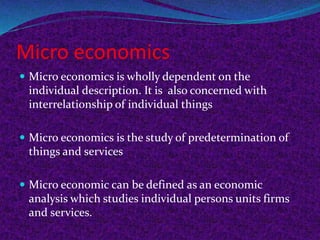
Micro economics
 Micro economics is wholly dependent on the
individual description. It is also concerned with
interrelationship of individual things
 Micro economics is the study of predetermination of
things and services
 Micro economic can be defined as an economic
analysis which studies individual persons units firms
and services.
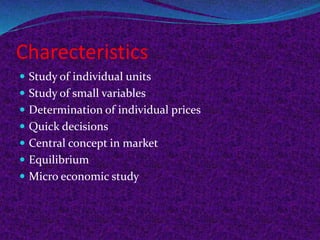
Charecteristics
 Study of individual units
 Study of small variables
 Determination of individual prices
 Quick decisions
 Central concept in market
 Equilibrium
 Micro economic study
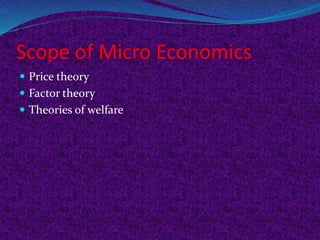
Scope of Micro Economics
 Price theory
 Factor theory
 Theories of welfare
Difference between Micro and
Macro Economics
MICRO ECONOMICS MACROECONOMICS
It analyses individual units It analysis aggregate of activities
It analysis is with the nature of
activities of each individual person or
unit eg. cost exp
It is concerned with collective nature
Priority is given to the structure and
different components of the economy
Priority is given to whole economy
It is helpful for correctness of laws It is useful in remove of doubt of
structure
It is important in analysis of individual
institution
It is important in the formation of
national policies
Method of study in economics
A systematic knowlwdge of the subject is called science. Like
other sciences there are certain methods of study of
economies. On bases of which laws are formulated.
In economics there are two methods of deriving the
generalization or laws :
1. Deductive Method
2. Inductive Method
Deductive method.
This method is also called abstract, analytical and
priority method. Under this method laws are deducted
in logical manner.
Hypothesis is verified by observation and experiments
Example. Man is rational (buy in cheap and sell dear
ones)-they not happen
Its principle which have been established down and
handed generation to generation.
Merits of Deductive method
 Simplicity
 Certainty
 Universal result
 Impartiality
 Effective conclusion
 suitability
Demerits of Deductive method
 Lack of complete truth
 Unreal and imaginative
 Test of truth not possible
 Wrong assumption
 Lack of personal Experience
Inductive method
According to this method conclusion is drawn on
the basis of collection and analysis of the facts
which are relevant to the enquiry
 Reasoning from specific outcomes to generalized
conclusion
 Micro economics is derived from the greek word micro
meaning small or millionth part.
 Micro economics is focused on individual consumer or
an individual consumer or individual business firm an
individual factor owner.
 Henderson and Quant
 “Micro economics is the study of economic action of
individuals and well defined groups of individuals”
Micro economics theory explains
 How a free enterprise economy operates
 How the market system distributes various goods and
services for consumption
 How prices of different commodities and factors are
determined
 How is the efficiency in consumption and production
ensures.
Characteristics of Micro Economics
 Study of individual economic units
 Study of micro variables
 Study of individual price determination
LIMITATION OF MICRO
ECONOMICS
 Study not a whole but fraction
 Inadequate analysis
 Based on unrealistic assumption
 based on laissez faire concept (individual plays
important role)

Unit 1 micro economics

  • 1.
  • 2.
    Books to bereferred S K Singh Sahitya Bhawan Publication Jhingan Vrinda Pubication
  • 3.
    Economics  Economics issocial Science concerned with the production, distribution and consumption of goods and services. It studies how individual, business, Government choices.  Economics is the study of human behavior with the emphasis on human decision making.  Economics is one of the several science that tries to explain human behavior but different in that it emphasize national decision making.
  • 4.
    Cont.  Economics isthe study of how people choose to allocate scares goods and resources to achieve their unlimited desires.  Goods: things people like to consume  Sofa house luxury cars mobile
  • 5.
     Resources Thingswe use to produce the goods  3 key economic concept  scarcity exist = ( unlimited wants and need but limited resources) implies tradeoff- giving up of one thing for another thing  The people tend to choose rationally to achieve their goal.  Market and trade tend to work well
  • 6.
    Micro economics  Microeconomics is wholly dependent on the individual description. It is also concerned with interrelationship of individual things  Micro economics is the study of predetermination of things and services  Micro economic can be defined as an economic analysis which studies individual persons units firms and services.
  • 7.
    Charecteristics  Study ofindividual units  Study of small variables  Determination of individual prices  Quick decisions  Central concept in market  Equilibrium  Micro economic study
  • 8.
    Scope of MicroEconomics  Price theory  Factor theory  Theories of welfare
  • 9.
    Difference between Microand Macro Economics MICRO ECONOMICS MACROECONOMICS It analyses individual units It analysis aggregate of activities It analysis is with the nature of activities of each individual person or unit eg. cost exp It is concerned with collective nature Priority is given to the structure and different components of the economy Priority is given to whole economy It is helpful for correctness of laws It is useful in remove of doubt of structure It is important in analysis of individual institution It is important in the formation of national policies
  • 10.
    Method of studyin economics A systematic knowlwdge of the subject is called science. Like other sciences there are certain methods of study of economies. On bases of which laws are formulated. In economics there are two methods of deriving the generalization or laws : 1. Deductive Method 2. Inductive Method
  • 11.
    Deductive method. This methodis also called abstract, analytical and priority method. Under this method laws are deducted in logical manner. Hypothesis is verified by observation and experiments Example. Man is rational (buy in cheap and sell dear ones)-they not happen Its principle which have been established down and handed generation to generation.
  • 12.
    Merits of Deductivemethod  Simplicity  Certainty  Universal result  Impartiality  Effective conclusion  suitability
  • 13.
    Demerits of Deductivemethod  Lack of complete truth  Unreal and imaginative  Test of truth not possible  Wrong assumption  Lack of personal Experience
  • 14.
    Inductive method According tothis method conclusion is drawn on the basis of collection and analysis of the facts which are relevant to the enquiry  Reasoning from specific outcomes to generalized conclusion
  • 15.
     Micro economicsis derived from the greek word micro meaning small or millionth part.  Micro economics is focused on individual consumer or an individual consumer or individual business firm an individual factor owner.  Henderson and Quant  “Micro economics is the study of economic action of individuals and well defined groups of individuals”
  • 16.
    Micro economics theoryexplains  How a free enterprise economy operates  How the market system distributes various goods and services for consumption  How prices of different commodities and factors are determined  How is the efficiency in consumption and production ensures.
  • 17.
    Characteristics of MicroEconomics  Study of individual economic units  Study of micro variables  Study of individual price determination
  • 18.
    LIMITATION OF MICRO ECONOMICS Study not a whole but fraction  Inadequate analysis  Based on unrealistic assumption  based on laissez faire concept (individual plays important role)