Market Mechanism
What is market?   Literal meaning- Place where goods and services are brought and sold In economics-   It is used in abstract sense. According to SAMUELSON & NORDHAUS  A market is a mechanism by which buyers &  sellers interact to determine the price & quantity of a good or service. Sellers & buyers- individuals, firms, factories, dealers & agents
Features of market concept A market need not be situated in a particular locality or area Buyers & sellers need not come into personal contact with each other Word market may refer to a commodity / service or to a geographical area Economists distinguish market on the  basis of Nature of goods & services (input market, output market) No. of firms & degree of competition. (competitive mkt., monopolistic market)
What is market mechanism? The market for a product works on certain market principles i.e. the laws that govern the working of the market system, also called market mechanism Working of the market system is governed by certain fundamental laws of market called  Law of Demand and Supply. Clear understanding of this is required for chalking out an appropriate market strategy.
Supply side of the market Some important terms in this:-   Supply-  It is the quantity of a commodity that its producers/ sellers offer for sale at a given price, per unit of time. Market supply-  Sum of suppliers of a commodity made by all the individual firms or their supply agencies. Market supply of product is governed by the law of supply. Supply of a commodity depends on:- 1.Its price 2.Cost of production.
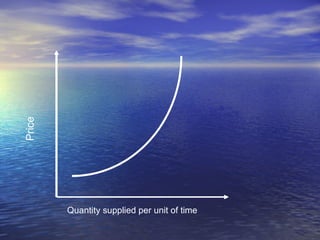
Law of supply-   Supply of a product  –  Increase in price  And vice versa all the other factors remaining constant.  Other things – technology, price of related goods, weather & climatic conditions in case of agricultural goods. Supply schedule-  A supply schedule is a tabular  presentation of the law of supply.  Supply curve-  Graphical representation of supply schedule.
Price Quantity supplied per unit of time
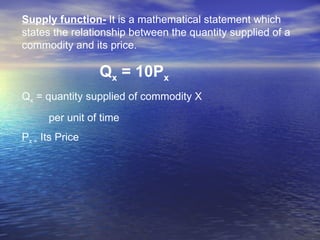
Supply function-  It is a mathematical statement which states the relationship between the quantity supplied of a commodity and its price.  Q x  = 10P x Q x  = quantity supplied of commodity X per unit of time P x =  Its Price
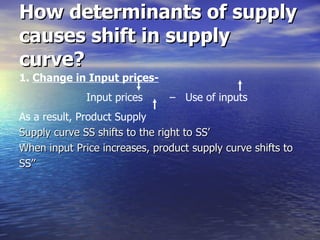
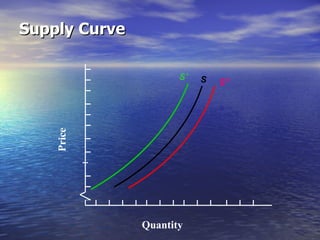
How determinants of supply causes shift in supply curve? 1.  Change in Input prices-   Input prices  –  Use of inputs  As a result, Product Supply  Supply curve SS shifts to the right to SS’  When input Price increases, product supply curve shifts to SS’’
Supply Curve Quantity Price   S S’ S’’
2.  Technological Progress-   Technological changes that  ------  Product Supply  reduce cost of production or  increase efficiency in production  3 .Price of product substitutes-   Fall in the price of  ---------  Supply of other  one of the product ’s  substitutes  4 .Nature & Size of the industry - Depend on whether an industry is monopolized or competitive. Under monopoly  -------- Supply is fixed If monopolized industry  ------- Total supply  is made competitive
If size of an industry  ------- Total supply  due to new firms  joining the industry 5.  Government policy- When govt. imposes  --------- Production tends to fall  restrictions on production  Supply  6. Non economic factors – Labor, strikes, lockouts, communal riots, epidemics, affect supply
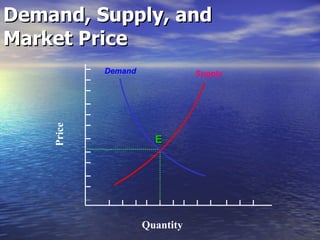
Market equilibrium-  equilibrium of demand & supply Determination of price in a Free market Free market –  is one in which the market forces of demand  & supply are free to take their own course & no outside control on price, demand & supply Market equilibrium  –  Refers to a state of market in which Quantity demanded  =  Quantity supplied  of a commodity  of the commodity Equality of demand and supply produces equilibrium Price  It is also called  Market Clearing Price  because market is cleared in the sense that there is no unsold stock and no unsupplied demand .
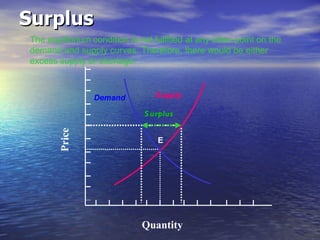
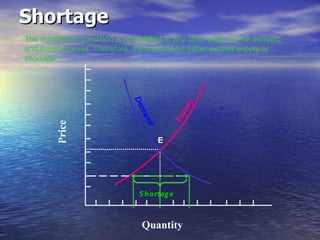
Determination of market price In a free market, disequilibrium itself creates the condition for equilibrium. When there is excess supply, it forces downward adjustment in the price & quantity supplied. When there is excess of demand it forces upward adjustment in the price & quantity demanded. Process of downward & upward adjustment in price determines till price reaches equilibrium and the quantities supplied and demanded are in balance This process is automatic.
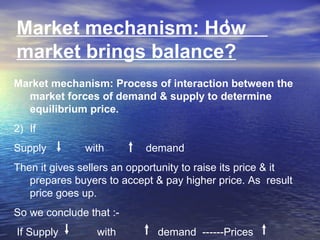
Market mechanism: How  market brings balance? Market mechanism: Process of interaction between the market forces of demand & supply to determine equilibrium price. If  Supply  with  demand Then it gives sellers an opportunity to raise its price & it prepares buyers to accept & pay higher price. As  result price goes up.  So we conclude that :- If Supply  with  demand  ------Prices
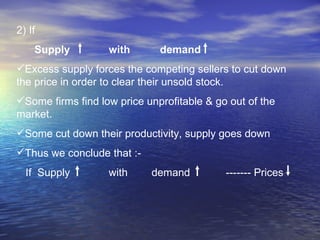
2) If  Supply  with  demand  Excess supply forces the competing sellers to cut down  the price in order to clear their unsold stock. Some firms find low price unprofitable & go out of the market. Some cut down their productivity, supply goes down Thus we conclude that :- If  Supply  with  demand  ------- Prices
Demand, Supply, and  Market Price  Quantity Price  Supply Demand E
Surplus Quantity Price  Supply Demand E Surplus The equilibrium condition is not fulfilled at any other point on the demand and supply curves. Therefore, there would be either excess supply or shortage.
Shortage   Quantity Price  Supply Demand E Shortage The equilibrium condition is not fulfilled at any other point on the demand and supply curves. Therefore, there would be either excess supply or shortage.
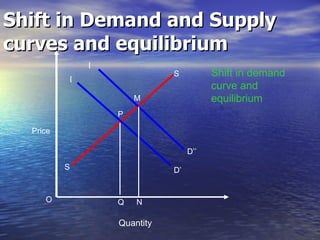
Shift in Demand and Supply curves and equilibrium O Quantity D D’’ D’ D P M Q N S S Shift in demand curve and equilibrium Price
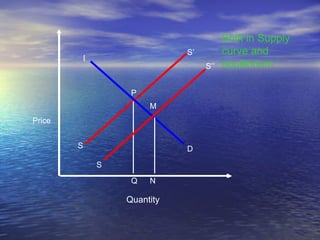
Quantity S S’’ D D P M Q N S S’ Price Shift in Supply curve and equilibrium
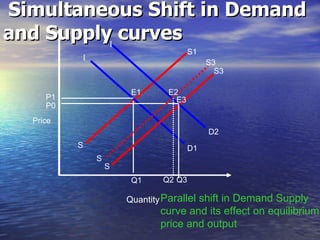
S S3 D1 D E1 Q1 S S1 P1 D2 P0 Q3 E3 E2 Q2 D S S3 Parallel shift in Demand Supply curve and its effect on equilibrium price and output  Simultaneous Shift in Demand and Supply curves Quantity Price
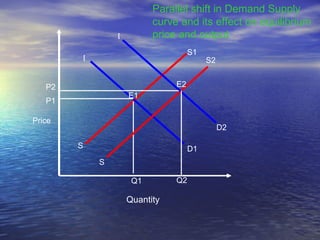
Parallel shift in Demand Supply curve and its effect on equilibrium price and output  Quantity S S2 D1 D E1 Q1 S S1 Price P1 D2 P2 Q2 E2 D

Market mechanism

  • 1.
  • 2.
    What is market? Literal meaning- Place where goods and services are brought and sold In economics- It is used in abstract sense. According to SAMUELSON & NORDHAUS A market is a mechanism by which buyers & sellers interact to determine the price & quantity of a good or service. Sellers & buyers- individuals, firms, factories, dealers & agents
  • 3.
    Features of marketconcept A market need not be situated in a particular locality or area Buyers & sellers need not come into personal contact with each other Word market may refer to a commodity / service or to a geographical area Economists distinguish market on the basis of Nature of goods & services (input market, output market) No. of firms & degree of competition. (competitive mkt., monopolistic market)
  • 4.
    What is marketmechanism? The market for a product works on certain market principles i.e. the laws that govern the working of the market system, also called market mechanism Working of the market system is governed by certain fundamental laws of market called Law of Demand and Supply. Clear understanding of this is required for chalking out an appropriate market strategy.
  • 5.
    Supply side ofthe market Some important terms in this:- Supply- It is the quantity of a commodity that its producers/ sellers offer for sale at a given price, per unit of time. Market supply- Sum of suppliers of a commodity made by all the individual firms or their supply agencies. Market supply of product is governed by the law of supply. Supply of a commodity depends on:- 1.Its price 2.Cost of production.
  • 6.
    Law of supply- Supply of a product – Increase in price And vice versa all the other factors remaining constant. Other things – technology, price of related goods, weather & climatic conditions in case of agricultural goods. Supply schedule- A supply schedule is a tabular presentation of the law of supply. Supply curve- Graphical representation of supply schedule.
  • 7.
    Price Quantity suppliedper unit of time
  • 8.
    Supply function- It is a mathematical statement which states the relationship between the quantity supplied of a commodity and its price. Q x = 10P x Q x = quantity supplied of commodity X per unit of time P x = Its Price
  • 9.
    How determinants ofsupply causes shift in supply curve? 1. Change in Input prices- Input prices – Use of inputs As a result, Product Supply Supply curve SS shifts to the right to SS’ When input Price increases, product supply curve shifts to SS’’
  • 10.
    Supply Curve QuantityPrice S S’ S’’
  • 11.
    2. TechnologicalProgress- Technological changes that ------ Product Supply reduce cost of production or increase efficiency in production 3 .Price of product substitutes- Fall in the price of --------- Supply of other one of the product ’s substitutes 4 .Nature & Size of the industry - Depend on whether an industry is monopolized or competitive. Under monopoly -------- Supply is fixed If monopolized industry ------- Total supply is made competitive
  • 12.
    If size ofan industry ------- Total supply due to new firms joining the industry 5. Government policy- When govt. imposes --------- Production tends to fall restrictions on production Supply 6. Non economic factors – Labor, strikes, lockouts, communal riots, epidemics, affect supply
  • 13.
    Market equilibrium- equilibrium of demand & supply Determination of price in a Free market Free market – is one in which the market forces of demand & supply are free to take their own course & no outside control on price, demand & supply Market equilibrium – Refers to a state of market in which Quantity demanded = Quantity supplied of a commodity of the commodity Equality of demand and supply produces equilibrium Price It is also called Market Clearing Price because market is cleared in the sense that there is no unsold stock and no unsupplied demand .
  • 14.
    Determination of marketprice In a free market, disequilibrium itself creates the condition for equilibrium. When there is excess supply, it forces downward adjustment in the price & quantity supplied. When there is excess of demand it forces upward adjustment in the price & quantity demanded. Process of downward & upward adjustment in price determines till price reaches equilibrium and the quantities supplied and demanded are in balance This process is automatic.
  • 15.
    Market mechanism: How market brings balance? Market mechanism: Process of interaction between the market forces of demand & supply to determine equilibrium price. If Supply with demand Then it gives sellers an opportunity to raise its price & it prepares buyers to accept & pay higher price. As result price goes up. So we conclude that :- If Supply with demand ------Prices
  • 16.
    2) If Supply with demand Excess supply forces the competing sellers to cut down the price in order to clear their unsold stock. Some firms find low price unprofitable & go out of the market. Some cut down their productivity, supply goes down Thus we conclude that :- If Supply with demand ------- Prices
  • 17.
    Demand, Supply, and Market Price Quantity Price Supply Demand E
  • 18.
    Surplus Quantity Price Supply Demand E Surplus The equilibrium condition is not fulfilled at any other point on the demand and supply curves. Therefore, there would be either excess supply or shortage.
  • 19.
    Shortage Quantity Price Supply Demand E Shortage The equilibrium condition is not fulfilled at any other point on the demand and supply curves. Therefore, there would be either excess supply or shortage.
  • 20.
    Shift in Demandand Supply curves and equilibrium O Quantity D D’’ D’ D P M Q N S S Shift in demand curve and equilibrium Price
  • 21.
    Quantity S S’’D D P M Q N S S’ Price Shift in Supply curve and equilibrium
  • 22.
    S S3 D1D E1 Q1 S S1 P1 D2 P0 Q3 E3 E2 Q2 D S S3 Parallel shift in Demand Supply curve and its effect on equilibrium price and output Simultaneous Shift in Demand and Supply curves Quantity Price
  • 23.
    Parallel shift inDemand Supply curve and its effect on equilibrium price and output Quantity S S2 D1 D E1 Q1 S S1 Price P1 D2 P2 Q2 E2 D