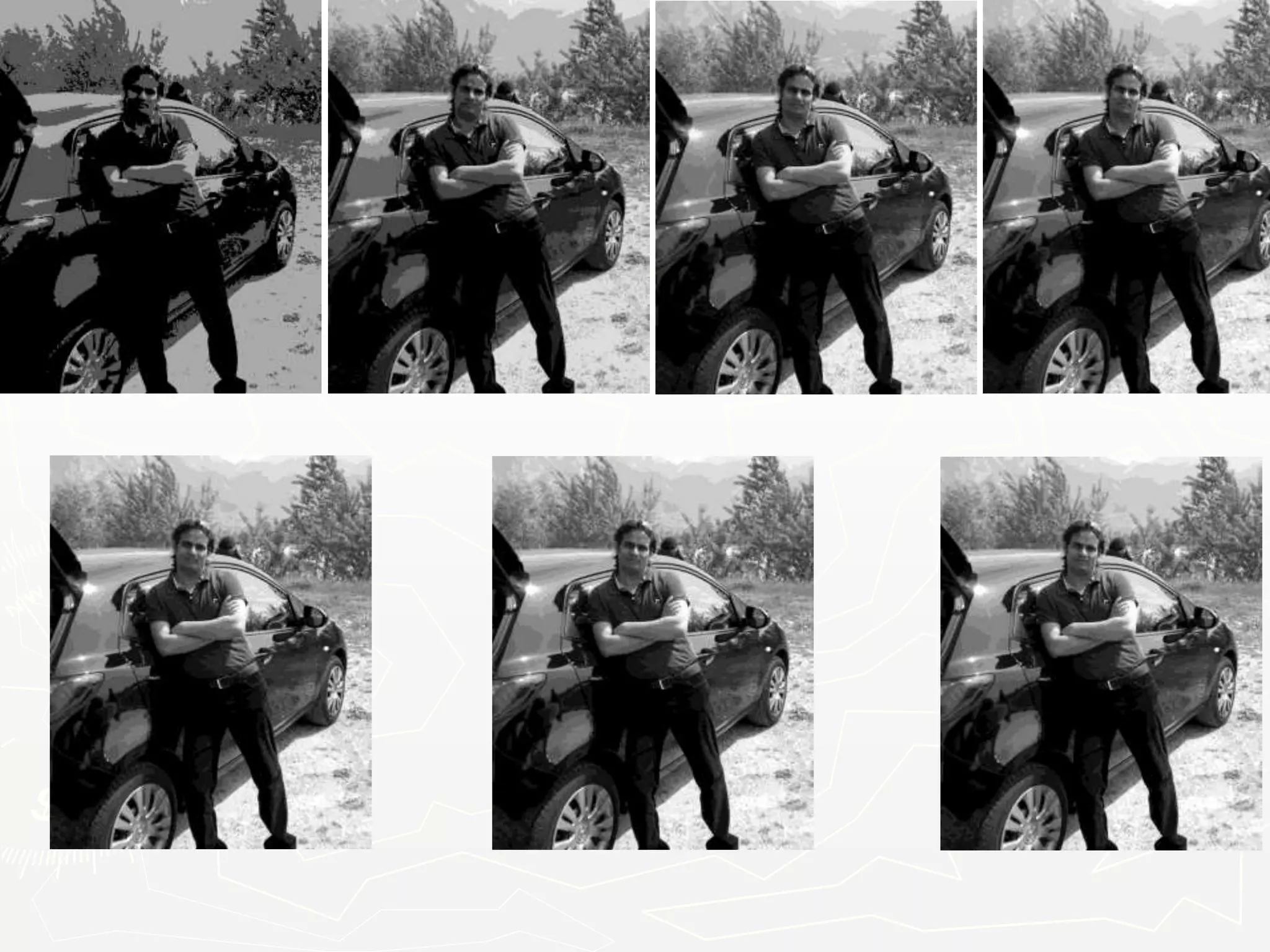
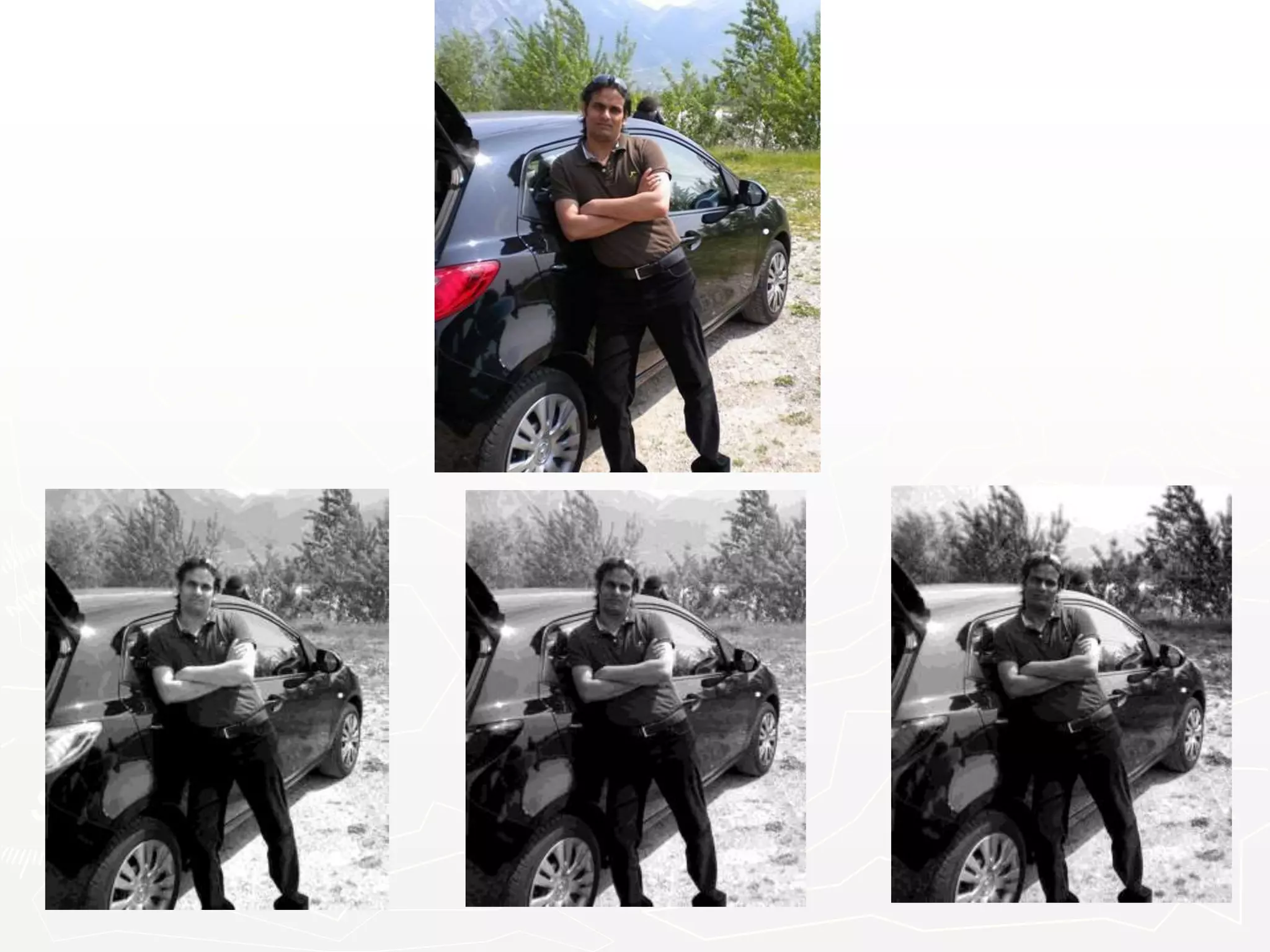
Digital Image Processing
Contents
This lecture will cover:
• What is digital image processing?
• History of digital image processing
• State of the art
• examples of digital image processing
• Key stages in digital image processing
Weeks 1 & 2 2
S. No.
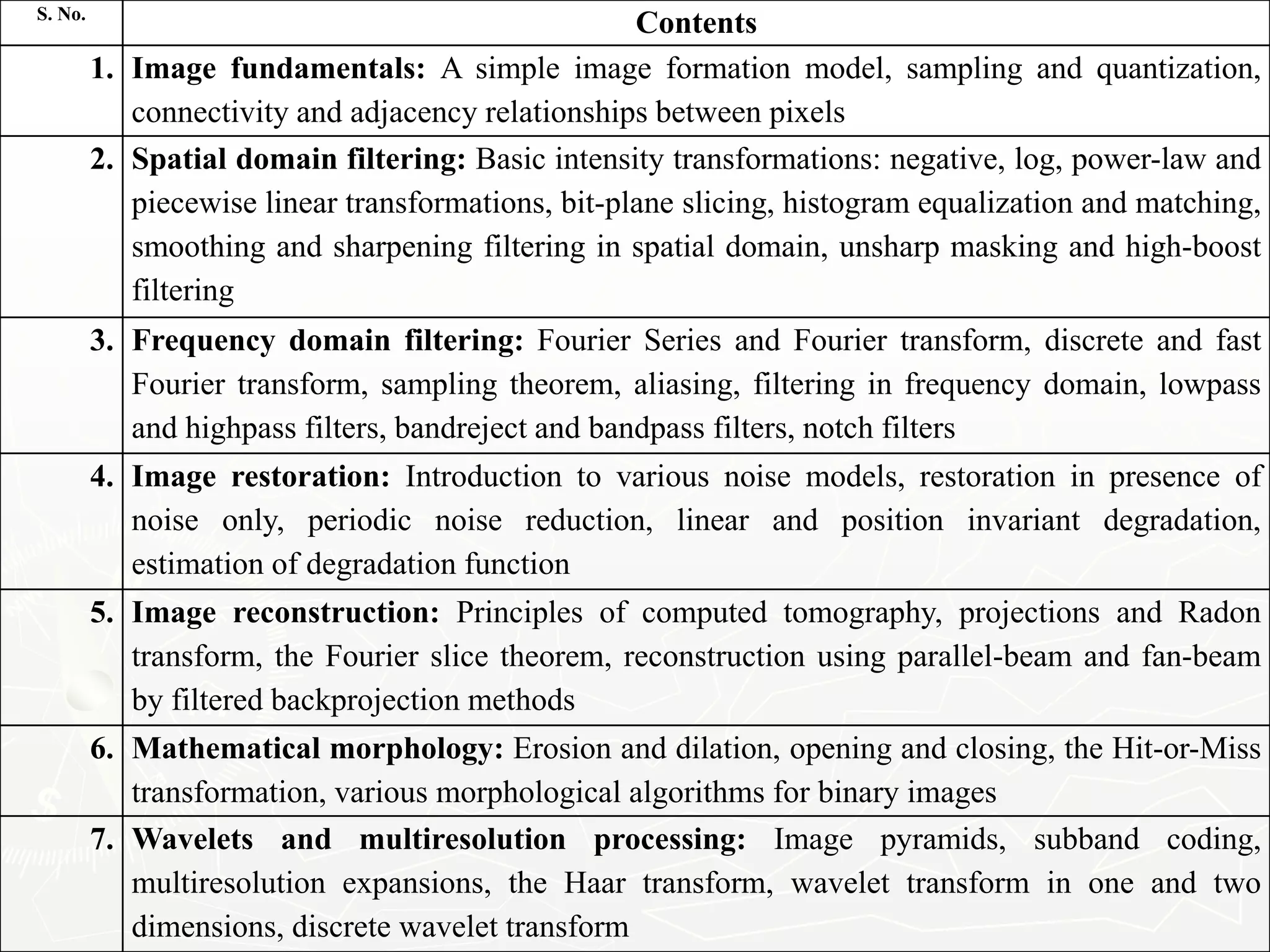
Contents
1. Image fundamentals: A simple image formation model, sampling and quantization,
connectivity and adjacency relationships between pixels
2. Spatial domain filtering: Basic intensity transformations: negative, log, power-law and
piecewise linear transformations, bit-plane slicing, histogram equalization and matching,
smoothing and sharpening filtering in spatial domain, unsharp masking and high-boost
filtering
3. Frequency domain filtering: Fourier Series and Fourier transform, discrete and fast
Fourier transform, sampling theorem, aliasing, filtering in frequency domain, lowpass
and highpass filters, bandreject and bandpass filters, notch filters
4. Image restoration: Introduction to various noise models, restoration in presence of
noise only, periodic noise reduction, linear and position invariant degradation,
estimation of degradation function
5. Image reconstruction: Principles of computed tomography, projections and Radon
transform, the Fourier slice theorem, reconstruction using parallel-beam and fan-beam
by filtered backprojection methods
6. Mathematical morphology: Erosion and dilation, opening and closing, the Hit-or-Miss
transformation, various morphological algorithms for binary images
7. Wavelets and multiresolution processing: Image pyramids, subband coding,
multiresolution expansions, the Haar transform, wavelet transform in one and two
dimensions, discrete wavelet transform
Gonzalez, R. C. and Woods, R. E., "Digital Image
Processing", Prentice Hall, 3rd Ed.
Jain, A. K., "Fundamentals of Digital Image Processing",
PHI Learning, 1st Ed.
Bernd, J., "Digital Image Processing", Springer, 6th Ed.
Burger, W. and Burge, M. J., "Principles of Digital Image
Processing", Springer
Scherzer, O., " Handbook of Mathematical Methods in
Imaging", Springer
Weeks 1 & 2 7
Image Acquisition Process
Weeks 1 & 2 8
Introduction
► What is Digital Image Processing?
Digital Image
— a two-dimensional function
x and y are spatial coordinates
The amplitude of f is called intensity or gray level at the point (x, y)
Digital Image Processing
— process digital images by means of computer, it covers low-, mid-, and high-level
processes
low-level: inputs and outputs are images
mid-level: outputs are attributes extracted from input images
high-level: an ensemble of recognition of individual objects
Pixel
— the elements of a digital image
( , )
f x y
9
A Simple Image Formation Model
( , ) ( , ) ( , )
( , ): intensity at the point ( , )
( , ): illumination at the point ( , )
(the amount of source illumination incident on the scene)
( , ): reflectance/transmissivity
f x y i x y r x y
f x y x y
i x y x y
r x y

at the point ( , )
(the amount of illumination reflected/transmitted by the object)
where 0 < ( , ) < and 0 < ( , ) < 1
x y
i x y r x y

Weeks 1 & 2 10
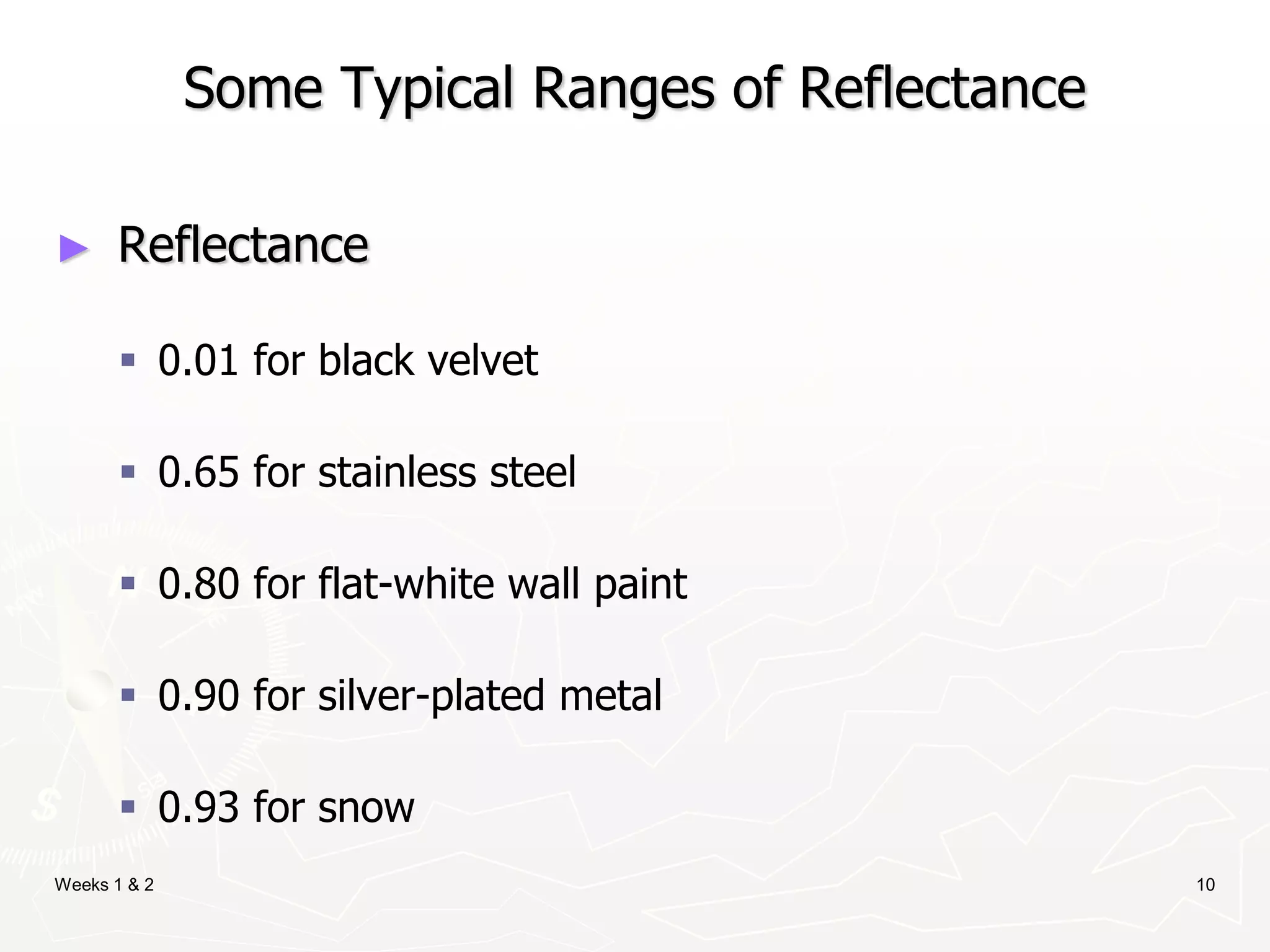
Some Typical Ranges of Reflectance
► Reflectance
 0.01 for black velvet
 0.65 for stainless steel
 0.80 for flat-white wall paint
 0.90 for silver-plated metal
 0.93 for snow
Weeks 1 & 2 11
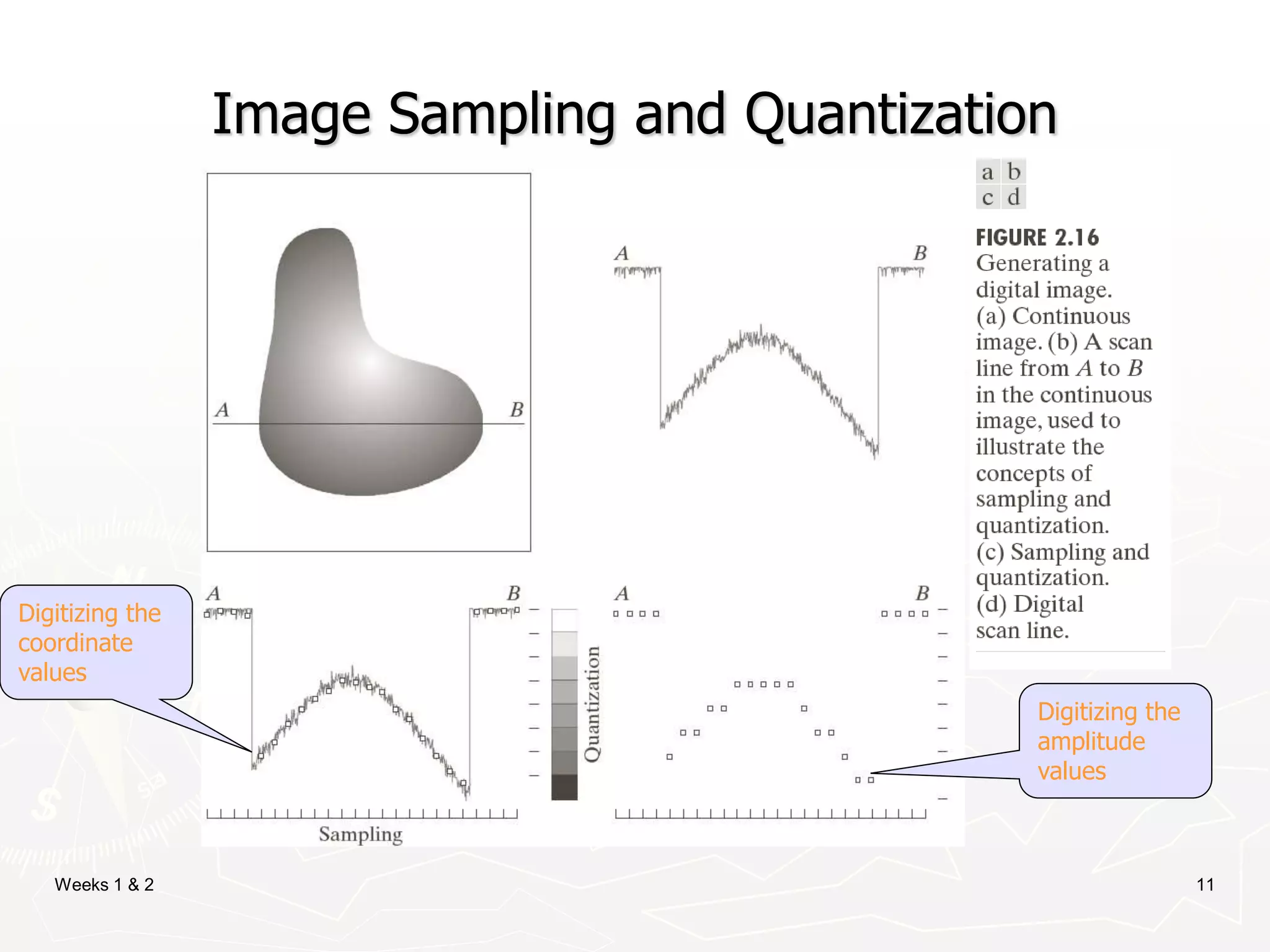
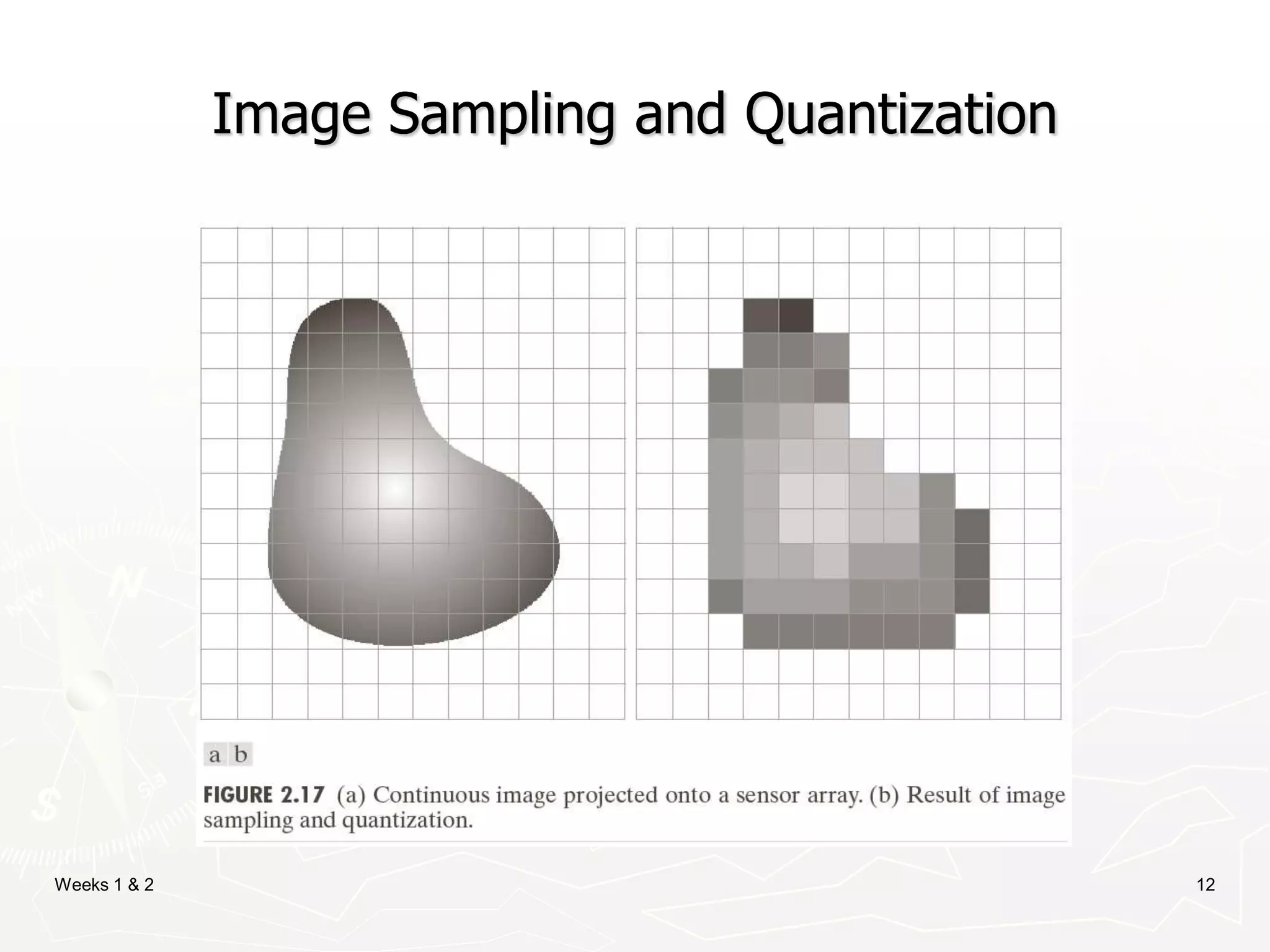
Image Sampling and Quantization
Digitizing the
coordinate
values
Digitizing the
amplitude
values
Weeks 1 & 2 12
Image Sampling and Quantization
Weeks 1 & 2 13
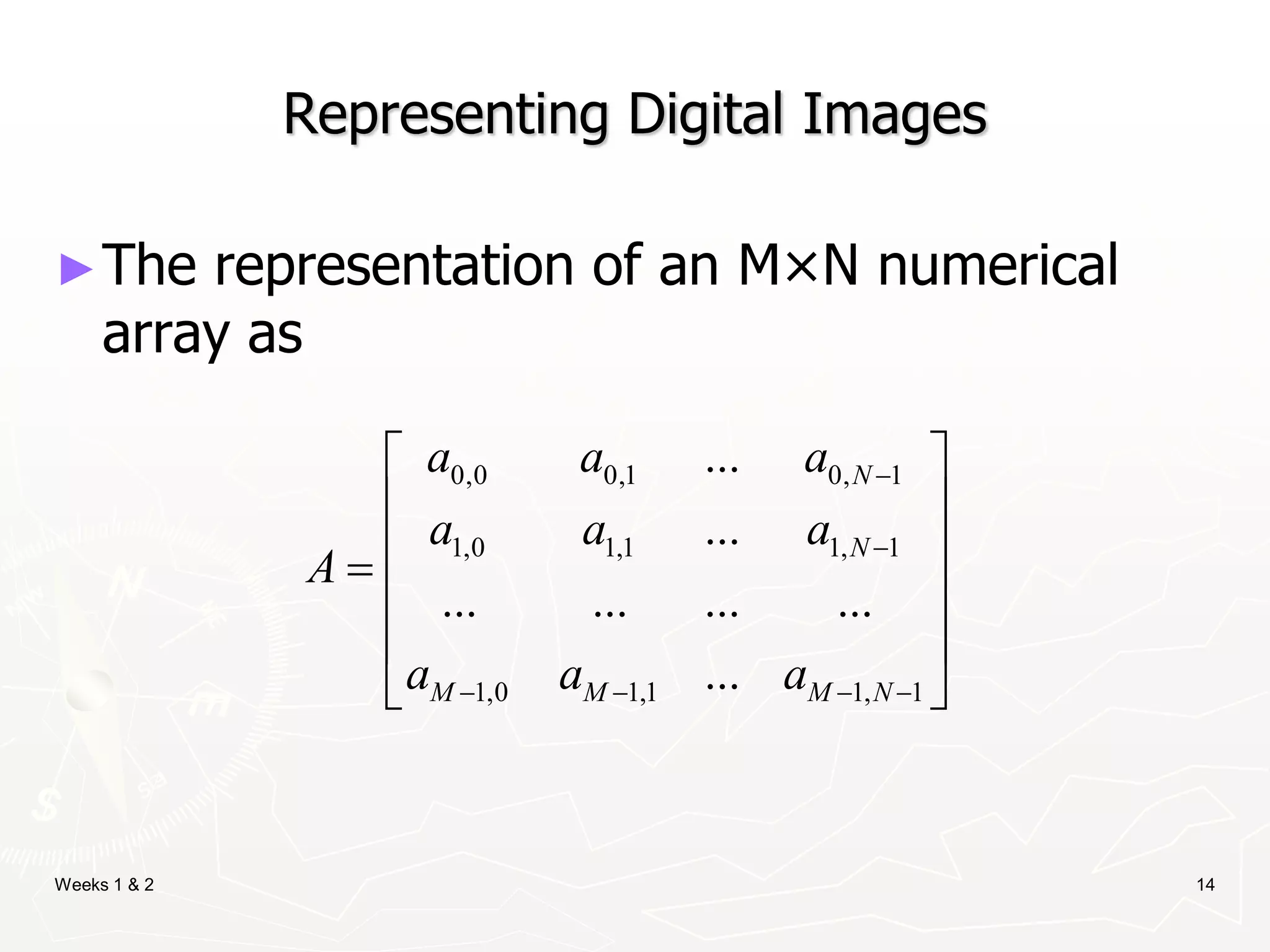
Representing Digital Images
►The representation of an M×N numerical
array as
(0,0) (0,1) ... (0, 1)
(1,0) (1,1) ... (1, 1)
( , )
... ... ... ...
( 1,0) ( 1,1) ... ( 1, 1)
f f f N
f f f N
f x y
f M f M f M N

 
 

 

 
 
   
 
Weeks 1 & 2 14
Representing Digital Images
►The representation of an M×N numerical
array as
0,0 0,1 0, 1
1,0 1,1 1, 1
1,0 1,1 1, 1
...
...
... ... ... ...
...
N
N
M M M N
a a a
a a a
A
a a a


   
 
 
 

 
 
 
Weeks 1 & 2 15
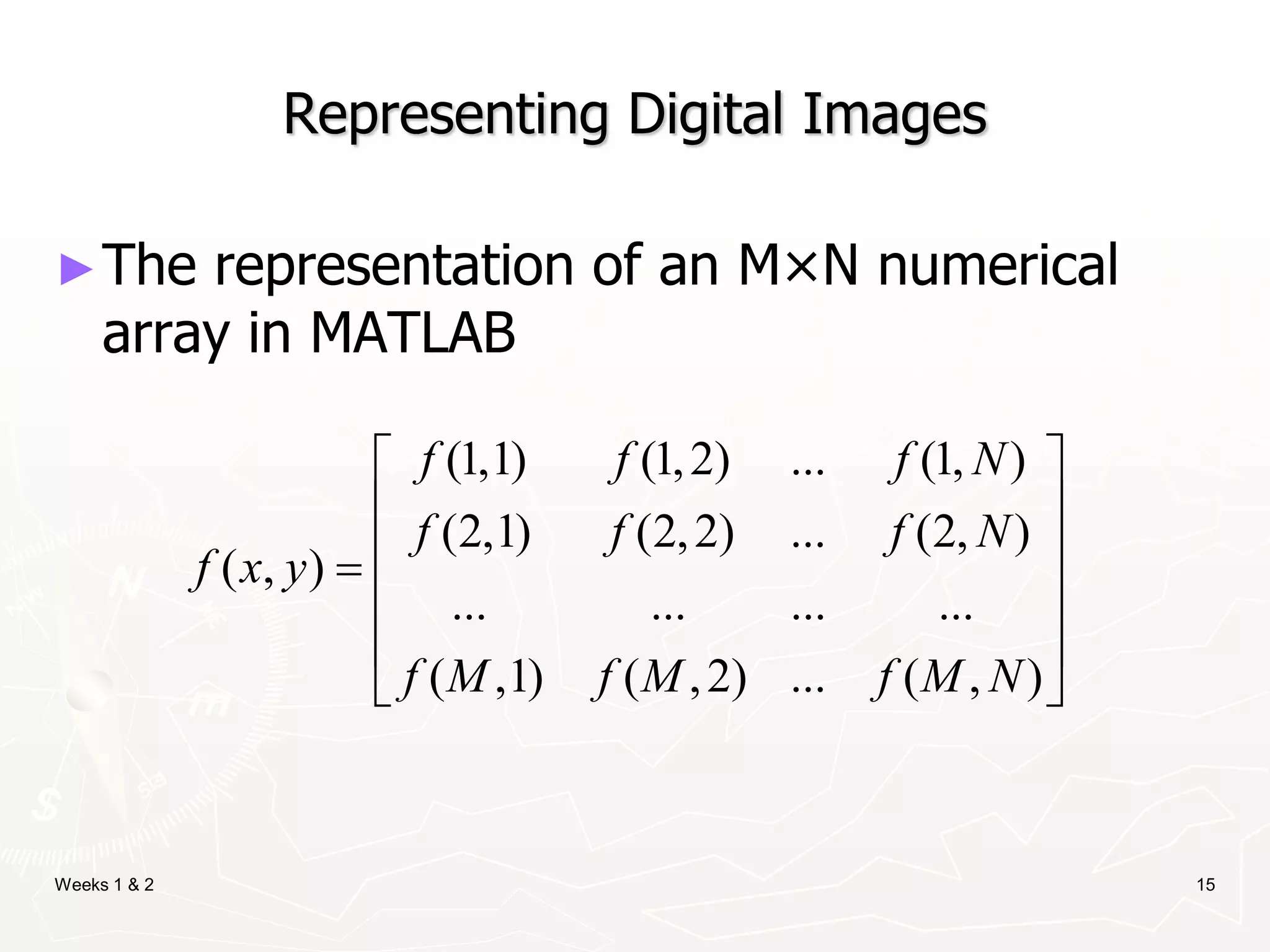
Representing Digital Images
►The representation of an M×N numerical
array in MATLAB
(1,1) (1,2) ... (1, )
(2,1) (2,2) ... (2, )
( , )
... ... ... ...
( ,1) ( ,2) ... ( , )
f f f N
f f f N
f x y
f M f M f M N
 
 
 

 
 
 
Weeks 1 & 2 16
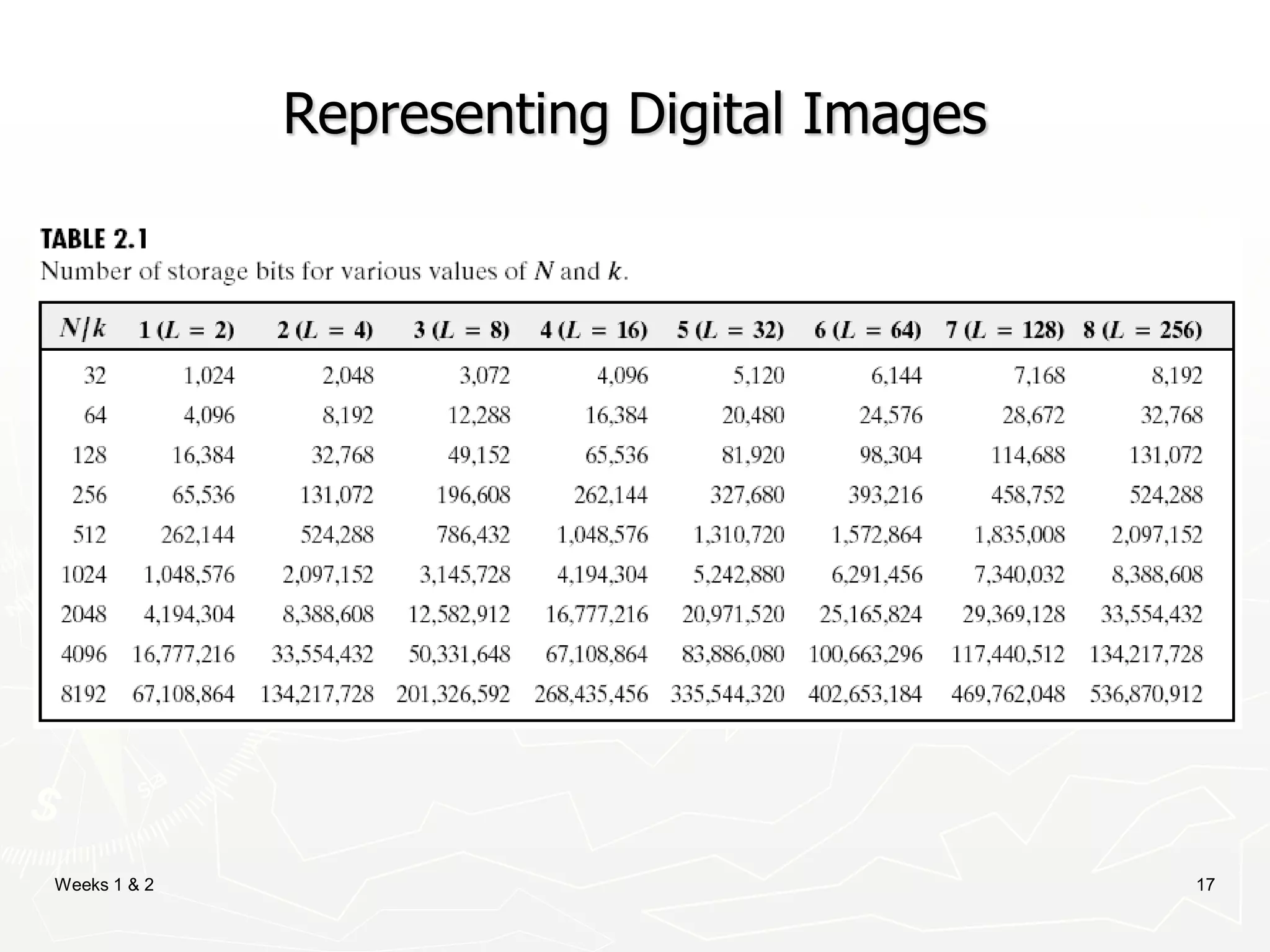
Representing Digital Images
► Discrete intensity interval [0, L-1], L=2k
► The number b of bits required to store a M × N
digitized image
b = M × N × k
Weeks 1 & 2 17
Representing Digital Images
What is a Digital Image? (cont…)
►Common image formats include:
 1 sample per point (B&W or Grayscale)
 3 samples per point (Red, Green, and Blue)
 4 samples per point (Red, Green, Blue, and “Alpha”,
a.k.a. Opacity)
►For most of this course we will focus on grey-scale
Image processing
► An image processing operation typically defines
a new image g in terms of an existing image f.
► We can transform either the range of f.
► Or the domain of f:
► What kinds of operations can each perform?
What is DIP? (cont…)
►The continuum from image processing to
computer vision can be broken up into low-,
mid- and high-level processes
Low Level Process
Input: Image
Output: Image
Examples: Noise
removal, image
sharpening
Mid Level Process
Input: Image
Output: Attributes
Examples: Object
recognition,
segmentation
High Level Process
Input: Attributes
Output:
Understanding
Examples: Scene
understanding,
autonomous navigation
In this course we will
stop here
Key Stages in Digital Image Processing
Image
Acquisition
Image
Restoration
Morphological
Processing
Segmentation
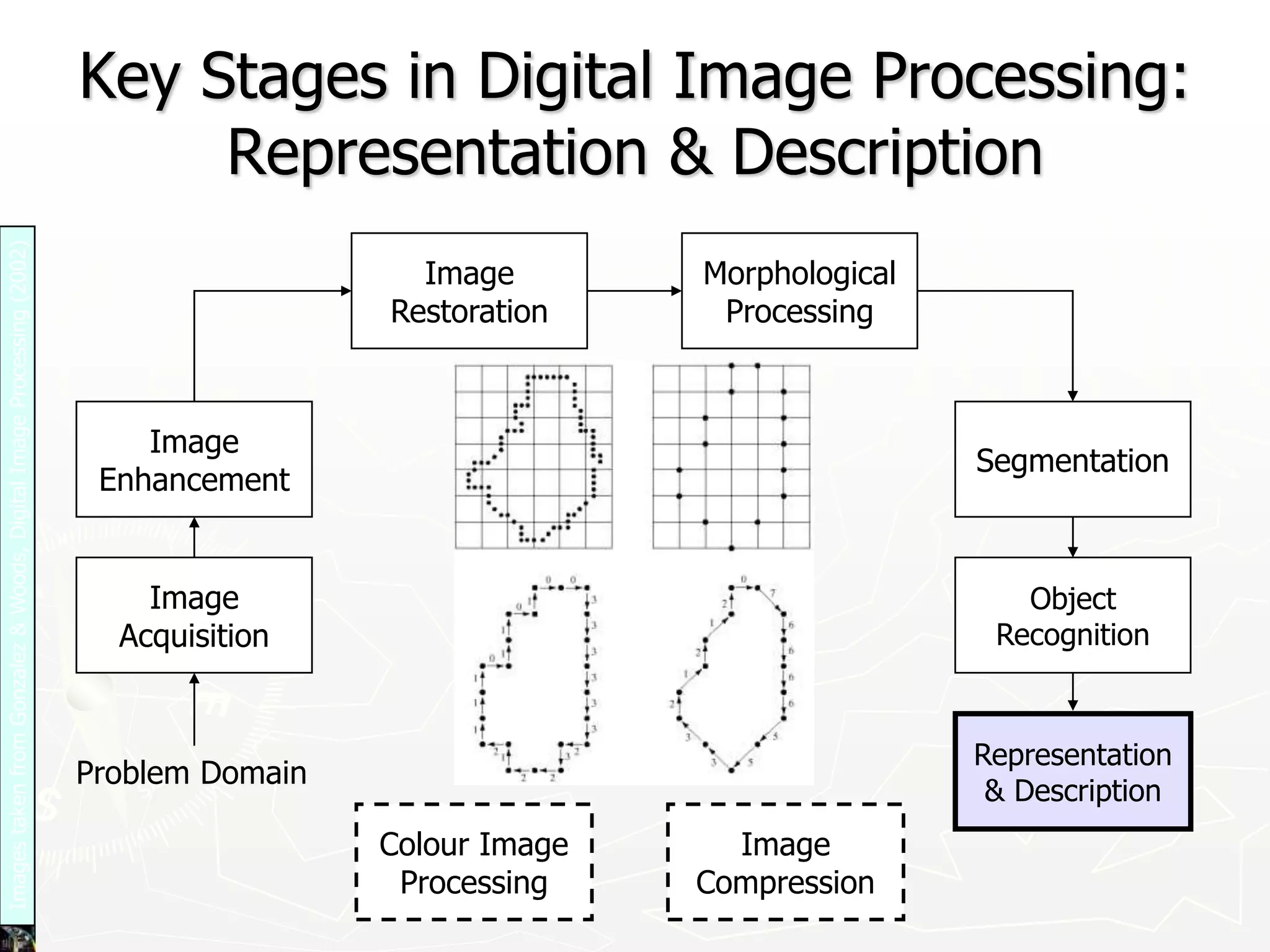
Representation
& Description
Image
Enhancement
Object
Recognition
Problem Domain
Colour Image
Processing
Image
Compression
Key Stages in Digital Image Processing:
Image Aquisition
Image
Acquisition
Image
Restoration
Morphological
Processing
Segmentation
Representation
& Description
Image
Enhancement
Object
Recognition
Problem Domain
Colour Image
Processing
Image
Compression
Images
taken
from
Gonzalez
&
Woods,
Digital
Image
Processing
(2002)
Key Stages in Digital Image Processing:
Image Enhancement
Image
Acquisition
Image
Restoration
Morphological
Processing
Segmentation
Representation
& Description
Image
Enhancement
Object
Recognition
Problem Domain
Colour Image
Processing
Image
Compression
Images
taken
from
Gonzalez
&
Woods,
Digital
Image
Processing
(2002)
Key Stages in Digital Image Processing:
Image Restoration
Image
Acquisition
Image
Restoration
Morphological
Processing
Segmentation
Representation
& Description
Image
Enhancement
Object
Recognition
Problem Domain
Colour Image
Processing
Image
Compression
Images
taken
from
Gonzalez
&
Woods,
Digital
Image
Processing
(2002)
Key Stages in Digital Image Processing:
Morphological Processing
Image
Acquisition
Image
Restoration
Morphological
Processing
Segmentation
Representation
& Description
Image
Enhancement
Object
Recognition
Problem Domain
Colour Image
Processing
Image
Compression
Images
taken
from
Gonzalez
&
Woods,
Digital
Image
Processing
(2002)
Key Stages in Digital Image Processing:
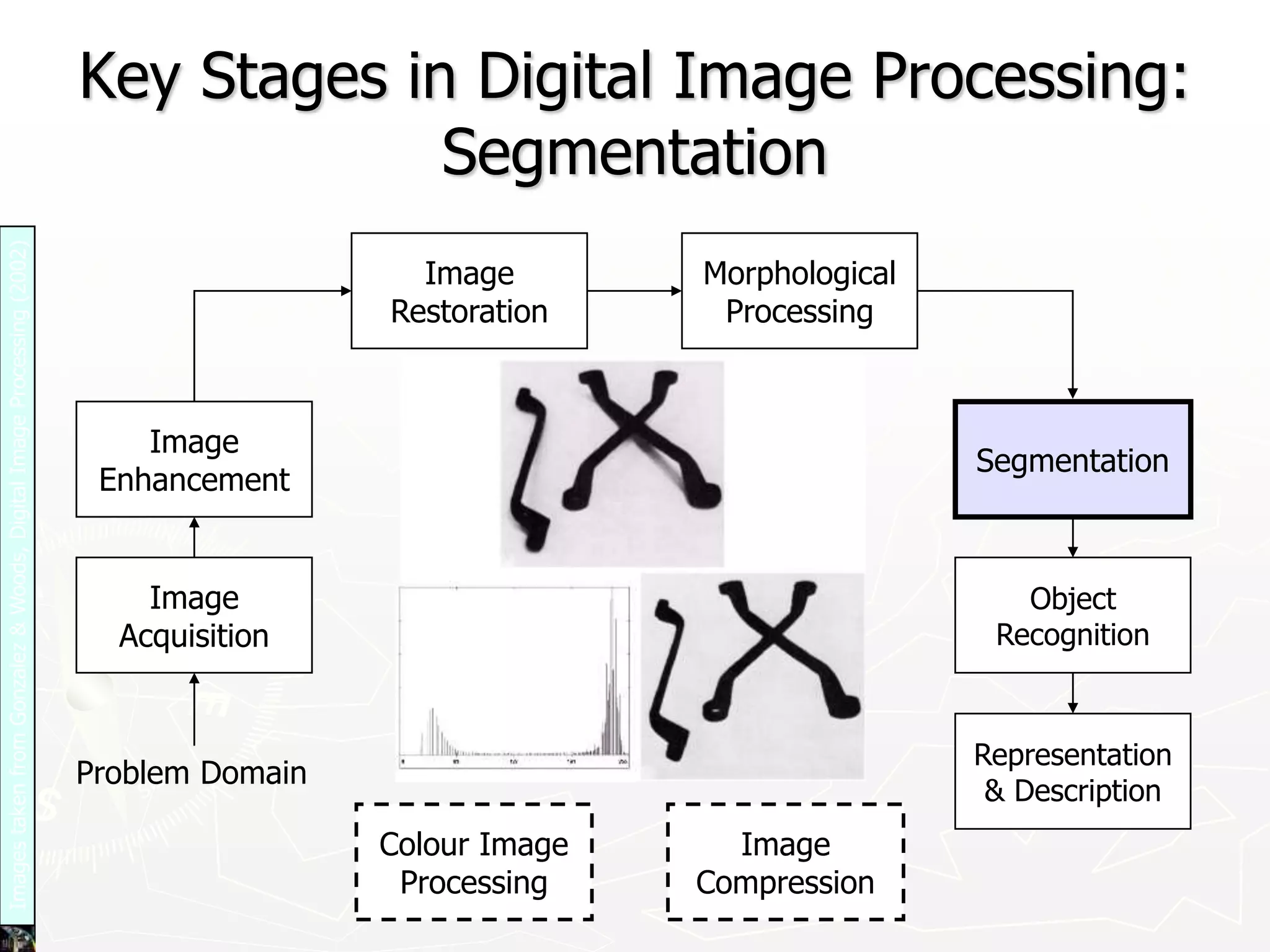
Segmentation
Image
Acquisition
Image
Restoration
Morphological
Processing
Segmentation
Representation
& Description
Image
Enhancement
Object
Recognition
Problem Domain
Colour Image
Processing
Image
Compression
Images
taken
from
Gonzalez
&
Woods,
Digital
Image
Processing
(2002)
Key Stages in Digital Image Processing:
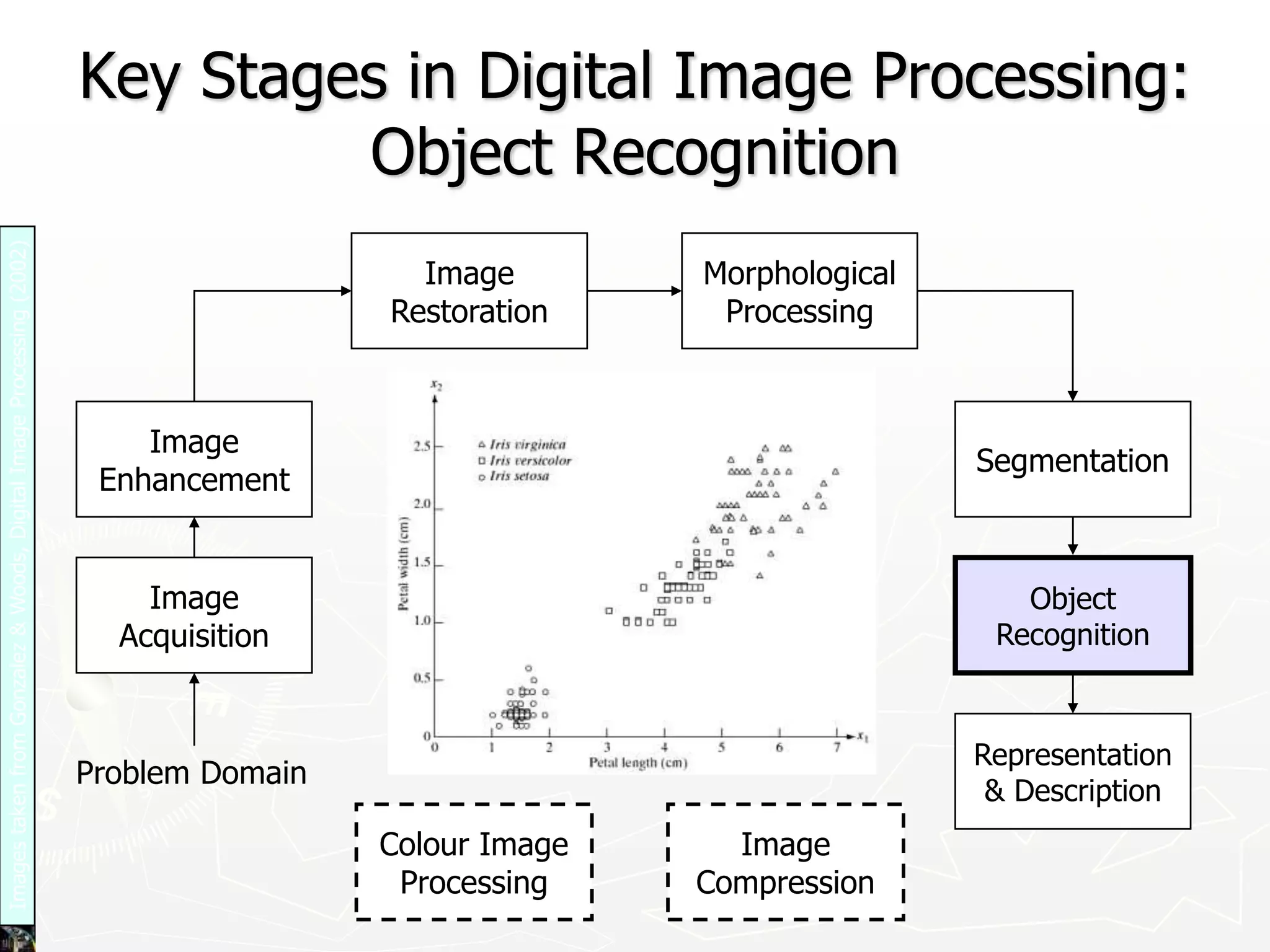
Object Recognition
Image
Acquisition
Image
Restoration
Morphological
Processing
Segmentation
Representation
& Description
Image
Enhancement
Object
Recognition
Problem Domain
Colour Image
Processing
Image
Compression
Images
taken
from
Gonzalez
&
Woods,
Digital
Image
Processing
(2002)
Key Stages in Digital Image Processing:
Representation & Description
Image
Acquisition
Image
Restoration
Morphological
Processing
Segmentation
Representation
& Description
Image
Enhancement
Object
Recognition
Problem Domain
Colour Image
Processing
Image
Compression
Images
taken
from
Gonzalez
&
Woods,
Digital
Image
Processing
(2002)
Key Stages in Digital Image Processing:
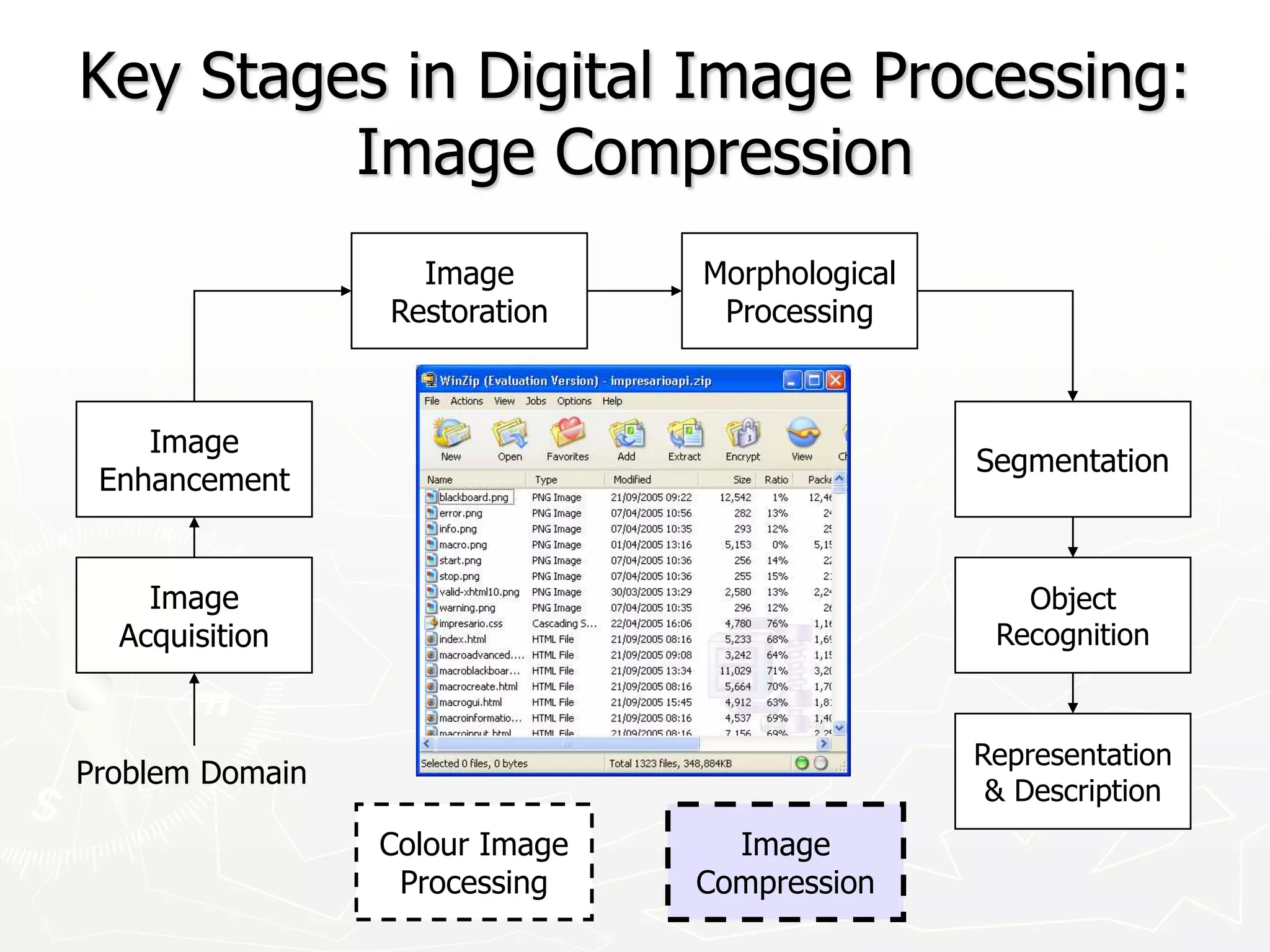
Image Compression
Image
Acquisition
Image
Restoration
Morphological
Processing
Segmentation
Representation
& Description
Image
Enhancement
Object
Recognition
Problem Domain
Colour Image
Processing
Image
Compression
Key Stages in Digital Image Processing:
Colour Image Processing
Image
Acquisition
Image
Restoration
Morphological
Processing
Segmentation
Representation
& Description
Image
Enhancement
Object
Recognition
Problem Domain
Colour Image
Processing
Image
Compression
Applications
&
Research Topics
Document Handling
Signature Verification
Biometrics
Fingerprint Verification /
Identification
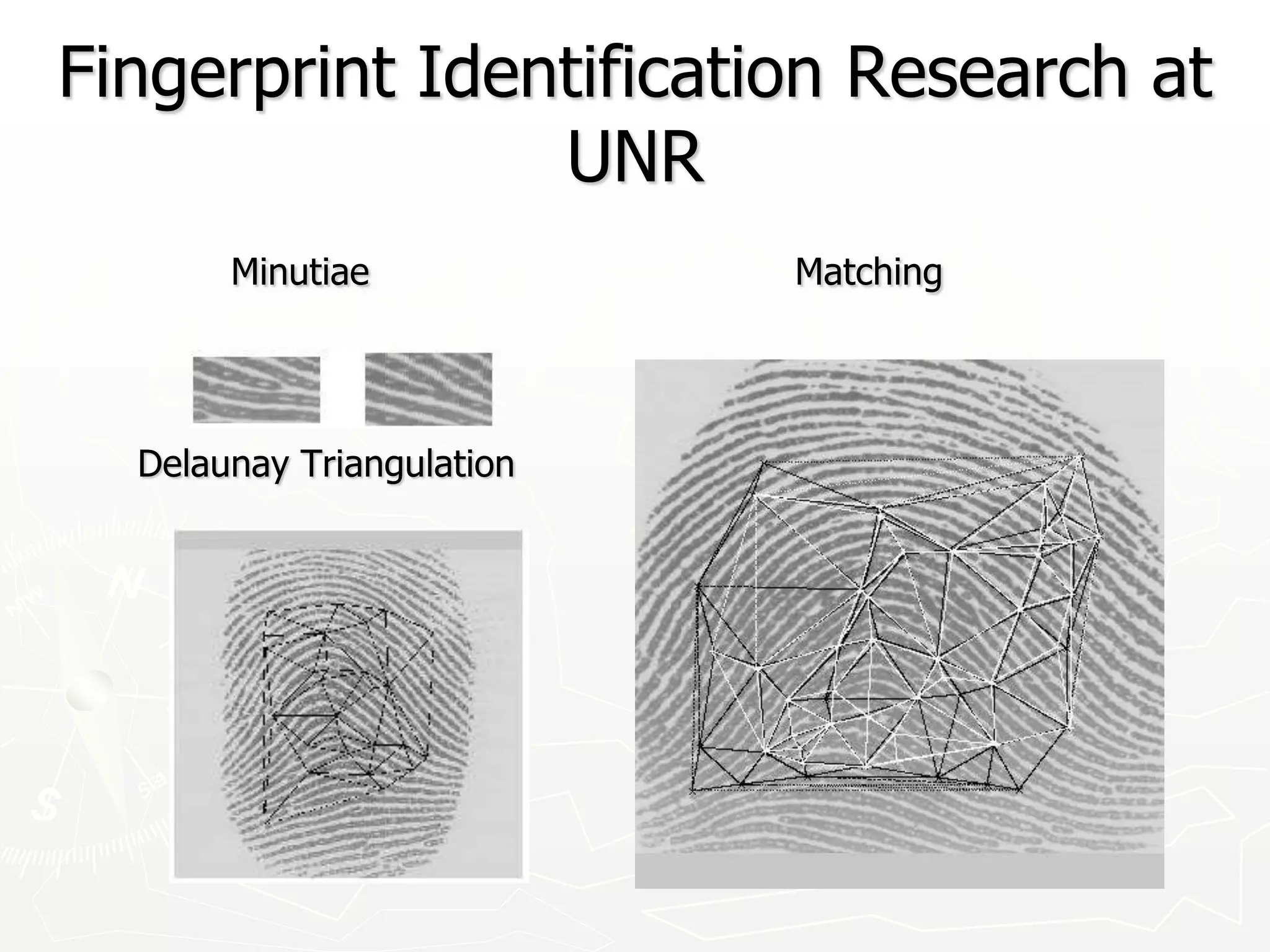
Fingerprint Identification Research at
UNR
Minutiae Matching
Delaunay Triangulation
Object Recognition
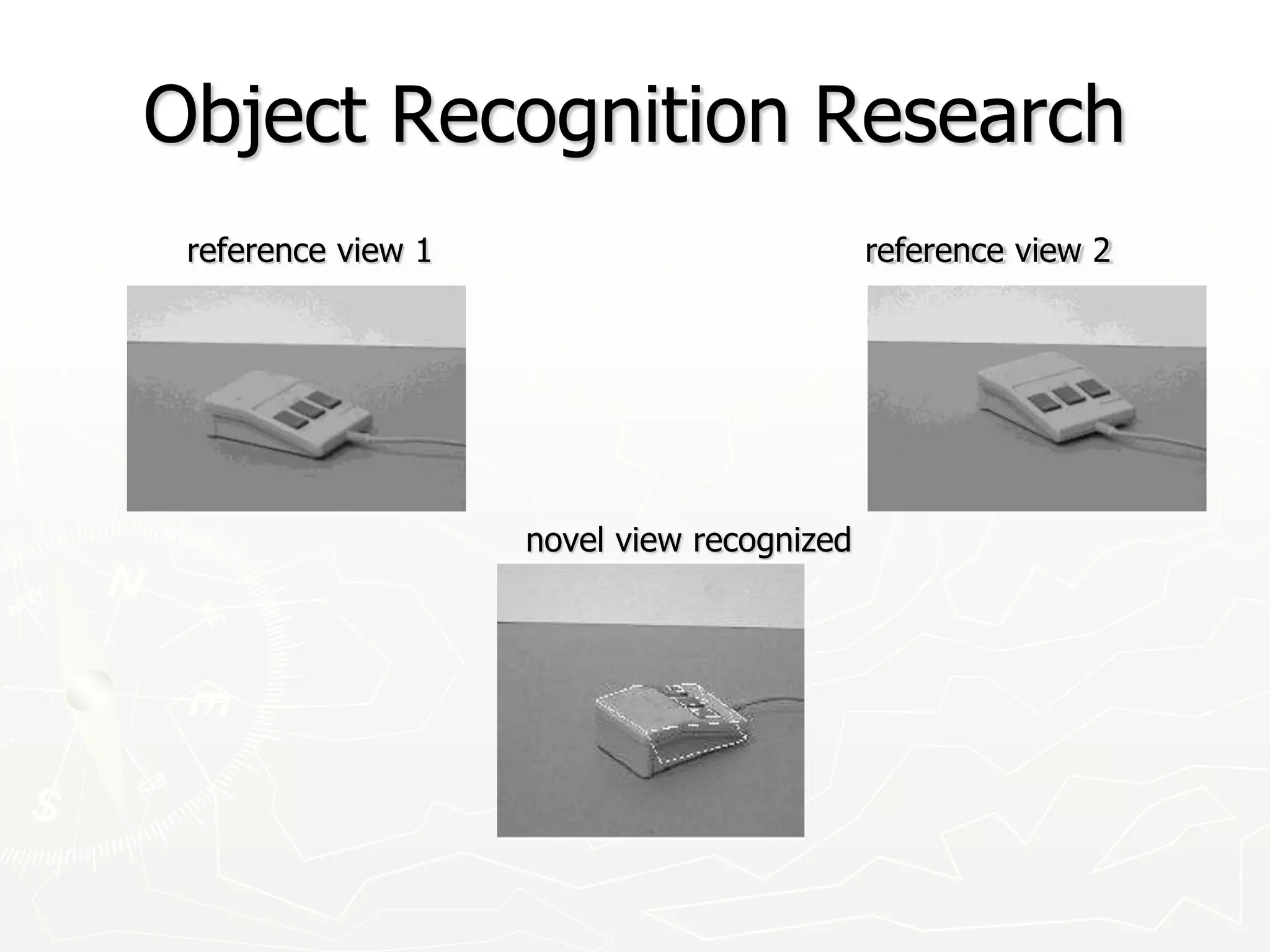
Object Recognition Research
reference view 1 reference view 2
novel view recognized
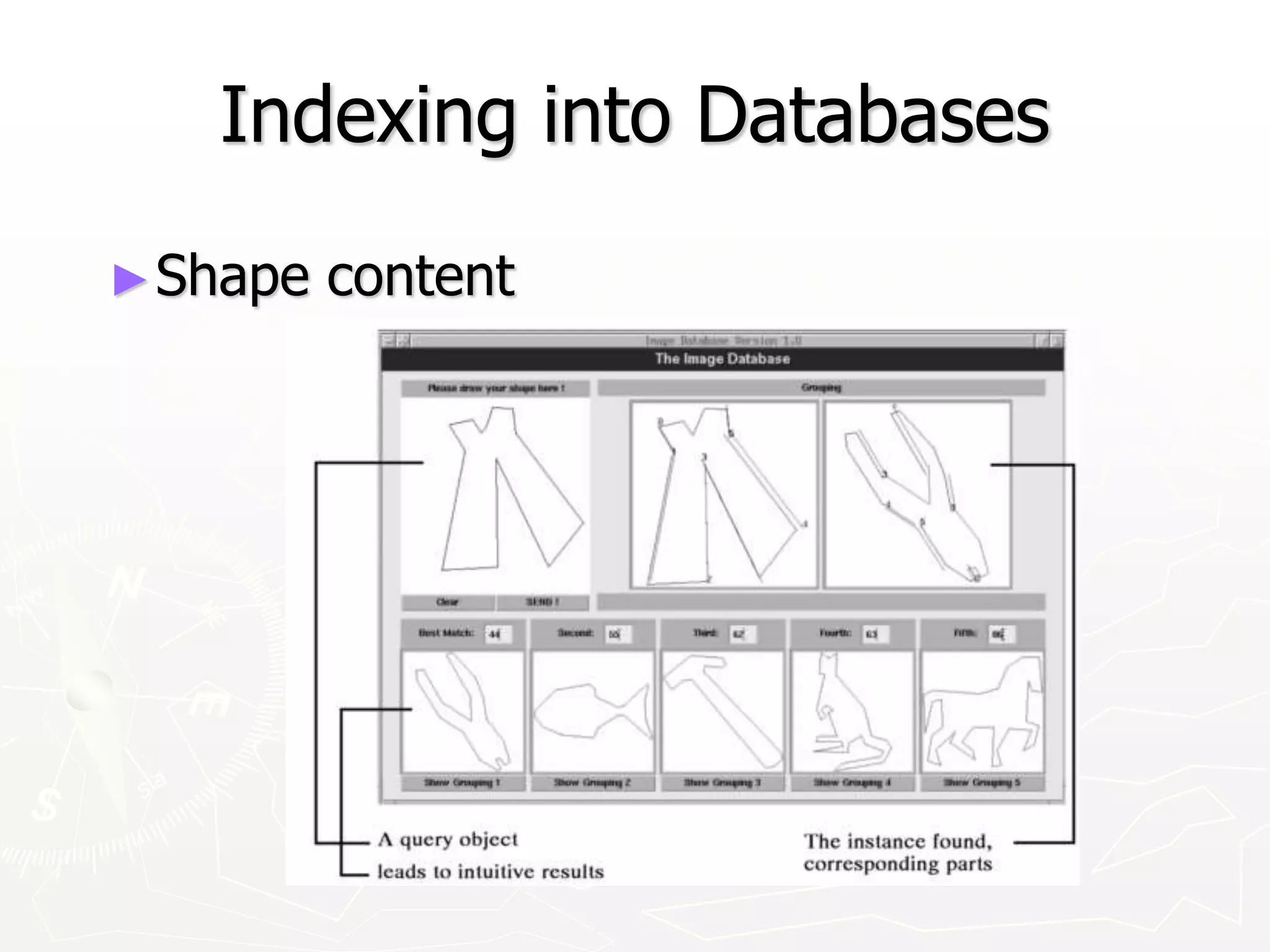
Indexing into Databases
►Shape content
Indexing into Databases
(cont’d)
►Color, texture
Target Recognition
►Department of Defense (Army, Airforce,
Navy)
Interpretation of aerial photography is a problem domain in both
computer vision and registration.
Interpretation of Aerial
Photography
Autonomous Vehicles
►Land, Underwater, Space
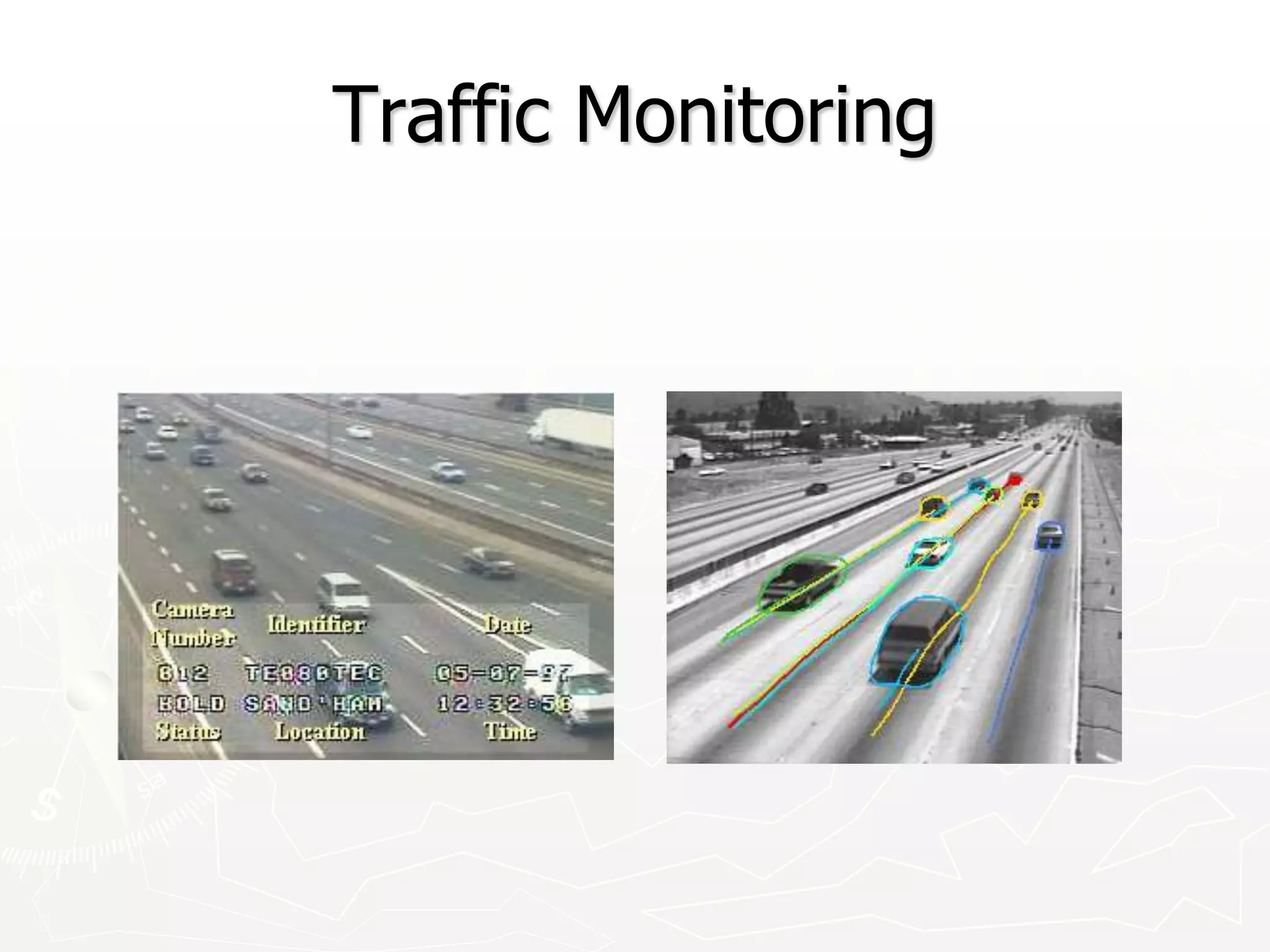
Traffic Monitoring
Face Detection
Face Recognition
Face Detection/Recognition Research
at UNR
Facial Expression Recognition
Face Tracking
Face Tracking (cont’d)
Hand Gesture Recognition
► Smart Human-Computer User Interfaces
► Sign Language Recognition
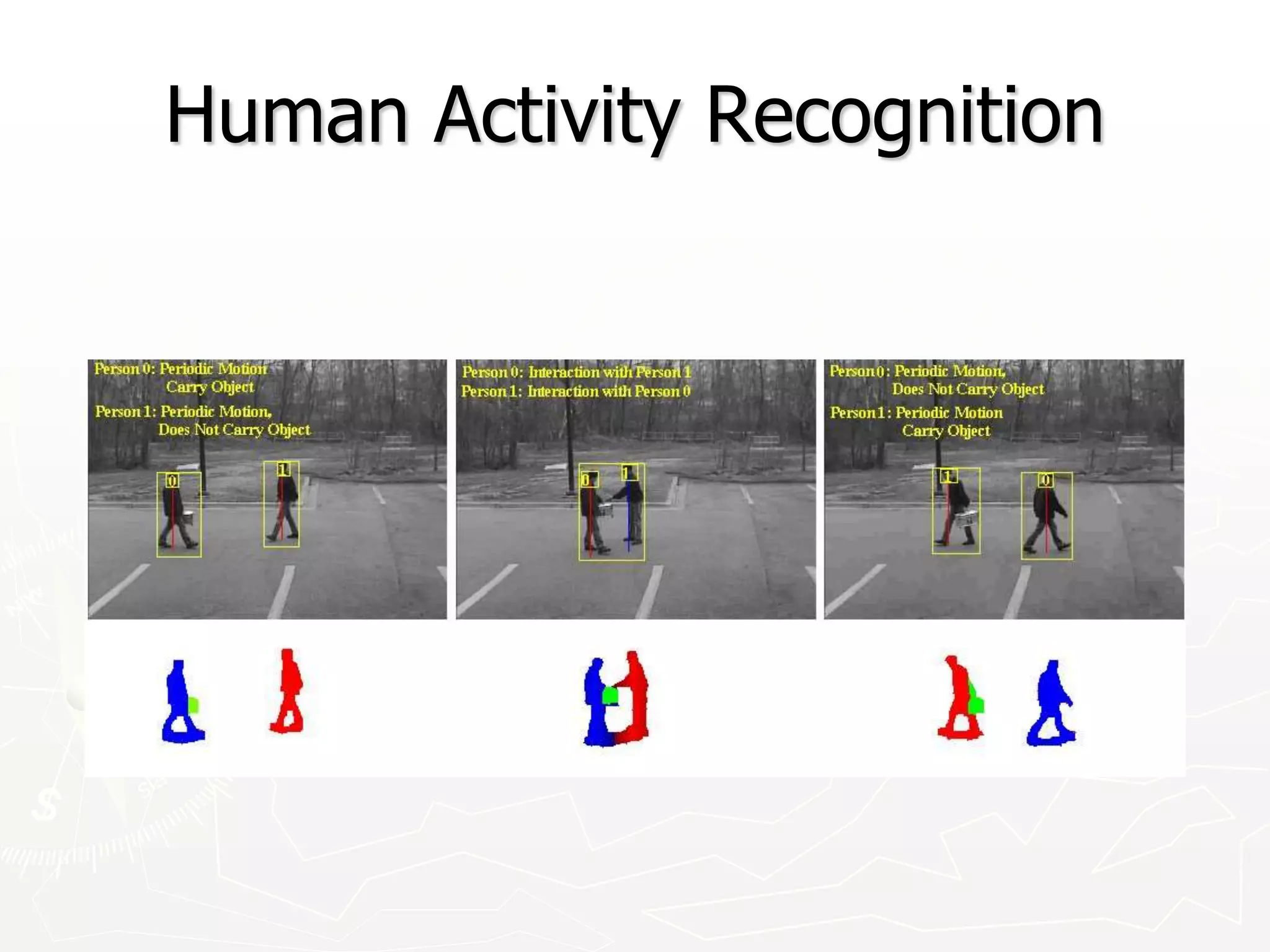
Human Activity Recognition
Medical Applications
► skin cancer breast cancer
Morphing
Inserting Artificial Objects into a Scene
Companies In this Field In India
► Sarnoff Corporation
► Kritikal Solutions
► National Instruments
► GE Laboratories
► Ittiam, Bangalore
► Interra Systems, Noida
► Yahoo India (Multimedia Searching)
► nVidia Graphics, Pune (have high requirements)
► Microsoft research
► DRDO labs
► ISRO labs
► …

Seema dip

  • 1.
  • 2.
    Contents This lecture willcover: • What is digital image processing? • History of digital image processing • State of the art • examples of digital image processing • Key stages in digital image processing Weeks 1 & 2 2
  • 4.
    S. No. Contents 1. Imagefundamentals: A simple image formation model, sampling and quantization, connectivity and adjacency relationships between pixels 2. Spatial domain filtering: Basic intensity transformations: negative, log, power-law and piecewise linear transformations, bit-plane slicing, histogram equalization and matching, smoothing and sharpening filtering in spatial domain, unsharp masking and high-boost filtering 3. Frequency domain filtering: Fourier Series and Fourier transform, discrete and fast Fourier transform, sampling theorem, aliasing, filtering in frequency domain, lowpass and highpass filters, bandreject and bandpass filters, notch filters 4. Image restoration: Introduction to various noise models, restoration in presence of noise only, periodic noise reduction, linear and position invariant degradation, estimation of degradation function 5. Image reconstruction: Principles of computed tomography, projections and Radon transform, the Fourier slice theorem, reconstruction using parallel-beam and fan-beam by filtered backprojection methods 6. Mathematical morphology: Erosion and dilation, opening and closing, the Hit-or-Miss transformation, various morphological algorithms for binary images 7. Wavelets and multiresolution processing: Image pyramids, subband coding, multiresolution expansions, the Haar transform, wavelet transform in one and two dimensions, discrete wavelet transform
  • 5.
    Gonzalez, R. C.and Woods, R. E., "Digital Image Processing", Prentice Hall, 3rd Ed. Jain, A. K., "Fundamentals of Digital Image Processing", PHI Learning, 1st Ed. Bernd, J., "Digital Image Processing", Springer, 6th Ed. Burger, W. and Burge, M. J., "Principles of Digital Image Processing", Springer Scherzer, O., " Handbook of Mathematical Methods in Imaging", Springer
  • 7.
    Weeks 1 &2 7 Image Acquisition Process
  • 8.
    Weeks 1 &2 8 Introduction ► What is Digital Image Processing? Digital Image — a two-dimensional function x and y are spatial coordinates The amplitude of f is called intensity or gray level at the point (x, y) Digital Image Processing — process digital images by means of computer, it covers low-, mid-, and high-level processes low-level: inputs and outputs are images mid-level: outputs are attributes extracted from input images high-level: an ensemble of recognition of individual objects Pixel — the elements of a digital image ( , ) f x y
  • 9.
    9 A Simple ImageFormation Model ( , ) ( , ) ( , ) ( , ): intensity at the point ( , ) ( , ): illumination at the point ( , ) (the amount of source illumination incident on the scene) ( , ): reflectance/transmissivity f x y i x y r x y f x y x y i x y x y r x y  at the point ( , ) (the amount of illumination reflected/transmitted by the object) where 0 < ( , ) < and 0 < ( , ) < 1 x y i x y r x y 
  • 10.
    Weeks 1 &2 10 Some Typical Ranges of Reflectance ► Reflectance  0.01 for black velvet  0.65 for stainless steel  0.80 for flat-white wall paint  0.90 for silver-plated metal  0.93 for snow
  • 11.
    Weeks 1 &2 11 Image Sampling and Quantization Digitizing the coordinate values Digitizing the amplitude values
  • 12.
    Weeks 1 &2 12 Image Sampling and Quantization
  • 13.
    Weeks 1 &2 13 Representing Digital Images ►The representation of an M×N numerical array as (0,0) (0,1) ... (0, 1) (1,0) (1,1) ... (1, 1) ( , ) ... ... ... ... ( 1,0) ( 1,1) ... ( 1, 1) f f f N f f f N f x y f M f M f M N                   
  • 14.
    Weeks 1 &2 14 Representing Digital Images ►The representation of an M×N numerical array as 0,0 0,1 0, 1 1,0 1,1 1, 1 1,0 1,1 1, 1 ... ... ... ... ... ... ... N N M M M N a a a a a a A a a a                   
  • 15.
    Weeks 1 &2 15 Representing Digital Images ►The representation of an M×N numerical array in MATLAB (1,1) (1,2) ... (1, ) (2,1) (2,2) ... (2, ) ( , ) ... ... ... ... ( ,1) ( ,2) ... ( , ) f f f N f f f N f x y f M f M f M N             
  • 16.
    Weeks 1 &2 16 Representing Digital Images ► Discrete intensity interval [0, L-1], L=2k ► The number b of bits required to store a M × N digitized image b = M × N × k
  • 17.
    Weeks 1 &2 17 Representing Digital Images
  • 21.
    What is aDigital Image? (cont…) ►Common image formats include:  1 sample per point (B&W or Grayscale)  3 samples per point (Red, Green, and Blue)  4 samples per point (Red, Green, Blue, and “Alpha”, a.k.a. Opacity) ►For most of this course we will focus on grey-scale
  • 22.
    Image processing ► Animage processing operation typically defines a new image g in terms of an existing image f. ► We can transform either the range of f. ► Or the domain of f: ► What kinds of operations can each perform?
  • 23.
    What is DIP?(cont…) ►The continuum from image processing to computer vision can be broken up into low-, mid- and high-level processes Low Level Process Input: Image Output: Image Examples: Noise removal, image sharpening Mid Level Process Input: Image Output: Attributes Examples: Object recognition, segmentation High Level Process Input: Attributes Output: Understanding Examples: Scene understanding, autonomous navigation In this course we will stop here
  • 24.
    Key Stages inDigital Image Processing Image Acquisition Image Restoration Morphological Processing Segmentation Representation & Description Image Enhancement Object Recognition Problem Domain Colour Image Processing Image Compression
  • 25.
    Key Stages inDigital Image Processing: Image Aquisition Image Acquisition Image Restoration Morphological Processing Segmentation Representation & Description Image Enhancement Object Recognition Problem Domain Colour Image Processing Image Compression Images taken from Gonzalez & Woods, Digital Image Processing (2002)
  • 26.
    Key Stages inDigital Image Processing: Image Enhancement Image Acquisition Image Restoration Morphological Processing Segmentation Representation & Description Image Enhancement Object Recognition Problem Domain Colour Image Processing Image Compression Images taken from Gonzalez & Woods, Digital Image Processing (2002)
  • 27.
    Key Stages inDigital Image Processing: Image Restoration Image Acquisition Image Restoration Morphological Processing Segmentation Representation & Description Image Enhancement Object Recognition Problem Domain Colour Image Processing Image Compression Images taken from Gonzalez & Woods, Digital Image Processing (2002)
  • 28.
    Key Stages inDigital Image Processing: Morphological Processing Image Acquisition Image Restoration Morphological Processing Segmentation Representation & Description Image Enhancement Object Recognition Problem Domain Colour Image Processing Image Compression Images taken from Gonzalez & Woods, Digital Image Processing (2002)
  • 29.
    Key Stages inDigital Image Processing: Segmentation Image Acquisition Image Restoration Morphological Processing Segmentation Representation & Description Image Enhancement Object Recognition Problem Domain Colour Image Processing Image Compression Images taken from Gonzalez & Woods, Digital Image Processing (2002)
  • 30.
    Key Stages inDigital Image Processing: Object Recognition Image Acquisition Image Restoration Morphological Processing Segmentation Representation & Description Image Enhancement Object Recognition Problem Domain Colour Image Processing Image Compression Images taken from Gonzalez & Woods, Digital Image Processing (2002)
  • 31.
    Key Stages inDigital Image Processing: Representation & Description Image Acquisition Image Restoration Morphological Processing Segmentation Representation & Description Image Enhancement Object Recognition Problem Domain Colour Image Processing Image Compression Images taken from Gonzalez & Woods, Digital Image Processing (2002)
  • 32.
    Key Stages inDigital Image Processing: Image Compression Image Acquisition Image Restoration Morphological Processing Segmentation Representation & Description Image Enhancement Object Recognition Problem Domain Colour Image Processing Image Compression
  • 33.
    Key Stages inDigital Image Processing: Colour Image Processing Image Acquisition Image Restoration Morphological Processing Segmentation Representation & Description Image Enhancement Object Recognition Problem Domain Colour Image Processing Image Compression
  • 34.
  • 35.
  • 36.
  • 37.
  • 38.
  • 39.
    Fingerprint Identification Researchat UNR Minutiae Matching Delaunay Triangulation
  • 40.
  • 41.
    Object Recognition Research referenceview 1 reference view 2 novel view recognized
  • 42.
  • 43.
  • 44.
    Target Recognition ►Department ofDefense (Army, Airforce, Navy)
  • 45.
    Interpretation of aerialphotography is a problem domain in both computer vision and registration. Interpretation of Aerial Photography
  • 46.
  • 47.
  • 48.
  • 49.
  • 50.
  • 51.
  • 52.
  • 53.
  • 54.
    Hand Gesture Recognition ►Smart Human-Computer User Interfaces ► Sign Language Recognition
  • 55.
  • 56.
    Medical Applications ► skincancer breast cancer
  • 57.
  • 58.
  • 59.
    Companies In thisField In India ► Sarnoff Corporation ► Kritikal Solutions ► National Instruments ► GE Laboratories ► Ittiam, Bangalore ► Interra Systems, Noida ► Yahoo India (Multimedia Searching) ► nVidia Graphics, Pune (have high requirements) ► Microsoft research ► DRDO labs ► ISRO labs ► …