Digestive System
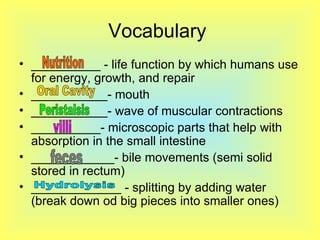
Vocabulary  __________ - life function by which humans use for energy, growth, and repair ___________- mouth  ___________- wave of muscular contractions __________- microscopic parts that help with absorption in the small intestine ____________- bile movements (semi solid stored in rectum) _____________ - splitting by adding water (break down od big pieces into smaller ones)  Nutrition  Oral Cavity  villi Peristalsis  feces Hydrolysis
Let’s Review  One of the Life Process that are similar in ALL Living things is nutrition.  Nutrition is needed for growth, repair, and energy.  In order for us to us nutrition we need to break down the nutrients into small enough pieces that they can reach each cell.  Our bodies need a healthy diet this includes the right amount of protein, carbs, fats, and minerals
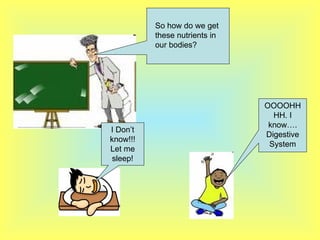
So how do we get these nutrients in  our bodies? I Don’t know!!! Let me sleep! OOOOHHHH. I know…. Digestive System
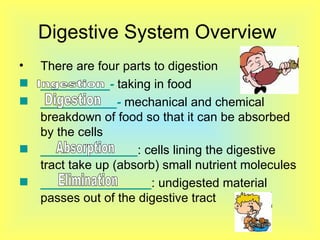
Digestive System Overview  There are four parts to digestion  __________-  taking in food ___________-  mechanical and chemical breakdown of food so that it can be absorbed by the cells ______________ : cells lining the digestive tract take up (absorb) small nutrient molecules ________________ : undigested material passes out of the digestive tract Ingestion Digestion Absorption  Elimination
There are two ways digestion breaks up the food  1. Mechanical digestion – physical breakdown of large pieces of food into smaller ones 2. Chemical digestion –  hydrolysis  – the splitting of large molecules into small, molecules with the use of water and enzymes (  in other words; breaking complex molecules into simple ones)   The process of chemical digestion (  hydrolysis ) is controlled by enzymes
Examples of Chemical Digestion : 1. Carbohydrates+ water -> simple sugars (glucose for instance) 2. Proteins+ water -> amino acids 3. Lipids+ water -> 3 fatty acids +gylcerol
How Does Our Digestive system work?
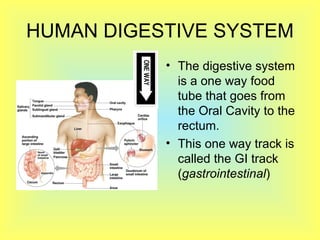
HUMAN DIGESTIVE SYSTEM The digestive system is a one way food tube that goes from the Oral Cavity to the rectum.  This one way track is called the GI track ( gastrointestinal )
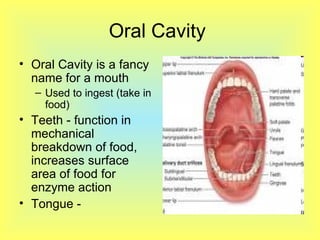
Oral Cavity  Oral Cavity is a fancy name for a mouth Used to ingest (take in food)  Teeth - function in mechanical breakdown of food, increases surface area of food for enzyme action Tongue -
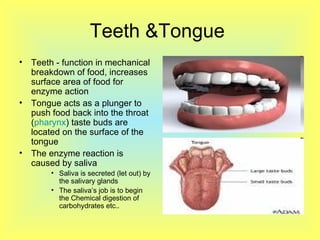
Teeth &Tongue  Teeth - function in mechanical breakdown of food, increases surface area of food for enzyme action Tongue acts as a plunger to push food back into the throat ( pharynx ) taste buds are located on the surface of the tongue The enzyme reaction is caused by saliva  Saliva is secreted (let out) by the salivary glands  The saliva’s job is to begin the Chemical digestion of carbohydrates etc..
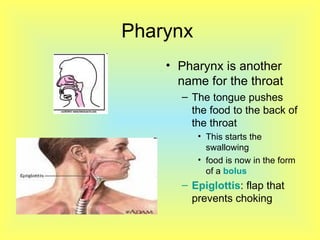
Pharynx  Pharynx is another name for the throat  The tongue pushes the food to the back of the throat This starts the swallowing  food is now in the form of a  bolus Epiglottis : flap that prevents choking
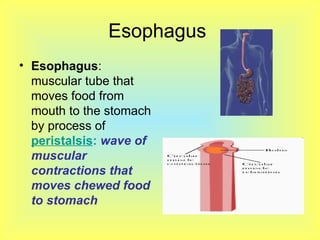
Esophagus  Esophagus : muscular tube that moves food from mouth to the stomach by process of  peristalsis :   wave of muscular contractions that moves chewed food to stomach
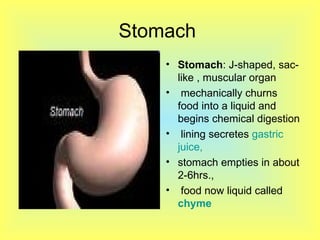
Stomach  Stomach : J-shaped, sac-like , muscular organ mechanically churns food into a liquid and begins chemical digestion  lining secretes  gastric juice,  stomach empties in about 2-6hrs., food now liquid called  chyme
Gastric Juice  Components of gastric juice: 1. water-solvent 2. mucus-lubrication 3 .  enzyme that begins chemical digestion of protein 4. hydrochloric acid (HCl)
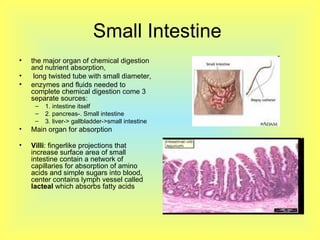
Small Intestine  the major organ of chemical digestion and nutrient absorption, long twisted tube with small diameter,  enzymes and fluids needed to complete chemical digestion come 3 separate sources: 1. intestine itself 2. pancreas-. Small intestine 3. liver-> gallbladder->small intestine Main organ for absorption  Villi : fingerlike projections that increase surface area of small intestine contain a network of capillaries for absorption of amino acids and simple sugars into blood, center contains lymph vessel called  lacteal  which absorbs fatty acids
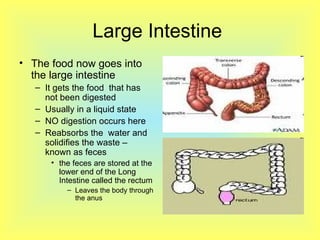
Large Intestine  The food now goes into the large intestine  It gets the food  that has not been digested  Usually in a liquid state  NO digestion occurs here  Reabsorbs the  water and solidifies the waste – known as feces  the feces are stored at the lower end of the Long Intestine called the rectum  Leaves the body through the anus
Accessory Organs to the digestive system  Even though not part of the food tube there are important organs for digestion  This includes  Liver  Gallbladder  Pancreas
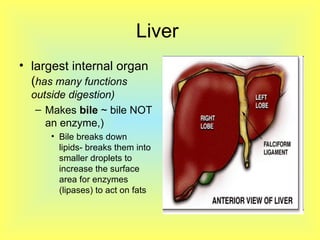
Liver  largest internal organ ( has many functions outside digestion) Makes  bile  ~ bile NOT an enzyme,)  Bile breaks down  lipids- breaks them into smaller droplets to increase the surface area for enzymes (lipases) to act on fats
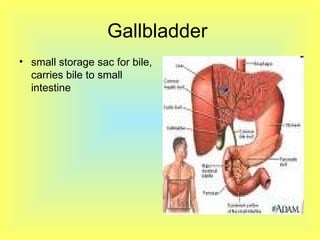
Gallbladder  small storage sac for bile, carries bile to small intestine
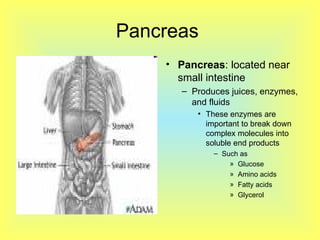
Pancreas  Pancreas : located near small intestine Produces juices, enzymes, and fluids These enzymes are important to break down complex molecules into soluble end products Such as  Glucose  Amino acids  Fatty acids  Glycerol
Digestive Homeostasis Disorders 1.Constipation – person has uncomfortable or infrequent bowel movements results from sluggish peristalsis that allows excess water to be removed from feces (fecal matter hardens)- may result from insufficient fiber in diet 2 . Diarrhea – opposite of constipation– associated with intestinal disturbances caused by infections or stress– prolonged diarrhea may result in severe dehydration 3.  Gall stones – small hard particles made of cholesterol which form  & collect in gall bladder- may block the bile duct and cause pain  4.  acid reflux  -backflow of stomach contents upward into esophagus 5.  appendicitis - inflammation of appendix

Digestive system

  • 1.
  • 2.
    Vocabulary __________- life function by which humans use for energy, growth, and repair ___________- mouth ___________- wave of muscular contractions __________- microscopic parts that help with absorption in the small intestine ____________- bile movements (semi solid stored in rectum) _____________ - splitting by adding water (break down od big pieces into smaller ones) Nutrition Oral Cavity villi Peristalsis feces Hydrolysis
  • 3.
    Let’s Review One of the Life Process that are similar in ALL Living things is nutrition. Nutrition is needed for growth, repair, and energy. In order for us to us nutrition we need to break down the nutrients into small enough pieces that they can reach each cell. Our bodies need a healthy diet this includes the right amount of protein, carbs, fats, and minerals
  • 4.
    So how dowe get these nutrients in our bodies? I Don’t know!!! Let me sleep! OOOOHHHH. I know…. Digestive System
  • 5.
    Digestive System Overview There are four parts to digestion __________- taking in food ___________- mechanical and chemical breakdown of food so that it can be absorbed by the cells ______________ : cells lining the digestive tract take up (absorb) small nutrient molecules ________________ : undigested material passes out of the digestive tract Ingestion Digestion Absorption Elimination
  • 6.
    There are twoways digestion breaks up the food 1. Mechanical digestion – physical breakdown of large pieces of food into smaller ones 2. Chemical digestion – hydrolysis – the splitting of large molecules into small, molecules with the use of water and enzymes ( in other words; breaking complex molecules into simple ones) The process of chemical digestion ( hydrolysis ) is controlled by enzymes
  • 7.
    Examples of ChemicalDigestion : 1. Carbohydrates+ water -> simple sugars (glucose for instance) 2. Proteins+ water -> amino acids 3. Lipids+ water -> 3 fatty acids +gylcerol
  • 8.
    How Does OurDigestive system work?
  • 9.
    HUMAN DIGESTIVE SYSTEMThe digestive system is a one way food tube that goes from the Oral Cavity to the rectum. This one way track is called the GI track ( gastrointestinal )
  • 10.
    Oral Cavity Oral Cavity is a fancy name for a mouth Used to ingest (take in food) Teeth - function in mechanical breakdown of food, increases surface area of food for enzyme action Tongue -
  • 11.
    Teeth &Tongue Teeth - function in mechanical breakdown of food, increases surface area of food for enzyme action Tongue acts as a plunger to push food back into the throat ( pharynx ) taste buds are located on the surface of the tongue The enzyme reaction is caused by saliva Saliva is secreted (let out) by the salivary glands The saliva’s job is to begin the Chemical digestion of carbohydrates etc..
  • 12.
    Pharynx Pharynxis another name for the throat The tongue pushes the food to the back of the throat This starts the swallowing food is now in the form of a bolus Epiglottis : flap that prevents choking
  • 13.
    Esophagus Esophagus: muscular tube that moves food from mouth to the stomach by process of peristalsis : wave of muscular contractions that moves chewed food to stomach
  • 14.
    Stomach Stomach: J-shaped, sac-like , muscular organ mechanically churns food into a liquid and begins chemical digestion lining secretes gastric juice, stomach empties in about 2-6hrs., food now liquid called chyme
  • 15.
    Gastric Juice Components of gastric juice: 1. water-solvent 2. mucus-lubrication 3 . enzyme that begins chemical digestion of protein 4. hydrochloric acid (HCl)
  • 16.
    Small Intestine the major organ of chemical digestion and nutrient absorption, long twisted tube with small diameter, enzymes and fluids needed to complete chemical digestion come 3 separate sources: 1. intestine itself 2. pancreas-. Small intestine 3. liver-> gallbladder->small intestine Main organ for absorption Villi : fingerlike projections that increase surface area of small intestine contain a network of capillaries for absorption of amino acids and simple sugars into blood, center contains lymph vessel called lacteal which absorbs fatty acids
  • 17.
    Large Intestine The food now goes into the large intestine It gets the food that has not been digested Usually in a liquid state NO digestion occurs here Reabsorbs the water and solidifies the waste – known as feces the feces are stored at the lower end of the Long Intestine called the rectum Leaves the body through the anus
  • 18.
    Accessory Organs tothe digestive system Even though not part of the food tube there are important organs for digestion This includes Liver Gallbladder Pancreas
  • 19.
    Liver largestinternal organ ( has many functions outside digestion) Makes bile ~ bile NOT an enzyme,) Bile breaks down lipids- breaks them into smaller droplets to increase the surface area for enzymes (lipases) to act on fats
  • 20.
    Gallbladder smallstorage sac for bile, carries bile to small intestine
  • 21.
    Pancreas Pancreas: located near small intestine Produces juices, enzymes, and fluids These enzymes are important to break down complex molecules into soluble end products Such as Glucose Amino acids Fatty acids Glycerol
  • 22.
    Digestive Homeostasis Disorders1.Constipation – person has uncomfortable or infrequent bowel movements results from sluggish peristalsis that allows excess water to be removed from feces (fecal matter hardens)- may result from insufficient fiber in diet 2 . Diarrhea – opposite of constipation– associated with intestinal disturbances caused by infections or stress– prolonged diarrhea may result in severe dehydration 3. Gall stones – small hard particles made of cholesterol which form & collect in gall bladder- may block the bile duct and cause pain 4. acid reflux -backflow of stomach contents upward into esophagus 5. appendicitis - inflammation of appendix