DIGESTIVE
SYSTEM
is thesystem by which
ingested food is acted
upon by physical and
chemical means to provide
the body with absorbable
nutrients and to excrete
waste products.
3.
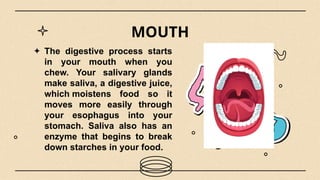
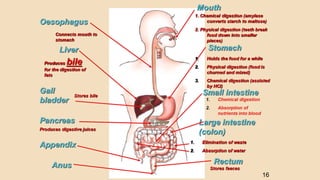
MOUTH
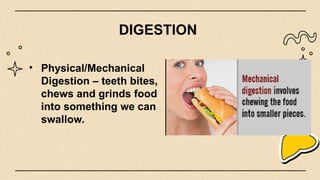
✦ The digestiveprocess starts
in your mouth when you
chew. Your salivary glands
make saliva, a digestive juice,
which moistens food so it
moves more easily through
your esophagus into your
stomach. Saliva also has an
enzyme that begins to break
down starches in your food.
4.
ESOPHAGUS
✦The esophagus
serves topass food
and liquids from the
mouth down to the
stomach. This is
accomplished by
periodic contractions
(peristalsis).
5.
STOMACH
✦ After foodenters your
stomach, the stomach
muscles mix the food
and liquid with digestive
juices. The stomach
slowly empties its
contents, called chyme,
into your small
intestine.
6.
SMALL INTESTINE
✦ Themuscles of the small intestine
mix food with digestive juices
from the pancreas, liver, and
intestine, and push the mixture
forward for further digestion. The
walls of the small intestine absorb
water and the digested nutrients
into your bloodstream. As
peristalsis continues, the waste
products of the digestive process
move into the large intestine.
7.
LARGE INTESTINE
✦ Wasteproducts from the
digestive process include
undigested parts of food,
fluid, and older cells from the
lining of your GI tract. The
large intestine absorbs water
and changes the waste from
liquid into stool. Peristalsis
helps move the stool into
your rectum.
8.
RECTUM
✦ The lowerend of your
large intestine, the
rectum, stores stool
until it pushes stool
out of your anus
during a bowel
movement.
9.
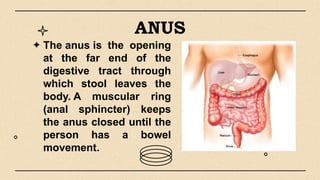
ANUS
✦ The anusis the opening
at the far end of the
digestive tract through
which stool leaves the
body. A muscular ring
(anal sphincter) keeps
the anus closed until the
person has a bowel
movement.
SALIVARY GLANDS
✦ Salivaryglands play an
important role in digestion
because they make saliva.
Saliva helps moisten food
so we can swallow it more
easily. It also has an
enzyme called amylase
that makes it easier for the
stomach to break down
starches in food.
12.
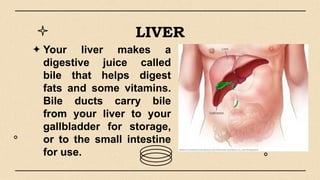
LIVER
✦ Your livermakes a
digestive juice called
bile that helps digest
fats and some vitamins.
Bile ducts carry bile
from your liver to your
gallbladder for storage,
or to the small intestine
for use.
13.
PANCREAS
✦ Your pancreasmakes a
digestive juice that has
enzymes that break
down carbohydrates,
fats, and proteins. The
pancreas delivers the
digestive juice to the
small intestine through
small tubes called ducts.
14.
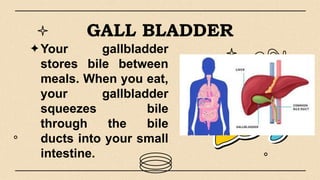
GALL BLADDER
✦Your gallbladder
storesbile between
meals. When you eat,
your gallbladder
squeezes bile
through the bile
ducts into your small
intestine.
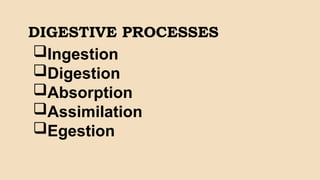
INGESTION
is the firstprocess
that happens in
digestive system. It is
the journey of taking
in food or any
substance into the
body through the
mouth.
18.
DIGESTION
is thesecond process.
It is the process that
involves breakdown of
large food molecules
into smaller molecules
for easy absorption of
the cells.
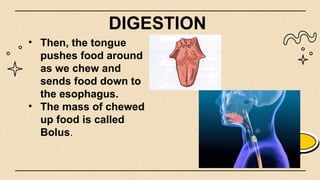
DIGESTION
• Then, thetongue
pushes food around
as we chew and
sends food down to
the esophagus.
• The mass of chewed
up food is called
Bolus.
22.
DIGESTION
• Esophagus –receives food
from mouth
• Epiglottis is a small flap
that folds over your
windpipe as you swallow to
prevent you from choking
• A series of muscular
contractions within the
esophagus called
peristalsis delivers food to
your stomach.
23.
DIGESTION
• Stomach –it is
a muscular sac
that actually
chums, mashes
and adds
special
chemicals, or
gastric juices,
to the bolus.
24.
DIGESTION
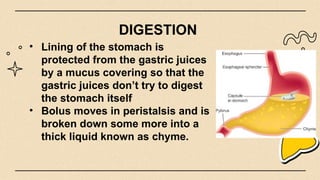
• Lining ofthe stomach is
protected from the gastric juices
by a mucus covering so that the
gastric juices don’t try to digest
the stomach itself
• Bolus moves in peristalsis and is
broken down some more into a
thick liquid known as chyme.
25.
DIGESTION
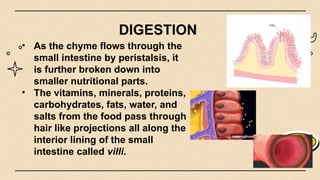
• As thechyme flows through the
small intestine by peristalsis, it
is further broken down into
smaller nutritional parts.
• The vitamins, minerals, proteins,
carbohydrates, fats, water, and
salts from the food pass through
hair like projections all along the
interior lining of the small
intestine called villi.
26.
DIGESTION
There are alsohelpful liquids and
chemicals from the pancreas and liver
that helps in the digestion and
absorption.
-So, what are those helpful organs?
27.
DIGESTION
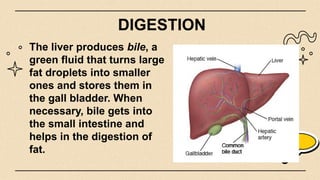
The liver producesbile, a
green fluid that turns large
fat droplets into smaller
ones and stores them in
the gall bladder. When
necessary, bile gets into
the small intestine and
helps in the digestion of
fat.
28.
DIGESTION
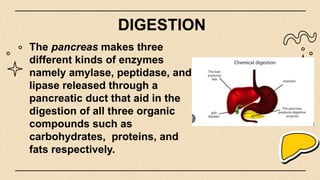
The pancreas makesthree
different kinds of enzymes
namely amylase, peptidase, and
lipase released through a
pancreatic duct that aid in the
digestion of all three organic
compounds such as
carbohydrates, proteins, and
fats respectively.
29.
ABSORPTION
it occurs mostlyin
the small intestine
where several
digestive juices,
pancreatic juices,
and bile aid in the
chemical digestion
of food.
30.
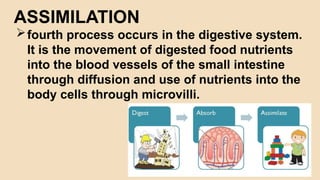
ASSIMILATION
fourth process occursin the digestive system.
It is the movement of digested food nutrients
into the blood vessels of the small intestine
through diffusion and use of nutrients into the
body cells through microvilli.
31.
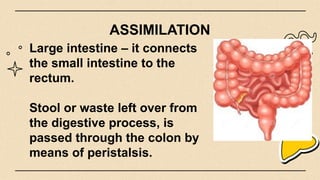
ASSIMILATION
Large intestine –it connects
the small intestine to the
rectum.
Stool or waste left over from
the digestive process, is
passed through the colon by
means of peristalsis.
32.
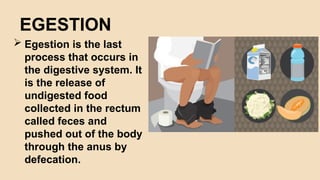
EGESTION
Egestion isthe last
process that occurs in
the digestive system. It
is the release of
undigested food
collected in the rectum
called feces and
pushed out of the body
through the anus by
defecation.