Introduction to
COMPUTER COMMUNICATION
Dr. S. Swapna Kumar
1.1
Introduction to computer communication, Transmission
modes, Switching, Networks, Network models
KNOWLEDGE SERIES
EC 407 COMPUTER COMMUNICATION
Syllabus
 Module I
 Introduction to computer communication:
 Transmission modes- serial and parallel
transmission, asynchronous, synchronous,
simplex, half duplex, full duplex
communication.
 Switching: circuit switching and packet
switching
 Networks: Network criteria, physical structures,
network models, categories of networks,
Interconnection of Networks: Internetwork
 Network models: Layered tasks, OSI model,
Layers in OSI model, TCP/IP protocol suite.
Text book
1. Data Communications and Networking,
4/e, Behrouz A Forouzan, Tata McGraw-Hill,
2006.
2. Cryptography & Network Security ,
Behrouz A. Forouzan, IV Edition,Tata
McGraw-Hill, 2008
Reference books
1. Larry Peterson and Bruce S Davie:
Computer Network- A System Approach, 4/e,
Elsevier India, 2011.
2. J F Kurose, Computer Network A Topdown
Approach Featuring the Internet,3/e,Pearson
Education, 2010
3. S.Keshav: An Engineering Approach to
Computer Networking, Pearson Education,
2005.
4. Achyut S.Godbole Data Communication
and Networking,2e, McGraw –Hill Education
New Delhi,2011
KNOWLEDGE SERIES
Dr. S. Swapna Kumar
1.2
Module 1
Introduction
KNOWLEDGE SERIES
Sr. Module 1 (YouTube Links) Duration
1 Introduction to Computer Communication= https://youtu.be/A-_OH9kuGiI 50.55
2 Switching= https://youtu.be/K-mXF-Tqu_0 41.52
1.3
Computer Communications
KNOWLEDGE SERIES
1.4
Cond…
 Data Communications is interested in the transfer of data, the
method of transfer and the preservation of the data during the
transfer process.
 The rules and regulations are called protocols and standards in Data
Communications.
 Telecommunication
 Voice Channels Talking to someone on the phone uses Voice
Channels.
 Data Channels are dedicated lines for communicating digitized
voice and data.
 Voice Channel communication rates are: 300, 1200, 2400, 9600,
14.4k, 19.2k, 28.8k, 33.6k and 56 kbps (bits per second).
 Data Channels Typical transfer rates for data communication are:
56 k, 128k, 1.544 M, 2.08 M, 45M and 155 Mbps.
KNOWLEDGE SERIES
1.5
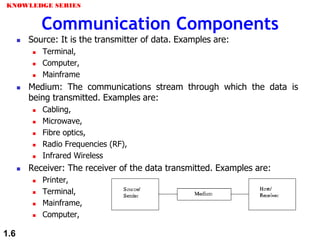
 Source: It is the transmitter of data. Examples are:
 Terminal,
 Computer,
 Mainframe
 Medium: The communications stream through which the data is
being transmitted. Examples are:
 Cabling,
 Microwave,
 Fibre optics,
 Radio Frequencies (RF),
 Infrared Wireless
 Receiver: The receiver of the data transmitted. Examples are:
 Printer,
 Terminal,
 Mainframe,
 Computer,
KNOWLEDGE SERIES
Communication Components
1.6
 Data Communications system components
 Message
 Sender
 Receiver
 Medium
 Protocol

Cond…
KNOWLEDGE SERIES
1.7
Characteristics of DC
 Data communication characteristics
 Delivery
 Accuracy
 Timeliness
 Jitter
 Data communication Ideal characteristics
KNOWLEDGE SERIES
1.8
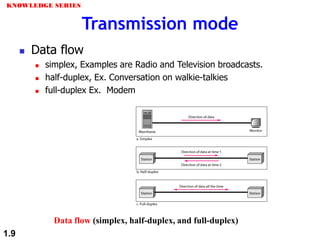
Data flow (simplex, half-duplex, and full-duplex)
 Data flow
 simplex, Examples are Radio and Television broadcasts.
 half-duplex, Ex. Conversation on walkie-talkies
 full-duplex Ex. Modem
KNOWLEDGE SERIES
Transmission mode
1.9
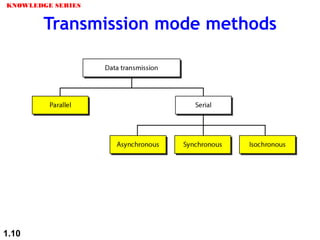
Transmission mode methods
KNOWLEDGE SERIES
1.10
The transmission of binary data across a link can be
accomplished in either parallel or serial mode.
In parallel mode, multiple bits are sent with each clock
tick.
In serial mode, 1 bit is sent with each clock tick. While
there is only one way to send parallel data, there are three
subclasses of serial transmission:
1. Asynchronous,
2. Synchronous, and
3. Isochronous.
KNOWLEDGE SERIES
1.11
Cond…
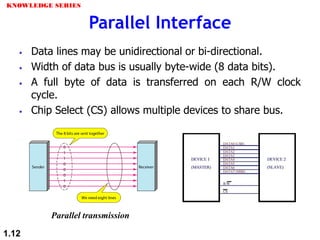
Parallel Interface
• Data lines may be unidirectional or bi-directional.
• Width of data bus is usually byte-wide (8 data bits).
• A full byte of data is transferred on each R/W clock
cycle.
• Chip Select (CS) allows multiple devices to share bus.
Parallel transmission
KNOWLEDGE SERIES
1.12
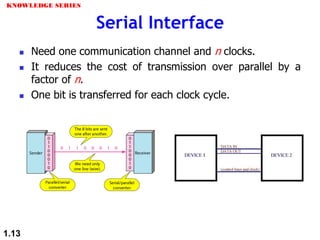
Serial Interface
 Need one communication channel and n clocks.
 It reduces the cost of transmission over parallel by a
factor of n.
 One bit is transferred for each clock cycle.
KNOWLEDGE SERIES
1.13
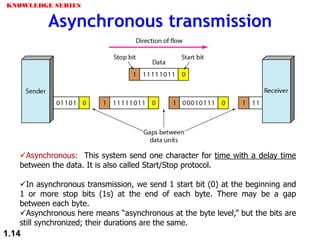
Asynchronous: This system send one character for time with a delay time
between the data. It is also called Start/Stop protocol.
In asynchronous transmission, we send 1 start bit (0) at the beginning and
1 or more stop bits (1s) at the end of each byte. There may be a gap
between each byte.
Asynchronous here means “asynchronous at the byte level,” but the bits are
still synchronized; their durations are the same.
KNOWLEDGE SERIES
1.14
Asynchronous transmission
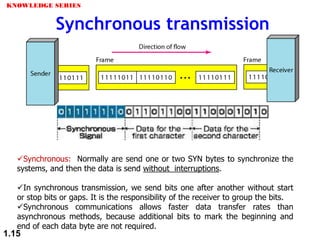
Synchronous transmission
Synchronous: Normally are send one or two SYN bytes to synchronize the
systems, and then the data is send without interruptions.
In synchronous transmission, we send bits one after another without start
or stop bits or gaps. It is the responsibility of the receiver to group the bits.
Synchronous communications allows faster data transfer rates than
asynchronous methods, because additional bits to mark the beginning and
end of each data byte are not required.
KNOWLEDGE SERIES
1.15
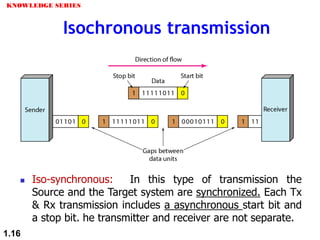
Isochronous transmission
 Iso-synchronous: In this type of transmission the
Source and the Target system are synchronized. Each Tx
& Rx transmission includes a asynchronous start bit and
a stop bit. he transmitter and receiver are not separate.
KNOWLEDGE SERIES
1.16
Cond…
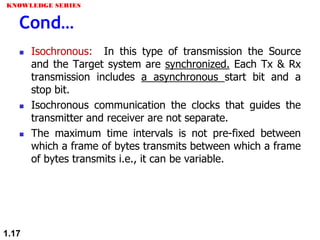
 Isochronous: In this type of transmission the Source
and the Target system are synchronized. Each Tx & Rx
transmission includes a asynchronous start bit and a
stop bit.
 Isochronous communication the clocks that guides the
transmitter and receiver are not separate.
 The maximum time intervals is not pre-fixed between
which a frame of bytes transmits between which a frame
of bytes transmits i.e., it can be variable.
KNOWLEDGE SERIES
1.17
Next
1.18
EC 407 COMPUTER COMMUNICATION
Syllabus
 Module I (6 hours)
 Introduction to computer communication:
 Transmission modes- serial and parallel
transmission, asynchronous, synchronous,
simplex, half duplex, full duplex
communication.
 Switching: circuit switching and packet
switching
 Networks: Network criteria, physical structures,
network models, categories of networks,
Interconnection of Networks: Internetwork
 Network models: Layered tasks, OSI model,
Layers in OSI model, TCP/IP protocol suite.
Text book
1. Data Communications and Networking,
4/e, Behrouz A Forouzan, Tata McGraw-Hill,
2006.
2. Cryptography & Network Security ,
Behrouz A. Forouzan, IV Edition,Tata
McGraw-Hill, 2008
Reference books
1. Larry Peterson and Bruce S Davie:
Computer Network- A System Approach, 4/e,
Elsevier India, 2011.
2. J F Kurose, Computer Network A Topdown
Approach Featuring the Internet,3/e,Pearson
Education, 2010
3. S.Keshav: An Engineering Approach to
Computer Networking, Pearson Education,
2005.
4. Achyut S.Godbole Data Communication
and Networking,2e, McGraw –Hill Education
New Delhi,2011
KNOWLEDGE SERIES
Dr. S. Swapna Kumar
1.19
Module 1
Switching
KNOWLEDGE SERIES
1.20
Switching network
KNOWLEDGE SERIES
1.21
Taxonomy of switched networks
KNOWLEDGE SERIES
1.22
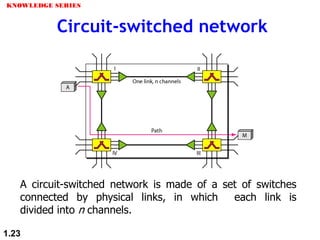
A circuit-switched network is made of a set of switches
connected by physical links, in which each link is
divided into n channels.
Circuit-switched network
KNOWLEDGE SERIES
1.23
Circuit-switched network
KNOWLEDGE SERIES
1.24
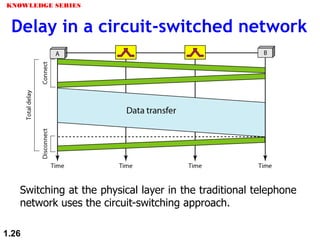
In circuit switching, the resources need to be reserved
during the setup phase; the resources remain dedicated
for the entire duration of data transfer until the teardown
phase.
Cond…
KNOWLEDGE SERIES
1.25
Delay in a circuit-switched network
Switching at the physical layer in the traditional telephone
network uses the circuit-switching approach.
KNOWLEDGE SERIES
1.26
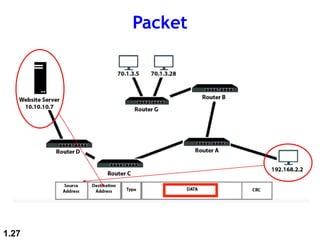
Packet
1.27
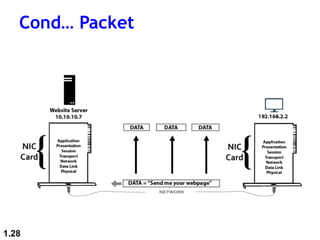
Cond… Packet
1.28
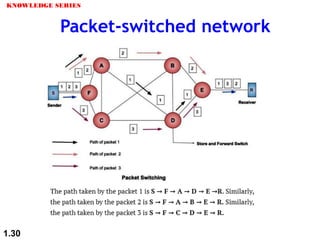
In a packet-switched network, there is no resource
reservation; resources are allocated on demand.
Packet-switched network
KNOWLEDGE SERIES
1.29
Packet-switched network
KNOWLEDGE SERIES
1.30
Message-switched network
KNOWLEDGE SERIES
1.31
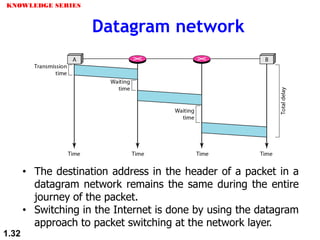
• The destination address in the header of a packet in a
datagram network remains the same during the entire
journey of the packet.
• Switching in the Internet is done by using the datagram
approach to packet switching at the network layer.
Datagram network
KNOWLEDGE SERIES
1.32
A virtual-circuit network is a cross between a circuit-
switched network and a datagram network. It has
some characteristics of both.
Virtual-circuit network
KNOWLEDGE SERIES
1.33
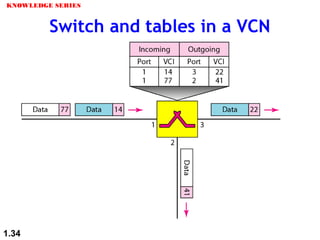
Switch and tables in a VCN
KNOWLEDGE SERIES
1.34
Crossbar switch
KNOWLEDGE SERIES
1.35
Multistage switch
KNOWLEDGE SERIES
1.36
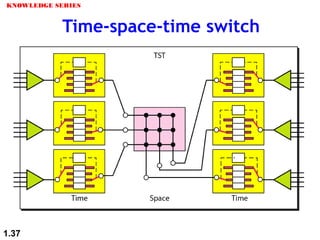
Time-space-time switch
KNOWLEDGE SERIES
1.37
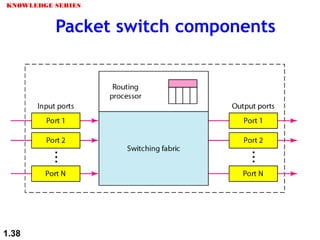
Packet switch components
KNOWLEDGE SERIES
1.38
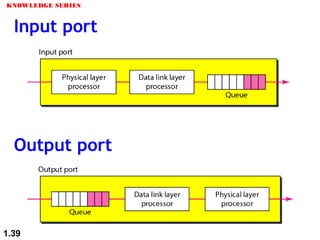
Input port
Output port
KNOWLEDGE SERIES
1.39
End
1.40

Introduction to Computer Communication M1

  • 1.
    Introduction to COMPUTER COMMUNICATION Dr.S. Swapna Kumar 1.1 Introduction to computer communication, Transmission modes, Switching, Networks, Network models KNOWLEDGE SERIES
  • 2.
    EC 407 COMPUTERCOMMUNICATION Syllabus  Module I  Introduction to computer communication:  Transmission modes- serial and parallel transmission, asynchronous, synchronous, simplex, half duplex, full duplex communication.  Switching: circuit switching and packet switching  Networks: Network criteria, physical structures, network models, categories of networks, Interconnection of Networks: Internetwork  Network models: Layered tasks, OSI model, Layers in OSI model, TCP/IP protocol suite. Text book 1. Data Communications and Networking, 4/e, Behrouz A Forouzan, Tata McGraw-Hill, 2006. 2. Cryptography & Network Security , Behrouz A. Forouzan, IV Edition,Tata McGraw-Hill, 2008 Reference books 1. Larry Peterson and Bruce S Davie: Computer Network- A System Approach, 4/e, Elsevier India, 2011. 2. J F Kurose, Computer Network A Topdown Approach Featuring the Internet,3/e,Pearson Education, 2010 3. S.Keshav: An Engineering Approach to Computer Networking, Pearson Education, 2005. 4. Achyut S.Godbole Data Communication and Networking,2e, McGraw –Hill Education New Delhi,2011 KNOWLEDGE SERIES Dr. S. Swapna Kumar 1.2
  • 3.
    Module 1 Introduction KNOWLEDGE SERIES Sr.Module 1 (YouTube Links) Duration 1 Introduction to Computer Communication= https://youtu.be/A-_OH9kuGiI 50.55 2 Switching= https://youtu.be/K-mXF-Tqu_0 41.52 1.3
  • 4.
  • 5.
    Cond…  Data Communicationsis interested in the transfer of data, the method of transfer and the preservation of the data during the transfer process.  The rules and regulations are called protocols and standards in Data Communications.  Telecommunication  Voice Channels Talking to someone on the phone uses Voice Channels.  Data Channels are dedicated lines for communicating digitized voice and data.  Voice Channel communication rates are: 300, 1200, 2400, 9600, 14.4k, 19.2k, 28.8k, 33.6k and 56 kbps (bits per second).  Data Channels Typical transfer rates for data communication are: 56 k, 128k, 1.544 M, 2.08 M, 45M and 155 Mbps. KNOWLEDGE SERIES 1.5
  • 6.
     Source: Itis the transmitter of data. Examples are:  Terminal,  Computer,  Mainframe  Medium: The communications stream through which the data is being transmitted. Examples are:  Cabling,  Microwave,  Fibre optics,  Radio Frequencies (RF),  Infrared Wireless  Receiver: The receiver of the data transmitted. Examples are:  Printer,  Terminal,  Mainframe,  Computer, KNOWLEDGE SERIES Communication Components 1.6
  • 7.
     Data Communicationssystem components  Message  Sender  Receiver  Medium  Protocol  Cond… KNOWLEDGE SERIES 1.7
  • 8.
    Characteristics of DC Data communication characteristics  Delivery  Accuracy  Timeliness  Jitter  Data communication Ideal characteristics KNOWLEDGE SERIES 1.8
  • 9.
    Data flow (simplex,half-duplex, and full-duplex)  Data flow  simplex, Examples are Radio and Television broadcasts.  half-duplex, Ex. Conversation on walkie-talkies  full-duplex Ex. Modem KNOWLEDGE SERIES Transmission mode 1.9
  • 10.
  • 11.
    The transmission ofbinary data across a link can be accomplished in either parallel or serial mode. In parallel mode, multiple bits are sent with each clock tick. In serial mode, 1 bit is sent with each clock tick. While there is only one way to send parallel data, there are three subclasses of serial transmission: 1. Asynchronous, 2. Synchronous, and 3. Isochronous. KNOWLEDGE SERIES 1.11 Cond…
  • 12.
    Parallel Interface • Datalines may be unidirectional or bi-directional. • Width of data bus is usually byte-wide (8 data bits). • A full byte of data is transferred on each R/W clock cycle. • Chip Select (CS) allows multiple devices to share bus. Parallel transmission KNOWLEDGE SERIES 1.12
  • 13.
    Serial Interface  Needone communication channel and n clocks.  It reduces the cost of transmission over parallel by a factor of n.  One bit is transferred for each clock cycle. KNOWLEDGE SERIES 1.13
  • 14.
    Asynchronous: This systemsend one character for time with a delay time between the data. It is also called Start/Stop protocol. In asynchronous transmission, we send 1 start bit (0) at the beginning and 1 or more stop bits (1s) at the end of each byte. There may be a gap between each byte. Asynchronous here means “asynchronous at the byte level,” but the bits are still synchronized; their durations are the same. KNOWLEDGE SERIES 1.14 Asynchronous transmission
  • 15.
    Synchronous transmission Synchronous: Normallyare send one or two SYN bytes to synchronize the systems, and then the data is send without interruptions. In synchronous transmission, we send bits one after another without start or stop bits or gaps. It is the responsibility of the receiver to group the bits. Synchronous communications allows faster data transfer rates than asynchronous methods, because additional bits to mark the beginning and end of each data byte are not required. KNOWLEDGE SERIES 1.15
  • 16.
    Isochronous transmission  Iso-synchronous:In this type of transmission the Source and the Target system are synchronized. Each Tx & Rx transmission includes a asynchronous start bit and a stop bit. he transmitter and receiver are not separate. KNOWLEDGE SERIES 1.16
  • 17.
    Cond…  Isochronous: Inthis type of transmission the Source and the Target system are synchronized. Each Tx & Rx transmission includes a asynchronous start bit and a stop bit.  Isochronous communication the clocks that guides the transmitter and receiver are not separate.  The maximum time intervals is not pre-fixed between which a frame of bytes transmits between which a frame of bytes transmits i.e., it can be variable. KNOWLEDGE SERIES 1.17
  • 18.
  • 19.
    EC 407 COMPUTERCOMMUNICATION Syllabus  Module I (6 hours)  Introduction to computer communication:  Transmission modes- serial and parallel transmission, asynchronous, synchronous, simplex, half duplex, full duplex communication.  Switching: circuit switching and packet switching  Networks: Network criteria, physical structures, network models, categories of networks, Interconnection of Networks: Internetwork  Network models: Layered tasks, OSI model, Layers in OSI model, TCP/IP protocol suite. Text book 1. Data Communications and Networking, 4/e, Behrouz A Forouzan, Tata McGraw-Hill, 2006. 2. Cryptography & Network Security , Behrouz A. Forouzan, IV Edition,Tata McGraw-Hill, 2008 Reference books 1. Larry Peterson and Bruce S Davie: Computer Network- A System Approach, 4/e, Elsevier India, 2011. 2. J F Kurose, Computer Network A Topdown Approach Featuring the Internet,3/e,Pearson Education, 2010 3. S.Keshav: An Engineering Approach to Computer Networking, Pearson Education, 2005. 4. Achyut S.Godbole Data Communication and Networking,2e, McGraw –Hill Education New Delhi,2011 KNOWLEDGE SERIES Dr. S. Swapna Kumar 1.19
  • 20.
  • 21.
  • 22.
    Taxonomy of switchednetworks KNOWLEDGE SERIES 1.22
  • 23.
    A circuit-switched networkis made of a set of switches connected by physical links, in which each link is divided into n channels. Circuit-switched network KNOWLEDGE SERIES 1.23
  • 24.
  • 25.
    In circuit switching,the resources need to be reserved during the setup phase; the resources remain dedicated for the entire duration of data transfer until the teardown phase. Cond… KNOWLEDGE SERIES 1.25
  • 26.
    Delay in acircuit-switched network Switching at the physical layer in the traditional telephone network uses the circuit-switching approach. KNOWLEDGE SERIES 1.26
  • 27.
  • 28.
  • 29.
    In a packet-switchednetwork, there is no resource reservation; resources are allocated on demand. Packet-switched network KNOWLEDGE SERIES 1.29
  • 30.
  • 31.
  • 32.
    • The destinationaddress in the header of a packet in a datagram network remains the same during the entire journey of the packet. • Switching in the Internet is done by using the datagram approach to packet switching at the network layer. Datagram network KNOWLEDGE SERIES 1.32
  • 33.
    A virtual-circuit networkis a cross between a circuit- switched network and a datagram network. It has some characteristics of both. Virtual-circuit network KNOWLEDGE SERIES 1.33
  • 34.
    Switch and tablesin a VCN KNOWLEDGE SERIES 1.34
  • 35.
  • 36.
  • 37.
  • 38.
  • 39.
  • 40.