Sachin Desai
( Subject & Practical I/C)
THADOMAL SHAHANI ENGG. COLLEGE
AI & DS DEPARTMENT
TE / SEM – V / A. Y. 2023-2024
Computer Network
Introduction
Teaching & Examination Scheme
 Computer Networks
1. Course Code  CSC501 (TH)/ CSL501 (PR)
2. Contact Hours  Computer Networks  02 (Theory)
Web Computing and Network Lab  02 (Practical)
3. Mark Scheme (CSC 501) (TH)
 TH : 80M
 IA : 20M
(CSL501) (PR)
 Term Work : 25M
Experiments – 15 M
Attendance TH/PR -- 05 M
Assignment -- 05 M
 Oral & Practical : 25M
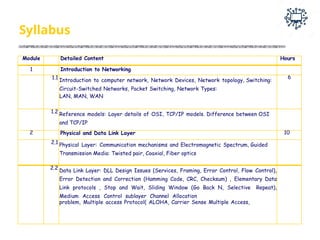
Syllabus
Module Detailed Content Hours
1 Introduction to Networking
1.1 Introduction to computer network, Network Devices, Network topology, Switching:
Circuit-Switched Networks, Packet Switching, Network Types:
LAN, MAN, WAN
6
1.2 Reference models: Layer details of OSI, TCP/IP models. Difference between OSI
and TCP/IP
2 Physical and Data Link Layer 10
2.1 Physical Layer: Communication mechanisms and Electromagnetic Spectrum, Guided
Transmission Media: Twisted pair, Coaxial, Fiber optics
2.2 Data Link Layer: DLL Design Issues (Services, Framing, Error Control, Flow Control),
Error Detection and Correction (Hamming Code, CRC, Checksum) , Elementary Data
Link protocols , Stop and Wait, Sliding Window (Go Back N, Selective Repeat),
Medium Access Control sublayer Channel Allocation
problem, Multiple access Protocol( ALOHA, Carrier Sense Multiple Access,
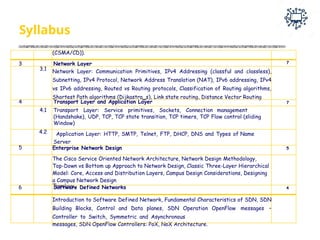
Syllabus
(CSMA/CD)).
3 Network Layer 7
3.1 Network Layer: Communication Primitives, IPv4 Addressing (classful and classless),
Subnetting, IPv4 Protocol, Network Address Translation (NAT), IPv6 addressing, IPv4
vs IPv6 addressing, Routed vs Routing protocols, Classification of Routing algorithms,
Shortest Path algorithms (Dijkastra‗s), Link state routing, Distance Vector Routing
4 Transport Layer and Application Layer 7
4.1 Transport Layer: Service primitives, Sockets, Connection management
(Handshake), UDP, TCP, TCP state transition, TCP timers, TCP Flow control (sliding
Window)
4.2 Application Layer: HTTP, SMTP, Telnet, FTP, DHCP, DNS and Types of Name
Server
5 Enterprise Network Design 5
The Cisco Service Oriented Network Architecture, Network Design Methodology,
Top-Down vs Bottom up Approach to Network Design, Classic Three-Layer Hierarchical
Model: Core, Access and Distribution Layers, Campus Design Considerations, Designing
a Campus Network Design
Topology.
6 Software Defined Networks 4
Introduction to Software Defined Network, Fundamental Characteristics of SDN, SDN
Building Blocks, Control and Data planes, SDN Operation OpenFlow messages –
Controller to Switch, Symmetric and Asynchronous
messages, SDN OpenFlow Controllers: PoX, NoX Architecture.
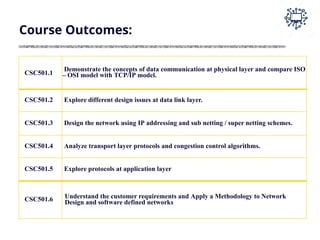
Course Outcomes:
CSC501.1
Demonstrate the concepts of data communication at physical layer and compare ISO
– OSI model with TCP/IP model.
CSC501.2 Explore different design issues at data link layer.
CSC501.3 Design the network using IP addressing and sub netting / super netting schemes.
CSC501.4 Analyze transport layer protocols and congestion control algorithms.
CSC501.5 Explore protocols at application layer
CSC501.6 Understand the customer requirements and Apply a Methodology to Network
Design and software defined networks
Introduction to Computer Network
Fundamentals
What is Computer Network ?
- A Computer network is a set of nodes connected by
communication links.
- A node can be a computer, printer or any other device capable of
sending/ receiving data generated by other nodes in the network.
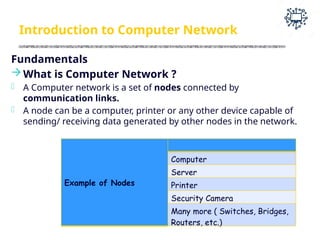
Example of Nodes
Computer
Server
Printer
Security Camera
Many more ( Switches, Bridges,
Routers, etc.)
Introduction to Computer Network
What is Computer Network ?
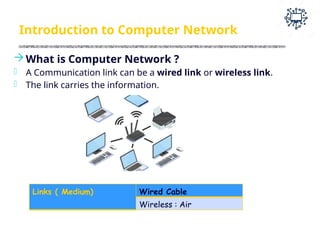
- A Communication link can be a wired link or wireless link.
- The link carries the information.
Links ( Medium) Wired Cable
Wireless : Air
Introduction to Computer Network
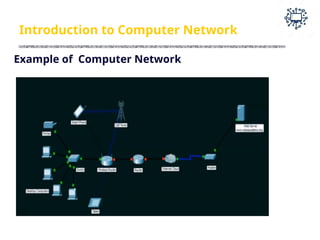
Example of Computer Network
Introduction to Computer Network
Example of Computer Network
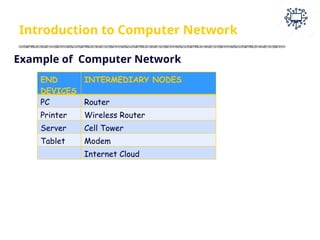
END
DEVICES
INTERMEDIARY NODES
PC Router
Printer Wireless Router
Server Cell Tower
Tablet Modem
Internet Cloud
Introduction to Computer Network
Benefits
-- Resource Sharing: Share files, printers, and other resources.
-- Communication: Email, instant messaging, video conferencing,
etc.
-- Centralized Data Storage: Access data from any connected
device.
-- Collaboration: Work on shared documents and projects.
-- Internet Access: Connect to the World Wide Web.
Introduction to Computer Network
Basic characteristics of Computer Network
-- Fault tolerance
-- Scalability
-- Quality of Service
-- Security
Introduction to Computer Network
Basic characteristics of Computer Network
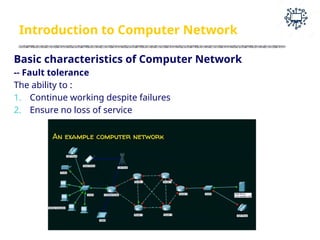
-- Fault tolerance
The ability to :
1. Continue working despite failures
2. Ensure no loss of service
Introduction to Computer Network
Basic characteristics of Computer Network
-- Scalability
The ability to :
1. Grow based on the needs
2. Have good performance after growth
Example : Internet
Introduction to Computer Network
Basic characteristics of Computer Network
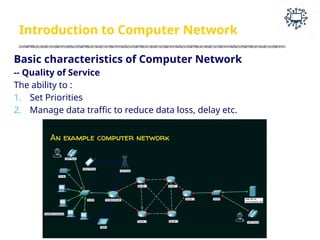
-- Quality of Service
The ability to :
1. Set Priorities
2. Manage data traffic to reduce data loss, delay etc.
Introduction to Computer Network
Basic characteristics of Computer Network
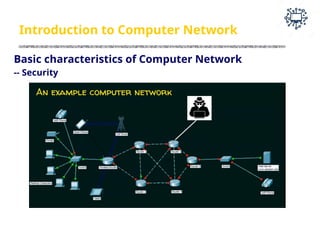
-- Security
The ability to prevent :
1. Unauthorized access
2. Misuse
3. Forgery
The ability to provide :
4. Confidentiality
5. Integrity
6. Availability
Introduction to Computer Network
Basic characteristics of Computer Network
-- Security
Introduction to Computer Network
Network Protocols and Communications
-- Data Communication
-- Data flow
-- Importance of protocols in Computer Network
-- Elements of protocol
Introduction to Computer Network
Network Protocols and Communications
-- Data Communication
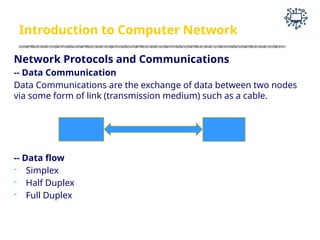
Data Communications are the exchange of data between two nodes
via some form of link (transmission medium) such as a cable.
-- Data flow
- Simplex
- Half Duplex
- Full Duplex
Introduction to Computer Network
Network Protocols and Communications
-- Data flow
- Simplex
1. Communication is always unidirectional
2. One device can transmit and other device will receive.
3. Example : Keyboards, Traditional monitors
- Half Duplex
4. Communication is in both directions but not at the same time.
5. If one device is sending the other device can only receive and
vice versa.
6. Example : Walkie – Talkies.
Introduction to Computer Network
Network Protocols and Communications
-- Data flow
- Full Duplex
1. Communication is in both directions simultaneously.
2. Device can send and receive at the same time.
3. Example : Telephone line.
Introduction to Computer Network
Network Protocols and Communications
- Protocols in Computer Network
All communication schemes will have the following things in
common
1. Source or Sender
2. Destination or Receiver
3. Channels or Media
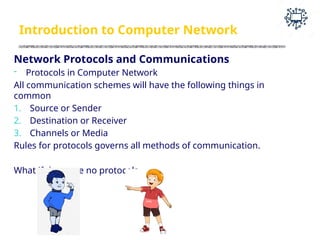
Rules for protocols governs all methods of communication.
What if there are no protocols
Introduction to Computer Network
Network Protocols and Communications
Protocols in Computer Network
- Protocol = Rule
- It is set of rules that govern data communication.
- Protocol determines :
1. What is communicated ?
2. How it is communicated?
3. When it is communicated ?
Protocols - Human Communication
- Protocols are necessary for human communication and include :
1. An identified sender/ Receiver
2. Common Language and grammar
3. Speed and timing of delivery
4. Confirmation or Acknowledgement requirements
Introduction to Computer Network
Network Protocols and Communications
Protocols - Network Communication
- Protocols are used in network communications also define ( Elements of
Protocol):
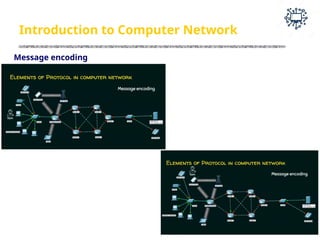
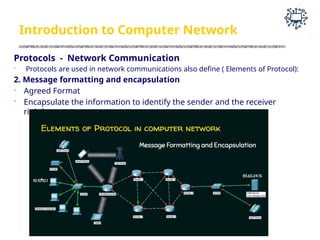
1. Message encoding
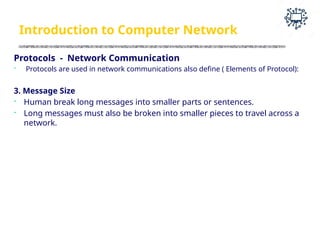
2. Message formatting and encapsulation
3. Message Size
4. Message timing
5. Message Delivery options
Introduction to Computer Network
Protocols - Network Communication
- Protocols are used in network communications also define ( Elements of
Protocol):
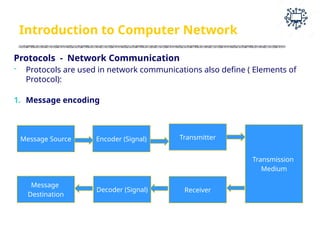
1. Message encoding
Message Source Encoder (Signal) Transmitter
Transmission
Medium
Receiver
Decoder (Signal)
Message
Destination
Introduction to Computer Network
Message encoding
Introduction to Computer Network
Protocols - Network Communication
- Protocols are used in network communications also define ( Elements of Protocol):
2. Message formatting and encapsulation
- Agreed Format
- Encapsulate the information to identify the sender and the receiver
rightly.
Introduction to Computer Network
Protocols - Network Communication
- Protocols are used in network communications also define ( Elements of Protocol):
3. Message Size
- Human break long messages into smaller parts or sentences.
- Long messages must also be broken into smaller pieces to travel across a
network.
Introduction to Computer Network
Protocols - Network Communication
- Protocols are used in network communications also define ( Elements of
Protocol):
4. Message timing
- Flow Control
- Response Timeout ( Ack / Retransmission)
5. Message Delivery options
- Unicast
- Multicast
- Broadcast
Introduction to Computer Network
Protocols - Network Communication
5. Message Delivery options
- Unicast
- Multicast
- Broadcast
Unicast
- One Sender and One Receiver
Multicast
- Sender sends data to set of receivers, not to all.
Broadcast
- Sender sends data to all participants in the network.
Introduction to Computer Network
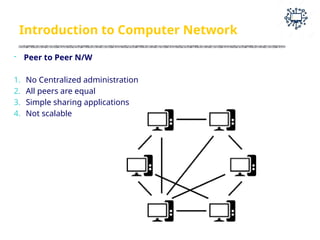
- Peer to Peer N/W
1. No Centralized administration
2. All peers are equal
3. Simple sharing applications
4. Not scalable
Introduction to Computer Network
- Client Server Network
1. Centralized Administration
2. Request- Response model
3. Scalable
4. Server may be overloaded.

Module Intro 1 What is Computer Network ?

  • 1.
    Sachin Desai ( Subject& Practical I/C) THADOMAL SHAHANI ENGG. COLLEGE AI & DS DEPARTMENT TE / SEM – V / A. Y. 2023-2024 Computer Network Introduction
  • 2.
    Teaching & ExaminationScheme  Computer Networks 1. Course Code  CSC501 (TH)/ CSL501 (PR) 2. Contact Hours  Computer Networks  02 (Theory) Web Computing and Network Lab  02 (Practical) 3. Mark Scheme (CSC 501) (TH)  TH : 80M  IA : 20M (CSL501) (PR)  Term Work : 25M Experiments – 15 M Attendance TH/PR -- 05 M Assignment -- 05 M  Oral & Practical : 25M
  • 3.
    Syllabus Module Detailed ContentHours 1 Introduction to Networking 1.1 Introduction to computer network, Network Devices, Network topology, Switching: Circuit-Switched Networks, Packet Switching, Network Types: LAN, MAN, WAN 6 1.2 Reference models: Layer details of OSI, TCP/IP models. Difference between OSI and TCP/IP 2 Physical and Data Link Layer 10 2.1 Physical Layer: Communication mechanisms and Electromagnetic Spectrum, Guided Transmission Media: Twisted pair, Coaxial, Fiber optics 2.2 Data Link Layer: DLL Design Issues (Services, Framing, Error Control, Flow Control), Error Detection and Correction (Hamming Code, CRC, Checksum) , Elementary Data Link protocols , Stop and Wait, Sliding Window (Go Back N, Selective Repeat), Medium Access Control sublayer Channel Allocation problem, Multiple access Protocol( ALOHA, Carrier Sense Multiple Access,
  • 4.
    Syllabus (CSMA/CD)). 3 Network Layer7 3.1 Network Layer: Communication Primitives, IPv4 Addressing (classful and classless), Subnetting, IPv4 Protocol, Network Address Translation (NAT), IPv6 addressing, IPv4 vs IPv6 addressing, Routed vs Routing protocols, Classification of Routing algorithms, Shortest Path algorithms (Dijkastra‗s), Link state routing, Distance Vector Routing 4 Transport Layer and Application Layer 7 4.1 Transport Layer: Service primitives, Sockets, Connection management (Handshake), UDP, TCP, TCP state transition, TCP timers, TCP Flow control (sliding Window) 4.2 Application Layer: HTTP, SMTP, Telnet, FTP, DHCP, DNS and Types of Name Server 5 Enterprise Network Design 5 The Cisco Service Oriented Network Architecture, Network Design Methodology, Top-Down vs Bottom up Approach to Network Design, Classic Three-Layer Hierarchical Model: Core, Access and Distribution Layers, Campus Design Considerations, Designing a Campus Network Design Topology. 6 Software Defined Networks 4 Introduction to Software Defined Network, Fundamental Characteristics of SDN, SDN Building Blocks, Control and Data planes, SDN Operation OpenFlow messages – Controller to Switch, Symmetric and Asynchronous messages, SDN OpenFlow Controllers: PoX, NoX Architecture.
  • 5.
    Course Outcomes: CSC501.1 Demonstrate theconcepts of data communication at physical layer and compare ISO – OSI model with TCP/IP model. CSC501.2 Explore different design issues at data link layer. CSC501.3 Design the network using IP addressing and sub netting / super netting schemes. CSC501.4 Analyze transport layer protocols and congestion control algorithms. CSC501.5 Explore protocols at application layer CSC501.6 Understand the customer requirements and Apply a Methodology to Network Design and software defined networks
  • 6.
    Introduction to ComputerNetwork Fundamentals What is Computer Network ? - A Computer network is a set of nodes connected by communication links. - A node can be a computer, printer or any other device capable of sending/ receiving data generated by other nodes in the network. Example of Nodes Computer Server Printer Security Camera Many more ( Switches, Bridges, Routers, etc.)
  • 7.
    Introduction to ComputerNetwork What is Computer Network ? - A Communication link can be a wired link or wireless link. - The link carries the information. Links ( Medium) Wired Cable Wireless : Air
  • 8.
    Introduction to ComputerNetwork Example of Computer Network
  • 9.
    Introduction to ComputerNetwork Example of Computer Network END DEVICES INTERMEDIARY NODES PC Router Printer Wireless Router Server Cell Tower Tablet Modem Internet Cloud
  • 10.
    Introduction to ComputerNetwork Benefits -- Resource Sharing: Share files, printers, and other resources. -- Communication: Email, instant messaging, video conferencing, etc. -- Centralized Data Storage: Access data from any connected device. -- Collaboration: Work on shared documents and projects. -- Internet Access: Connect to the World Wide Web.
  • 11.
    Introduction to ComputerNetwork Basic characteristics of Computer Network -- Fault tolerance -- Scalability -- Quality of Service -- Security
  • 12.
    Introduction to ComputerNetwork Basic characteristics of Computer Network -- Fault tolerance The ability to : 1. Continue working despite failures 2. Ensure no loss of service
  • 13.
    Introduction to ComputerNetwork Basic characteristics of Computer Network -- Scalability The ability to : 1. Grow based on the needs 2. Have good performance after growth Example : Internet
  • 14.
    Introduction to ComputerNetwork Basic characteristics of Computer Network -- Quality of Service The ability to : 1. Set Priorities 2. Manage data traffic to reduce data loss, delay etc.
  • 15.
    Introduction to ComputerNetwork Basic characteristics of Computer Network -- Security The ability to prevent : 1. Unauthorized access 2. Misuse 3. Forgery The ability to provide : 4. Confidentiality 5. Integrity 6. Availability
  • 16.
    Introduction to ComputerNetwork Basic characteristics of Computer Network -- Security
  • 17.
    Introduction to ComputerNetwork Network Protocols and Communications -- Data Communication -- Data flow -- Importance of protocols in Computer Network -- Elements of protocol
  • 18.
    Introduction to ComputerNetwork Network Protocols and Communications -- Data Communication Data Communications are the exchange of data between two nodes via some form of link (transmission medium) such as a cable. -- Data flow - Simplex - Half Duplex - Full Duplex
  • 19.
    Introduction to ComputerNetwork Network Protocols and Communications -- Data flow - Simplex 1. Communication is always unidirectional 2. One device can transmit and other device will receive. 3. Example : Keyboards, Traditional monitors - Half Duplex 4. Communication is in both directions but not at the same time. 5. If one device is sending the other device can only receive and vice versa. 6. Example : Walkie – Talkies.
  • 20.
    Introduction to ComputerNetwork Network Protocols and Communications -- Data flow - Full Duplex 1. Communication is in both directions simultaneously. 2. Device can send and receive at the same time. 3. Example : Telephone line.
  • 21.
    Introduction to ComputerNetwork Network Protocols and Communications - Protocols in Computer Network All communication schemes will have the following things in common 1. Source or Sender 2. Destination or Receiver 3. Channels or Media Rules for protocols governs all methods of communication. What if there are no protocols
  • 22.
    Introduction to ComputerNetwork Network Protocols and Communications Protocols in Computer Network - Protocol = Rule - It is set of rules that govern data communication. - Protocol determines : 1. What is communicated ? 2. How it is communicated? 3. When it is communicated ? Protocols - Human Communication - Protocols are necessary for human communication and include : 1. An identified sender/ Receiver 2. Common Language and grammar 3. Speed and timing of delivery 4. Confirmation or Acknowledgement requirements
  • 23.
    Introduction to ComputerNetwork Network Protocols and Communications Protocols - Network Communication - Protocols are used in network communications also define ( Elements of Protocol): 1. Message encoding 2. Message formatting and encapsulation 3. Message Size 4. Message timing 5. Message Delivery options
  • 24.
    Introduction to ComputerNetwork Protocols - Network Communication - Protocols are used in network communications also define ( Elements of Protocol): 1. Message encoding Message Source Encoder (Signal) Transmitter Transmission Medium Receiver Decoder (Signal) Message Destination
  • 25.
    Introduction to ComputerNetwork Message encoding
  • 26.
    Introduction to ComputerNetwork Protocols - Network Communication - Protocols are used in network communications also define ( Elements of Protocol): 2. Message formatting and encapsulation - Agreed Format - Encapsulate the information to identify the sender and the receiver rightly.
  • 27.
    Introduction to ComputerNetwork Protocols - Network Communication - Protocols are used in network communications also define ( Elements of Protocol): 3. Message Size - Human break long messages into smaller parts or sentences. - Long messages must also be broken into smaller pieces to travel across a network.
  • 28.
    Introduction to ComputerNetwork Protocols - Network Communication - Protocols are used in network communications also define ( Elements of Protocol): 4. Message timing - Flow Control - Response Timeout ( Ack / Retransmission) 5. Message Delivery options - Unicast - Multicast - Broadcast
  • 29.
    Introduction to ComputerNetwork Protocols - Network Communication 5. Message Delivery options - Unicast - Multicast - Broadcast Unicast - One Sender and One Receiver Multicast - Sender sends data to set of receivers, not to all. Broadcast - Sender sends data to all participants in the network.
  • 30.
    Introduction to ComputerNetwork - Peer to Peer N/W 1. No Centralized administration 2. All peers are equal 3. Simple sharing applications 4. Not scalable
  • 31.
    Introduction to ComputerNetwork - Client Server Network 1. Centralized Administration 2. Request- Response model 3. Scalable 4. Server may be overloaded.

Editor's Notes

  • #1 I’m going to talk about work we’ve been doing on designing a compositional logic for protocol correctness. This is joint work with John Mitchell and Dusko Pavlovic