DIGITAL COMMUNICATION
Course Code : PC601EC
Presented
Mr.A.Abhishek Reddy,
Assistant Professor,
Dept. ECE,MECS
Email:abhireddy470@gmail.com
8121444996
PREREQUSISITE
 PC403EC –PTSP
 PC502EC-ANALOG COMMUNIATION
COURSE OBJECTIVES
 Familiarize the students with elements of digital communication system
and waveform coding techniques like PCM, DPCM, DM and ADM.
 Introduce the concepts of information theory and source coding.
 Familiarize the students with channel coding techniques such as LBC,
BCC and convolution codes.
 Introduce the concepts of baseband digital data transmission and
analyze the error performance of different digital carrier modulation
schemes like ASK, FSK, PSK etc.
 Familiarize the students with the concepts of spread spectrum
communication with emphasis on DSSS and FHSS
COURSE OBJECTIVES
<after completion of course students should be able to>
 Classify the different types of digital modulation techniques PCM, DPCM,
DM and ADM and compare their performance by SNR.
 Illustrate the classification of channels and Source coding methods.
 Distinguish different types of Error control codes along with their
encoding/decoding algorithms.
 Examine the Performance of different Digital Carrier Modulation schemes
of Coherent and Non-coherent type based on Probability of error.
 Generation of PN sequence using Spread Spectrum and characterize the
Acquisition Schemes for Receivers to track the signals.
UNIT – I
Elements of Digital Communication System
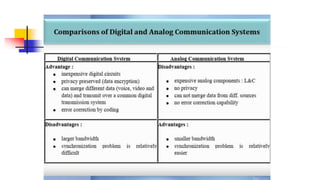
 Comparison of Digital and Analog Communication Systems
 Waveform Coding: Analog to Digital Conversion,
Quantization and Encoding techniques, PCM.
 Companding in PCM systems - u law and A law,
Applications PCM
 Introduction to Linear Prediction Theory.
 Modulation and demodulation of DPCM, DM and ADM.
Comparison of PCM, DPCM, DM and ADM.
 SNRQ of PCM and DM
UNIT – II
Information Theory and Source Coding
 Uncertainty, Information and entropy
 Source coding: Shannon – Fano and Huffman coding.
 Discrete memory less channel – Probability relations in a
channel, priori & posteriori entropies, mutual information
 Channel capacity - Binary Symmetric Channel, Binary
Erasure Channel, cascaded channels, information rate.
 Shannon-Hartley Theorem – Shannon Bound.
UNIT – III
Channel Coding
 Types of transmission errors, need for error control coding.
 Linear Block Codes (LBC): description of LBC, generation, Syndrome
and error detection, Minimum distance of Linear block code, error
correction and error detection capabilities, Standard array and
syndrome decoding
 Hamming codes.
 Binary cyclic codes (BCC): Description of cyclic codes, encoding,
decoding and error correction using shift registers.
 Convolution codes: description, encoding – code tree, state
diagram.
UNIT – IV
Introduction to Base band Digital data transmission
 Block diagram, ISI, eye pattern.
 Digital Carrier Modulation Schemes –– Description and
generation of ASK, FSK, PSK.
 Optimum receiver – matched filter, correlation receiver.
 Gaussian error probability -Coherent detection of Binary
ASK, FSK, PSK. DPSK.
 Comparison of digital carrier modulation schemes.
 M-arysignalingschemes:Introduction,QPSK, Synchronization
methods.
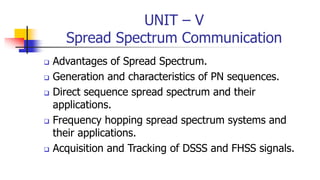
UNIT – V
Spread Spectrum Communication
 Advantages of Spread Spectrum.
 Generation and characteristics of PN sequences.
 Direct sequence spread spectrum and their
applications.
 Frequency hopping spread spectrum systems and
their applications.
 Acquisition and Tracking of DSSS and FHSS signals.
Suggested Reading-prescribed by OU
Simon Haykin, ―Communication systems‖ 4/e, Wiley
India 2011.
Sam Shanmugam K, ―Digital and Analog
Communication systems‖, Wiley 1979.
B.P.Lathi, ―Modern digital and analog communication
systems‖ 3/e, Oxford University Press. 1998
UNIT – I
Elements of Digital Communication System
 The word digital comes from the Latin word digit and digitus
(the Latin word for finger), as fingers.
What is Digital Communication?
Digital communication is a mode of communication
where the information or the thought is encoded
digitally as discrete signals and electronically transferred
to the recipients.
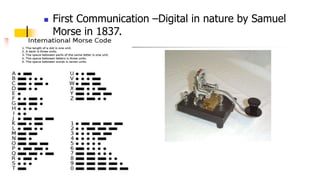
 First Communication –Digital in nature by Samuel
Morse in 1837.
Manager wanted to meet all his team members at the
Conference room to discuss their key responsibility areas and
areas of expertise. He didn’t have the time to go to their
workstations and invite them individually. Instead he opted an
easier and cheaper mode to communicate his idea. He sent an
email marking a cc to all the participants, inviting them for the
meeting. This is an example of Digital communication where
the information was sent electronically.
Example of Digital Communication
In digital communication
 Information flows in a digital form and the source is generally the
keyboard of the computer.
 A single individual is capable of digital communication.
 It also saves wastage of manpower and is one of the cheapest
modes of communication.
 Digital communication is also a really quick way to communicate.
The information can reach the recipient within a fraction of a
second.
 An individual no longer has to wait to personally meet the other
individual and share his information.
 Some examples of digital communication are
• E-mailing- Computers
• Texting- Cell Phones
• Fax
• Teleconferencing
• Video conferencing
Communications Techniques
Digital communication covers a broad area of communications
techniques including:
• Digital transmission is the transmission of digital pulses
between two or more points in a communication system.
• Digital radio is the transmitted of digital modulated analog
carriers between two or more points in a communication
system.
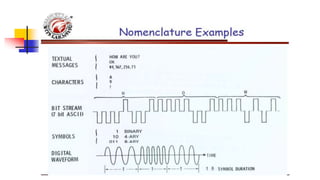
Basic Digital Communication Nomenclature
Textual Message: information comprised of a sequence of
characters.
Binary Digit (Bit): the fundamental information unit for all
digital systems.
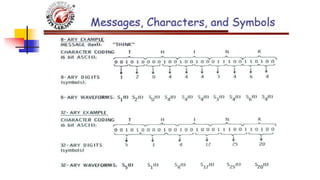
Symbol (mi where i=1,2,…M): for transmission of the bit
stream; groups of k bits are combined to form new symbol
from a finite set of M such symbols; M=2k.
Digital Waveform: voltage or current waveform representing
a digital symbol.
Data Rate: Symbol transmission is associated with a symbol
duration T. Data rate R=k/T [bps].
Baud Rate: number of symbols transmitted per second [baud]
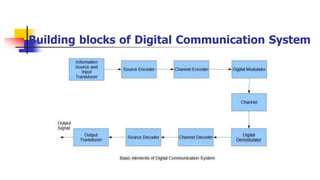
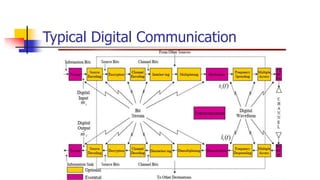
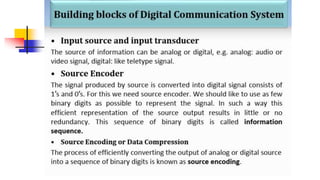
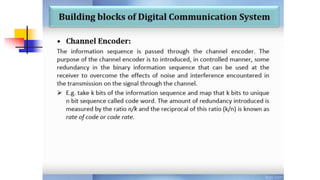
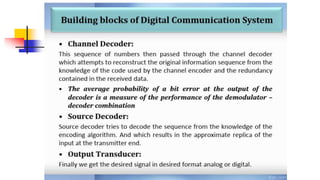
Building blocks of Digital Communication System
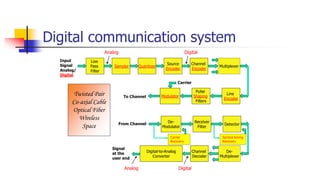
Digital communication system
Low
Pass
Filter
Sampler Quantizer
Channel
Encoder
Line
Encoder
Pulse
Shaping
Filters
Source
Encoder
Modulator
Multiplexer
Input
Signal
Analog/
Digital
To Channel
Detector
Receiver
Filter
De-
Modulator
From Channel
Channel
Decoder
Digital-to-Analog
Converter
De-
Multiplexer
Signal
at the
user end
Carrier
Analog Digital
Carrier
Recovery
Symbol timing
Recovery
Digital
Analog
Twisted Pair
Co-axial Cable
Optical Fiber
Wireless
Space
Typical Digital Communication
UNIT-1 Elements of Digital Communication

UNIT-1 Elements of Digital Communication

  • 1.
    DIGITAL COMMUNICATION Course Code: PC601EC Presented Mr.A.Abhishek Reddy, Assistant Professor, Dept. ECE,MECS Email:abhireddy470@gmail.com 8121444996
  • 2.
    PREREQUSISITE  PC403EC –PTSP PC502EC-ANALOG COMMUNIATION
  • 3.
    COURSE OBJECTIVES  Familiarizethe students with elements of digital communication system and waveform coding techniques like PCM, DPCM, DM and ADM.  Introduce the concepts of information theory and source coding.  Familiarize the students with channel coding techniques such as LBC, BCC and convolution codes.  Introduce the concepts of baseband digital data transmission and analyze the error performance of different digital carrier modulation schemes like ASK, FSK, PSK etc.  Familiarize the students with the concepts of spread spectrum communication with emphasis on DSSS and FHSS
  • 4.
    COURSE OBJECTIVES <after completionof course students should be able to>  Classify the different types of digital modulation techniques PCM, DPCM, DM and ADM and compare their performance by SNR.  Illustrate the classification of channels and Source coding methods.  Distinguish different types of Error control codes along with their encoding/decoding algorithms.  Examine the Performance of different Digital Carrier Modulation schemes of Coherent and Non-coherent type based on Probability of error.  Generation of PN sequence using Spread Spectrum and characterize the Acquisition Schemes for Receivers to track the signals.
  • 5.
    UNIT – I Elementsof Digital Communication System  Comparison of Digital and Analog Communication Systems  Waveform Coding: Analog to Digital Conversion, Quantization and Encoding techniques, PCM.  Companding in PCM systems - u law and A law, Applications PCM  Introduction to Linear Prediction Theory.  Modulation and demodulation of DPCM, DM and ADM. Comparison of PCM, DPCM, DM and ADM.  SNRQ of PCM and DM
  • 6.
    UNIT – II InformationTheory and Source Coding  Uncertainty, Information and entropy  Source coding: Shannon – Fano and Huffman coding.  Discrete memory less channel – Probability relations in a channel, priori & posteriori entropies, mutual information  Channel capacity - Binary Symmetric Channel, Binary Erasure Channel, cascaded channels, information rate.  Shannon-Hartley Theorem – Shannon Bound.
  • 7.
    UNIT – III ChannelCoding  Types of transmission errors, need for error control coding.  Linear Block Codes (LBC): description of LBC, generation, Syndrome and error detection, Minimum distance of Linear block code, error correction and error detection capabilities, Standard array and syndrome decoding  Hamming codes.  Binary cyclic codes (BCC): Description of cyclic codes, encoding, decoding and error correction using shift registers.  Convolution codes: description, encoding – code tree, state diagram.
  • 8.
    UNIT – IV Introductionto Base band Digital data transmission  Block diagram, ISI, eye pattern.  Digital Carrier Modulation Schemes –– Description and generation of ASK, FSK, PSK.  Optimum receiver – matched filter, correlation receiver.  Gaussian error probability -Coherent detection of Binary ASK, FSK, PSK. DPSK.  Comparison of digital carrier modulation schemes.  M-arysignalingschemes:Introduction,QPSK, Synchronization methods.
  • 9.
    UNIT – V SpreadSpectrum Communication  Advantages of Spread Spectrum.  Generation and characteristics of PN sequences.  Direct sequence spread spectrum and their applications.  Frequency hopping spread spectrum systems and their applications.  Acquisition and Tracking of DSSS and FHSS signals.
  • 10.
    Suggested Reading-prescribed byOU Simon Haykin, ―Communication systems‖ 4/e, Wiley India 2011. Sam Shanmugam K, ―Digital and Analog Communication systems‖, Wiley 1979. B.P.Lathi, ―Modern digital and analog communication systems‖ 3/e, Oxford University Press. 1998
  • 11.
    UNIT – I Elementsof Digital Communication System  The word digital comes from the Latin word digit and digitus (the Latin word for finger), as fingers. What is Digital Communication? Digital communication is a mode of communication where the information or the thought is encoded digitally as discrete signals and electronically transferred to the recipients.
  • 12.
     First Communication–Digital in nature by Samuel Morse in 1837.
  • 13.
    Manager wanted tomeet all his team members at the Conference room to discuss their key responsibility areas and areas of expertise. He didn’t have the time to go to their workstations and invite them individually. Instead he opted an easier and cheaper mode to communicate his idea. He sent an email marking a cc to all the participants, inviting them for the meeting. This is an example of Digital communication where the information was sent electronically. Example of Digital Communication
  • 14.
    In digital communication Information flows in a digital form and the source is generally the keyboard of the computer.  A single individual is capable of digital communication.  It also saves wastage of manpower and is one of the cheapest modes of communication.  Digital communication is also a really quick way to communicate. The information can reach the recipient within a fraction of a second.  An individual no longer has to wait to personally meet the other individual and share his information.
  • 15.
     Some examplesof digital communication are • E-mailing- Computers • Texting- Cell Phones • Fax • Teleconferencing • Video conferencing
  • 16.
    Communications Techniques Digital communicationcovers a broad area of communications techniques including: • Digital transmission is the transmission of digital pulses between two or more points in a communication system. • Digital radio is the transmitted of digital modulated analog carriers between two or more points in a communication system.
  • 17.
    Basic Digital CommunicationNomenclature Textual Message: information comprised of a sequence of characters. Binary Digit (Bit): the fundamental information unit for all digital systems. Symbol (mi where i=1,2,…M): for transmission of the bit stream; groups of k bits are combined to form new symbol from a finite set of M such symbols; M=2k. Digital Waveform: voltage or current waveform representing a digital symbol. Data Rate: Symbol transmission is associated with a symbol duration T. Data rate R=k/T [bps]. Baud Rate: number of symbols transmitted per second [baud]
  • 20.
    Building blocks ofDigital Communication System
  • 21.
    Digital communication system Low Pass Filter SamplerQuantizer Channel Encoder Line Encoder Pulse Shaping Filters Source Encoder Modulator Multiplexer Input Signal Analog/ Digital To Channel Detector Receiver Filter De- Modulator From Channel Channel Decoder Digital-to-Analog Converter De- Multiplexer Signal at the user end Carrier Analog Digital Carrier Recovery Symbol timing Recovery Digital Analog Twisted Pair Co-axial Cable Optical Fiber Wireless Space
  • 22.