3-1 Changing Windows
transformation:
a one-to-one correspondence between sets of points
Name some transformations
translation
reflection
rotation
3-1 Changing Windows
asymptote (a-simp-tote):
a line that the curve approaches but never touches
points of discontinuity:
points where there is a break in the graph
3-1 Changing Windows
automatic grapher:
Our graphing calculator. This is a function grapher.
default window:
The part of the coordinate plane that shows on the screen
of the calculator.
viewing window:
viewing rectangle:
−10 ≤ x ≤10 and −10 ≤ y ≤10
3-1 Changing Windows
parent function:
a simple form or the simplest form of a class of functions
from which other members of the class can be derived by
transformations.
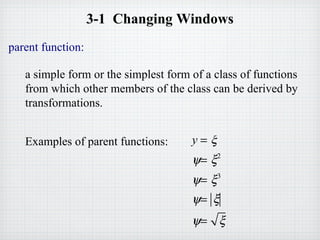
Examples of parent functions: y = ξ
ψ= ξ2
ψ= ξ3
ψ= ξ
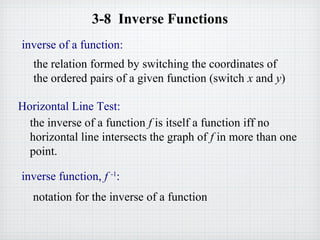
ψ= ξ
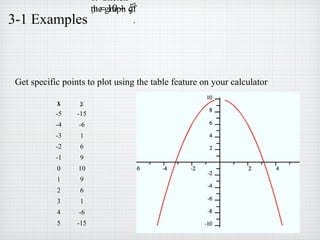
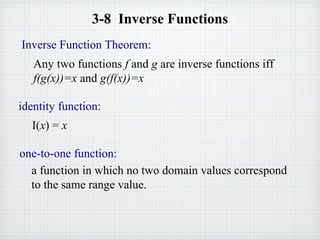
3-1 Examples
1. Sketch
the graph of
.
y = 10 − ξ2
Get specific points to plot using the table feature on your calculator
x y
-5 -15
-4 -6
-3 1
-2 6
-1 9
0 10
1 9
2 6
3 1
4 -6
5 -15
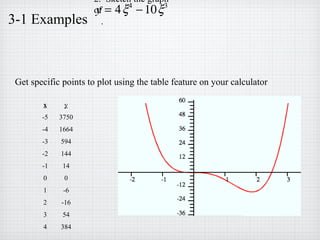
Get specific points to plot using the table feature on your calculator
x y
-5 3750
-4 1664
-3 594
-2 144
-1 14
0 0
1 -6
2 -16
3 54
4 384
3-1 Examples
2. Sketch the graph
of
.
y = 4ξ4
−10ξ3
3-2 The Graph Translation Theorem
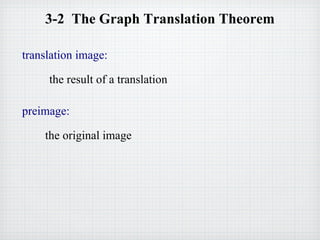
translation image:
the result of a translation
preimage:
the original image
3-2 The Graph Translation Theorem
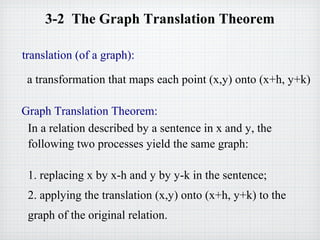
translation (of a graph):
a transformation that maps each point (x,y) onto (x+h, y+k)
Graph Translation Theorem:
In a relation described by a sentence in x and y, the
following two processes yield the same graph:
1. replacing x by x-h and y by y-k in the sentence;
2. applying the translation (x,y) onto (x+h, y+k) to the
graph of the original relation.
3-2 Examples
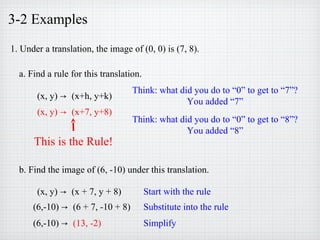
1. Under a translation, the image of (0, 0) is (7, 8).
a. Find a rule for this translation.
b. Find the image of (6, -10) under this translation.
(x, y) (x+7, y+8)→
(x, y) (x+h, y+k)→
Think: what did you do to “0” to get to “7”?
You added “7”
Think: what did you do to “0” to get to “8”?
You added “8”
This is the Rule!
(x, y) (x + 7, y + 8)→ Start with the rule
Substitute into the rule(6,-10) (6 + 7, -10 + 8)→
(6,-10) → (13, -2) Simplify
3-2 Examples
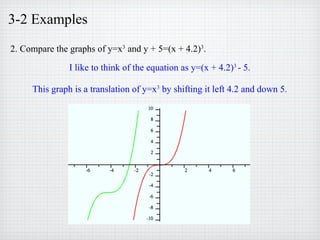
2. Compare the graphs of y=x3
and y + 5=(x + 4.2)3
.
I like to think of the equation as y=(x + 4.2)3
- 5.
This graph is a translation of y=x3
by shifting it left 4.2 and down 5.
3-2 Examples
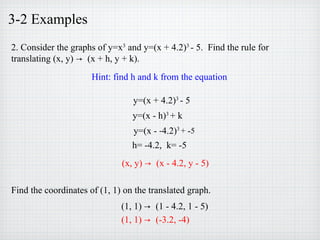
2. Consider the graphs of y=x3
and y=(x + 4.2)3
- 5. Find the rule for
translating (x, y) (x + h, y + k).→
y=(x + 4.2)3
- 5
y=(x - h)3
+ k
y=(x - -4.2)3
+ -5
h= -4.2, k= -5
(x, y) (x - 4.2, y - 5)→
Hint: find h and k from the equation
Find the coordinates of (1, 1) on the translated graph.
(1, 1) (1 - 4.2, 1 - 5)→
(1, 1) (-3.2, -4)→
3-2 Examples
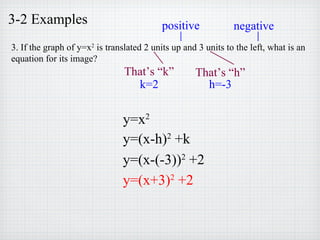
3. If the graph of y=x2
is translated 2 units up and 3 units to the left, what is an
equation for its image?
y=x2
y=(x-h)2
+k
That’s “h”That’s “k”
k=2 h=-3
positive negative
y=(x-(-3))2
+2
y=(x+3)2
+2
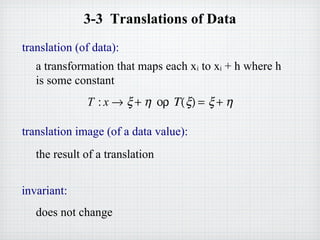
3-3 Translations of Data
translation (of data):
a transformation that maps each xi to xi + h where h
is some constant
T : x → ξ + η ορ Τ(ξ) = ξ + η
translation image (of a data value):
the result of a translation
invariant:
does not change
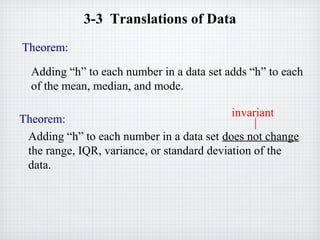
3-3 Translations of Data
Theorem:
Adding “h” to each number in a data set adds “h” to each
of the mean, median, and mode.
Theorem:
Adding “h” to each number in a data set does not change
the range, IQR, variance, or standard deviation of the
data.
invariant
3-3 Examples
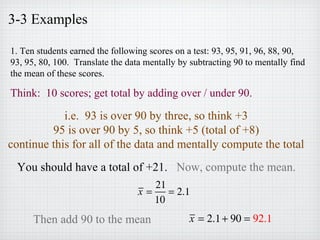
1. Ten students earned the following scores on a test: 93, 95, 91, 96, 88, 90,
93, 95, 80, 100. Translate the data mentally by subtracting 90 to mentally find
the mean of these scores.
Think: 10 scores; get total by adding over / under 90.
i.e. 93 is over 90 by three, so think +3
95 is over 90 by 5, so think +5 (total of +8)
continue this for all of the data and mentally compute the total
You should have a total of +21. Now, compute the mean.
x =
21
10
= 2.1
Then add 90 to the mean x = 2.1+ 90 = 92.1
3-3 Examples
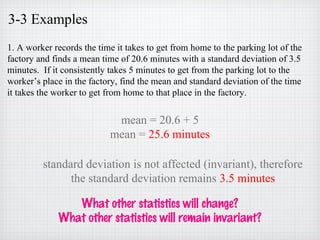
1. A worker records the time it takes to get from home to the parking lot of the
factory and finds a mean time of 20.6 minutes with a standard deviation of 3.5
minutes. If it consistently takes 5 minutes to get from the parking lot to the
worker’s place in the factory, find the mean and standard deviation of the time
it takes the worker to get from home to that place in the factory.
mean = 20.6 + 5
mean = 25.6 minutes
standard deviation is not affected (invariant), therefore
the standard deviation remains 3.5 minutes
What other statistics will change?
What other statistics will remain invariant?
3-5 The Graph Scale-Change Theorem
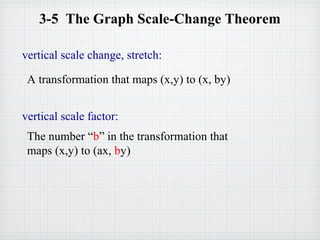
vertical scale change, stretch:
vertical scale factor:
A transformation that maps (x,y) to (x, by)
The number “b” in the transformation that
maps (x,y) to (ax, by)
3-5 The Graph Scale-Change Theorem
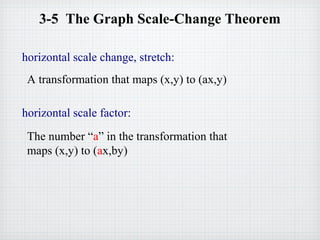
horizontal scale change, stretch:
horizontal scale factor:
A transformation that maps (x,y) to (ax,y)
The number “a” in the transformation that
maps (x,y) to (ax,by)
3-5 The Graph Scale-Change Theorem
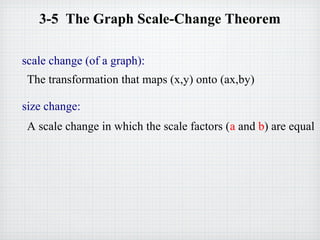
scale change (of a graph):
size change:
The transformation that maps (x,y) onto (ax,by)
A scale change in which the scale factors (a and b) are equal
3-5 The Graph Scale-Change Theorem
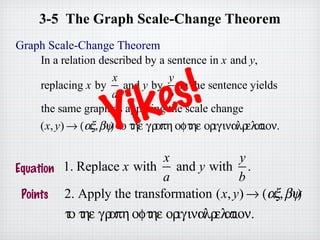
Graph Scale-Change Theorem
In a relation described by a sentence in x and y,
replacing x by
x
a
and y by
y
b
in the sentence yields
the same graph as applying the scale change
(x,y) → (αξ,βψ) το τηε γραπηοφτηε οριγιναλρελατιον.Yikes!
1. Replace x with
x
a
and y with
y
b
.
2. Apply the transformation (x,y) → (αξ,βψ)
το τηε γραπηοφτηε οριγιναλρελατιον.
Equation
Points
3-5 The Graph Scale-Change Theorem
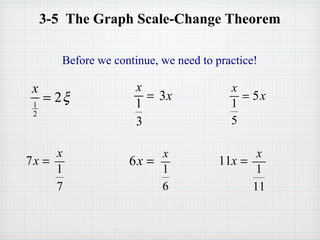
Before we continue, we need to practice!
x
1
3
= 3x
x
1
5
= 5x
7x =
x
1
7
6x =
x
1
6
11x =
x
1
11
x
1
2
= 2ξ
3-5 Examples
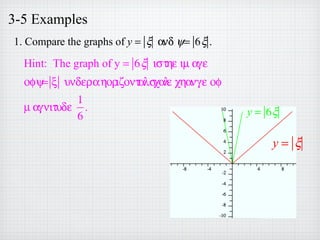
1. Compare the graphs of y = ξ ανδ ψ= 6ξ .
y = ξ
y = 6ξ
Hint: The graph of y = 6ξ ιστηε ιµ αγε
οφψ= ξ υνδεραηοριζονταλσχαλε χηανγε οφ
µ αγνιτυδε
1
6
.
3-5 Examples
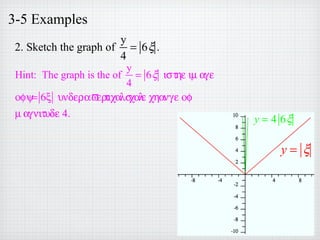
2. Sketch the graph of
y
4
= 6ξ .
Hint: The graph is the of
y
4
= 6ξ ιστηε ιµ αγε
οφψ= 6ξ υνδεραϖερτιχαλσχαλε χηανγε οφ
µ αγνιτυδε 4.
y = 4 6ξ
y = ξ
3-5 Examples
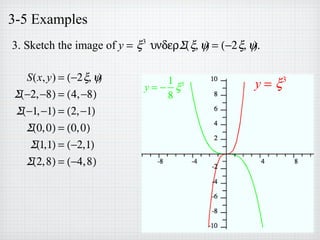
3. Sketch the image of y = ξ3
υνδερΣ(ξ,ψ) = (−2ξ,ψ).
S(x,y) = (−2ξ,ψ)
Σ(−2,−8) = (4,−8)
Σ(−1,−1) = (2,−1)
Σ(0,0) = (0,0)
Σ(1,1) = (−2,1)
Σ(2,8) = (−4,8)
y = ξ3
y = −
1
8
ξ3
3-5 Examples
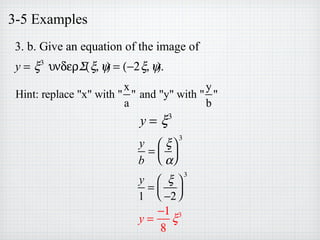
3. b. Give an equation of the image of
y = ξ3
υνδερΣ(ξ,ψ) = (−2ξ,ψ).
Hint: replace "x" with "
x
a
" and "y" with "
y
b
"
y = ξ3
y
b
=
ξ
α




3
y
1
=
ξ
−2




3
y =
−1
8
ξ3
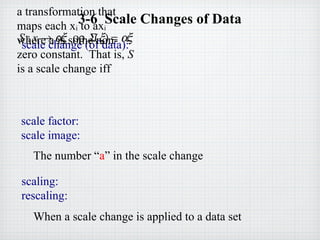
3-6 Scale Changes of Data
scale factor:
scale image:
The number “a” in the scale change
scale change (of data):
a transformation that
maps each xi to axi
where a is some non-
zero constant. That is, S
is a scale change iff
S : x → αξ ορ Σ(ξ) = αξ
scaling:
rescaling:
When a scale change is applied to a data set
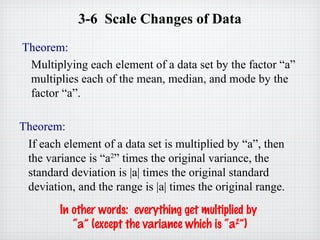
3-6 Scale Changes of Data
Theorem:
Multiplying each element of a data set by the factor “a”
multiplies each of the mean, median, and mode by the
factor “a”.
Theorem:
If each element of a data set is multiplied by “a”, then
the variance is “a2
” times the original variance, the
standard deviation is |a| times the original standard
deviation, and the range is |a| times the original range.
In other words: everything get multiplied by
“a” (except the variance which is “a2
”)
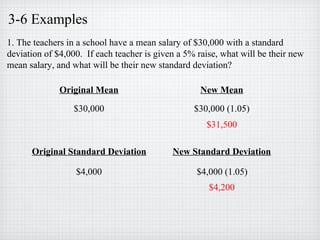
3-6 Examples
1. The teachers in a school have a mean salary of $30,000 with a standard
deviation of $4,000. If each teacher is given a 5% raise, what will be their new
mean salary, and what will be their new standard deviation?
Original Mean New Mean
Original Standard Deviation New Standard Deviation
$30,000 $30,000 (1.05)
$31,500
$4,000 $4,000 (1.05)
$4,200
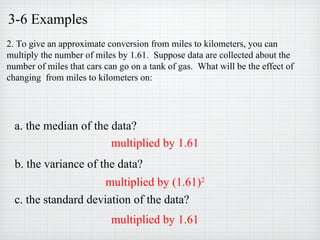
3-6 Examples
2. To give an approximate conversion from miles to kilometers, you can
multiply the number of miles by 1.61. Suppose data are collected about the
number of miles that cars can go on a tank of gas. What will be the effect of
changing from miles to kilometers on:
a. the median of the data?
c. the standard deviation of the data?
b. the variance of the data?
multiplied by 1.61
multiplied by (1.61)2
multiplied by 1.61
3-8 Inverse Functions
Horizontal Line Test:
the inverse of a function f is itself a function iff no
horizontal line intersects the graph of f in more than one
point.
inverse of a function:
the relation formed by switching the coordinates of
the ordered pairs of a given function (switch x and y)
inverse function, f -1
:
notation for the inverse of a function
3-8 Inverse Functions
identity function:
I(x) = x
Inverse Function Theorem:
Any two functions f and g are inverse functions iff
f(g(x))=x and g(f(x))=x
one-to-one function:
a function in which no two domain values correspond
to the same range value.
3-8 Examples
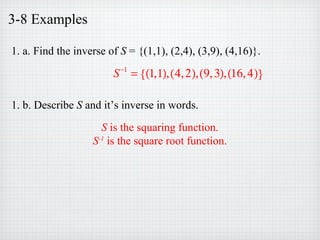
1. a. Find the inverse of S = {(1,1), (2,4), (3,9), (4,16)}.
1. b. Describe S and it’s inverse in words.
S−1
= (1,1),(4,2),(9,3),(16,4){ }
S is the squaring function.
S-1
is the square root function.
3-8 Examples
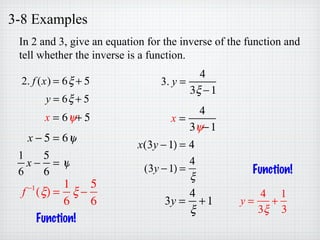
In 2 and 3, give an equation for the inverse of the function and
tell whether the inverse is a function.
2. f (x) = 6ξ + 5
y = 6ξ + 5
x = 6ψ+ 5
x − 5 = 6ψ
1
6
x −
5
6
= ψ
f −1
(ξ) =
1
6
ξ −
5
6
Function!
3. y =
4
3ξ −1
x =
4
3ψ−1
x(3y −1) = 4
(3y −1) =
4
ξ
3y =
4
ξ
+1 y =
4
3ξ
+
1
3
Function!
3-9 z-scores
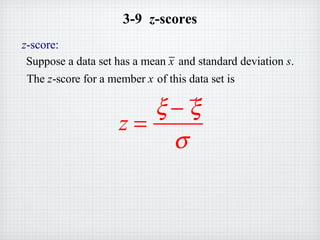
z-score:
z =
ξ − ξ
σ
Suppose a data set has a mean x and standard deviation s.
The z-score for a member x of this data set is
raw score:
the original data
raw data:
3-9 z-scores
the results of a transformation
standardized scores:
standardized data:
3-9 z-scores
Theorem:
If a data set has a mean x and standard deviation s,
the mean of its z-scores will be 0, and the standard
deviation of its z-scores will be 1.
3-9 Examples
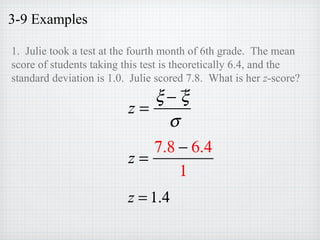
1. Julie took a test at the fourth month of 6th grade. The mean
score of students taking this test is theoretically 6.4, and the
standard deviation is 1.0. Julie scored 7.8. What is her z-score?
z =
ξ − ξ
σ
z =
7.8 − 6.4
1
z = 1.4
3-9 Examples
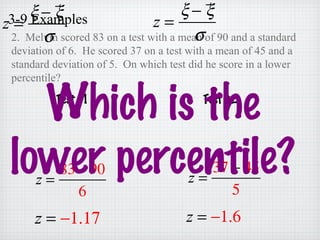
2. Melvin scored 83 on a test with a mean of 90 and a standard
deviation of 6. He scored 37 on a test with a mean of 45 and a
standard deviation of 5. On which test did he score in a lower
percentile?
z =
ξ − ξ
σ
z =
ξ − ξ
σ
z =
83− 90
6
z =
37 − 45
5
z = −1.17 z = −1.6
Test #1 Test #2
Which is the
lower percentile?

Fst ch3 notes

  • 1.
    3-1 Changing Windows transformation: aone-to-one correspondence between sets of points Name some transformations translation reflection rotation
  • 2.
    3-1 Changing Windows asymptote(a-simp-tote): a line that the curve approaches but never touches points of discontinuity: points where there is a break in the graph
  • 3.
    3-1 Changing Windows automaticgrapher: Our graphing calculator. This is a function grapher. default window: The part of the coordinate plane that shows on the screen of the calculator. viewing window: viewing rectangle: −10 ≤ x ≤10 and −10 ≤ y ≤10
  • 4.
    3-1 Changing Windows parentfunction: a simple form or the simplest form of a class of functions from which other members of the class can be derived by transformations. Examples of parent functions: y = ξ ψ= ξ2 ψ= ξ3 ψ= ξ ψ= ξ
  • 5.
    3-1 Examples 1. Sketch thegraph of . y = 10 − ξ2 Get specific points to plot using the table feature on your calculator x y -5 -15 -4 -6 -3 1 -2 6 -1 9 0 10 1 9 2 6 3 1 4 -6 5 -15
  • 6.
    Get specific pointsto plot using the table feature on your calculator x y -5 3750 -4 1664 -3 594 -2 144 -1 14 0 0 1 -6 2 -16 3 54 4 384 3-1 Examples 2. Sketch the graph of . y = 4ξ4 −10ξ3
  • 7.
    3-2 The GraphTranslation Theorem translation image: the result of a translation preimage: the original image
  • 8.
    3-2 The GraphTranslation Theorem translation (of a graph): a transformation that maps each point (x,y) onto (x+h, y+k) Graph Translation Theorem: In a relation described by a sentence in x and y, the following two processes yield the same graph: 1. replacing x by x-h and y by y-k in the sentence; 2. applying the translation (x,y) onto (x+h, y+k) to the graph of the original relation.
  • 9.
    3-2 Examples 1. Undera translation, the image of (0, 0) is (7, 8). a. Find a rule for this translation. b. Find the image of (6, -10) under this translation. (x, y) (x+7, y+8)→ (x, y) (x+h, y+k)→ Think: what did you do to “0” to get to “7”? You added “7” Think: what did you do to “0” to get to “8”? You added “8” This is the Rule! (x, y) (x + 7, y + 8)→ Start with the rule Substitute into the rule(6,-10) (6 + 7, -10 + 8)→ (6,-10) → (13, -2) Simplify
  • 10.
    3-2 Examples 2. Comparethe graphs of y=x3 and y + 5=(x + 4.2)3 . I like to think of the equation as y=(x + 4.2)3 - 5. This graph is a translation of y=x3 by shifting it left 4.2 and down 5.
  • 11.
    3-2 Examples 2. Considerthe graphs of y=x3 and y=(x + 4.2)3 - 5. Find the rule for translating (x, y) (x + h, y + k).→ y=(x + 4.2)3 - 5 y=(x - h)3 + k y=(x - -4.2)3 + -5 h= -4.2, k= -5 (x, y) (x - 4.2, y - 5)→ Hint: find h and k from the equation Find the coordinates of (1, 1) on the translated graph. (1, 1) (1 - 4.2, 1 - 5)→ (1, 1) (-3.2, -4)→
  • 12.
    3-2 Examples 3. Ifthe graph of y=x2 is translated 2 units up and 3 units to the left, what is an equation for its image? y=x2 y=(x-h)2 +k That’s “h”That’s “k” k=2 h=-3 positive negative y=(x-(-3))2 +2 y=(x+3)2 +2
  • 13.
    3-3 Translations ofData translation (of data): a transformation that maps each xi to xi + h where h is some constant T : x → ξ + η ορ Τ(ξ) = ξ + η translation image (of a data value): the result of a translation invariant: does not change
  • 14.
    3-3 Translations ofData Theorem: Adding “h” to each number in a data set adds “h” to each of the mean, median, and mode. Theorem: Adding “h” to each number in a data set does not change the range, IQR, variance, or standard deviation of the data. invariant
  • 15.
    3-3 Examples 1. Tenstudents earned the following scores on a test: 93, 95, 91, 96, 88, 90, 93, 95, 80, 100. Translate the data mentally by subtracting 90 to mentally find the mean of these scores. Think: 10 scores; get total by adding over / under 90. i.e. 93 is over 90 by three, so think +3 95 is over 90 by 5, so think +5 (total of +8) continue this for all of the data and mentally compute the total You should have a total of +21. Now, compute the mean. x = 21 10 = 2.1 Then add 90 to the mean x = 2.1+ 90 = 92.1
  • 16.
    3-3 Examples 1. Aworker records the time it takes to get from home to the parking lot of the factory and finds a mean time of 20.6 minutes with a standard deviation of 3.5 minutes. If it consistently takes 5 minutes to get from the parking lot to the worker’s place in the factory, find the mean and standard deviation of the time it takes the worker to get from home to that place in the factory. mean = 20.6 + 5 mean = 25.6 minutes standard deviation is not affected (invariant), therefore the standard deviation remains 3.5 minutes What other statistics will change? What other statistics will remain invariant?
  • 17.
    3-5 The GraphScale-Change Theorem vertical scale change, stretch: vertical scale factor: A transformation that maps (x,y) to (x, by) The number “b” in the transformation that maps (x,y) to (ax, by)
  • 18.
    3-5 The GraphScale-Change Theorem horizontal scale change, stretch: horizontal scale factor: A transformation that maps (x,y) to (ax,y) The number “a” in the transformation that maps (x,y) to (ax,by)
  • 19.
    3-5 The GraphScale-Change Theorem scale change (of a graph): size change: The transformation that maps (x,y) onto (ax,by) A scale change in which the scale factors (a and b) are equal
  • 20.
    3-5 The GraphScale-Change Theorem Graph Scale-Change Theorem In a relation described by a sentence in x and y, replacing x by x a and y by y b in the sentence yields the same graph as applying the scale change (x,y) → (αξ,βψ) το τηε γραπηοφτηε οριγιναλρελατιον.Yikes! 1. Replace x with x a and y with y b . 2. Apply the transformation (x,y) → (αξ,βψ) το τηε γραπηοφτηε οριγιναλρελατιον. Equation Points
  • 21.
    3-5 The GraphScale-Change Theorem Before we continue, we need to practice! x 1 3 = 3x x 1 5 = 5x 7x = x 1 7 6x = x 1 6 11x = x 1 11 x 1 2 = 2ξ
  • 22.
    3-5 Examples 1. Comparethe graphs of y = ξ ανδ ψ= 6ξ . y = ξ y = 6ξ Hint: The graph of y = 6ξ ιστηε ιµ αγε οφψ= ξ υνδεραηοριζονταλσχαλε χηανγε οφ µ αγνιτυδε 1 6 .
  • 23.
    3-5 Examples 2. Sketchthe graph of y 4 = 6ξ . Hint: The graph is the of y 4 = 6ξ ιστηε ιµ αγε οφψ= 6ξ υνδεραϖερτιχαλσχαλε χηανγε οφ µ αγνιτυδε 4. y = 4 6ξ y = ξ
  • 24.
    3-5 Examples 3. Sketchthe image of y = ξ3 υνδερΣ(ξ,ψ) = (−2ξ,ψ). S(x,y) = (−2ξ,ψ) Σ(−2,−8) = (4,−8) Σ(−1,−1) = (2,−1) Σ(0,0) = (0,0) Σ(1,1) = (−2,1) Σ(2,8) = (−4,8) y = ξ3 y = − 1 8 ξ3
  • 25.
    3-5 Examples 3. b.Give an equation of the image of y = ξ3 υνδερΣ(ξ,ψ) = (−2ξ,ψ). Hint: replace "x" with " x a " and "y" with " y b " y = ξ3 y b = ξ α     3 y 1 = ξ −2     3 y = −1 8 ξ3
  • 26.
    3-6 Scale Changesof Data scale factor: scale image: The number “a” in the scale change scale change (of data): a transformation that maps each xi to axi where a is some non- zero constant. That is, S is a scale change iff S : x → αξ ορ Σ(ξ) = αξ scaling: rescaling: When a scale change is applied to a data set
  • 27.
    3-6 Scale Changesof Data Theorem: Multiplying each element of a data set by the factor “a” multiplies each of the mean, median, and mode by the factor “a”. Theorem: If each element of a data set is multiplied by “a”, then the variance is “a2 ” times the original variance, the standard deviation is |a| times the original standard deviation, and the range is |a| times the original range. In other words: everything get multiplied by “a” (except the variance which is “a2 ”)
  • 28.
    3-6 Examples 1. Theteachers in a school have a mean salary of $30,000 with a standard deviation of $4,000. If each teacher is given a 5% raise, what will be their new mean salary, and what will be their new standard deviation? Original Mean New Mean Original Standard Deviation New Standard Deviation $30,000 $30,000 (1.05) $31,500 $4,000 $4,000 (1.05) $4,200
  • 29.
    3-6 Examples 2. Togive an approximate conversion from miles to kilometers, you can multiply the number of miles by 1.61. Suppose data are collected about the number of miles that cars can go on a tank of gas. What will be the effect of changing from miles to kilometers on: a. the median of the data? c. the standard deviation of the data? b. the variance of the data? multiplied by 1.61 multiplied by (1.61)2 multiplied by 1.61
  • 30.
    3-8 Inverse Functions HorizontalLine Test: the inverse of a function f is itself a function iff no horizontal line intersects the graph of f in more than one point. inverse of a function: the relation formed by switching the coordinates of the ordered pairs of a given function (switch x and y) inverse function, f -1 : notation for the inverse of a function
  • 31.
    3-8 Inverse Functions identityfunction: I(x) = x Inverse Function Theorem: Any two functions f and g are inverse functions iff f(g(x))=x and g(f(x))=x one-to-one function: a function in which no two domain values correspond to the same range value.
  • 32.
    3-8 Examples 1. a.Find the inverse of S = {(1,1), (2,4), (3,9), (4,16)}. 1. b. Describe S and it’s inverse in words. S−1 = (1,1),(4,2),(9,3),(16,4){ } S is the squaring function. S-1 is the square root function.
  • 33.
    3-8 Examples In 2and 3, give an equation for the inverse of the function and tell whether the inverse is a function. 2. f (x) = 6ξ + 5 y = 6ξ + 5 x = 6ψ+ 5 x − 5 = 6ψ 1 6 x − 5 6 = ψ f −1 (ξ) = 1 6 ξ − 5 6 Function! 3. y = 4 3ξ −1 x = 4 3ψ−1 x(3y −1) = 4 (3y −1) = 4 ξ 3y = 4 ξ +1 y = 4 3ξ + 1 3 Function!
  • 34.
    3-9 z-scores z-score: z = ξ− ξ σ Suppose a data set has a mean x and standard deviation s. The z-score for a member x of this data set is
  • 35.
    raw score: the originaldata raw data: 3-9 z-scores the results of a transformation standardized scores: standardized data:
  • 36.
    3-9 z-scores Theorem: If adata set has a mean x and standard deviation s, the mean of its z-scores will be 0, and the standard deviation of its z-scores will be 1.
  • 37.
    3-9 Examples 1. Julietook a test at the fourth month of 6th grade. The mean score of students taking this test is theoretically 6.4, and the standard deviation is 1.0. Julie scored 7.8. What is her z-score? z = ξ − ξ σ z = 7.8 − 6.4 1 z = 1.4
  • 38.
    3-9 Examples 2. Melvinscored 83 on a test with a mean of 90 and a standard deviation of 6. He scored 37 on a test with a mean of 45 and a standard deviation of 5. On which test did he score in a lower percentile? z = ξ − ξ σ z = ξ − ξ σ z = 83− 90 6 z = 37 − 45 5 z = −1.17 z = −1.6 Test #1 Test #2 Which is the lower percentile?