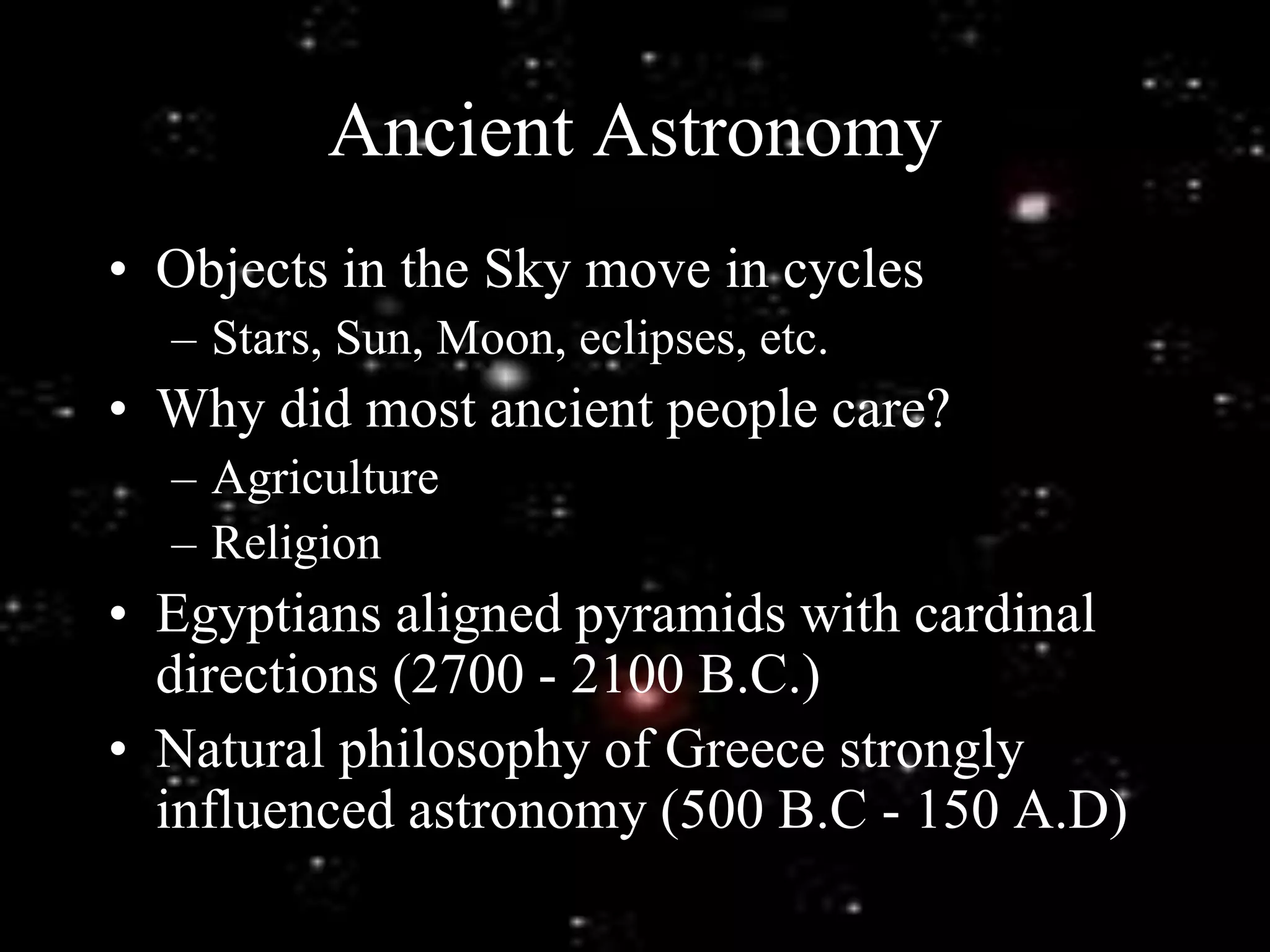
Ancient Astronomy
• Objects in the Sky move in cycles
– Stars, Sun, Moon, eclipses, etc.
• Why did most ancient people care?
– Agriculture
– Religion
• Egyptians aligned pyramids with cardinal
directions (2700 - 2100 B.C.)
• Natural philosophy of Greece strongly
influenced astronomy (500 B.C - 150 A.D)
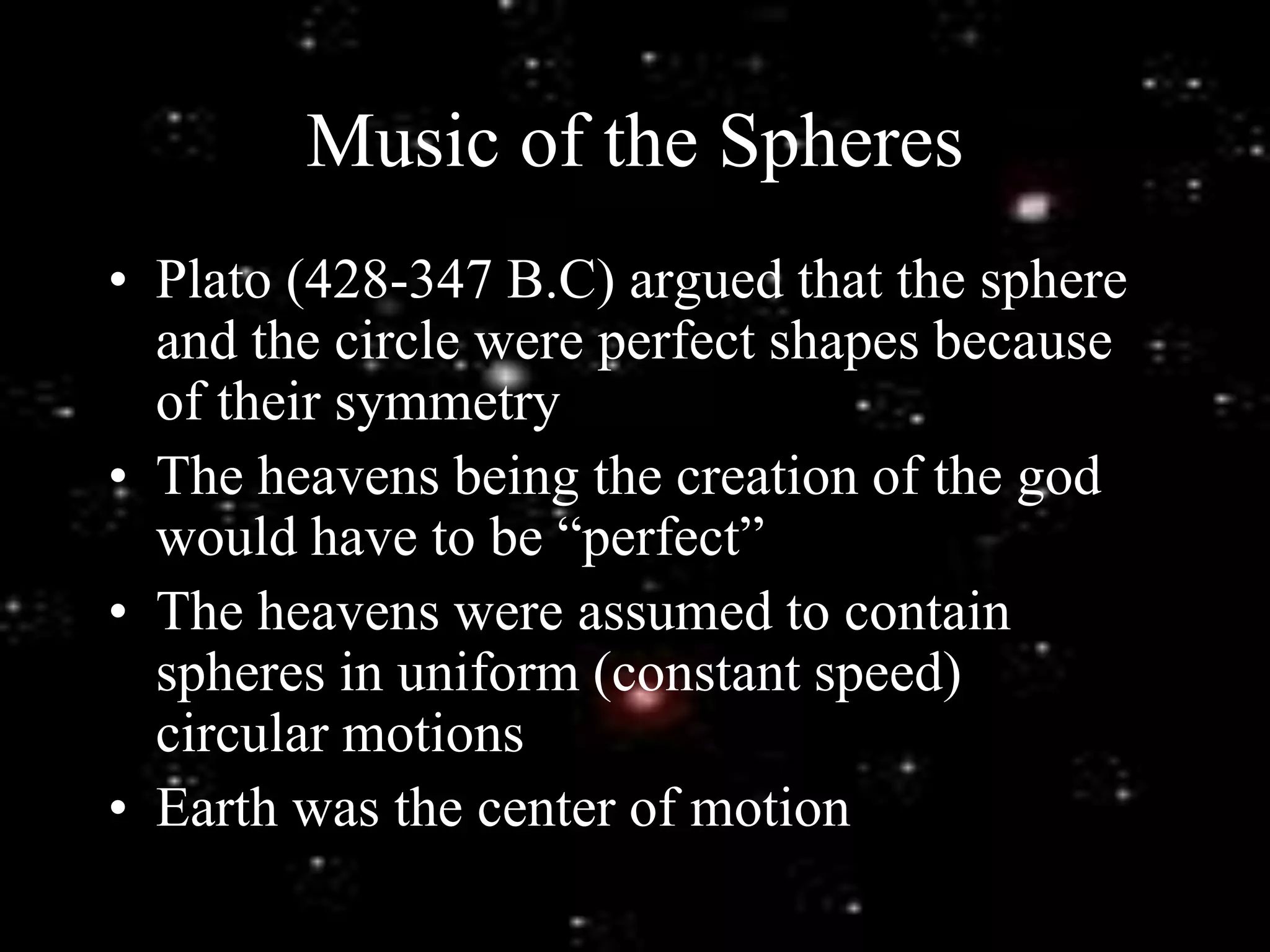
Music of the Spheres
• Plato (428-347 B.C) argued that the sphere
and the circle were perfect shapes because
of their symmetry
• The heavens being the creation of the god
would have to be “perfect”
• The heavens were assumed to contain
spheres in uniform (constant speed)
circular motions
• Earth was the center of motion
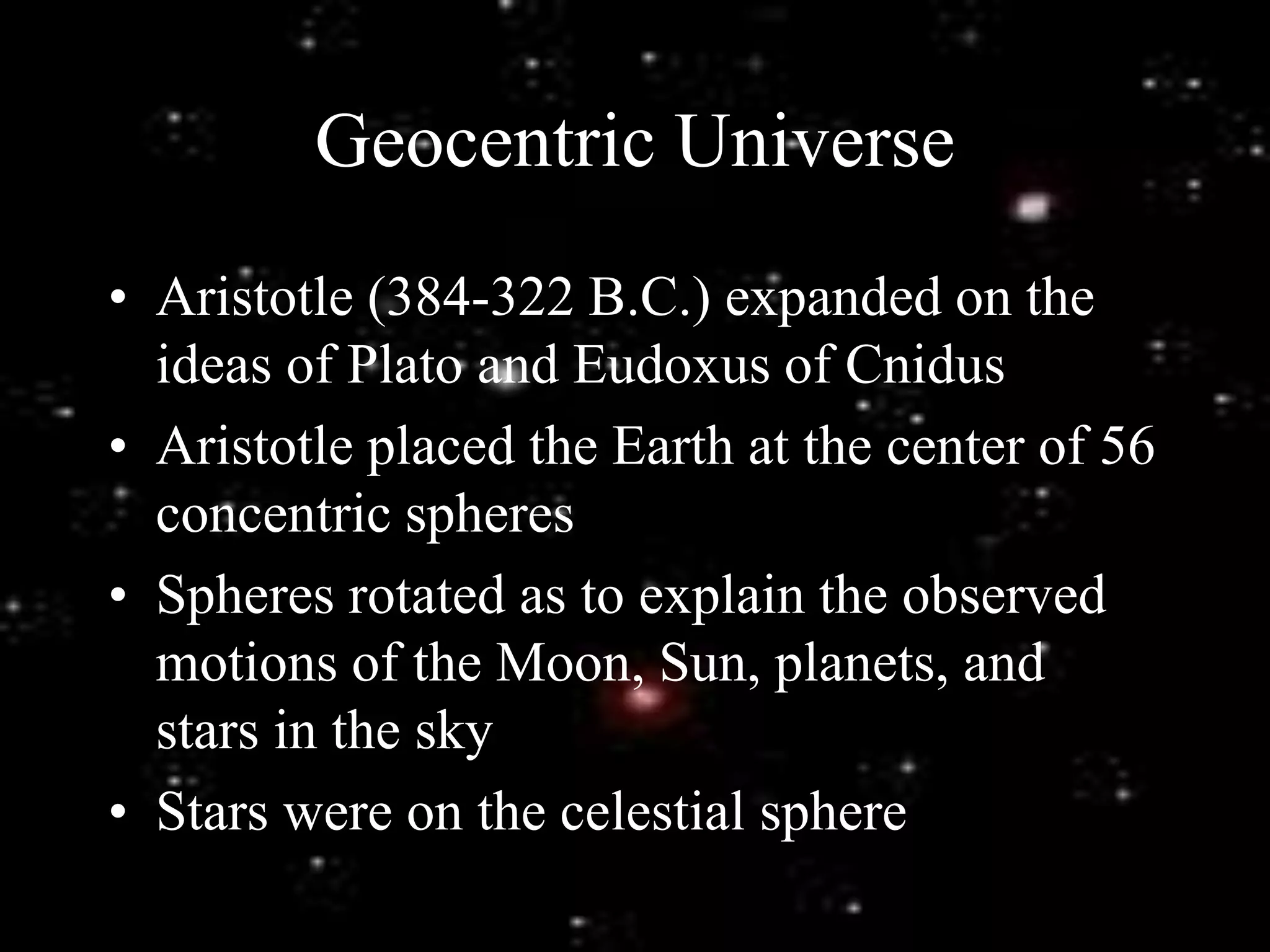
Geocentric Universe
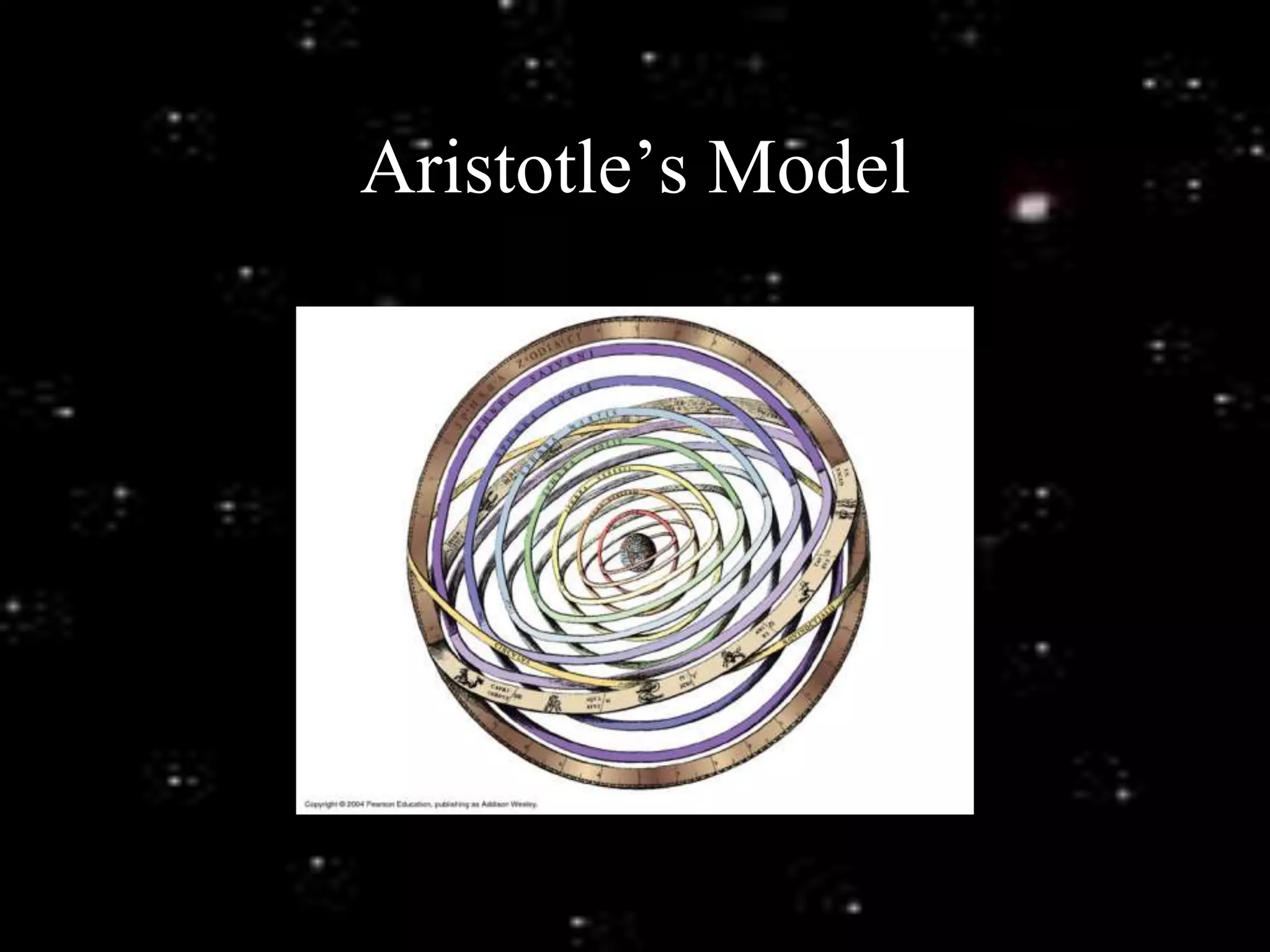
• Aristotle (384-322 B.C.) expanded on the
ideas of Plato and Eudoxus of Cnidus
• Aristotle placed the Earth at the center of 56
concentric spheres
• Spheres rotated as to explain the observed
motions of the Moon, Sun, planets, and
stars in the sky
• Stars were on the celestial sphere
Aristotle’s Model
Earth the Central Sphere
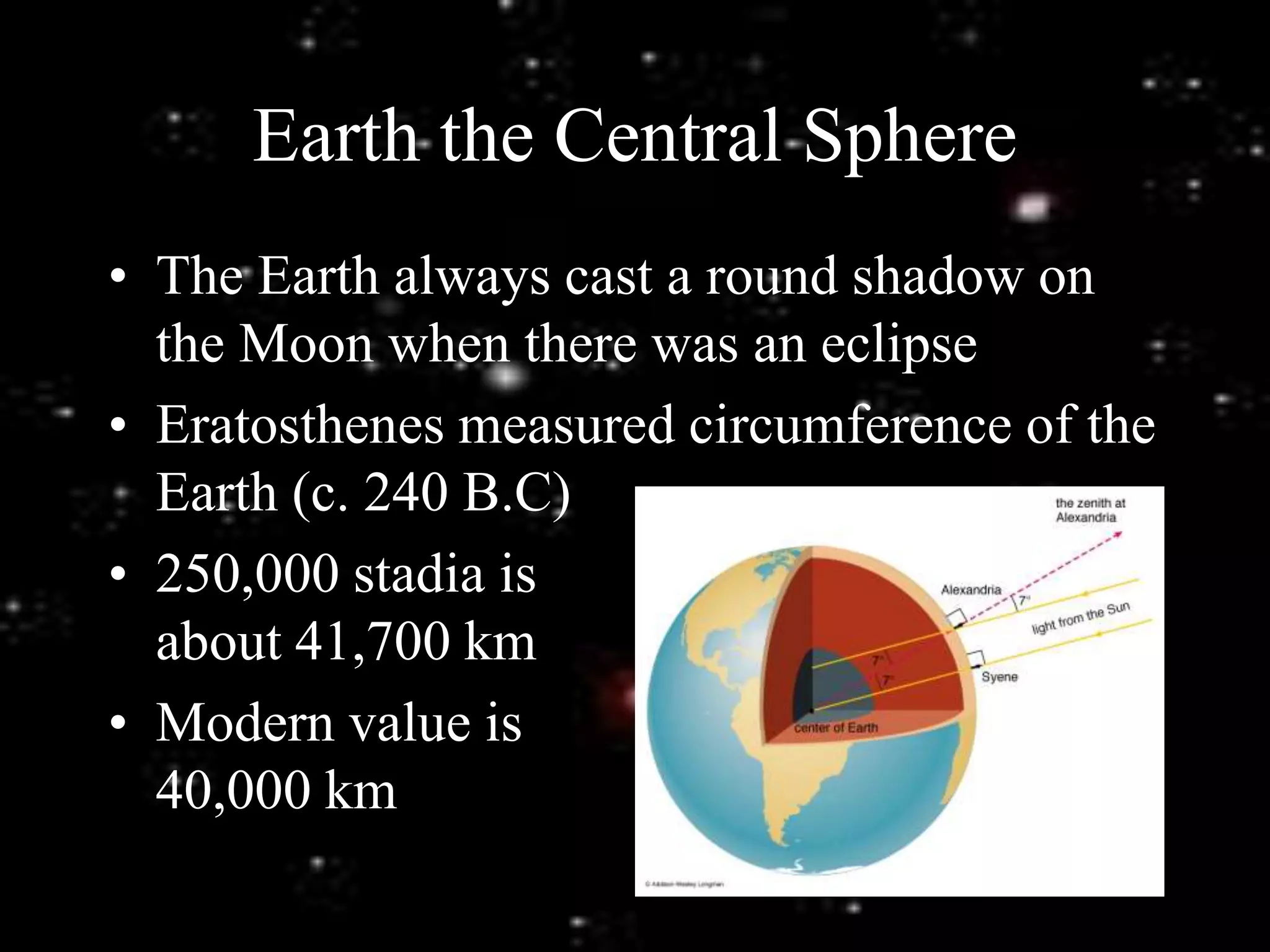
• The Earth always cast a round shadow on
the Moon when there was an eclipse
• Eratosthenes measured circumference of the
Earth (c. 240 B.C)
• 250,000 stadia is
about 41,700 km
• Modern value is
40,000 km
Aristarchus (310-230 B.C)
• Hypothesized the Sun was the center of
motion for the planets and Earth
• Retrograde motion of Mars, Jupiter, Saturn
• Believed Sun was bigger than Earth
• Heracleides (388-315 B.C) suggested that
Mercury and Venus orbited the sun
• Heliocentrism was dismissed for 1800 years
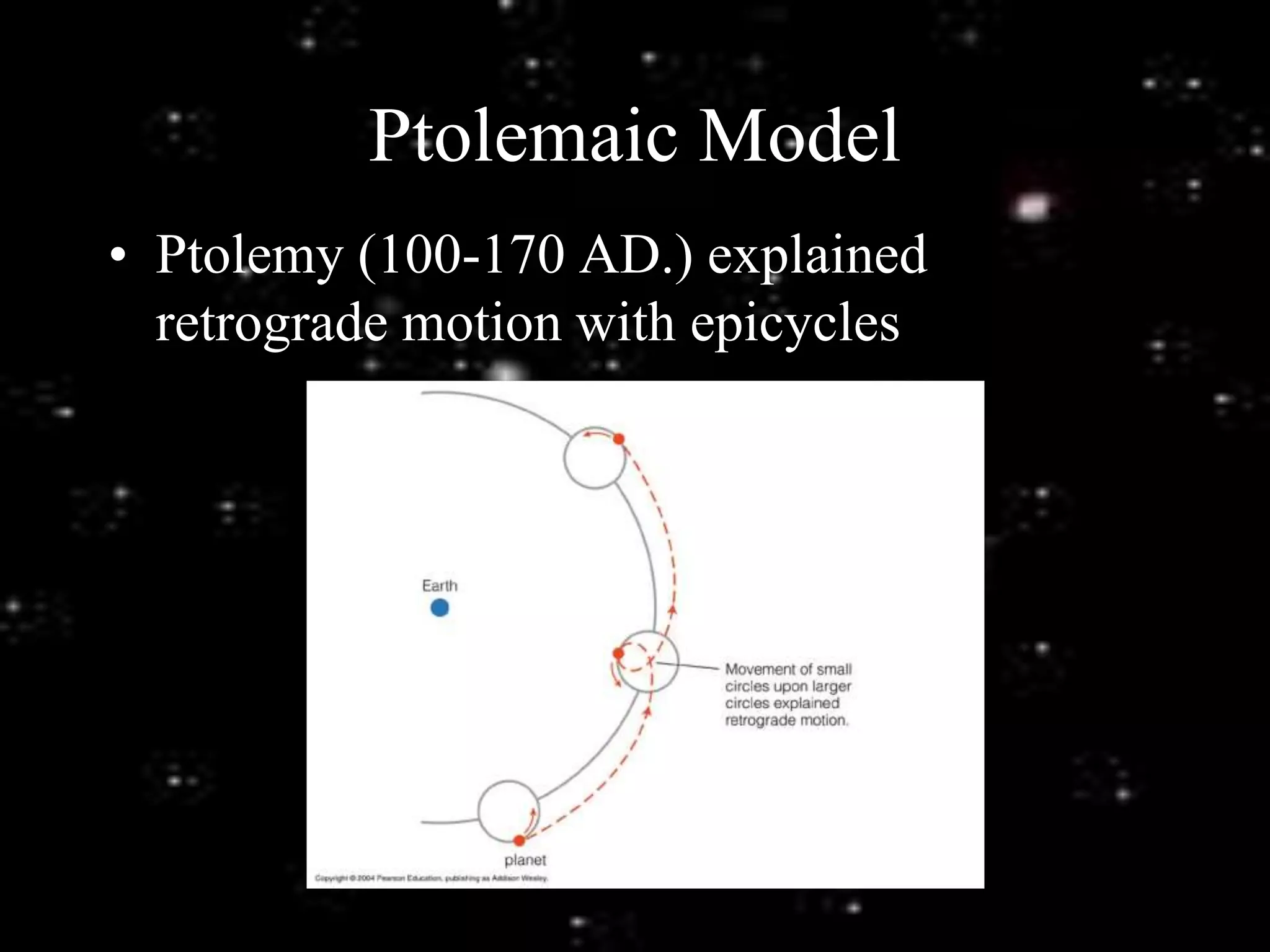
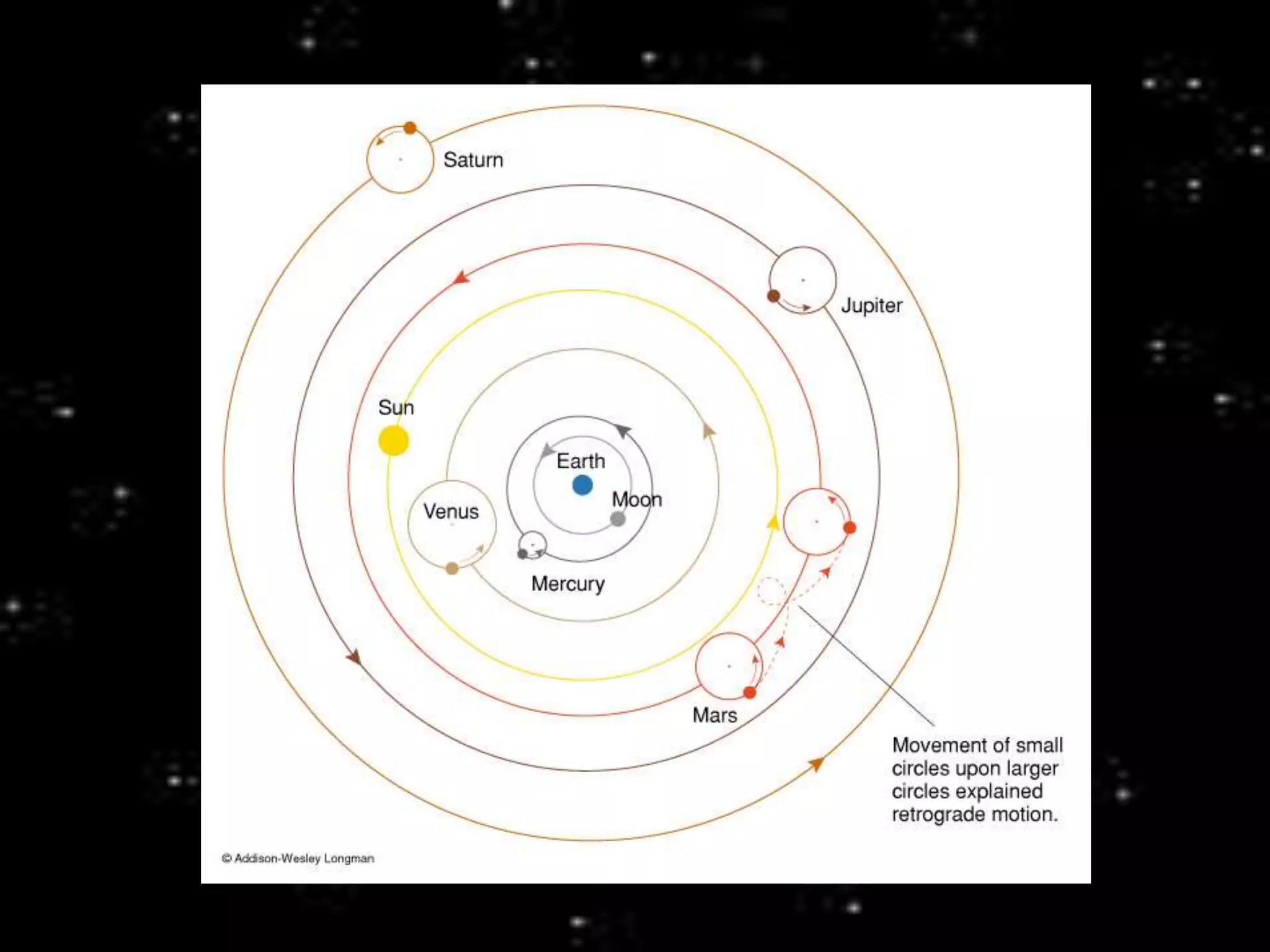
Ptolemaic Model
• Ptolemy (100-170 AD.) explained
retrograde motion with epicycles
Heliocentrism
• Copernicus (1473-1543) developed a theory that
explained retrograde motion without epicycles
• De Revolutionibus Orbium Caelestium was
published near his death
• Completed in 1530 not published until his death
– fear of Church
– inaccurate predictions for planets required epicycles
• Copernicus put the Sun at the center of motion
• The Copernican Model was inaccurate for planet
positions, but heliocentrism is correct
Tycho’s Data
• Tycho Brahe (1546-1601) was a Danish nobleman
who studied Astronomy
• As student, noticed inaccurate planet positions of
earlier models
• In 1572, observed a Supernovae and deduced that
celestial sphere was not constant
• Tycho performed accurate measurements of
positions for 777 stars and all the planets, the
Moon, and the Sun (better than arcminutes)
• Before his death, named Johannes Kepler to be his
successor
Kelper’s Laws
• Kepler was brilliant at mathematics
• Kepler supported heliocentrism
• Noticed that predictions for Mars were off
by up to 8 arcminutes using circular orbits
• Believed Kepler’s data was accurate
• Only other explanation was elliptical orbits
• Discovered 3 laws of planetary Motion
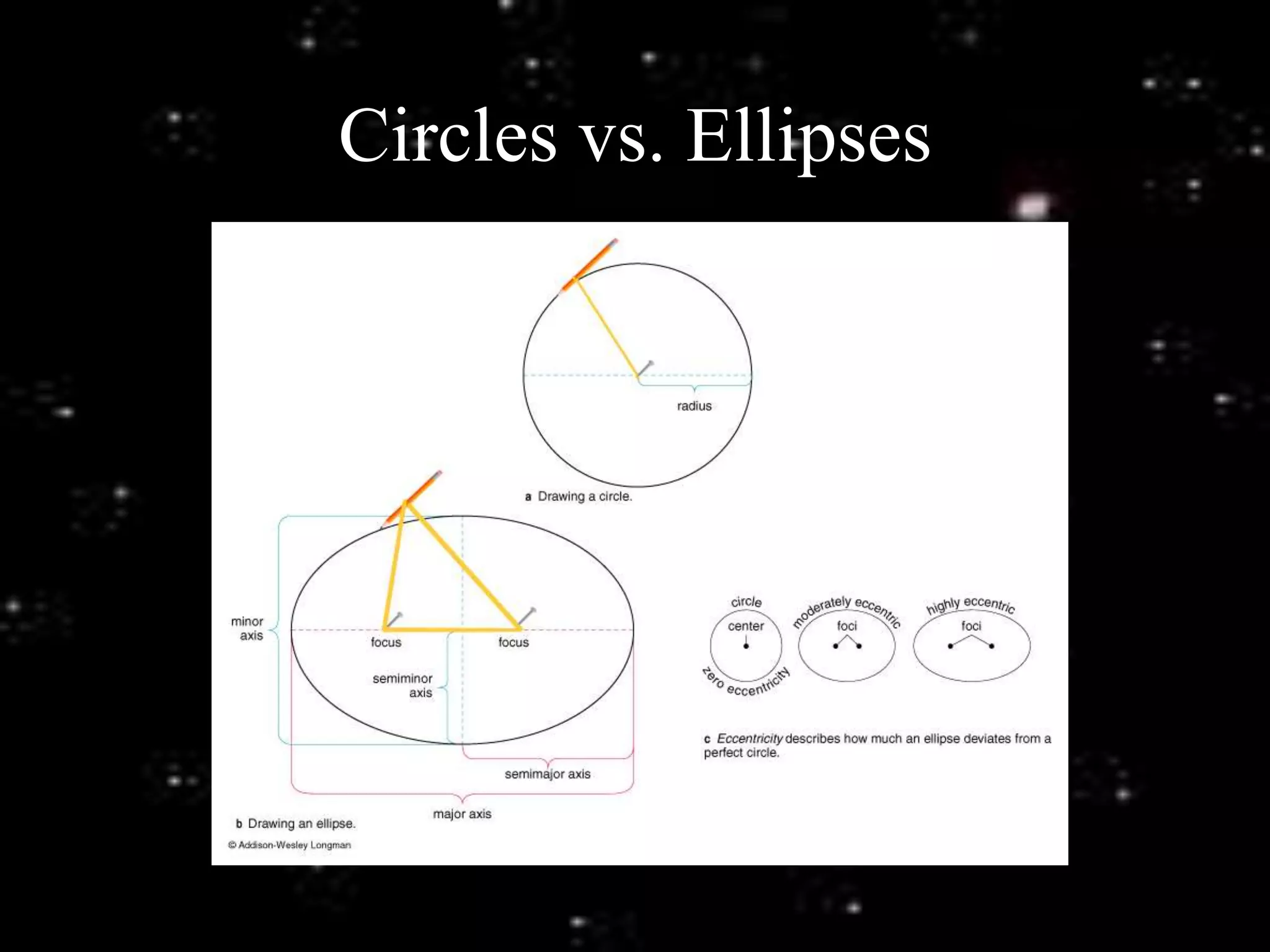
Circles vs. Ellipses
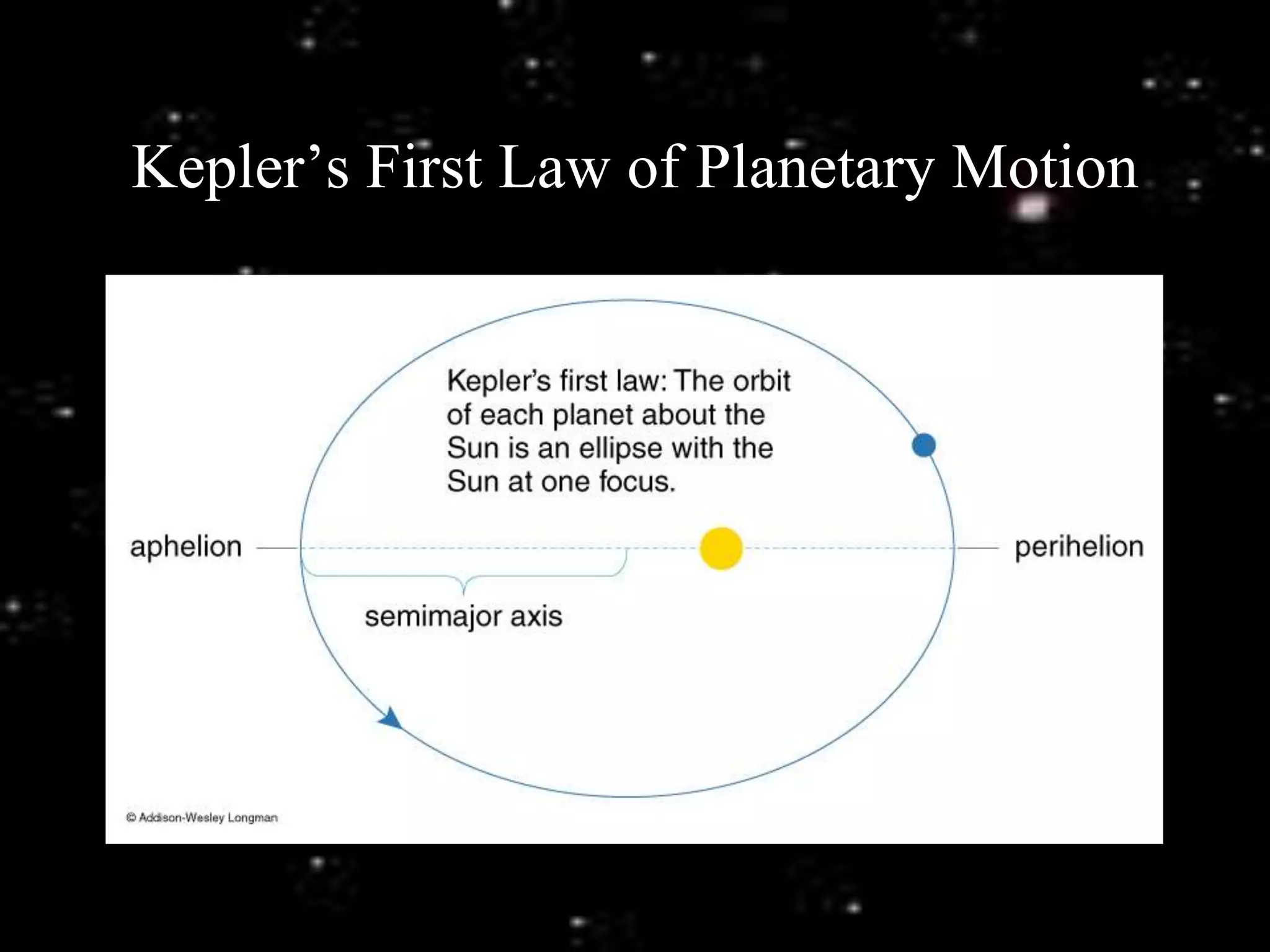
Kepler’s First Law of Planetary Motion
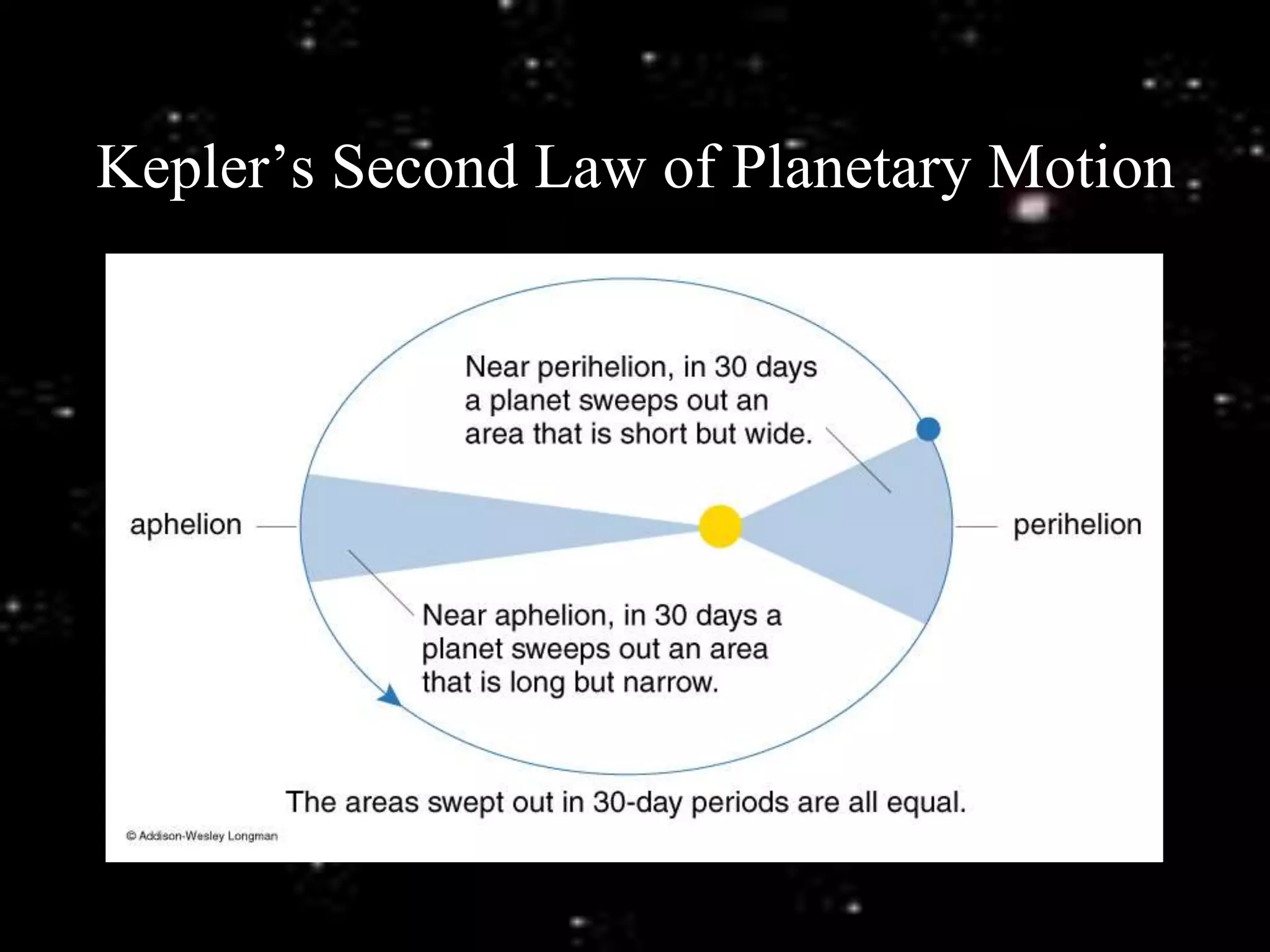
Kepler’s Second Law of Planetary Motion
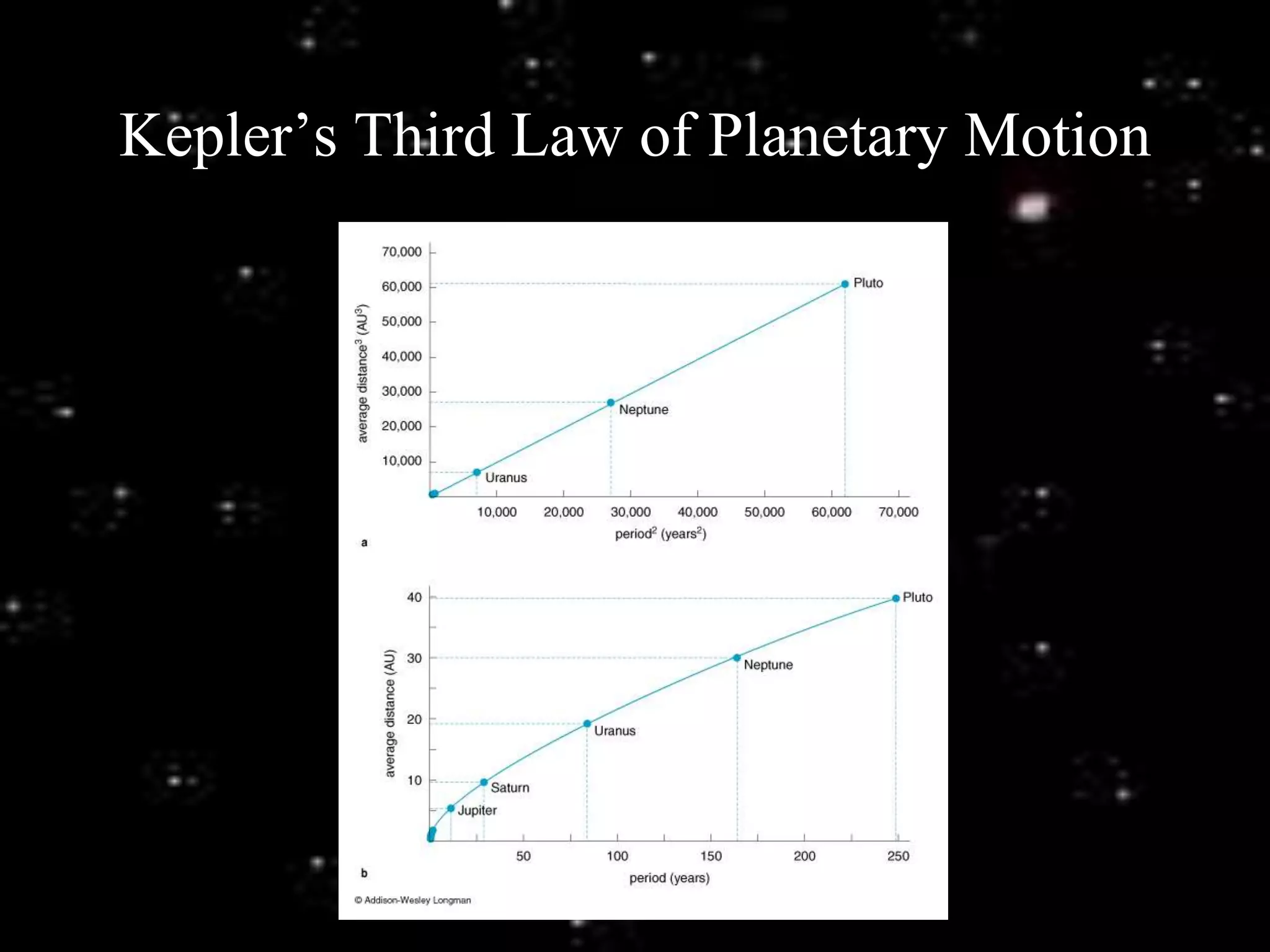
Kepler’s Third Law of Planetary Motion
Galileo and the Telescope
• The telescope was invented by Hans
Lippershy in 1608 (Holland)
• Galileo (1564-1642) was the first to use the
telescope for astronomical observations
• Galileo supported heliocentrism but not
publicly in his early years
• The first 3 of his 5 biggest discoveries were
published in the Sidereal Messenger (1610)
Galileo's Telescopic Discoveries
• The Moon was not a perfect sphere because of
shadows from mountains and valleys
• Milky Way was composed of many stars that are
too faint to see individually without a telescope
• Observed 4 "planets" orbiting Jupiter
– These are now known as the 4 Galilean moons (Io,
Europa, Ganymede, Callisto)
– Proved there could be other centers of motion
• Observed sunspots on Sun
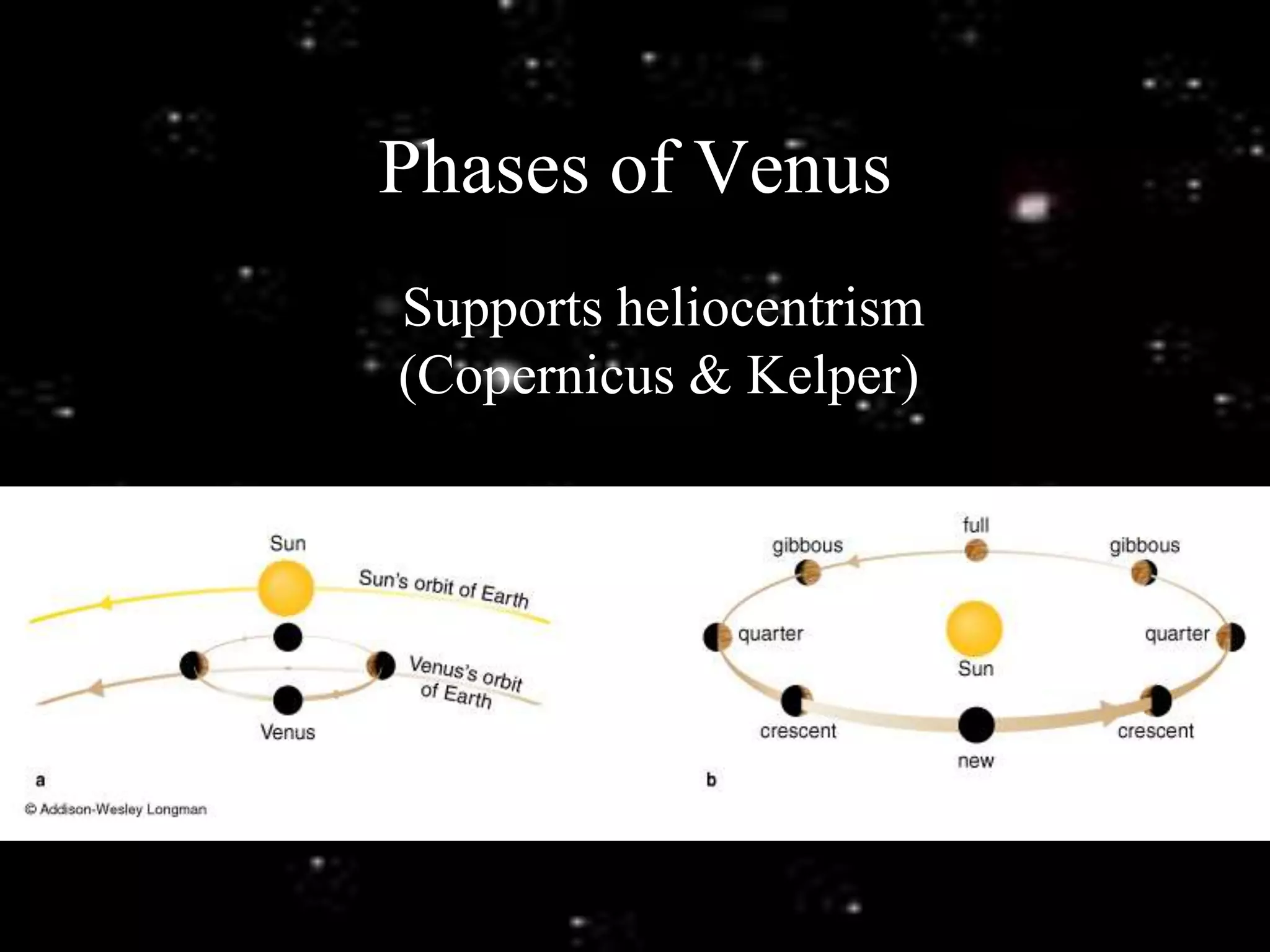
• Venus had phases much like the Moon
Phases of Venus
Supports heliocentrism
(Copernicus & Kelper)
Ancient Astronomy ppt.ppt

Ancient Astronomy ppt.ppt

  • 1.
    Ancient Astronomy • Objectsin the Sky move in cycles – Stars, Sun, Moon, eclipses, etc. • Why did most ancient people care? – Agriculture – Religion • Egyptians aligned pyramids with cardinal directions (2700 - 2100 B.C.) • Natural philosophy of Greece strongly influenced astronomy (500 B.C - 150 A.D)
  • 3.
    Music of theSpheres • Plato (428-347 B.C) argued that the sphere and the circle were perfect shapes because of their symmetry • The heavens being the creation of the god would have to be “perfect” • The heavens were assumed to contain spheres in uniform (constant speed) circular motions • Earth was the center of motion
  • 4.
    Geocentric Universe • Aristotle(384-322 B.C.) expanded on the ideas of Plato and Eudoxus of Cnidus • Aristotle placed the Earth at the center of 56 concentric spheres • Spheres rotated as to explain the observed motions of the Moon, Sun, planets, and stars in the sky • Stars were on the celestial sphere
  • 5.
  • 6.
    Earth the CentralSphere • The Earth always cast a round shadow on the Moon when there was an eclipse • Eratosthenes measured circumference of the Earth (c. 240 B.C) • 250,000 stadia is about 41,700 km • Modern value is 40,000 km
  • 7.
    Aristarchus (310-230 B.C) •Hypothesized the Sun was the center of motion for the planets and Earth • Retrograde motion of Mars, Jupiter, Saturn • Believed Sun was bigger than Earth • Heracleides (388-315 B.C) suggested that Mercury and Venus orbited the sun • Heliocentrism was dismissed for 1800 years
  • 8.
    Ptolemaic Model • Ptolemy(100-170 AD.) explained retrograde motion with epicycles
  • 10.
    Heliocentrism • Copernicus (1473-1543)developed a theory that explained retrograde motion without epicycles • De Revolutionibus Orbium Caelestium was published near his death • Completed in 1530 not published until his death – fear of Church – inaccurate predictions for planets required epicycles • Copernicus put the Sun at the center of motion • The Copernican Model was inaccurate for planet positions, but heliocentrism is correct
  • 11.
    Tycho’s Data • TychoBrahe (1546-1601) was a Danish nobleman who studied Astronomy • As student, noticed inaccurate planet positions of earlier models • In 1572, observed a Supernovae and deduced that celestial sphere was not constant • Tycho performed accurate measurements of positions for 777 stars and all the planets, the Moon, and the Sun (better than arcminutes) • Before his death, named Johannes Kepler to be his successor
  • 12.
    Kelper’s Laws • Keplerwas brilliant at mathematics • Kepler supported heliocentrism • Noticed that predictions for Mars were off by up to 8 arcminutes using circular orbits • Believed Kepler’s data was accurate • Only other explanation was elliptical orbits • Discovered 3 laws of planetary Motion
  • 13.
  • 14.
    Kepler’s First Lawof Planetary Motion
  • 15.
    Kepler’s Second Lawof Planetary Motion
  • 16.
    Kepler’s Third Lawof Planetary Motion
  • 17.
    Galileo and theTelescope • The telescope was invented by Hans Lippershy in 1608 (Holland) • Galileo (1564-1642) was the first to use the telescope for astronomical observations • Galileo supported heliocentrism but not publicly in his early years • The first 3 of his 5 biggest discoveries were published in the Sidereal Messenger (1610)
  • 18.
    Galileo's Telescopic Discoveries •The Moon was not a perfect sphere because of shadows from mountains and valleys • Milky Way was composed of many stars that are too faint to see individually without a telescope • Observed 4 "planets" orbiting Jupiter – These are now known as the 4 Galilean moons (Io, Europa, Ganymede, Callisto) – Proved there could be other centers of motion • Observed sunspots on Sun • Venus had phases much like the Moon
  • 19.
    Phases of Venus Supportsheliocentrism (Copernicus & Kelper)