Introduction to Vectors
•• A vector is a quantity that has both
magnitude and direction.
• • Examples: Displacement, Velocity,
Acceleration, Force.
• • Represented by arrows where length
indicates magnitude and arrowhead shows
direction.
3.
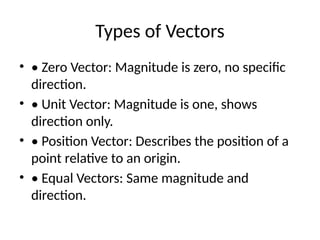
Types of Vectors
•• Zero Vector: Magnitude is zero, no specific
direction.
• • Unit Vector: Magnitude is one, shows
direction only.
• • Position Vector: Describes the position of a
point relative to an origin.
• • Equal Vectors: Same magnitude and
direction.
4.
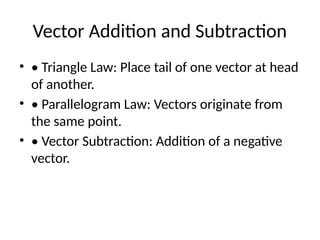
Vector Addition andSubtraction
• • Triangle Law: Place tail of one vector at head
of another.
• • Parallelogram Law: Vectors originate from
the same point.
• • Vector Subtraction: Addition of a negative
vector.
5.
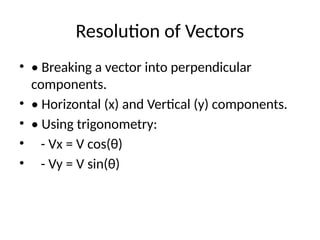
Resolution of Vectors
•• Breaking a vector into perpendicular
components.
• • Horizontal (x) and Vertical (y) components.
• • Using trigonometry:
• - Vx = V cos(θ)
• - Vy = V sin(θ)
6.
Applications of Vectors
•• Navigation: Determining direction and
speed.
• • Physics: Analyzing forces and motion.
• • Engineering: Design and analysis of
structures.