







Introduction
To Business
Research
Research Methodology
Mah Noor
27 Jan 2021
What Is
Research?
Research is the process of
finding solutions to a
problem after a thorough
study and analysis of the
situational factors.
2
Managers in organizations constantly engage themselves
in studying and analyzing issues and hence are involved
in some form of research activity as they make decisions
at the workplace.
Business
Research
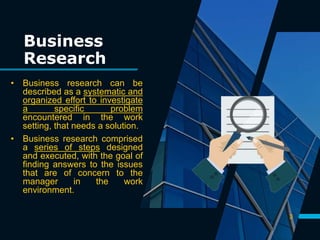
• Business research can be
described as a systematic and
organized effort to investigate
a specific problem
encountered in the work
setting, that needs a solution.
• Business research comprised
a series of steps designed
and executed, with the goal of
finding answers to the issues
that are of concern to the
manager in the work
environment.
3
Problems in
Management
Problems in
management are:
 Employee attitudes and
behaviors
 Human Resource
Management
 Production operation
management
 Information System
4
Problems in
Marketing
Problems in marketing
are:
 Advertising
 Sales Promotion
 Product packaging
 Product pricing
 Consumer preferences
 New product development
5
6
“The secret of success is to
know something nobody
else knows.”
-Aristotle Onassis
7
Kellogg’s
Problems
• The world’s leading
producer of cereals and a
major snack foods
manufacturer Kellogg’s
entered the Indian market
way back in 1994.
• When Kellogg’s initially
launched into the Indian
market it was with crispy
flakes that would go soggy
when consumed with hot
milk. When Indians tried
the unsweetened
breakfast flakes with cold
milk, they couldn’t get the
sugar they added to
dissolve properly.
Where were
they wrong?
8
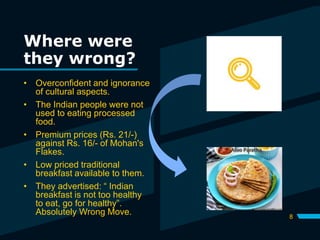
• Overconfident and ignorance
of cultural aspects.
• The Indian people were not
used to eating processed
food.
• Premium prices (Rs. 21/-)
against Rs. 16/- of Mohan's
Flakes.
• Low priced traditional
breakfast available to them.
• They advertised: “ Indian
breakfast is not too healthy
to eat, go for healthy”.
Absolutely Wrong Move.
How Kellogg’s
overcame the
challenges?
9
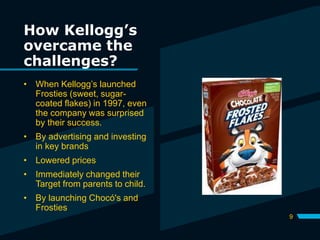
• When Kellogg’s launched
Frosties (sweet, sugar-
coated flakes) in 1997, even
the company was surprised
by their success.
• By advertising and investing
in key brands
• Lowered prices
• Immediately changed their
Target from parents to child.
• By launching Chocó's and
Frosties
10
Types of
Business Research
Research type is a method to discover information
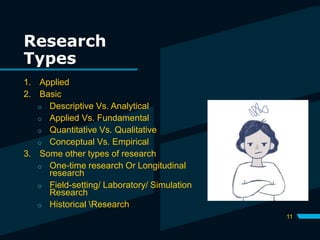
Research
Types
11
1. Applied
2. Basic
o Descriptive Vs. Analytical
o Applied Vs. Fundamental
o Quantitative Vs. Qualitative
o Conceptual Vs. Empirical
3. Some other types of research
o One-time research Or Longitudinal
research
o Field-setting/ Laboratory/ Simulation
Research
o Historical Research
12
Applied Research Basic Research
Applied research
is designed to
answer specific
questions aimed at
solving practical
problems.
Basic research does
not have
immediate commercia
l objectives and
although it certainly
could, it may not
necessarily result in
an invention or a
solution to a practical
problem
Types of
Research
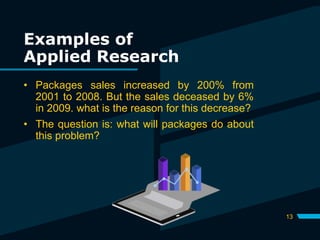
Examples of
Applied Research
13
• Packages sales increased by 200% from
2001 to 2008. But the sales deceased by 6%
in 2009. what is the reason for this decrease?
• The question is: what will packages do about
this problem?
Examples of Basic
Research
14
• University professors engage in basic research in
an effort to understand and generate more
knowledge about various aspects of businesses,
such as:
 How to improve the effectiveness of information
system?
 How to integrate technology into the overall
strategic objectives of an organization?
 How to increase the productivity of the
employees?
 How to increase the effectiveness of small
businesses?
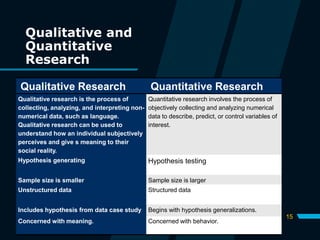
15
Qualitative and
Quantitative
Research
Qualitative Research Quantitative Research
Qualitative research is the process of
collecting, analyzing, and interpreting non-
numerical data, such as language.
Qualitative research can be used to
understand how an individual subjectively
perceives and give s meaning to their
social reality.
Quantitative research involves the process of
objectively collecting and analyzing numerical
data to describe, predict, or control variables of
interest.
Hypothesis generating Hypothesis testing
Sample size is smaller Sample size is larger
Unstructured data Structured data
Includes hypothesis from data case study Begins with hypothesis generalizations.
Concerned with meaning. Concerned with behavior.
16
Research Methods in
Business
CLASSIFICATION
OF RESEARCH BY
METHOD
17
Quantitative Approaches:
Quantitative research approaches are
applied to describe current conditions,
investigate relations, and study cause–
effect phenomena. Types of quantitative
researches are:
• Survey Research
• Correlational Research
• Causal–Comparative Research
• Experimental Research
• Single-Subject Research
CLASSIFICATION
OF RESEARCH BY
METHOD
18
Qualitative Approaches:
Qualitative research seeks to probe
deeply into the research setting to obtain
in-depth understandings about the way
things are, why they are that way, and
how the participants in the context
perceive them. Types of qualitative
approaches are:
• Narrative Research
• Ethnographic Research
• Case Study Research
Quantitative
Research
19
• Survey Research: determines and reports the way things are; it involves
collecting numerical data to test hypotheses or answer questions about the
current status of the subject of study.
• Correlational Research: involves collecting data to determine whether,
and to what degree, a relation exists between two or more quantifiable
variables.
• Causal–Comparative Research: attempts to determine the cause, or
reason, for existing differences in the behavior or status of groups of
individuals.
• Experimental Research: In experimental research, at least one
independent variable is manipulated, other relevant variables are controlled,
and the effect on one or more dependent variables is observed.
• Single-Subject Research: are those used to study the behavior
change that an individual or group exhibits as a result of some
intervention or treatment.
Qualitative
Approaches
20
• Narrative Research: is the study of how different humans
experience the world around them; it involves a methodology that
allows people to tell the stories of their “storied lives”.
• Ethnographic Research: is the study of the cultural patterns and
perspectives of participants in their natural settings.
• Case Study Research: is a qualitative research approach to
conducting research on a unit of study or bounded system (e.g. case
study of different competitive companies)
21
Internal and External
Researchers
22
Internal External
Internal data is
information
generated from
within the business,
covering areas such
as operations,
maintenance,
personnel, and
finance.
External data comes
from the market,
including customers
and competitors.
It’s things like statistics
from surveys,
questionnaires,
research, and
customer feedback.
Data Sources
Ethics and
Business
Research
23
• Ethics in business research refers to a
code of conduct of behavior while
conducting research.
• Ethical conduct applies to the organization
and the members that sponsors the
research. The researcher who undertake
the research, and the respondents that
provide them with necessary data.
24
Any
Question?
Questions?
25
1. Define Research?
2. Write any two applications of research in
business?
3. Difference between quantitative and qualitative
research.
4. What is basic research?
5. What are the different types of research?
6. Define Narrative Research?
7. Define Casual Comparative Research?
26
THANK YOU!

Introduction to Business Research

  • 1.
  • 2.
    What Is Research? Research isthe process of finding solutions to a problem after a thorough study and analysis of the situational factors. 2 Managers in organizations constantly engage themselves in studying and analyzing issues and hence are involved in some form of research activity as they make decisions at the workplace.
  • 3.
    Business Research • Business researchcan be described as a systematic and organized effort to investigate a specific problem encountered in the work setting, that needs a solution. • Business research comprised a series of steps designed and executed, with the goal of finding answers to the issues that are of concern to the manager in the work environment. 3
  • 4.
    Problems in Management Problems in managementare:  Employee attitudes and behaviors  Human Resource Management  Production operation management  Information System 4
  • 5.
    Problems in Marketing Problems inmarketing are:  Advertising  Sales Promotion  Product packaging  Product pricing  Consumer preferences  New product development 5
  • 6.
    6 “The secret ofsuccess is to know something nobody else knows.” -Aristotle Onassis
  • 7.
    7 Kellogg’s Problems • The world’sleading producer of cereals and a major snack foods manufacturer Kellogg’s entered the Indian market way back in 1994. • When Kellogg’s initially launched into the Indian market it was with crispy flakes that would go soggy when consumed with hot milk. When Indians tried the unsweetened breakfast flakes with cold milk, they couldn’t get the sugar they added to dissolve properly.
  • 8.
    Where were they wrong? 8 •Overconfident and ignorance of cultural aspects. • The Indian people were not used to eating processed food. • Premium prices (Rs. 21/-) against Rs. 16/- of Mohan's Flakes. • Low priced traditional breakfast available to them. • They advertised: “ Indian breakfast is not too healthy to eat, go for healthy”. Absolutely Wrong Move.
  • 9.
    How Kellogg’s overcame the challenges? 9 •When Kellogg’s launched Frosties (sweet, sugar- coated flakes) in 1997, even the company was surprised by their success. • By advertising and investing in key brands • Lowered prices • Immediately changed their Target from parents to child. • By launching Chocó's and Frosties
  • 10.
    10 Types of Business Research Researchtype is a method to discover information
  • 11.
    Research Types 11 1. Applied 2. Basic oDescriptive Vs. Analytical o Applied Vs. Fundamental o Quantitative Vs. Qualitative o Conceptual Vs. Empirical 3. Some other types of research o One-time research Or Longitudinal research o Field-setting/ Laboratory/ Simulation Research o Historical Research
  • 12.
    12 Applied Research BasicResearch Applied research is designed to answer specific questions aimed at solving practical problems. Basic research does not have immediate commercia l objectives and although it certainly could, it may not necessarily result in an invention or a solution to a practical problem Types of Research
  • 13.
    Examples of Applied Research 13 •Packages sales increased by 200% from 2001 to 2008. But the sales deceased by 6% in 2009. what is the reason for this decrease? • The question is: what will packages do about this problem?
  • 14.
    Examples of Basic Research 14 •University professors engage in basic research in an effort to understand and generate more knowledge about various aspects of businesses, such as:  How to improve the effectiveness of information system?  How to integrate technology into the overall strategic objectives of an organization?  How to increase the productivity of the employees?  How to increase the effectiveness of small businesses?
  • 15.
    15 Qualitative and Quantitative Research Qualitative ResearchQuantitative Research Qualitative research is the process of collecting, analyzing, and interpreting non- numerical data, such as language. Qualitative research can be used to understand how an individual subjectively perceives and give s meaning to their social reality. Quantitative research involves the process of objectively collecting and analyzing numerical data to describe, predict, or control variables of interest. Hypothesis generating Hypothesis testing Sample size is smaller Sample size is larger Unstructured data Structured data Includes hypothesis from data case study Begins with hypothesis generalizations. Concerned with meaning. Concerned with behavior.
  • 16.
  • 17.
    CLASSIFICATION OF RESEARCH BY METHOD 17 QuantitativeApproaches: Quantitative research approaches are applied to describe current conditions, investigate relations, and study cause– effect phenomena. Types of quantitative researches are: • Survey Research • Correlational Research • Causal–Comparative Research • Experimental Research • Single-Subject Research
  • 18.
    CLASSIFICATION OF RESEARCH BY METHOD 18 QualitativeApproaches: Qualitative research seeks to probe deeply into the research setting to obtain in-depth understandings about the way things are, why they are that way, and how the participants in the context perceive them. Types of qualitative approaches are: • Narrative Research • Ethnographic Research • Case Study Research
  • 19.
    Quantitative Research 19 • Survey Research:determines and reports the way things are; it involves collecting numerical data to test hypotheses or answer questions about the current status of the subject of study. • Correlational Research: involves collecting data to determine whether, and to what degree, a relation exists between two or more quantifiable variables. • Causal–Comparative Research: attempts to determine the cause, or reason, for existing differences in the behavior or status of groups of individuals. • Experimental Research: In experimental research, at least one independent variable is manipulated, other relevant variables are controlled, and the effect on one or more dependent variables is observed. • Single-Subject Research: are those used to study the behavior change that an individual or group exhibits as a result of some intervention or treatment.
  • 20.
    Qualitative Approaches 20 • Narrative Research:is the study of how different humans experience the world around them; it involves a methodology that allows people to tell the stories of their “storied lives”. • Ethnographic Research: is the study of the cultural patterns and perspectives of participants in their natural settings. • Case Study Research: is a qualitative research approach to conducting research on a unit of study or bounded system (e.g. case study of different competitive companies)
  • 21.
  • 22.
    22 Internal External Internal datais information generated from within the business, covering areas such as operations, maintenance, personnel, and finance. External data comes from the market, including customers and competitors. It’s things like statistics from surveys, questionnaires, research, and customer feedback. Data Sources
  • 23.
    Ethics and Business Research 23 • Ethicsin business research refers to a code of conduct of behavior while conducting research. • Ethical conduct applies to the organization and the members that sponsors the research. The researcher who undertake the research, and the respondents that provide them with necessary data.
  • 24.
  • 25.
    Questions? 25 1. Define Research? 2.Write any two applications of research in business? 3. Difference between quantitative and qualitative research. 4. What is basic research? 5. What are the different types of research? 6. Define Narrative Research? 7. Define Casual Comparative Research?
  • 26.