INFORMAL FALLACIES
Copyright © Mahnoor
FALLACY
 Fallacy refers to a defect in reasoning i.e.
false argument(incorrect argument).
 Similarly, any mistaken idea or false belief
may sometimes be labeled “fallacious.”
 Fallacies may be committed intentionally
or unintentionally.
 Fallacies are commonly used in our daily
lives such as in advertisements and
politics.
Copyright © Mahnoor
TYPES OF FALLACIES
FORMAL FALLACY:
A defect in the form of an argument i.e. poor
form of argument. It includes the following:
⮚ Affirming the consequent:
P1: If X thenY
P2:Y
C:Therefore X
Example:
P1: If someone is allergic to peanut, then she doesn’t
eat peanut butter.
P2: Jane doesn’t eat peanut butter.
C:Therefore, Jane is allergic to peanuts.
Copyright © Mahnoor
⮚To affirm the consequent is to infer the truth
of the truth of the antecedent of a
conditional statement from the truth of the
conditional and its consequent.
Denying the antecedent:
P1: If P then Q
P2: Not P
C:Therefore not Q
Example:
P1: If you are a teacher, then you have a
job.
P2:You are not a teacher.
C :Therefore, you do not have a job.
Copyright © Mahnoor
CLASSIFICATION OF
FALLACIES
⮚Fallacies of relevance.
⮚Fallacies of defective induction.
⮚Fallacies of presumption.
⮚Fallacies of ambiguity.
Copyright © Mahnoor
FALLACIES OF RELEVANCE
⮚ This fallacy arises when there is no connection
between the premises and the conclusion.These
include:
❖ Appeal to the Populace: Establishes the truth of
some claim P on the basis that a lot of people
believe P to be true. Something can be false even if
everyone thinks its true and vice versa.
Example:
(1)You should buy “Flossy dental floss.”
(2)90% of people already use “Flossy dental floss.”
(C)Therefore you should use “Flossy dental floss.”
Copyright © Mahnoor
Example:
P1: Millions of people think that Justin Bieber
has musical talent.
C: Therefore, Justin Bieber has musical
talent.
Fallacy of Straw man: Distorting an
opponent’s argument for the purpose of
making it easier to object or misrepresenting
an opponent’s argument to make it weaker.
Example:
P1: The factory workers have put in a petition
for better ventilation in their workplace.
Copyright © Mahnoor
P2: Air conditioning is far too expensive and will take
to much time and money to put in place.
C: Therefore we should not give the workers better
ventilation.
❖ The Red Herring: An informal fallacy committed
when some distraction is used to mislead and
confuse.
Example:
(1)Some people claim that television is preventing
kids from learning to read.
(2)But our television programs today are fantastic.
They are well written, directed and acted. They have
bearing on real life. TV is great.
But the original claim wasn’t if TV is great.
Copyright © Mahnoor
❖Appeal to Force: An informal fallacy committed
when force, or threat of force is relied on to win
consent.
Example:
(1) You should vote for Nawaz Sharif.
(2) If you don’t, I will get you fired from this job.
(C)Therefore you should vote for Nawaz Sharif.
❖ Argument against the person( Ad Hominem):
An informal fallacy committed when, rather than
attacking the substance of some position, one
attacks the person of its advocate, either
abusively or as a consequence of his or her
special circumstances.
Copyright © Mahnoor
Example(Abusive):
He is not a good athlete; he is a fraud, a cheat
and a liar.
❖ Appeal to Emotion: An informal fallacy
committed when the support offered for
some conclusion is emotions-fear, envy, pity,
or the like- of the listeners.
Example:
(1)You should find me not guilty.
(2)If I go to jail, my children will starve.
(C)Therefore you should find me not guilty.
Copyright © Mahnoor
❖ Missing the point: An informal fallacy committed
when an argument entails one conclusion but the
arguer claims it entails another conclusion from
the argument.
Example:
(1)We are quickly diminishing the supplies of fossil
fuels in the earth.
(C)Therefore we should give up on cars and
electricity and go back to the ways of the Amish.
Example:
(1)There are many angry riots occurring in the
street.
(C)We must start killing people that gather in groups
larger than three.
Copyright © Mahnoor
FALLACIES OF DEFEECTIVE
INDUCTION
❖These fallacies are committed when the
premises do not serve as good reasons to
reach the conclusion drawn.These include:
❖Appeal to Ignorance: Claiming that simply
because something has not yet been proven,
that it is not the case or vice versa.
Example:
(1)No one has ever provided real evidence that
ghosts do not exist.
Copyright © Mahnoor
(C)Therefore ghosts exist.
Example:
(1)No one has ever provided substantial proof
that God doesn’t exist.
(C)Therefore God exists.
❖ Appeal to Inappropriate Authority: An
informal fallacy in which the appeal to
authority is illegitimate, either because the
authority appealed to has no special claim to
expertise on the topic at issue, or, more
generally, because no authority is assured to
be reliable. Copyright © Mahnoor
Example: Gun laws should be extremely strict and it
should be incredibly difficult to acquire a gun. Many
respected people such as actor, Brad Pitt have
expressed their support for this.
Hasty Generalization: An informal fallacy in which
a principle that is true of a particular case is applied
carelessly or deliberately to the great run of cases.
Example:
I just saw a black person mug someone.
(C)Therefore all black people are thieves.
False Cause: An informal fallacy in which the
mistake arises from accepting as the cause of an
Copyright © Mahnoor
Event what really is not its cause.
Example:
(1)Jane took some cold medication before her math's
test.
(2)She got 98%.
(C)The cold medication made Jane ace her test.
FALLACIES OF PRESUMPTION
These are fallacies in which the conclusion is
presumed in the premises or vice versa. They
include the following:
❖ Begging the question (Circular reasoning): An
informal fallacy in which the conclusion of an
argument is stated or assumed in one of the
premises.
Copyright © Mahnoor
Example:
Student: Why didn’t I receive full credit on my
essay?
Teacher: Because your paper did not meet the
requirements for full credit.
Example:
Smoking cigarettes can kill you because
cigarettes are deadly.
Copyright © Mahnoor
Complex Question: This is a fallacy in which you have
two or more questions asked, but they are disguised as
one. No matter what you answer to the second
question, you will be forced to have the same answer
to the first.
Example:
Have you stopped beating up little old ladies?
Answer: YES
Conclusion: So you used to beat up little old ladies.
OR
Answer: NO
Conclusion: So you are still beating up little old ladies.
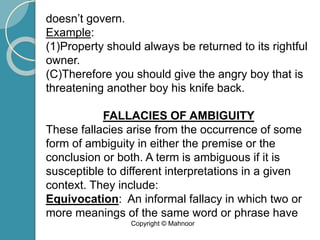
Accident: An informal fallacy in which generalization is
applied to individual cases that it
Copyright © Mahnoor
doesn’t govern.
Example:
(1)Property should always be returned to its rightful
owner.
(C)Therefore you should give the angry boy that is
threatening another boy his knife back.
FALLACIES OF AMBIGUITY
These fallacies arise from the occurrence of some
form of ambiguity in either the premise or the
conclusion or both. A term is ambiguous if it is
susceptible to different interpretations in a given
context. They include:
Equivocation: An informal fallacy in which two or
more meanings of the same word or phrase have
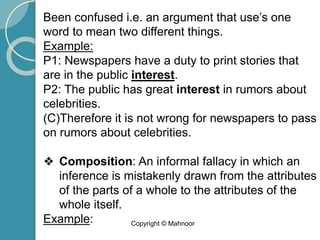
Copyright © Mahnoor
Been confused i.e. an argument that use’s one
word to mean two different things.
Example:
P1: Newspapers have a duty to print stories that
are in the public interest.
P2: The public has great interest in rumors about
celebrities.
(C)Therefore it is not wrong for newspapers to pass
on rumors about celebrities.
❖ Composition: An informal fallacy in which an
inference is mistakenly drawn from the attributes
of the parts of a whole to the attributes of the
whole itself.
Example: Copyright © Mahnoor
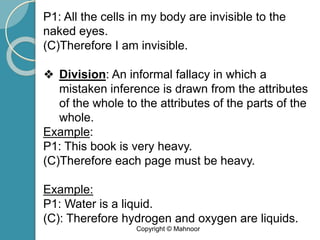
P1: All the cells in my body are invisible to the
naked eyes.
(C)Therefore I am invisible.
❖ Division: An informal fallacy in which a
mistaken inference is drawn from the attributes
of the whole to the attributes of the parts of the
whole.
Example:
P1: This book is very heavy.
(C)Therefore each page must be heavy.
Example:
P1: Water is a liquid.
(C): Therefore hydrogen and oxygen are liquids.
Copyright © Mahnoor
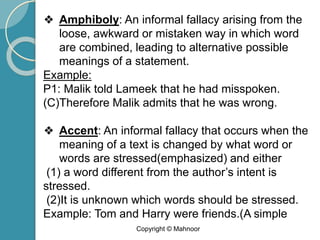
❖ Amphiboly: An informal fallacy arising from the
loose, awkward or mistaken way in which word
are combined, leading to alternative possible
meanings of a statement.
Example:
P1: Malik told Lameek that he had misspoken.
(C)Therefore Malik admits that he was wrong.
❖ Accent: An informal fallacy that occurs when the
meaning of a text is changed by what word or
words are stressed(emphasized) and either
(1) a word different from the author’s intent is
stressed.
(2)It is unknown which words should be stressed.
Example: Tom and Harry were friends.(A simple
Copyright © Mahnoor
Statement of fact by the author)
Text quoted using fallacy of accent:
Tom and Harry “were” friends(could imply they
are no longer friends which would violate the
original author’s intent.
Copyright © Mahnoor
AVOIDANCE OF FALLACIES
❖We encounter fallacies almost everywhere i.e.
in Politics, sales people and children often
use fallacies in order to get us to think what
they want us to think.
❖How to avoid fallacies will show you how to
identify and avoid many of the fallacies that
people use to get us to think the way they want
us to think.
Copyright © Mahnoor
You should reject reasoning when the author:
❖ Attacks a person or a person’s background
instead of the person’s idea.
❖ Uses slippery slope reasoning.
❖ Reflects a search for perfect solutions.
❖ Equivocates: defined as to use of vague
language in order to mislead or deceive.
❖ Inappropriately appeals to common opinion.
❖ Appeals to questionable authority.
❖ Appeals to emotions.
❖ Presents a faulty dilemma.
❖ Engages in wishful thinking.
❖ Explain by naming.
❖ Divert attention from the issue.
❖ Begs the question.
Copyright © Mahnoor
SRATEGIES FOR AVOIDING FALLACIES
❖Pretend to argue against yourself.
❖List the evidence for each of your main
points.
❖Investigate your own personal fallacies.
❖Fairly characterize the arguments of others.
❖Build your self-confidence and self-esteem.
❖Cultivate good listening skills, study other
arguments for fallacies.
❖Avoid ambiguous, vague terms and faulty
grammar.
Copyright © Mahnoor
❖ Know your topic. Do your research.
❖ Watch your body language.
❖ Don’t aim on winning every argument. Seek
the truth not victory.
FACTORS OF AVOIDING FALLACIES
Three factors that underlie the commission of
fallacies in real life are :
❖ Intent:
The first is intent. Many fallacies are
committed intentionally. The arguer may know
well that his reasoning is defective but goes
ahead with it because of some benefit for
himself or some other persons.
Copyright © Mahnoor
❖Mental carelessness:
The second factor that leads to the
commission of fallacy is mental carelessness
combined with unchecked emotions
❖Unexamined world view: The third factor is
unexamined world view. To avoid this fallacy,
the arguer must acknowledge and critique his
presupposition.
Copyright © Mahnoor

Informal fallacies in Logic

  • 1.
  • 2.
    FALLACY  Fallacy refersto a defect in reasoning i.e. false argument(incorrect argument).  Similarly, any mistaken idea or false belief may sometimes be labeled “fallacious.”  Fallacies may be committed intentionally or unintentionally.  Fallacies are commonly used in our daily lives such as in advertisements and politics. Copyright © Mahnoor
  • 3.
    TYPES OF FALLACIES FORMALFALLACY: A defect in the form of an argument i.e. poor form of argument. It includes the following: ⮚ Affirming the consequent: P1: If X thenY P2:Y C:Therefore X Example: P1: If someone is allergic to peanut, then she doesn’t eat peanut butter. P2: Jane doesn’t eat peanut butter. C:Therefore, Jane is allergic to peanuts. Copyright © Mahnoor
  • 4.
    ⮚To affirm theconsequent is to infer the truth of the truth of the antecedent of a conditional statement from the truth of the conditional and its consequent. Denying the antecedent: P1: If P then Q P2: Not P C:Therefore not Q Example: P1: If you are a teacher, then you have a job. P2:You are not a teacher. C :Therefore, you do not have a job. Copyright © Mahnoor
  • 5.
    CLASSIFICATION OF FALLACIES ⮚Fallacies ofrelevance. ⮚Fallacies of defective induction. ⮚Fallacies of presumption. ⮚Fallacies of ambiguity. Copyright © Mahnoor
  • 6.
    FALLACIES OF RELEVANCE ⮚This fallacy arises when there is no connection between the premises and the conclusion.These include: ❖ Appeal to the Populace: Establishes the truth of some claim P on the basis that a lot of people believe P to be true. Something can be false even if everyone thinks its true and vice versa. Example: (1)You should buy “Flossy dental floss.” (2)90% of people already use “Flossy dental floss.” (C)Therefore you should use “Flossy dental floss.” Copyright © Mahnoor
  • 7.
    Example: P1: Millions ofpeople think that Justin Bieber has musical talent. C: Therefore, Justin Bieber has musical talent. Fallacy of Straw man: Distorting an opponent’s argument for the purpose of making it easier to object or misrepresenting an opponent’s argument to make it weaker. Example: P1: The factory workers have put in a petition for better ventilation in their workplace. Copyright © Mahnoor
  • 8.
    P2: Air conditioningis far too expensive and will take to much time and money to put in place. C: Therefore we should not give the workers better ventilation. ❖ The Red Herring: An informal fallacy committed when some distraction is used to mislead and confuse. Example: (1)Some people claim that television is preventing kids from learning to read. (2)But our television programs today are fantastic. They are well written, directed and acted. They have bearing on real life. TV is great. But the original claim wasn’t if TV is great. Copyright © Mahnoor
  • 9.
    ❖Appeal to Force:An informal fallacy committed when force, or threat of force is relied on to win consent. Example: (1) You should vote for Nawaz Sharif. (2) If you don’t, I will get you fired from this job. (C)Therefore you should vote for Nawaz Sharif. ❖ Argument against the person( Ad Hominem): An informal fallacy committed when, rather than attacking the substance of some position, one attacks the person of its advocate, either abusively or as a consequence of his or her special circumstances. Copyright © Mahnoor
  • 10.
    Example(Abusive): He is nota good athlete; he is a fraud, a cheat and a liar. ❖ Appeal to Emotion: An informal fallacy committed when the support offered for some conclusion is emotions-fear, envy, pity, or the like- of the listeners. Example: (1)You should find me not guilty. (2)If I go to jail, my children will starve. (C)Therefore you should find me not guilty. Copyright © Mahnoor
  • 11.
    ❖ Missing thepoint: An informal fallacy committed when an argument entails one conclusion but the arguer claims it entails another conclusion from the argument. Example: (1)We are quickly diminishing the supplies of fossil fuels in the earth. (C)Therefore we should give up on cars and electricity and go back to the ways of the Amish. Example: (1)There are many angry riots occurring in the street. (C)We must start killing people that gather in groups larger than three. Copyright © Mahnoor
  • 12.
    FALLACIES OF DEFEECTIVE INDUCTION ❖Thesefallacies are committed when the premises do not serve as good reasons to reach the conclusion drawn.These include: ❖Appeal to Ignorance: Claiming that simply because something has not yet been proven, that it is not the case or vice versa. Example: (1)No one has ever provided real evidence that ghosts do not exist. Copyright © Mahnoor
  • 13.
    (C)Therefore ghosts exist. Example: (1)Noone has ever provided substantial proof that God doesn’t exist. (C)Therefore God exists. ❖ Appeal to Inappropriate Authority: An informal fallacy in which the appeal to authority is illegitimate, either because the authority appealed to has no special claim to expertise on the topic at issue, or, more generally, because no authority is assured to be reliable. Copyright © Mahnoor
  • 14.
    Example: Gun lawsshould be extremely strict and it should be incredibly difficult to acquire a gun. Many respected people such as actor, Brad Pitt have expressed their support for this. Hasty Generalization: An informal fallacy in which a principle that is true of a particular case is applied carelessly or deliberately to the great run of cases. Example: I just saw a black person mug someone. (C)Therefore all black people are thieves. False Cause: An informal fallacy in which the mistake arises from accepting as the cause of an Copyright © Mahnoor
  • 15.
    Event what reallyis not its cause. Example: (1)Jane took some cold medication before her math's test. (2)She got 98%. (C)The cold medication made Jane ace her test. FALLACIES OF PRESUMPTION These are fallacies in which the conclusion is presumed in the premises or vice versa. They include the following: ❖ Begging the question (Circular reasoning): An informal fallacy in which the conclusion of an argument is stated or assumed in one of the premises. Copyright © Mahnoor
  • 16.
    Example: Student: Why didn’tI receive full credit on my essay? Teacher: Because your paper did not meet the requirements for full credit. Example: Smoking cigarettes can kill you because cigarettes are deadly. Copyright © Mahnoor
  • 17.
    Complex Question: Thisis a fallacy in which you have two or more questions asked, but they are disguised as one. No matter what you answer to the second question, you will be forced to have the same answer to the first. Example: Have you stopped beating up little old ladies? Answer: YES Conclusion: So you used to beat up little old ladies. OR Answer: NO Conclusion: So you are still beating up little old ladies. Accident: An informal fallacy in which generalization is applied to individual cases that it Copyright © Mahnoor
  • 18.
    doesn’t govern. Example: (1)Property shouldalways be returned to its rightful owner. (C)Therefore you should give the angry boy that is threatening another boy his knife back. FALLACIES OF AMBIGUITY These fallacies arise from the occurrence of some form of ambiguity in either the premise or the conclusion or both. A term is ambiguous if it is susceptible to different interpretations in a given context. They include: Equivocation: An informal fallacy in which two or more meanings of the same word or phrase have Copyright © Mahnoor
  • 19.
    Been confused i.e.an argument that use’s one word to mean two different things. Example: P1: Newspapers have a duty to print stories that are in the public interest. P2: The public has great interest in rumors about celebrities. (C)Therefore it is not wrong for newspapers to pass on rumors about celebrities. ❖ Composition: An informal fallacy in which an inference is mistakenly drawn from the attributes of the parts of a whole to the attributes of the whole itself. Example: Copyright © Mahnoor
  • 20.
    P1: All thecells in my body are invisible to the naked eyes. (C)Therefore I am invisible. ❖ Division: An informal fallacy in which a mistaken inference is drawn from the attributes of the whole to the attributes of the parts of the whole. Example: P1: This book is very heavy. (C)Therefore each page must be heavy. Example: P1: Water is a liquid. (C): Therefore hydrogen and oxygen are liquids. Copyright © Mahnoor
  • 21.
    ❖ Amphiboly: Aninformal fallacy arising from the loose, awkward or mistaken way in which word are combined, leading to alternative possible meanings of a statement. Example: P1: Malik told Lameek that he had misspoken. (C)Therefore Malik admits that he was wrong. ❖ Accent: An informal fallacy that occurs when the meaning of a text is changed by what word or words are stressed(emphasized) and either (1) a word different from the author’s intent is stressed. (2)It is unknown which words should be stressed. Example: Tom and Harry were friends.(A simple Copyright © Mahnoor
  • 22.
    Statement of factby the author) Text quoted using fallacy of accent: Tom and Harry “were” friends(could imply they are no longer friends which would violate the original author’s intent. Copyright © Mahnoor
  • 23.
    AVOIDANCE OF FALLACIES ❖Weencounter fallacies almost everywhere i.e. in Politics, sales people and children often use fallacies in order to get us to think what they want us to think. ❖How to avoid fallacies will show you how to identify and avoid many of the fallacies that people use to get us to think the way they want us to think. Copyright © Mahnoor
  • 24.
    You should rejectreasoning when the author: ❖ Attacks a person or a person’s background instead of the person’s idea. ❖ Uses slippery slope reasoning. ❖ Reflects a search for perfect solutions. ❖ Equivocates: defined as to use of vague language in order to mislead or deceive. ❖ Inappropriately appeals to common opinion. ❖ Appeals to questionable authority. ❖ Appeals to emotions. ❖ Presents a faulty dilemma. ❖ Engages in wishful thinking. ❖ Explain by naming. ❖ Divert attention from the issue. ❖ Begs the question. Copyright © Mahnoor
  • 25.
    SRATEGIES FOR AVOIDINGFALLACIES ❖Pretend to argue against yourself. ❖List the evidence for each of your main points. ❖Investigate your own personal fallacies. ❖Fairly characterize the arguments of others. ❖Build your self-confidence and self-esteem. ❖Cultivate good listening skills, study other arguments for fallacies. ❖Avoid ambiguous, vague terms and faulty grammar. Copyright © Mahnoor
  • 26.
    ❖ Know yourtopic. Do your research. ❖ Watch your body language. ❖ Don’t aim on winning every argument. Seek the truth not victory. FACTORS OF AVOIDING FALLACIES Three factors that underlie the commission of fallacies in real life are : ❖ Intent: The first is intent. Many fallacies are committed intentionally. The arguer may know well that his reasoning is defective but goes ahead with it because of some benefit for himself or some other persons. Copyright © Mahnoor
  • 27.
    ❖Mental carelessness: The secondfactor that leads to the commission of fallacy is mental carelessness combined with unchecked emotions ❖Unexamined world view: The third factor is unexamined world view. To avoid this fallacy, the arguer must acknowledge and critique his presupposition. Copyright © Mahnoor