(Everything is
Grounded In logic)
Introduction to logic
(Everything is Grounded In logic)
Prepared by
The students
of
BBA 2nd
Semester
• The Purpose of Definition
• TheTypes of Definition
• Various Kinds of Meaning
• Techniques For Defining
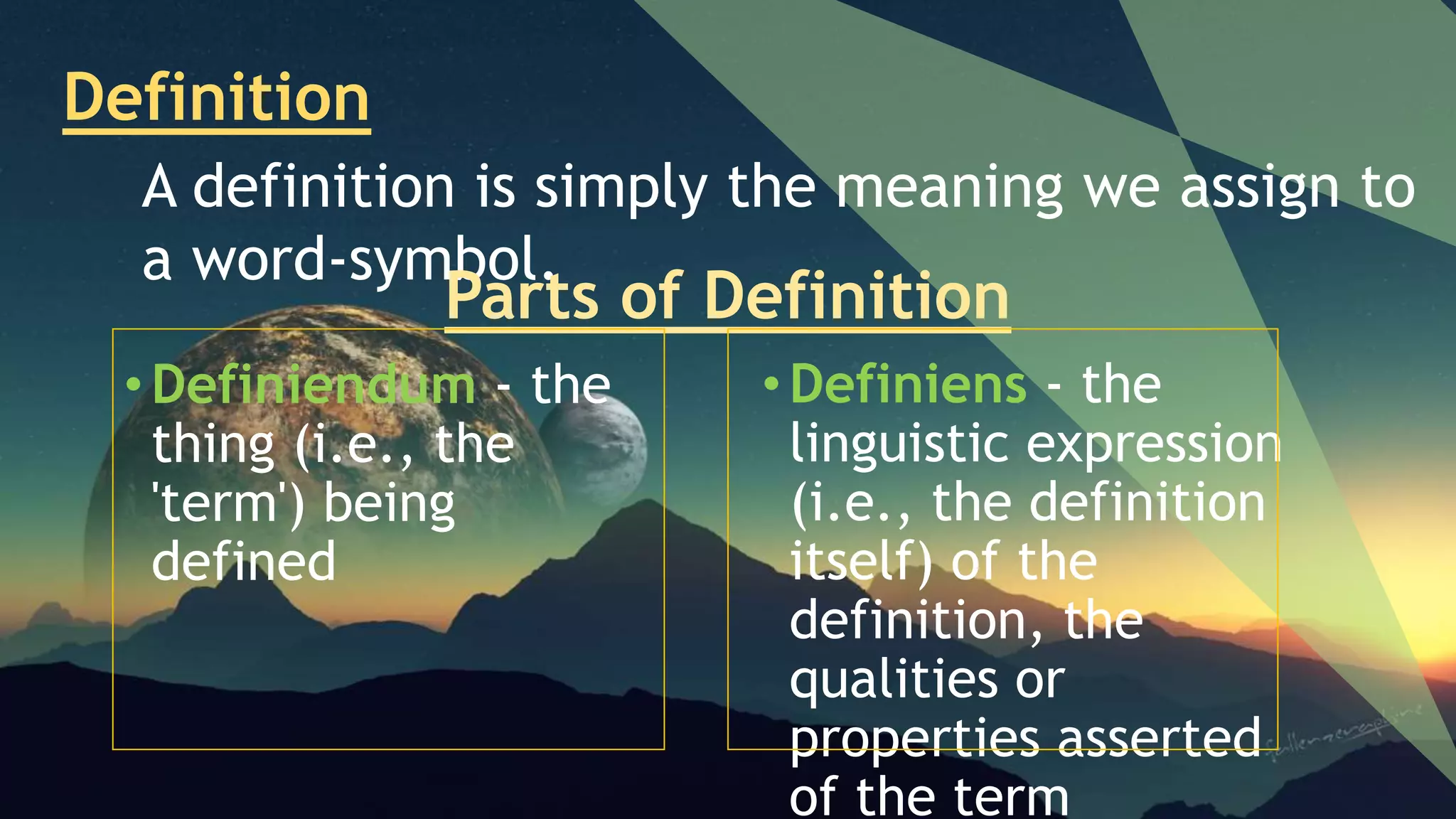
Definition
A definition is simply the meaning we assign to
a word-symbol.
Parts of Definition
•Definiendum - the
thing (i.e., the
'term') being
defined
•Definiens - the
linguistic expression
(i.e., the definition
itself) of the
definition, the
qualities or
properties asserted
of the term
Types of Definitions
Intensional - (connotation) Assigns
meaning by indicating the qualities of
term.
Extensional - (denotation) Assigns
meaning by indicating the members of
class of the definiendum.
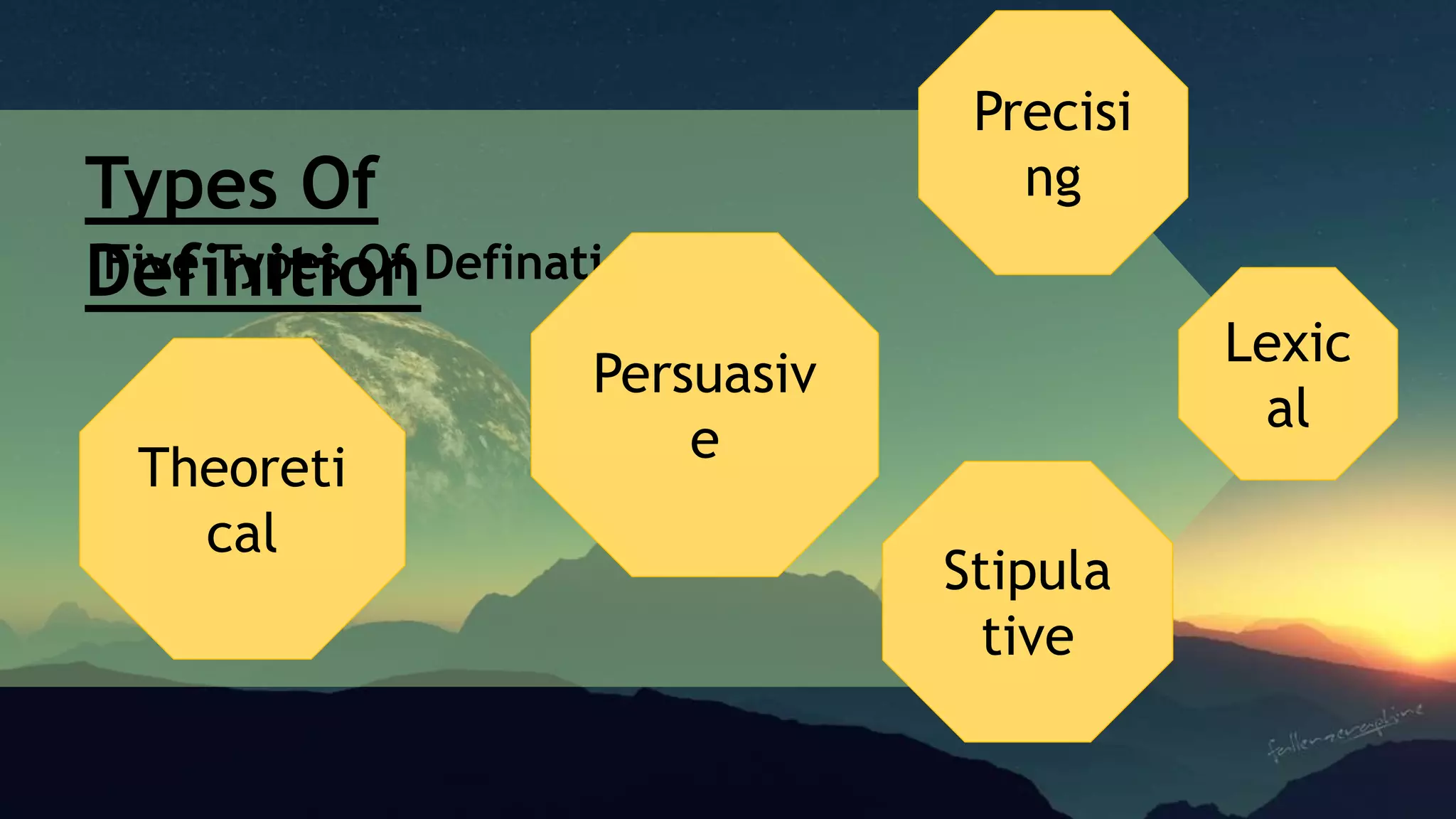
Types Of
Definition
Five Types Of Defination
Theoreti
cal
Persuasiv
e
Precisi
ng
Stipula
tive
Lexic
al
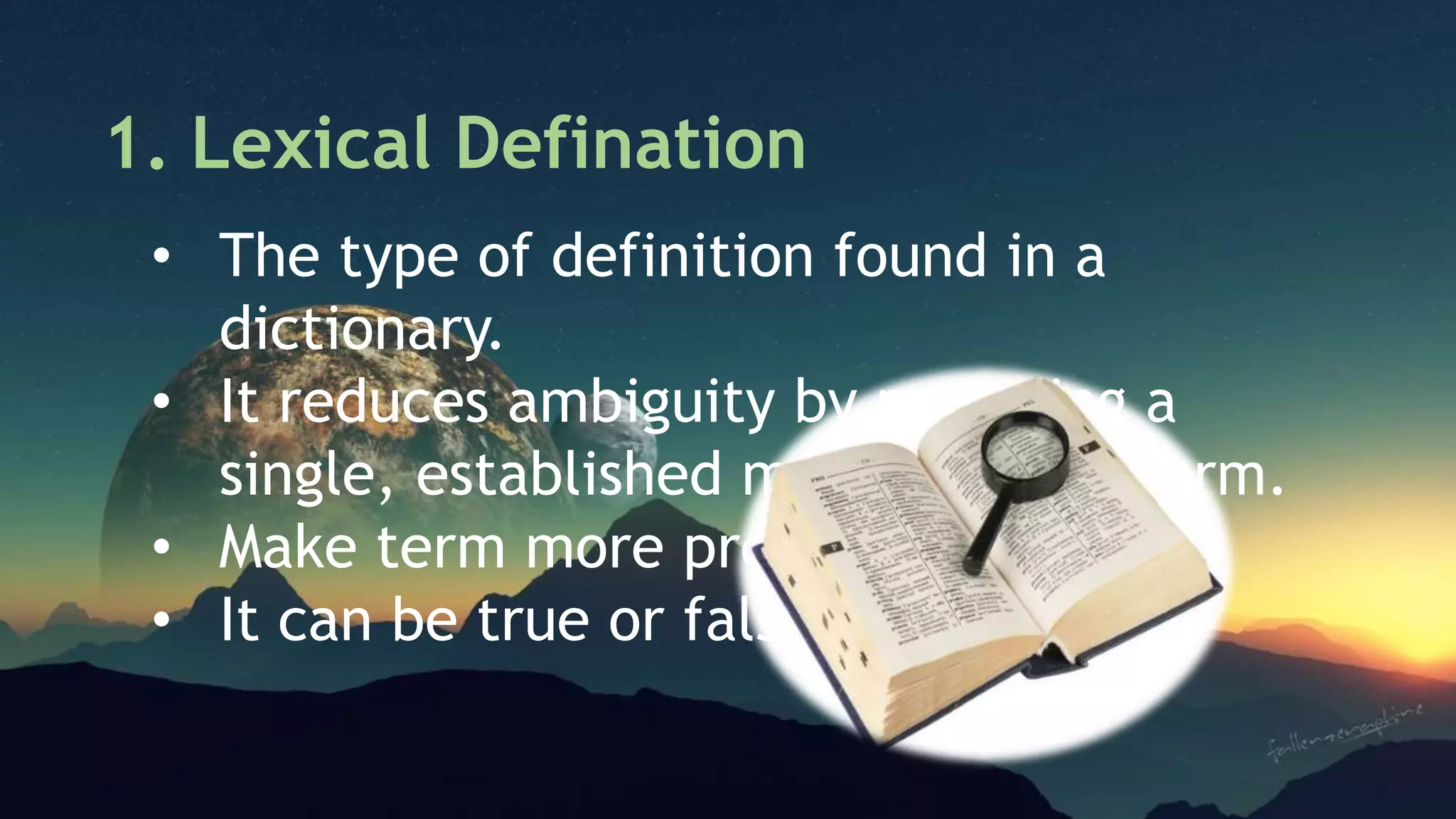
1. Lexical Defination
• The type of definition found in a
dictionary.
• It reduces ambiguity by providing a
single, established meaning for a term.
• Make term more precise.
• It can be true or false.
2. Stipulative
Definition
• Use to assign a new meaning to a term.
• It can’t be correct or incorrect, only can
ve differ from other definition.
Example:
3. Precising
Defination
• The type of definition NOT a
dictionary.
• They apply only to the
situation in which they are
used.
• Eliminate the ambiguity or
vagueness.
• Combination of Lexical And
4. Persuasive
Definition
• Attitude and emotions attached with
a definition.
• True or commenly accepted meaning
of a term.
• Defining a word with the aim of
persuading the listner one way or
another.
• These definitions are common in
• Are often scientifc or philosophical in
• Based on theories in which that term is a
element.
Example: H2O is not used to increase
your vocabulary but to explain water’s
structure.
Word planet… we define this word on
base of theories behind this.
5. Theoretical
Definitions
Purpose of
Definition
🔎📖
Definition:
A statement that gives the
meaning of a term.
Six purposes of definitions
1. Show relationships.
2. Remove ambiguity.
3. Reduce vagueness.
4. Increase vocabulary.
5. Explain concepts
theoretically.
6. Influence attitudes
1. Show Relationships
• When properly defined a term often gives some idea
of the relationships which that term has with other
terms.
Example: cold - the absence of heat; hot - the
presence of heat. The terms cold and hot show their
relationship which in this example happens to be
Cold Hot
2. Remove
Ambiguity
• Words are ambiguous when
they have more than one
possible meaning.
3. Reduce
Vagueness
• A term is vague when its
extent is unclear.
Example: old...how old?
tall...how tall?
4. Increase
vocabulary
• One of the most important
elements of education is
learning the meaning of
unfamiliar terms.
• An increase in vocabulary
means an increase in
knowledge.
5. Explain Concepts
Theoretically
• Because sometimes the word itself known, but
the term is not understoood.
Example: Water's relation to H20
6. Influence
Attitudes
• Often terms are defined, not necessarily
for the purpose of clarifying their
meaning, but in order to influence the
attitudes and emotions of an audience.
Techniques Of
Defining
Six Techniques Of Defining
Terms
Definitions By
Example
Ostentive Definitions
Quasi-Ostentive
Definitions
Definitions By Genus
and Differences
Operational
Definitions
Synonymous
Definitions
Defining By Example
• Another way children (and adults) are
taught the meaning of words is by
examples of them.
• A child, upon asking her mother what
money is, may be given a penny or shown
a dollar bill.
Ostentive
Definitions
• An ostensive definition conveys the
meaning of a term by pointing out
examples.
• It is usually accompanied with a gesture
pointing to the object serving as an
example, and for this reason is also often
referred to as "definition by pointing".
Quasi-Ostentive
Definition
A variety of de
• A variety of denotative definition that
reliies upon gesture, in conjunction with
a descriptive phrase.
• A kind of Connotative definition that
states that the term to be defined is
correctly applied to a given case if and
only if the performance of specified
operations in that case yeilds a specified
Operational Definitions
Definitions By
Synonymous
• InterWhen you look in a dictionary for the
definition of a word, you often find a
synonym (a word eiyh the same meaning)
of a word listed.
• This can be helpful, but only if you
already understand the meaning of the
synonym.
Definitions By Genus And
Difference
• A type of Connotative definition of a
term tat first identifies the larger
class of which the definiendum is a
species or subclass, and then
identifies the attributes that
distinguishes the members of all other
species from members of all other
species in that genus.
Thematic Meaning
Collocative Meaning
Conceptual Meaning
Reflected Meaning
Connotative Meaning
Social Meaning
Affective Meaning
Kinds Of
Meaning
What is
Meaning?
It is what a
language expresses
about the world we
live in or any
possible or
imaginary
worldMeaning is
always the
meaning of
1:Conceptual meaning
• The central factor or the core meaning
linguistic communication.
• Widely regarded as central factor in
communication.
• Also known as logical ,cognitive or
denotative meaning.
2:Connotative meaning
• Connotative meaning is the
communicative value of an
over and above it's purely conceptual
content.
• Varies according to age,culture and
individual.
3:Social meaning
• The meaning conveyed by the piece of
language about the social context of its
is called the social meaning.
• We recognise some words or
as being dialectical i.e as telling us
something about the regional or social
origin of the speaker.
4:Affective meaning
• A meaning which a piece of language
conveys about the social
of its use.
• Refers to emotive association or
of words evoked in the reader or
5:Reflected Meaning
• Reflective meaning arises when a word
has more than one conceptual
multiple conceptual meanings.
• There is some kind of ambiguity E.g
poetry
6:Thematic meaning
• What is communicated by the way in
which the message is organized in
of order and emphasis E.g passive and
active
7: Collocative Meaning
• What is communicated through
with words which tend to occure in the
environment of another word.
• It refers to the association of words
because of its usual or habitual co-
occurence with certain types of
pretty collocates with girlsHandsome

introduction to logics

  • 1.
    (Everything is Grounded Inlogic) Introduction to logic (Everything is Grounded In logic) Prepared by The students of BBA 2nd Semester • The Purpose of Definition • TheTypes of Definition • Various Kinds of Meaning • Techniques For Defining
  • 2.
    Definition A definition issimply the meaning we assign to a word-symbol. Parts of Definition •Definiendum - the thing (i.e., the 'term') being defined •Definiens - the linguistic expression (i.e., the definition itself) of the definition, the qualities or properties asserted of the term
  • 3.
    Types of Definitions Intensional- (connotation) Assigns meaning by indicating the qualities of term. Extensional - (denotation) Assigns meaning by indicating the members of class of the definiendum.
  • 4.
    Types Of Definition Five TypesOf Defination Theoreti cal Persuasiv e Precisi ng Stipula tive Lexic al
  • 5.
    1. Lexical Defination •The type of definition found in a dictionary. • It reduces ambiguity by providing a single, established meaning for a term. • Make term more precise. • It can be true or false.
  • 6.
    2. Stipulative Definition • Useto assign a new meaning to a term. • It can’t be correct or incorrect, only can ve differ from other definition. Example:
  • 7.
    3. Precising Defination • Thetype of definition NOT a dictionary. • They apply only to the situation in which they are used. • Eliminate the ambiguity or vagueness. • Combination of Lexical And
  • 8.
    4. Persuasive Definition • Attitudeand emotions attached with a definition. • True or commenly accepted meaning of a term. • Defining a word with the aim of persuading the listner one way or another. • These definitions are common in
  • 9.
    • Are oftenscientifc or philosophical in • Based on theories in which that term is a element. Example: H2O is not used to increase your vocabulary but to explain water’s structure. Word planet… we define this word on base of theories behind this. 5. Theoretical Definitions
  • 10.
    Purpose of Definition 🔎📖 Definition: A statementthat gives the meaning of a term. Six purposes of definitions 1. Show relationships. 2. Remove ambiguity. 3. Reduce vagueness. 4. Increase vocabulary. 5. Explain concepts theoretically. 6. Influence attitudes
  • 11.
    1. Show Relationships •When properly defined a term often gives some idea of the relationships which that term has with other terms. Example: cold - the absence of heat; hot - the presence of heat. The terms cold and hot show their relationship which in this example happens to be Cold Hot
  • 12.
    2. Remove Ambiguity • Wordsare ambiguous when they have more than one possible meaning. 3. Reduce Vagueness • A term is vague when its extent is unclear. Example: old...how old? tall...how tall?
  • 13.
    4. Increase vocabulary • Oneof the most important elements of education is learning the meaning of unfamiliar terms. • An increase in vocabulary means an increase in knowledge.
  • 14.
    5. Explain Concepts Theoretically •Because sometimes the word itself known, but the term is not understoood. Example: Water's relation to H20 6. Influence Attitudes • Often terms are defined, not necessarily for the purpose of clarifying their meaning, but in order to influence the attitudes and emotions of an audience.
  • 15.
    Techniques Of Defining Six TechniquesOf Defining Terms Definitions By Example Ostentive Definitions Quasi-Ostentive Definitions Definitions By Genus and Differences Operational Definitions Synonymous Definitions
  • 16.
    Defining By Example •Another way children (and adults) are taught the meaning of words is by examples of them. • A child, upon asking her mother what money is, may be given a penny or shown a dollar bill.
  • 17.
    Ostentive Definitions • An ostensivedefinition conveys the meaning of a term by pointing out examples. • It is usually accompanied with a gesture pointing to the object serving as an example, and for this reason is also often referred to as "definition by pointing".
  • 18.
    Quasi-Ostentive Definition A variety ofde • A variety of denotative definition that reliies upon gesture, in conjunction with a descriptive phrase. • A kind of Connotative definition that states that the term to be defined is correctly applied to a given case if and only if the performance of specified operations in that case yeilds a specified Operational Definitions
  • 19.
    Definitions By Synonymous • InterWhenyou look in a dictionary for the definition of a word, you often find a synonym (a word eiyh the same meaning) of a word listed. • This can be helpful, but only if you already understand the meaning of the synonym.
  • 20.
    Definitions By GenusAnd Difference • A type of Connotative definition of a term tat first identifies the larger class of which the definiendum is a species or subclass, and then identifies the attributes that distinguishes the members of all other species from members of all other species in that genus.
  • 21.
    Thematic Meaning Collocative Meaning ConceptualMeaning Reflected Meaning Connotative Meaning Social Meaning Affective Meaning Kinds Of Meaning What is Meaning? It is what a language expresses about the world we live in or any possible or imaginary worldMeaning is always the meaning of
  • 22.
    1:Conceptual meaning • Thecentral factor or the core meaning linguistic communication. • Widely regarded as central factor in communication. • Also known as logical ,cognitive or denotative meaning.
  • 23.
    2:Connotative meaning • Connotativemeaning is the communicative value of an over and above it's purely conceptual content. • Varies according to age,culture and individual.
  • 24.
    3:Social meaning • Themeaning conveyed by the piece of language about the social context of its is called the social meaning. • We recognise some words or as being dialectical i.e as telling us something about the regional or social origin of the speaker.
  • 25.
    4:Affective meaning • Ameaning which a piece of language conveys about the social of its use. • Refers to emotive association or of words evoked in the reader or
  • 26.
    5:Reflected Meaning • Reflectivemeaning arises when a word has more than one conceptual multiple conceptual meanings. • There is some kind of ambiguity E.g poetry
  • 27.
    6:Thematic meaning • Whatis communicated by the way in which the message is organized in of order and emphasis E.g passive and active
  • 28.
    7: Collocative Meaning •What is communicated through with words which tend to occure in the environment of another word. • It refers to the association of words because of its usual or habitual co- occurence with certain types of pretty collocates with girlsHandsome