William G. Zikmund
Course Instructor: Rajja Rashad
Lecture 1
Outline
• The role of business research
• Information systems and knowledge management
The Role of Business Research
The Nature of Business Research
• Business research covers a wide range of
phenomena.
• The purpose of research for managers is to provide
knowledge regarding the organization, the market,
the economy, or another area of uncertainty
• The ultimate goal of research is to supply accurate
information that reduces the uncertainty in
managerial decision making
• Business research helps decision makers shift from
intuitive information gathering to systematic and
objective investigation
Business Research Defined
• Business research is defined as, “the systematic and
objective process of generating information for aid in
making business decisions”
• The application of the scientific method in searching
for the truth about business phenomena. These
activities include defining business opportunities and
problems, generating and evaluating ideas,
monitoring performance, and understanding the
business process.
Business Research
• Research information is neither intuitive nor
haphazardly gathered.
• Literally, research (re-search) -“search again”
• Business research must be accurate and objective
• Business research should be detached and
impersonal rather than biased.
• It facilitates the managerial decision process for all
aspects of a business.
• Business research can be conducted by both profit
and not for-profit organizations
I don’t know
if we
should
offer on-site
child care?
The process of Business Research
• The business research process includes
– Idea and theory development
– Problem definition
– Searching for and collecting information
– Analyzing data
– Communicating the findings and their implications
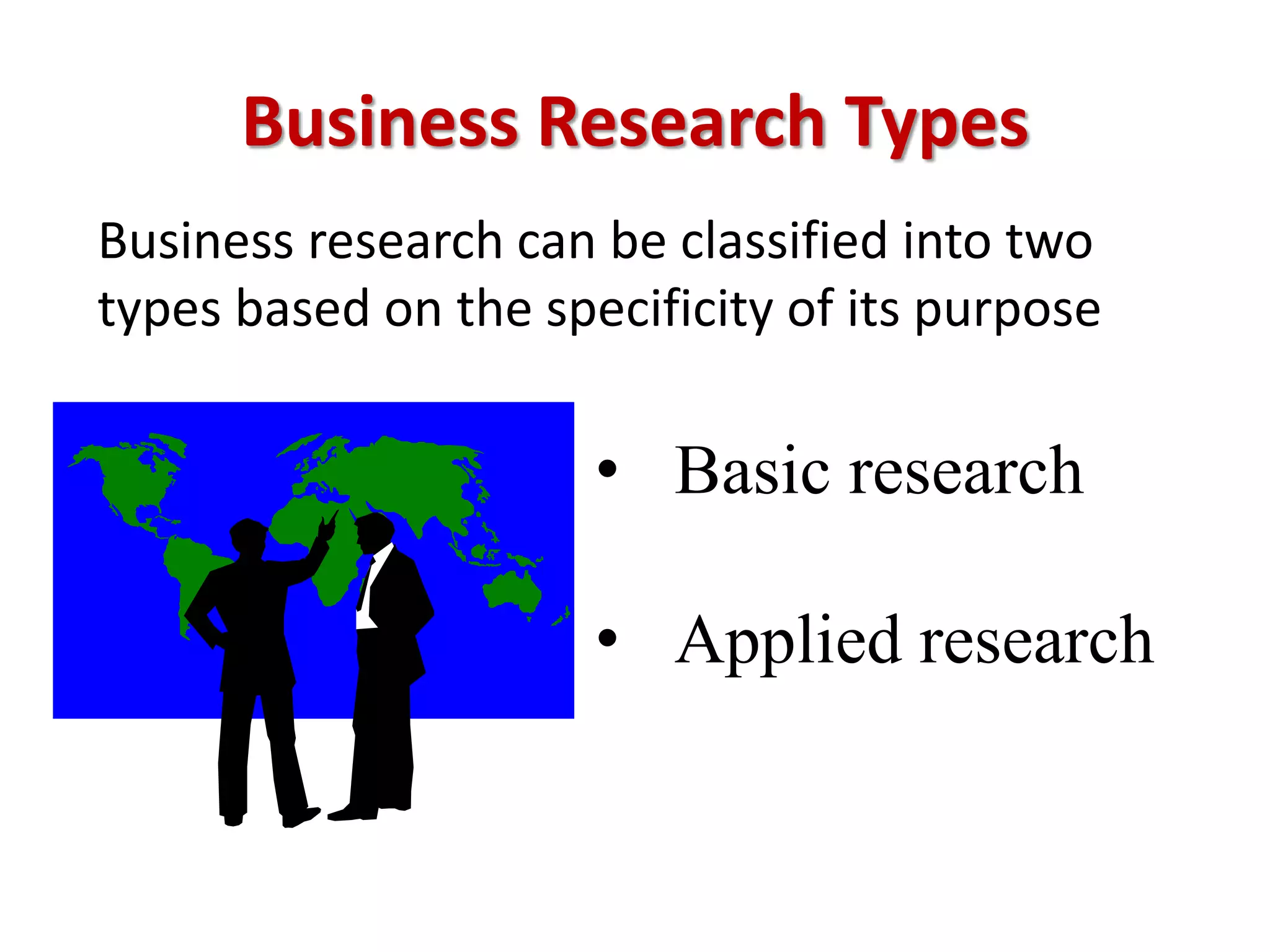
• Basic research
• Applied research
Business Research Types
Business research can be classified into two
types based on the specificity of its purpose
Basic Research
• Research conducted without a specific decision in
mind that usually does not address the needs of a
specific organization.
– Also referred to as ‘pure research’
– It attempts to expand the limits of knowledge in
general
– It is not aimed at solving a particular pragmatic
problem
– It can be used to test the validity of a general business
theory (one that applies to all businesses) or to learn
more about a particular business phenomenon.
– Basic research often provides the foundation for later
applied research.
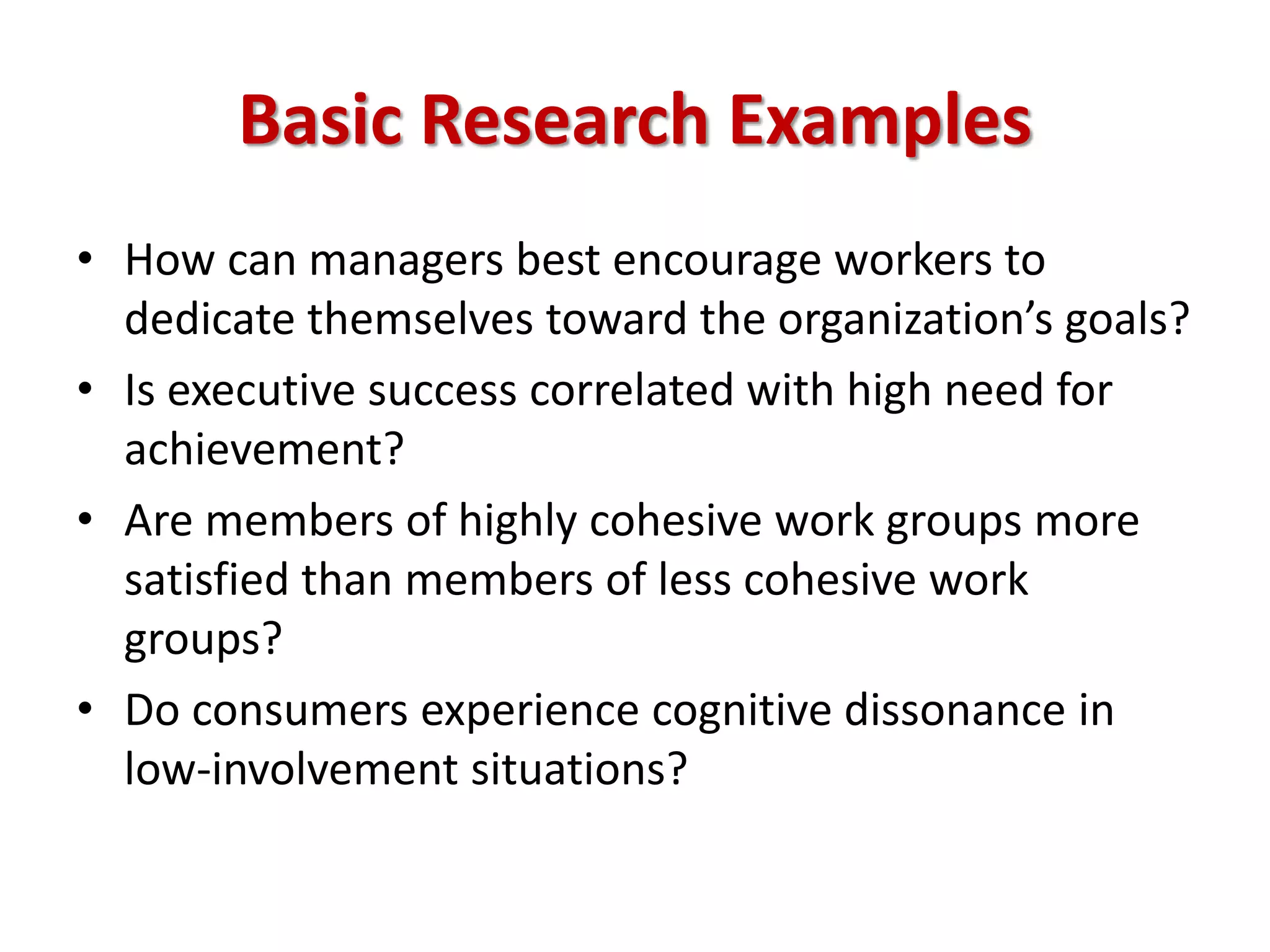
Basic Research Examples
• How can managers best encourage workers to
dedicate themselves toward the organization’s goals?
• Is executive success correlated with high need for
achievement?
• Are members of highly cohesive work groups more
satisfied than members of less cohesive work
groups?
• Do consumers experience cognitive dissonance in
low-involvement situations?
Applied Research
• Research conducted to address a specific
business decision for a specific firm or
organization.
– It is conducted when a decision must be made
about a specific real-life problem facing a specific
industry or organization
– It is solution-specific and addresses practical
questions
Applied Research Examples
• Should McDonalds add Italian pasta dinners to
its menu?
– Business research told McDonald’s it should not?
• Should Procter & Gamble add a high-priced
home teeth bleaching kit to its product line?
– Research showed Crest Whitestrips would sell well
at a retail price of $44
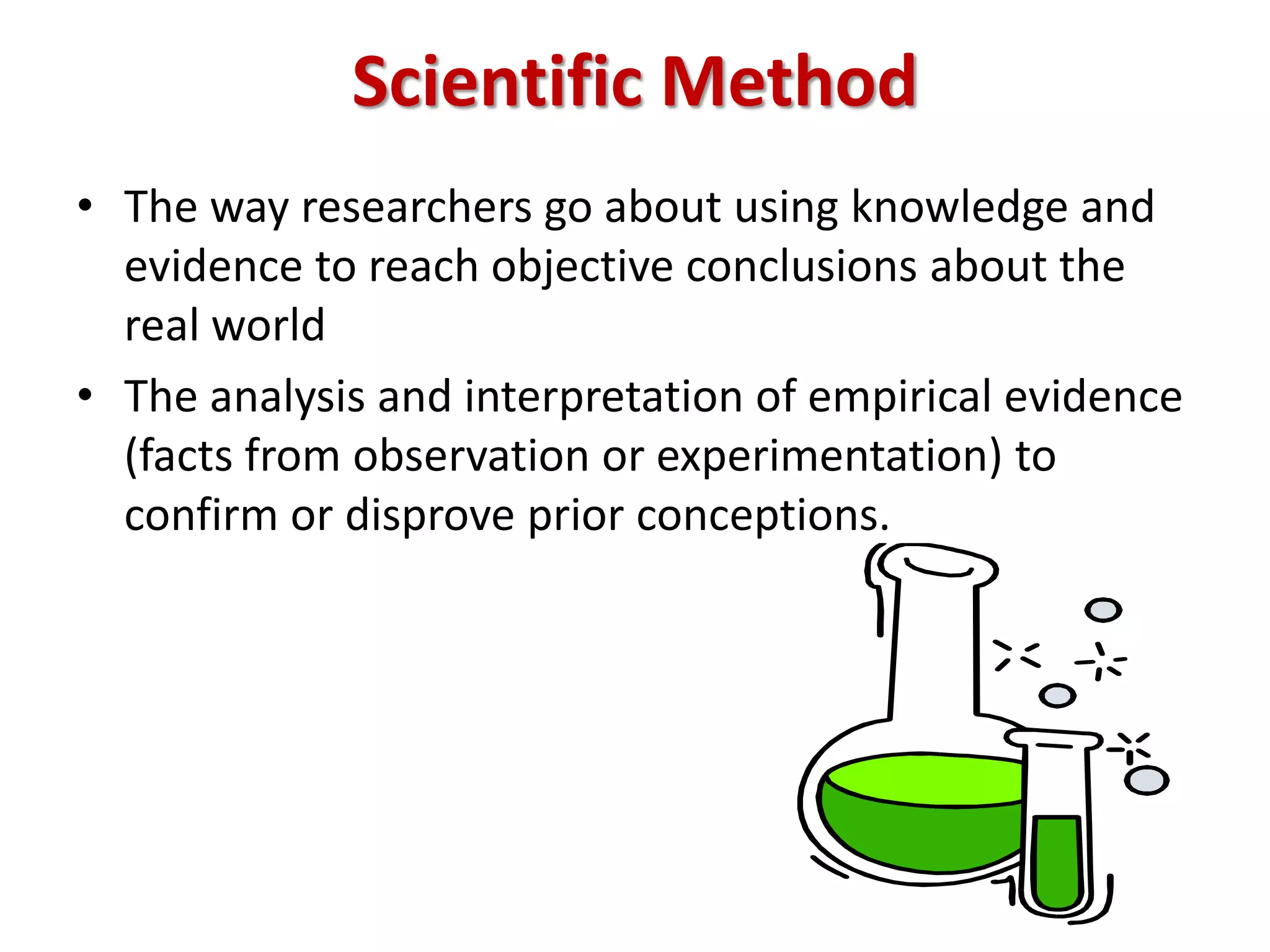
Scientific Method
• The way researchers go about using knowledge and
evidence to reach objective conclusions about the
real world
• The analysis and interpretation of empirical evidence
(facts from observation or experimentation) to
confirm or disprove prior conceptions.
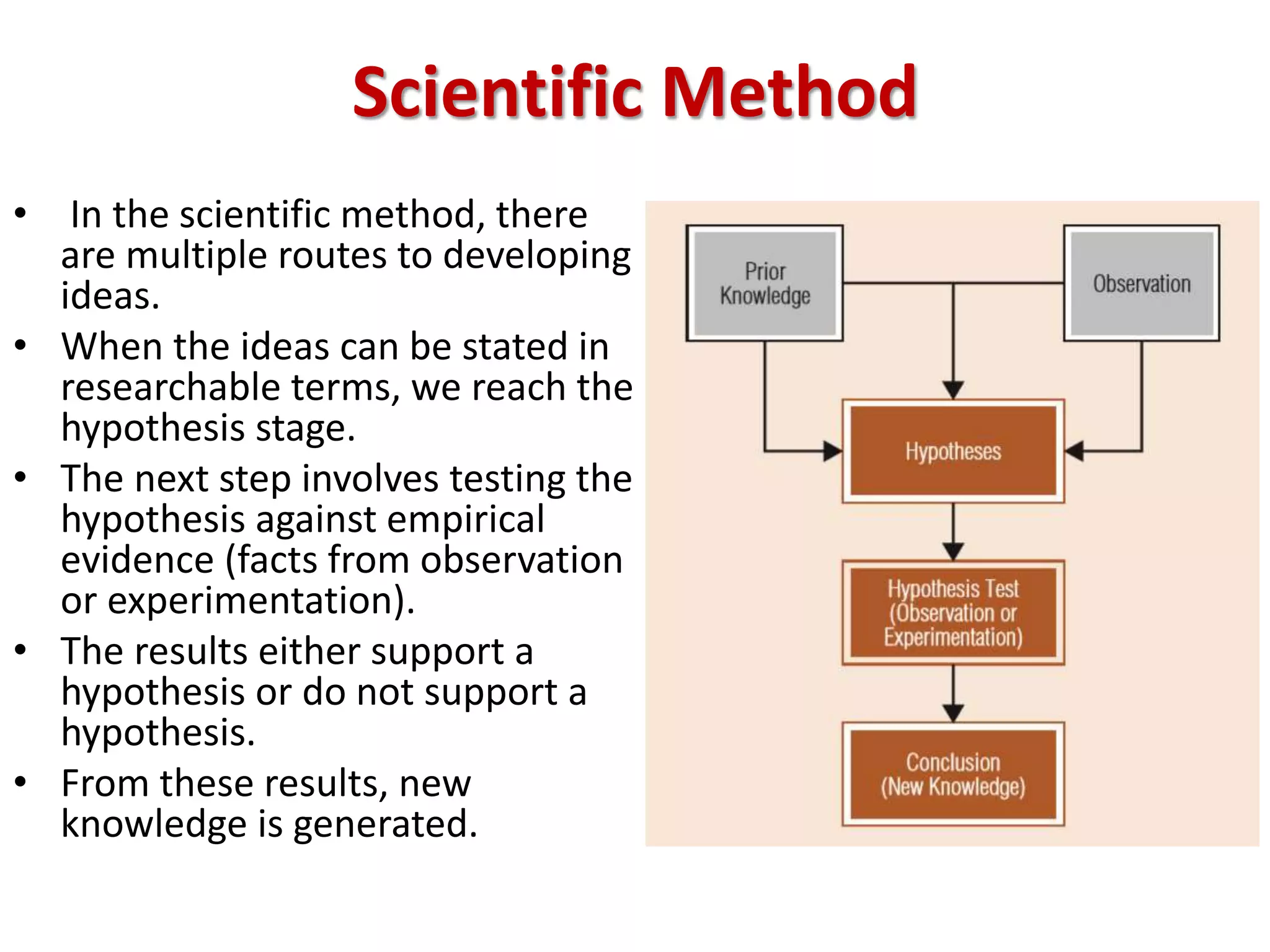
Scientific Method
• In the scientific method, there
are multiple routes to developing
ideas.
• When the ideas can be stated in
researchable terms, we reach the
hypothesis stage.
• The next step involves testing the
hypothesis against empirical
evidence (facts from observation
or experimentation).
• The results either support a
hypothesis or do not support a
hypothesis.
• From these results, new
knowledge is generated.
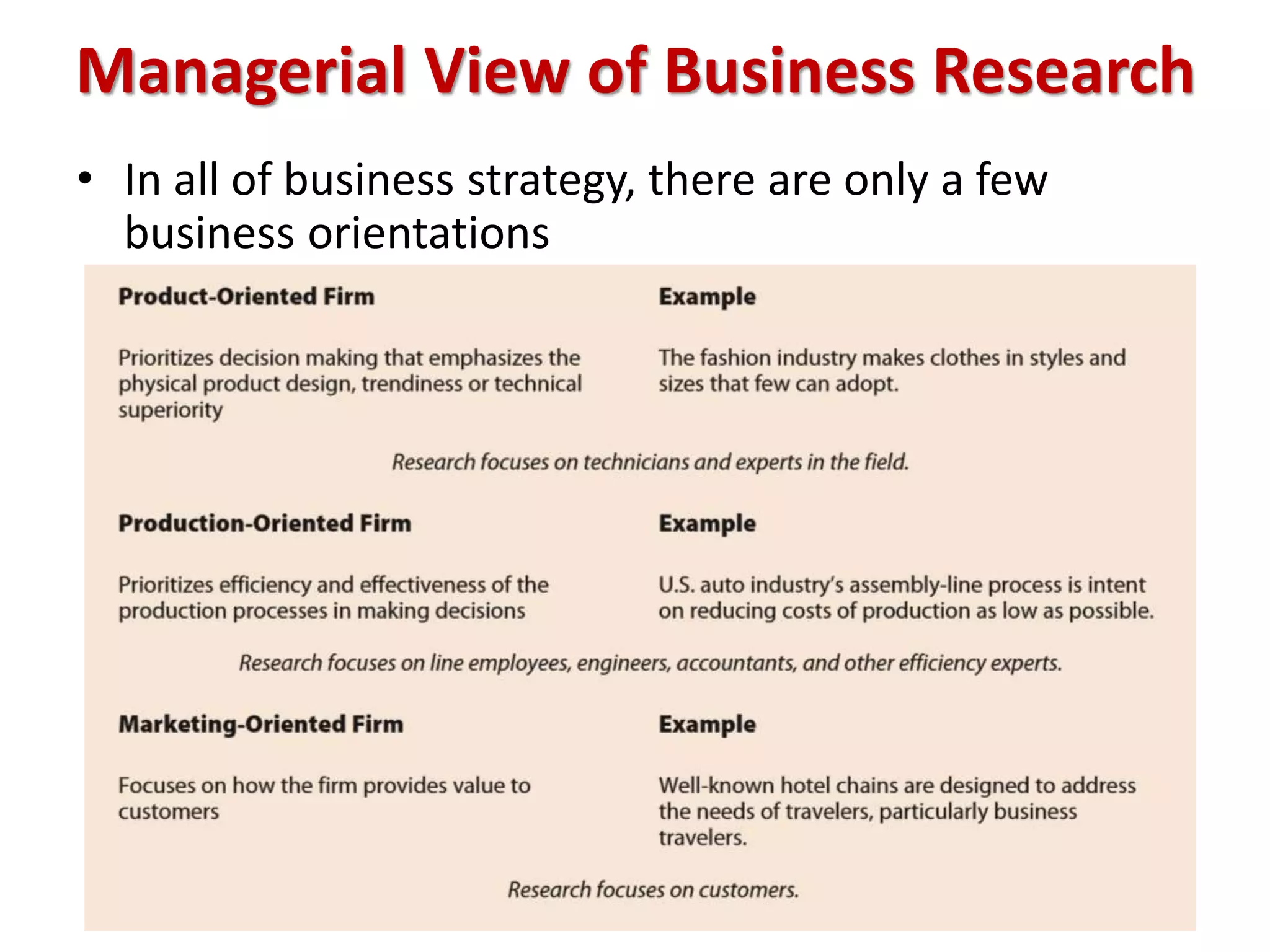
Managerial View of Business Research
• In all of business strategy, there are only a few
business orientations
The Decision-making Process Associated
with the Development and
Implementation of a Strategy
• Identifying problems and opportunities
• Diagnosis and assessment of problem
• Selecting and implementing a course of action
• Evaluating the course of action
Evaluation Research
• Evaluation research is the formal, objective
measurement and appraisal of the extent to which a
given activity, project, or program has achieved its
objectives.
Performance monitoring research
• Research that regularly provides feedback for evaluation
and control
• Indicates things are or are not going as planned
• Research may be required to explain why something
“went wrong”
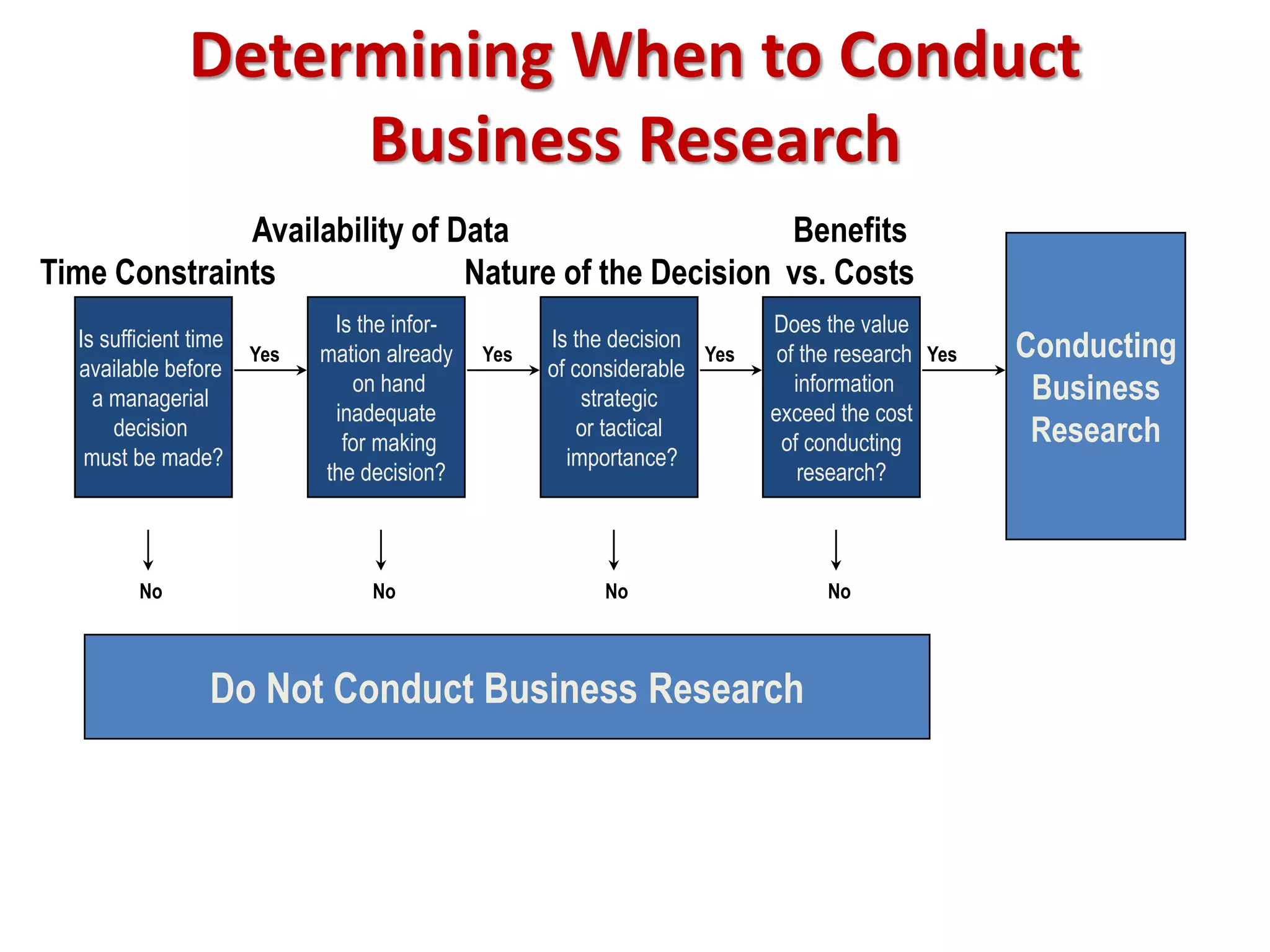
Determining When to Conduct
Business Research
• Time constraints
• Availability of data
• Nature of the decision
• Benefits versus costs
Is sufficient time
available before
a managerial
decision
must be made?
Is the infor-
mation already
on hand
inadequate
for making
the decision?
Is the decision
of considerable
strategic
or tactical
importance?
Does the value
of the research
information
exceed the cost
of conducting
research?
Conducting
Business
Research
Do Not Conduct Business Research
Time Constraints
Availability of Data
Nature of the Decision
Benefits
vs. Costs
Yes Yes
Yes
Yes
No No No No
Determining When to Conduct
Business Research
Value
•Decreased certainty
•Increased likelihood
of a correct decision
•Improved business
performance and
resulting higher
profits
Costs
•Research
expenditures
•Delay of business
decision and
possible disclosure
of information to
rivals
•Possible erroneous
research results
Value Should Exceed
Estimated Costs
Major Topics for Research in Business
• General Business Conditions and Corporate Research
• Financial and Accounting Research
• Management and Organizational Behavior Research
• Sales and Marketing Research
• Information Systems Research
• Corporate Responsibility Research
Business Research in the 21st Century
• Increased globalization
– As more companies do business outside their own borders,
companies are conducting research globally. This places a
greater emphasis on research that can assess the degree
to which research tools can be applied and interpreted the
same way in different cultures
• Growth of the Internet and other information
technologies
– Technology has changed almost every aspect of business
research. Modern computer and communications
technology makes data collection, study design, data
analysis, data reporting, and practically all other aspects of
research easier and better.
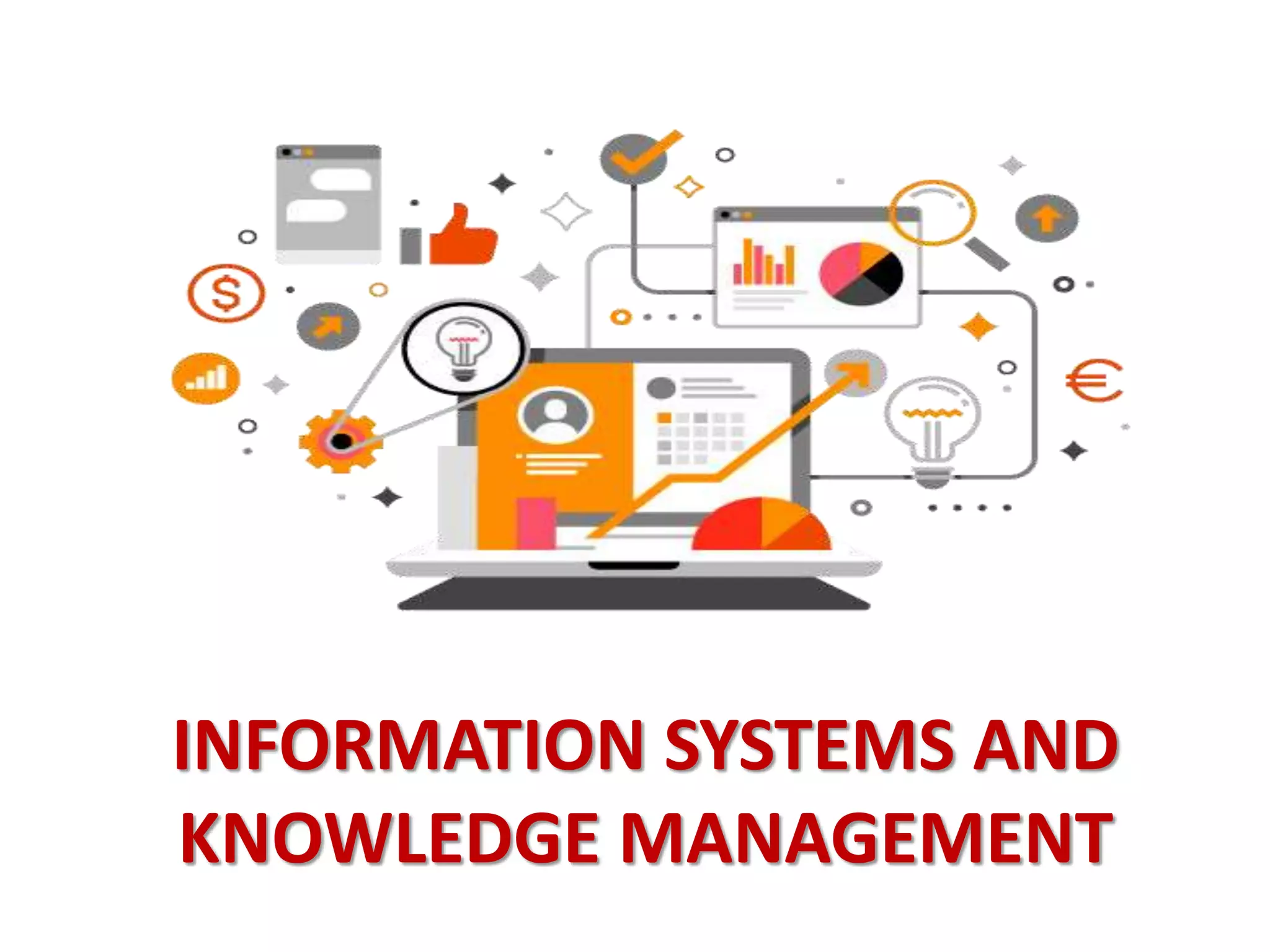
INFORMATION SYSTEMS AND
KNOWLEDGE MANAGEMENT
Information, Data, and Intelligence
• Data
– Facts or recorded measures of certain phenomena
(things or events).
• Information
– Data formatted (structured) to support decision
making or define the relationship between two
facts.
• Business intelligence
– The subset of data and information that actually
has some explanatory power enabling effective
managerial decisions to be made.
The Characteristics of Valuable
Information
• Relevance
– The characteristics of data reflecting how pertinent these
particular facts are to the situation at hand.
• Data quality
– The degree to which data represent the true situation.
High-quality data are accurate, valid, and reliable
• Timeliness
– It means that the data are current enough to still be
relevant
• Information completeness
– Having the right amount of information.
Knowledge Management
• Knowledge
– A blend of previous experience, insight, and data that forms
organizational memory.
• Knowledge management
– The process of creating an inclusive, comprehensive, easily
accessible organizational memory, which is often called the
organization’s intellectual capital
• The purpose of knowledge management is to organize the
intellectual capital of an organization in a formally structured way
for easy use
• Knowledge is presented in a way that helps managers comprehend
and act on that information and make better decisions in all areas
of business.
• Knowledge management systems are particularly useful in making
data available across the functional areas of the firm

BRM Chapter 1.ppt

  • 1.
    William G. Zikmund CourseInstructor: Rajja Rashad Lecture 1
  • 2.
    Outline • The roleof business research • Information systems and knowledge management
  • 3.
    The Role ofBusiness Research
  • 4.
    The Nature ofBusiness Research • Business research covers a wide range of phenomena. • The purpose of research for managers is to provide knowledge regarding the organization, the market, the economy, or another area of uncertainty • The ultimate goal of research is to supply accurate information that reduces the uncertainty in managerial decision making • Business research helps decision makers shift from intuitive information gathering to systematic and objective investigation
  • 5.
    Business Research Defined •Business research is defined as, “the systematic and objective process of generating information for aid in making business decisions” • The application of the scientific method in searching for the truth about business phenomena. These activities include defining business opportunities and problems, generating and evaluating ideas, monitoring performance, and understanding the business process.
  • 6.
    Business Research • Researchinformation is neither intuitive nor haphazardly gathered. • Literally, research (re-search) -“search again” • Business research must be accurate and objective • Business research should be detached and impersonal rather than biased. • It facilitates the managerial decision process for all aspects of a business. • Business research can be conducted by both profit and not for-profit organizations
  • 7.
    I don’t know ifwe should offer on-site child care? The process of Business Research • The business research process includes – Idea and theory development – Problem definition – Searching for and collecting information – Analyzing data – Communicating the findings and their implications
  • 8.
    • Basic research •Applied research Business Research Types Business research can be classified into two types based on the specificity of its purpose
  • 9.
    Basic Research • Researchconducted without a specific decision in mind that usually does not address the needs of a specific organization. – Also referred to as ‘pure research’ – It attempts to expand the limits of knowledge in general – It is not aimed at solving a particular pragmatic problem – It can be used to test the validity of a general business theory (one that applies to all businesses) or to learn more about a particular business phenomenon. – Basic research often provides the foundation for later applied research.
  • 10.
    Basic Research Examples •How can managers best encourage workers to dedicate themselves toward the organization’s goals? • Is executive success correlated with high need for achievement? • Are members of highly cohesive work groups more satisfied than members of less cohesive work groups? • Do consumers experience cognitive dissonance in low-involvement situations?
  • 11.
    Applied Research • Researchconducted to address a specific business decision for a specific firm or organization. – It is conducted when a decision must be made about a specific real-life problem facing a specific industry or organization – It is solution-specific and addresses practical questions
  • 12.
    Applied Research Examples •Should McDonalds add Italian pasta dinners to its menu? – Business research told McDonald’s it should not? • Should Procter & Gamble add a high-priced home teeth bleaching kit to its product line? – Research showed Crest Whitestrips would sell well at a retail price of $44
  • 13.
    Scientific Method • Theway researchers go about using knowledge and evidence to reach objective conclusions about the real world • The analysis and interpretation of empirical evidence (facts from observation or experimentation) to confirm or disprove prior conceptions.
  • 14.
    Scientific Method • Inthe scientific method, there are multiple routes to developing ideas. • When the ideas can be stated in researchable terms, we reach the hypothesis stage. • The next step involves testing the hypothesis against empirical evidence (facts from observation or experimentation). • The results either support a hypothesis or do not support a hypothesis. • From these results, new knowledge is generated.
  • 15.
    Managerial View ofBusiness Research • In all of business strategy, there are only a few business orientations
  • 16.
    The Decision-making ProcessAssociated with the Development and Implementation of a Strategy • Identifying problems and opportunities • Diagnosis and assessment of problem • Selecting and implementing a course of action • Evaluating the course of action
  • 17.
    Evaluation Research • Evaluationresearch is the formal, objective measurement and appraisal of the extent to which a given activity, project, or program has achieved its objectives. Performance monitoring research • Research that regularly provides feedback for evaluation and control • Indicates things are or are not going as planned • Research may be required to explain why something “went wrong”
  • 18.
    Determining When toConduct Business Research • Time constraints • Availability of data • Nature of the decision • Benefits versus costs
  • 19.
    Is sufficient time availablebefore a managerial decision must be made? Is the infor- mation already on hand inadequate for making the decision? Is the decision of considerable strategic or tactical importance? Does the value of the research information exceed the cost of conducting research? Conducting Business Research Do Not Conduct Business Research Time Constraints Availability of Data Nature of the Decision Benefits vs. Costs Yes Yes Yes Yes No No No No Determining When to Conduct Business Research
  • 20.
    Value •Decreased certainty •Increased likelihood ofa correct decision •Improved business performance and resulting higher profits Costs •Research expenditures •Delay of business decision and possible disclosure of information to rivals •Possible erroneous research results Value Should Exceed Estimated Costs
  • 21.
    Major Topics forResearch in Business • General Business Conditions and Corporate Research • Financial and Accounting Research • Management and Organizational Behavior Research • Sales and Marketing Research • Information Systems Research • Corporate Responsibility Research
  • 22.
    Business Research inthe 21st Century • Increased globalization – As more companies do business outside their own borders, companies are conducting research globally. This places a greater emphasis on research that can assess the degree to which research tools can be applied and interpreted the same way in different cultures • Growth of the Internet and other information technologies – Technology has changed almost every aspect of business research. Modern computer and communications technology makes data collection, study design, data analysis, data reporting, and practically all other aspects of research easier and better.
  • 23.
  • 24.
    Information, Data, andIntelligence • Data – Facts or recorded measures of certain phenomena (things or events). • Information – Data formatted (structured) to support decision making or define the relationship between two facts. • Business intelligence – The subset of data and information that actually has some explanatory power enabling effective managerial decisions to be made.
  • 25.
    The Characteristics ofValuable Information • Relevance – The characteristics of data reflecting how pertinent these particular facts are to the situation at hand. • Data quality – The degree to which data represent the true situation. High-quality data are accurate, valid, and reliable • Timeliness – It means that the data are current enough to still be relevant • Information completeness – Having the right amount of information.
  • 26.
    Knowledge Management • Knowledge –A blend of previous experience, insight, and data that forms organizational memory. • Knowledge management – The process of creating an inclusive, comprehensive, easily accessible organizational memory, which is often called the organization’s intellectual capital • The purpose of knowledge management is to organize the intellectual capital of an organization in a formally structured way for easy use • Knowledge is presented in a way that helps managers comprehend and act on that information and make better decisions in all areas of business. • Knowledge management systems are particularly useful in making data available across the functional areas of the firm