MUD IN ARCHITECTURE
ELECTIVE
Jinal Jain
19SA122
MUD IS A BUILDING MATERIAL
WHICH HAS ALREADY BEING
TESTED AND TRIED FOR
THOUSANDS OF YEARS. IT
IS USED IN MODERN
DAY CONSTRUCTION AND THE
METHOD OF USING IT IS VERY
DIFFERENT.
USES OF MUD
THEY ARE OFTEN IN
SPECTACULAR LOCATIONS
AND AS AN ENSEMBLE LOOK
AS IF THEY HAVE GROWN
OUT OF THE LANDSCAPE.
THE TRADITION
OF CONSTRUCTION USING M
UD BRICKS CONTINUES
TODAY IN THE AREA; A
VISITOR CAN SEE
OLD BUILDINGS BEING
REPAIRED AND EXTENDED,
NEW BUILDINGS IN THE
EXISTING TOWNS AND EVEN
NEW SETTLEMENTS.
Mud brick building in sahibam, Yemen
Uses of mud
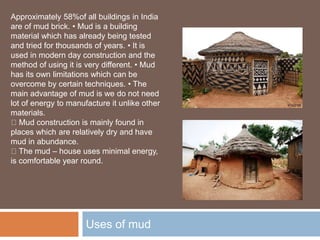
Approximately 58%of all buildings in India
are of mud brick. • Mud is a building
material which has already being tested
and tried for thousands of years. • It is
used in modern day construction and the
method of using it is very different. • Mud
has its own limitations which can be
overcome by certain techniques. • The
main advantage of mud is we do not need
lot of energy to manufacture it unlike other
materials.
Mud construction is mainly found in
places which are relatively dry and have
mud in abundance.
The mud – house uses minimal energy,
is comfortable year round.
Uses and types
The mud – house construction uses only
simple natural materials, which are any
digging soil from the earth mixed with water
and added up with paddy or hay or any dried
fiber or even recycling garbage. • Mud house
construction is durable and can be easily
rebuilt . • Mud construction also provide
natural air conditioning which provide cool air
from the massive walls. Lab, Auroville Earth
Institute Auroville Earth Institute
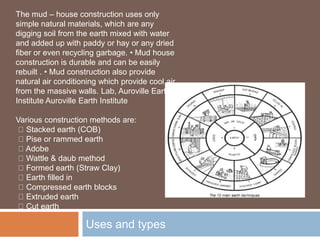
Various construction methods are:
Stacked earth (COB)
Pise or rammed earth
Adobe
Wattle & daub method
Formed earth (Straw Clay)
Earth filled in
Compressed earth blocks
Extruded earth
Cut earth
ADVANTAGES OF MUD:
• ENVIRONMENTAL IMPACT:
• TO SAVE NATURAL RESOURCES.
• USING NEITHER CEMENT NOR ROCK (SAVE OUR
MOUNTAINS).
• TO SAVE BUILDING MATERIALS:
• MAIN MATERIALS ARE SOIL AND WATER, MIXED TO BE
MUD, IF THE MUD IS TOO STICKY, WE CAN ADD UP WITH
PADDY HUSKY OR RICE STRAW OR LOCAL FIBER WEED
OR BAMBOO.
• ENERGY USE :
• TO SAVE ENERGY.
• COOL IN SUMMER (INSIDE BUILDING TEMPERATURE IS
ABOUT 24°C TO 26°C.
• WARM IN WINTER (AUTOMATIC CONTROL
TEMPERATURE BY PASSIVE COOLING SYSTEM)
• CAPITAL EXPENDITURE:
• TO SAVE MONEY .
• NO AIR – CONDITIONING, NO ELECTRICITY BILLS.
advantages
DISADVANTAGES-
HUMIDITY IS THE CRUCIAL FACTOR, MUD-HOUSE
WILL EASILY CATCH FUNGUS.
THE BRAND- NEW MUD-HOUSE MAY HAVE FOUL
ODOUR OF CRUSHED GREEN LEAVES.
ERODES EASILY BY WATER.
LOW TENSILE AND SHEAR STRENGTH , HENCE ,
ROOFS DIFFICULT.
SUSCEPTIBLE TO MECHANICAL DAMAGE, RODENTS
AND BURGLES.
GRIP BETWEEN EARTH AND WOOD IS VERY WEAK ,
HENCE, FRAMED DOORS AND WINDOWS ARE NOT
POSSIBLE.
REQUIRES REGULAR MAINTENANCE.
NOT FIRE PROOF AND NOT TERMITE PROOF.
disadvantage
CERAMIC IN
ARCHITECTURE
Ceramic
Clay can take any shape, form or texture.
Glazes can be a material with special
qualities, transforming it to something
really unique, thus making it a choice for
modern architecture.
THERE ARE THREE MAIN TYPES OF
POTTERY/CERAMIC. THESE ARE
EARTHENWARE, STONEWARE AND
PORCELAIN.
Ceramic uses
Ceramic products are hard, porous,
and brittle. As a result, they
are used to make pottery, bricks, tiles,
cements, and glass. Ceramics are
also used at many places in gas
turbine engines. Bio-
ceramics are used as dental implants
and synthetic bones.
CERAMIC PRODUCTS ARE HARD,
POROUS, AND BRITTLE. AS A RESULT,
THEY ARE USED TO MAKE POTTERY,
BRICKS, TILES, CEMENTS, AND GLASS.
CERAMICS ARE ALSO USED AT MANY
PLACES IN GAS TURBINE ENGINES.
Ceramic products for the construction sector include cements
and cement-based materials, interior and exterior tiles, sanitary
ware, non-refractory bricks, and other more complex shapes
such as drainage, sewer, and chimney pipes and linings.
Cements are used to make mortar and concrete.
Ceramic uses
THE GENERAL PROPERTIES
OF CERAMIC MATERIAL PRESENT THE
FOLLOWING ADVANTAGES:
HIGH WEAR, HEAT, PRESSURE, AND
CHEMICAL ATTACK RESISTANCE (GAS AND
LIQUIDS)
EXTREME HARDNESS.
EXCELLENT ELECTRICAL INSULATION.
RELATIVELY LIGHTWEIGHT.
advantages
DISADVANTAGES:
OF COURSE, DAILY-USE CERAMICS ALSO
HAVE THE FLY IN THE OINTMENT, THE
BIGGEST WEAKNESS IS LOW
IMPACT STRENGTH, IMPENETRABLE
TOUCH, EASILY DAMAGED, IS A FRAGILE
GOOD, THERE ARE CRACKS
RECOMMENDED NOT TO USE, MORE
EASILY BROKEN, HIDDEN DIRT IS NOT
CLEAN MAY PRODUCE BACTERIA.
disadvantages
TERRACOTTA IN
ARCHITECTURE
terracotta
THERE ARE TWO TYPES OF
TERRACOTTA PODUCT,POLISH AND
POROUS TERRACOTTA. THE
NAME TERRACOTTA ORGINATED FROM ITALIAN,TERRA
STANDS FOR CLAY AND COTTA MEANS BURNT.
THE CLAY USED FOR THE MANUFACTURE
OF TERRACOTTA TILES SHOULD BE HIGH
QUALITY. TERRACOTTA IS A
REFRACTORY CLAY PRODUCT.
Terracotta uses
advantages
Top Advantages of Reclaimed
Terracotta 1. Aesthetics
The warm hues of terracotta tiles bring an earthy
and welcoming feel to your home. These tiles
range from reds, to browns, to yellows and
more.
2. Unique and Authentic
These tiles reflect an elegant beauty and rich
culture.
3. Environmentally Friendly
Another benefit of these tiles is that they require
very little energy resources or manufacturing to
produce since they are salvaged from other
buildings.
4. Long Lasting
Terracotta tiles are durable, as they are built to
last.
5. Cost Effective
Whether you want to use terracotta tiles in
bathroom, kitchen or outdoor patio, they are an
affordable option.
DISADVANTAGES
TERRACOTTA IS QUITE POROUS
AND MUST BE PROPERLY TREATED
OR GLAZED BEFORE USING IT
AROUND WATER.
IT IS HARD TO CALCULATE
ACCURATE TIME DURATION OF THE
MATERIAL.
IT USUALLY CRACKS AND
DETERIORATES IF NOT TREATED
PROPERLY. IT CAN GET OXIDISED
AND ABSORBS STAINS RESULTING
IN CHANGE OF COLOR.
disadvantages

Mud in architecture

  • 1.
  • 2.
    MUD IS ABUILDING MATERIAL WHICH HAS ALREADY BEING TESTED AND TRIED FOR THOUSANDS OF YEARS. IT IS USED IN MODERN DAY CONSTRUCTION AND THE METHOD OF USING IT IS VERY DIFFERENT. USES OF MUD
  • 3.
    THEY ARE OFTENIN SPECTACULAR LOCATIONS AND AS AN ENSEMBLE LOOK AS IF THEY HAVE GROWN OUT OF THE LANDSCAPE. THE TRADITION OF CONSTRUCTION USING M UD BRICKS CONTINUES TODAY IN THE AREA; A VISITOR CAN SEE OLD BUILDINGS BEING REPAIRED AND EXTENDED, NEW BUILDINGS IN THE EXISTING TOWNS AND EVEN NEW SETTLEMENTS. Mud brick building in sahibam, Yemen
  • 4.
    Uses of mud Approximately58%of all buildings in India are of mud brick. • Mud is a building material which has already being tested and tried for thousands of years. • It is used in modern day construction and the method of using it is very different. • Mud has its own limitations which can be overcome by certain techniques. • The main advantage of mud is we do not need lot of energy to manufacture it unlike other materials. Mud construction is mainly found in places which are relatively dry and have mud in abundance. The mud – house uses minimal energy, is comfortable year round.
  • 5.
    Uses and types Themud – house construction uses only simple natural materials, which are any digging soil from the earth mixed with water and added up with paddy or hay or any dried fiber or even recycling garbage. • Mud house construction is durable and can be easily rebuilt . • Mud construction also provide natural air conditioning which provide cool air from the massive walls. Lab, Auroville Earth Institute Auroville Earth Institute Various construction methods are: Stacked earth (COB) Pise or rammed earth Adobe Wattle & daub method Formed earth (Straw Clay) Earth filled in Compressed earth blocks Extruded earth Cut earth
  • 6.
    ADVANTAGES OF MUD: •ENVIRONMENTAL IMPACT: • TO SAVE NATURAL RESOURCES. • USING NEITHER CEMENT NOR ROCK (SAVE OUR MOUNTAINS). • TO SAVE BUILDING MATERIALS: • MAIN MATERIALS ARE SOIL AND WATER, MIXED TO BE MUD, IF THE MUD IS TOO STICKY, WE CAN ADD UP WITH PADDY HUSKY OR RICE STRAW OR LOCAL FIBER WEED OR BAMBOO. • ENERGY USE : • TO SAVE ENERGY. • COOL IN SUMMER (INSIDE BUILDING TEMPERATURE IS ABOUT 24°C TO 26°C. • WARM IN WINTER (AUTOMATIC CONTROL TEMPERATURE BY PASSIVE COOLING SYSTEM) • CAPITAL EXPENDITURE: • TO SAVE MONEY . • NO AIR – CONDITIONING, NO ELECTRICITY BILLS. advantages
  • 7.
    DISADVANTAGES- HUMIDITY IS THECRUCIAL FACTOR, MUD-HOUSE WILL EASILY CATCH FUNGUS. THE BRAND- NEW MUD-HOUSE MAY HAVE FOUL ODOUR OF CRUSHED GREEN LEAVES. ERODES EASILY BY WATER. LOW TENSILE AND SHEAR STRENGTH , HENCE , ROOFS DIFFICULT. SUSCEPTIBLE TO MECHANICAL DAMAGE, RODENTS AND BURGLES. GRIP BETWEEN EARTH AND WOOD IS VERY WEAK , HENCE, FRAMED DOORS AND WINDOWS ARE NOT POSSIBLE. REQUIRES REGULAR MAINTENANCE. NOT FIRE PROOF AND NOT TERMITE PROOF. disadvantage
  • 8.
    CERAMIC IN ARCHITECTURE Ceramic Clay cantake any shape, form or texture. Glazes can be a material with special qualities, transforming it to something really unique, thus making it a choice for modern architecture.
  • 9.
    THERE ARE THREEMAIN TYPES OF POTTERY/CERAMIC. THESE ARE EARTHENWARE, STONEWARE AND PORCELAIN. Ceramic uses Ceramic products are hard, porous, and brittle. As a result, they are used to make pottery, bricks, tiles, cements, and glass. Ceramics are also used at many places in gas turbine engines. Bio- ceramics are used as dental implants and synthetic bones.
  • 10.
    CERAMIC PRODUCTS AREHARD, POROUS, AND BRITTLE. AS A RESULT, THEY ARE USED TO MAKE POTTERY, BRICKS, TILES, CEMENTS, AND GLASS. CERAMICS ARE ALSO USED AT MANY PLACES IN GAS TURBINE ENGINES. Ceramic products for the construction sector include cements and cement-based materials, interior and exterior tiles, sanitary ware, non-refractory bricks, and other more complex shapes such as drainage, sewer, and chimney pipes and linings. Cements are used to make mortar and concrete.
  • 11.
  • 12.
    THE GENERAL PROPERTIES OFCERAMIC MATERIAL PRESENT THE FOLLOWING ADVANTAGES: HIGH WEAR, HEAT, PRESSURE, AND CHEMICAL ATTACK RESISTANCE (GAS AND LIQUIDS) EXTREME HARDNESS. EXCELLENT ELECTRICAL INSULATION. RELATIVELY LIGHTWEIGHT. advantages
  • 13.
    DISADVANTAGES: OF COURSE, DAILY-USECERAMICS ALSO HAVE THE FLY IN THE OINTMENT, THE BIGGEST WEAKNESS IS LOW IMPACT STRENGTH, IMPENETRABLE TOUCH, EASILY DAMAGED, IS A FRAGILE GOOD, THERE ARE CRACKS RECOMMENDED NOT TO USE, MORE EASILY BROKEN, HIDDEN DIRT IS NOT CLEAN MAY PRODUCE BACTERIA. disadvantages
  • 14.
  • 15.
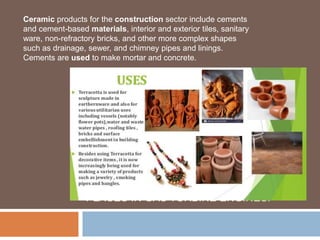
    THERE ARE TWOTYPES OF TERRACOTTA PODUCT,POLISH AND POROUS TERRACOTTA. THE NAME TERRACOTTA ORGINATED FROM ITALIAN,TERRA STANDS FOR CLAY AND COTTA MEANS BURNT. THE CLAY USED FOR THE MANUFACTURE OF TERRACOTTA TILES SHOULD BE HIGH QUALITY. TERRACOTTA IS A REFRACTORY CLAY PRODUCT. Terracotta uses
  • 16.
    advantages Top Advantages ofReclaimed Terracotta 1. Aesthetics The warm hues of terracotta tiles bring an earthy and welcoming feel to your home. These tiles range from reds, to browns, to yellows and more. 2. Unique and Authentic These tiles reflect an elegant beauty and rich culture. 3. Environmentally Friendly Another benefit of these tiles is that they require very little energy resources or manufacturing to produce since they are salvaged from other buildings. 4. Long Lasting Terracotta tiles are durable, as they are built to last. 5. Cost Effective Whether you want to use terracotta tiles in bathroom, kitchen or outdoor patio, they are an affordable option.
  • 17.
    DISADVANTAGES TERRACOTTA IS QUITEPOROUS AND MUST BE PROPERLY TREATED OR GLAZED BEFORE USING IT AROUND WATER. IT IS HARD TO CALCULATE ACCURATE TIME DURATION OF THE MATERIAL. IT USUALLY CRACKS AND DETERIORATES IF NOT TREATED PROPERLY. IT CAN GET OXIDISED AND ABSORBS STAINS RESULTING IN CHANGE OF COLOR. disadvantages