GOVT ENG COLLAGE BIKANER
 Power point presentation on:-
Building stone
 Submitted to :-
Ankit sir
 Submitted by :-
Akshay kumar
Building stone @akshaykumar
STONE
Stone →One of the oldest building material.
Rock : A large concreted mass of earthy or
mineral matter or broken pieces of such a
mass.
Stone : Quarried or smaller pieces of rock for a
specified function such as a building block.
CLASSIFICATION OF STONES
Stones can be classified in following ways :
1. Geological classification
2. Physical classification
3. Chemical classification
4. Classification based on stone hardness
GEOLOGICAL CLASSIFICATION
On basis of hardness stone classified as:
Igneous rocks: Formed by cooling and thus
solidfying from a molten state. (Granite, Basalt)
Sedimentary rocks : Formed by a process of
cementation of small particles that result from the
disintegration of rocks. (Limestone, sandstone)
Metamorphic rocks : Formed by gradual changes in
the structures of either igneous or sedimentary rocks
caused by heat, water, pressure. (Marble, Slate)
PHYSICAL CLASSIFICATION
On basis of hardness stone classified as:
Stratified stones : Derived from sedimentary rocks
. These stones are found in layers deposited one
above the other.(limestone , sandstone)
Unstratified stones : Do not show any type of
layer formation.(granite , marble)
Foliated stones : have tendency to split away in a
definite direction only . This type of structure is
commonly found in metamorphic rocks.
CHEMICAL CLASSIFICATION
On basis of hardness stone classified as :
 Siliceous rocks : silica is principal constituent , hard &
durable , not affected by weathering agencies.
(granites , quartzites )
Argillaceous rocks : clay predominates ,
moderately hard & durable but brittle.(slates ,
laterites )
Calcareous rocks : calcium carbonate
predominates.(limestone , marble )
HARDNESS CLASSIFICATION
On basis of hardness stone classified as:
As soft, medium, hard and very hard.
Very hard rocks as Granite, Trap and Taconite.
Hard rocks as Granite, Basalt, Gravel and
Quartzite.
Medium rocks as Dolomite and Lime Stone.
Soft rocks as Talc, Gypsum and Sand stone.
USES OF STONE
Following are the various uses of stones
1. For masonry work
2. For lintels and vertical columns
3. For covering floors of building
4. For paving of roads and foot paths
5. As a covering material for buildings
6. For the construction of roads in form of boulders
and aggregate.
7. As an aggregate in cement as well as lime concretes.
8. Base material for water and sewage filters.
9. For the manufacture of cement and lime.
10.In the construction of masonry dams , stones
of good quality and durability are of vital
importance.
COMMONLY USED BUILDING STONES
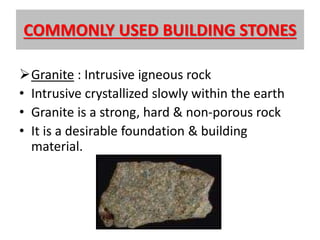
Granite : Intrusive igneous rock
• Intrusive crystallized slowly within the earth
• Granite is a strong, hard & non-porous rock
• It is a desirable foundation & building
material.
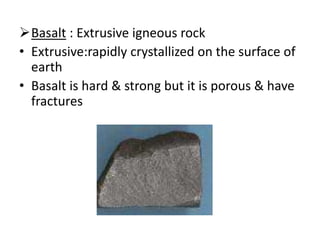
Basalt : Extrusive igneous rock
• Extrusive:rapidly crystallized on the surface of
earth
• Basalt is hard & strong but it is porous & have
fractures
Limestone : Sedimentary rock
• It is used as a concrete aggregate
• It is used in the production of cement & lime
Marble : Metamorphosed limestone
• Harder than limestone
• Used for interior work or wall or column facing
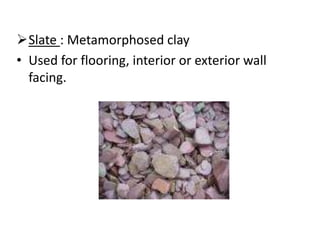
Slate : Metamorphosed clay
• Used for flooring, interior or exterior wall
facing.
TEST OF STONES
 Building stones are required to be tested for their
different properties before they may be recommended
for any specific case.
 1-Acid test.
 2- Water absorption test .
 3- Impact test .
 4- Crushing test .
 5- Hardness test .
ACID TEST
• This is the best test to find out the action of acids on
the stone. For this test about 50 to100 grams sample
of stone is immersed in a solution of 1 % HCl or
H2SO4 for about a week.
• The sample being agitated (pressed , disturbed) at
intervals. If the edges of stone are retained and there
is no deposition of any loose particles on the surface,
it indicates that the stone is good other wise weak
and bad.
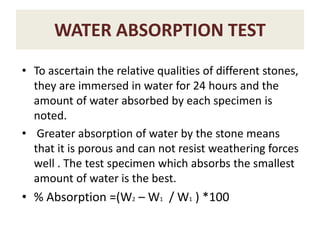
WATER ABSORPTION TEST
• To ascertain the relative qualities of different stones,
they are immersed in water for 24 hours and the
amount of water absorbed by each specimen is
noted.
• Greater absorption of water by the stone means
that it is porous and can not resist weathering forces
well . The test specimen which absorbs the smallest
amount of water is the best.
• % Absorption =(W2 – W1 / W1 ) *100
IMPACT TEST
• A cylinder of diameter & height 25mm is taken
and placed on cast iron anvil of machine.
• A steel hammer of weight 20N is allowed to fall
axially in vertical direction.The height of first blow
is 1cm, that of second blow is 2cm and so on.
• The blow no (n) at which specimen breaks is
noted. n represents the toughness index of stone.
CRUSHING TEST
• For this test finely dressed different samples of
stones are used .Their type is made flat and
horizontal and covered with plaster of Paris. They
are tested in a compression testing machine . The
load must be applied axially and the changes in
the blocks at the corresponding load are
recorded. The blocks or samples which bear more
loads are to be selected.
• Good quality stone has crushing strength more
then 70 N/mm*mm.
HARDNESS TEST
• This test is done to determine the hardness of
stone by mohr’s scale of hardness in the
laboratory where as in field it can be tested by
scratching with the knife.
• Hard stone do not so any mark of scratching.
• Coefficient of hardness =
20-(loss in weight in gm /3).
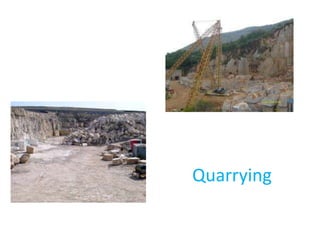
QUARRYING OF STONES
Stones are extracted from natural rocks in
different sizes. The various methods which are
involved in the extraction of stones from rock
beds are collectively termed as “Quarrying of
Stones”.
Methods Of Quarrying :
– Digging or excavating, heating, wedging
• For soft rocks like limestone, marble
– Blasting-blasting rocks with explosives
• For hard dense rocks like granite, basalt
Quarrying
DRESSING OF STONES
Dressing of stones is a process in which their
surfaces are prepared to a form, fit to be used for
any constructional purpose. Dressing is according
to the type of work and demand.
 Purpose of Dressing: To give them good looking.
• To provide horizontal and vertical joints in the
masonry.
• To make them fit, to be used for particular work.
Dressing
SEASONING OF STONES
 It makes the stone hard and compact , by exposing
the stone to open air for a period of six to twelve
months .
 All the stones should be seasoned before they are
used in structural work.
Characteristics and qualities of
good building stone
1.The stone should be easily and economically
obtainable in bulk .
2.The stone should be hard, strong and durable .
3.It should weather well.
4.It should have fine compact texture.
5.It should be capable to withstand the effects of
smoke and acidic atmosphere.
6.The stone should be free from soft patches,
flaws, cavities and cracks .
7.It should be well seasoned and easily workable.
END

Stone ppt by akshay

  • 1.
    GOVT ENG COLLAGEBIKANER  Power point presentation on:- Building stone  Submitted to :- Ankit sir  Submitted by :- Akshay kumar
  • 2.
  • 3.
    STONE Stone →One ofthe oldest building material. Rock : A large concreted mass of earthy or mineral matter or broken pieces of such a mass. Stone : Quarried or smaller pieces of rock for a specified function such as a building block.
  • 4.
    CLASSIFICATION OF STONES Stonescan be classified in following ways : 1. Geological classification 2. Physical classification 3. Chemical classification 4. Classification based on stone hardness
  • 5.
    GEOLOGICAL CLASSIFICATION On basisof hardness stone classified as: Igneous rocks: Formed by cooling and thus solidfying from a molten state. (Granite, Basalt) Sedimentary rocks : Formed by a process of cementation of small particles that result from the disintegration of rocks. (Limestone, sandstone) Metamorphic rocks : Formed by gradual changes in the structures of either igneous or sedimentary rocks caused by heat, water, pressure. (Marble, Slate)
  • 6.
    PHYSICAL CLASSIFICATION On basisof hardness stone classified as: Stratified stones : Derived from sedimentary rocks . These stones are found in layers deposited one above the other.(limestone , sandstone) Unstratified stones : Do not show any type of layer formation.(granite , marble) Foliated stones : have tendency to split away in a definite direction only . This type of structure is commonly found in metamorphic rocks.
  • 7.
    CHEMICAL CLASSIFICATION On basisof hardness stone classified as :  Siliceous rocks : silica is principal constituent , hard & durable , not affected by weathering agencies. (granites , quartzites ) Argillaceous rocks : clay predominates , moderately hard & durable but brittle.(slates , laterites ) Calcareous rocks : calcium carbonate predominates.(limestone , marble )
  • 8.
    HARDNESS CLASSIFICATION On basisof hardness stone classified as: As soft, medium, hard and very hard. Very hard rocks as Granite, Trap and Taconite. Hard rocks as Granite, Basalt, Gravel and Quartzite. Medium rocks as Dolomite and Lime Stone. Soft rocks as Talc, Gypsum and Sand stone.
  • 9.
    USES OF STONE Followingare the various uses of stones 1. For masonry work 2. For lintels and vertical columns 3. For covering floors of building 4. For paving of roads and foot paths 5. As a covering material for buildings
  • 10.
    6. For theconstruction of roads in form of boulders and aggregate. 7. As an aggregate in cement as well as lime concretes. 8. Base material for water and sewage filters. 9. For the manufacture of cement and lime. 10.In the construction of masonry dams , stones of good quality and durability are of vital importance.
  • 11.
    COMMONLY USED BUILDINGSTONES Granite : Intrusive igneous rock • Intrusive crystallized slowly within the earth • Granite is a strong, hard & non-porous rock • It is a desirable foundation & building material.
  • 12.
    Basalt : Extrusiveigneous rock • Extrusive:rapidly crystallized on the surface of earth • Basalt is hard & strong but it is porous & have fractures
  • 13.
    Limestone : Sedimentaryrock • It is used as a concrete aggregate • It is used in the production of cement & lime
  • 14.
    Marble : Metamorphosedlimestone • Harder than limestone • Used for interior work or wall or column facing
  • 15.
    Slate : Metamorphosedclay • Used for flooring, interior or exterior wall facing.
  • 16.
    TEST OF STONES Building stones are required to be tested for their different properties before they may be recommended for any specific case.  1-Acid test.  2- Water absorption test .  3- Impact test .  4- Crushing test .  5- Hardness test .
  • 17.
    ACID TEST • Thisis the best test to find out the action of acids on the stone. For this test about 50 to100 grams sample of stone is immersed in a solution of 1 % HCl or H2SO4 for about a week. • The sample being agitated (pressed , disturbed) at intervals. If the edges of stone are retained and there is no deposition of any loose particles on the surface, it indicates that the stone is good other wise weak and bad.
  • 18.
    WATER ABSORPTION TEST •To ascertain the relative qualities of different stones, they are immersed in water for 24 hours and the amount of water absorbed by each specimen is noted. • Greater absorption of water by the stone means that it is porous and can not resist weathering forces well . The test specimen which absorbs the smallest amount of water is the best. • % Absorption =(W2 – W1 / W1 ) *100
  • 19.
    IMPACT TEST • Acylinder of diameter & height 25mm is taken and placed on cast iron anvil of machine. • A steel hammer of weight 20N is allowed to fall axially in vertical direction.The height of first blow is 1cm, that of second blow is 2cm and so on. • The blow no (n) at which specimen breaks is noted. n represents the toughness index of stone.
  • 20.
    CRUSHING TEST • Forthis test finely dressed different samples of stones are used .Their type is made flat and horizontal and covered with plaster of Paris. They are tested in a compression testing machine . The load must be applied axially and the changes in the blocks at the corresponding load are recorded. The blocks or samples which bear more loads are to be selected. • Good quality stone has crushing strength more then 70 N/mm*mm.
  • 21.
    HARDNESS TEST • Thistest is done to determine the hardness of stone by mohr’s scale of hardness in the laboratory where as in field it can be tested by scratching with the knife. • Hard stone do not so any mark of scratching. • Coefficient of hardness = 20-(loss in weight in gm /3).
  • 22.
    QUARRYING OF STONES Stonesare extracted from natural rocks in different sizes. The various methods which are involved in the extraction of stones from rock beds are collectively termed as “Quarrying of Stones”. Methods Of Quarrying : – Digging or excavating, heating, wedging • For soft rocks like limestone, marble – Blasting-blasting rocks with explosives • For hard dense rocks like granite, basalt
  • 23.
  • 24.
    DRESSING OF STONES Dressingof stones is a process in which their surfaces are prepared to a form, fit to be used for any constructional purpose. Dressing is according to the type of work and demand.  Purpose of Dressing: To give them good looking. • To provide horizontal and vertical joints in the masonry. • To make them fit, to be used for particular work.
  • 25.
  • 26.
    SEASONING OF STONES It makes the stone hard and compact , by exposing the stone to open air for a period of six to twelve months .  All the stones should be seasoned before they are used in structural work.
  • 27.
    Characteristics and qualitiesof good building stone 1.The stone should be easily and economically obtainable in bulk . 2.The stone should be hard, strong and durable . 3.It should weather well. 4.It should have fine compact texture.
  • 28.
    5.It should becapable to withstand the effects of smoke and acidic atmosphere. 6.The stone should be free from soft patches, flaws, cavities and cracks . 7.It should be well seasoned and easily workable.
  • 29.