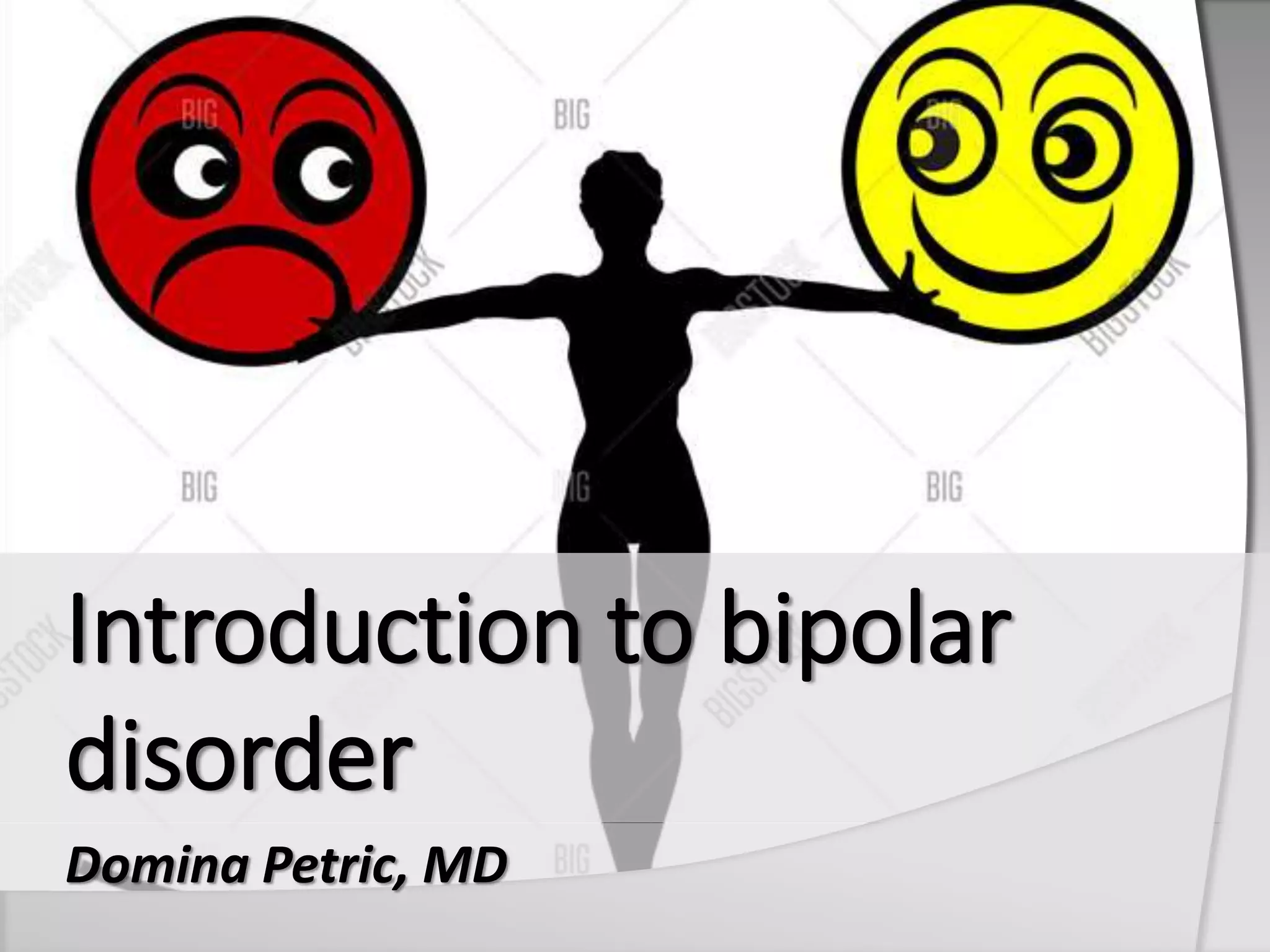
Introduction to bipolar
disorder
Domina Petric, MD
It is also called manic-depressive disorder.
BAD occurs in 1-3% of the adult population.
It may begin in childhood, but most cases are first
diagnosed in the third and fourth decades of life.
Bipolar affective disorder (BAD)
Katzung, Masters, Trevor.
Basic and clinical
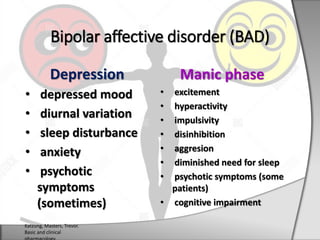
Depression
• depressed mood
• diurnal variation
• sleep disturbance
• anxiety
• psychotic
symptoms
(sometimes)
Manic phase
• excitement
• hyperactivity
• impulsivity
• disinhibition
• aggresion
• diminished need for sleep
• psychotic symptoms (some
patients)
• cognitive impairment
Bipolar affective disorder (BAD)
Katzung, Masters, Trevor.
Basic and clinical
Mixed manic and depressive
symptoms are also seen.
Patients with BAD are at
high risk for suicide.
Bipolar affective disorder (BAD)
Katzung, Masters, Trevor.
Basic and clinical
• The sequence, number and intensity of manic
and depressive episodes are highly variable.
• The cause of the mood swings is unknown:
preponderance of catecholamine-related
activity may be present.
• Drugs that increase this activity tend to
exacerbate mania.
• Drugs that reduce activity of dopamine or
norepinephrine relieve mania.
Bipolar affective disorder (BAD)
Katzung, Masters, Trevor.
Basic and clinical
• Acetylcholine or glutamate may also be
involved.
• The nature of the abrupt switch from mania to
depression experienced by some patients is
uncertain.
• Bipolar disorder has a strong familial
component.
• Genetically determined disorder: 8p, 13q.
Bipolar affective disorder (BAD)
Katzung, Masters, Trevor.
Basic and clinical
Several genes have shown
association with BAD with psychotic
features and with schizophrenia:
dysbindin, DAOA/G30, disrupted
inshizophrenia-1 (DISC-1) and
neuregulin 1.
Bipolar affective disorder (BAD)
Katzung, Masters, Trevor.
Basic and clinical
Lithium was the first agent shown to be useful in
the treatment of the manic phase.
It has no known use in schizophrenia.
Lithium continues to be used for acute-phase
illness as well as for prevention of recurrent
manic and depressive episodes.
Bipolar affective disorder (BAD)
Katzung, Masters, Trevor.
Basic and clinical
• Carbamazepine and valproic acid for the
treatment of acute mania and for
prevention of its recurrence.
• Lamotrigine for prevention of its
recurrence.
• Aripiprazole, chlorpromazine, olanzapine,
quetiapine, risperidone and ziprasidone
for treatment of the manic phase.
Bipolar affective disorder (BAD)
Katzung, Masters, Trevor.
Basic and clinical
• Olanzapine plus fluoxetine in
combination and quetiapine are
approved for the treatment of bipolar
depression.
• Gabapentin, oxcarbazepine and
topiramate are sometimes used, but not
approved (off label).
Bipolar affective disorder (BAD)
Katzung, Masters, Trevor.
Basic and clinical
• Katzung, Masters, Trevor.
Basic and clinical
pharmacology.
Literature
Katzung, Masters, Trevor.
Basic and clinical

Introduction to bipolar disorder

  • 1.
  • 2.
    It is alsocalled manic-depressive disorder. BAD occurs in 1-3% of the adult population. It may begin in childhood, but most cases are first diagnosed in the third and fourth decades of life. Bipolar affective disorder (BAD) Katzung, Masters, Trevor. Basic and clinical
  • 3.
    Depression • depressed mood •diurnal variation • sleep disturbance • anxiety • psychotic symptoms (sometimes) Manic phase • excitement • hyperactivity • impulsivity • disinhibition • aggresion • diminished need for sleep • psychotic symptoms (some patients) • cognitive impairment Bipolar affective disorder (BAD) Katzung, Masters, Trevor. Basic and clinical
  • 4.
    Mixed manic anddepressive symptoms are also seen. Patients with BAD are at high risk for suicide. Bipolar affective disorder (BAD) Katzung, Masters, Trevor. Basic and clinical
  • 5.
    • The sequence,number and intensity of manic and depressive episodes are highly variable. • The cause of the mood swings is unknown: preponderance of catecholamine-related activity may be present. • Drugs that increase this activity tend to exacerbate mania. • Drugs that reduce activity of dopamine or norepinephrine relieve mania. Bipolar affective disorder (BAD) Katzung, Masters, Trevor. Basic and clinical
  • 6.
    • Acetylcholine orglutamate may also be involved. • The nature of the abrupt switch from mania to depression experienced by some patients is uncertain. • Bipolar disorder has a strong familial component. • Genetically determined disorder: 8p, 13q. Bipolar affective disorder (BAD) Katzung, Masters, Trevor. Basic and clinical
  • 7.
    Several genes haveshown association with BAD with psychotic features and with schizophrenia: dysbindin, DAOA/G30, disrupted inshizophrenia-1 (DISC-1) and neuregulin 1. Bipolar affective disorder (BAD) Katzung, Masters, Trevor. Basic and clinical
  • 8.
    Lithium was thefirst agent shown to be useful in the treatment of the manic phase. It has no known use in schizophrenia. Lithium continues to be used for acute-phase illness as well as for prevention of recurrent manic and depressive episodes. Bipolar affective disorder (BAD) Katzung, Masters, Trevor. Basic and clinical
  • 9.
    • Carbamazepine andvalproic acid for the treatment of acute mania and for prevention of its recurrence. • Lamotrigine for prevention of its recurrence. • Aripiprazole, chlorpromazine, olanzapine, quetiapine, risperidone and ziprasidone for treatment of the manic phase. Bipolar affective disorder (BAD) Katzung, Masters, Trevor. Basic and clinical
  • 10.
    • Olanzapine plusfluoxetine in combination and quetiapine are approved for the treatment of bipolar depression. • Gabapentin, oxcarbazepine and topiramate are sometimes used, but not approved (off label). Bipolar affective disorder (BAD) Katzung, Masters, Trevor. Basic and clinical
  • 11.
    • Katzung, Masters,Trevor. Basic and clinical pharmacology. Literature Katzung, Masters, Trevor. Basic and clinical