Nirvana’s Lithium
I'm so happy 'cause today I've found my friends
They're in my head I'm so ugly, but that's okay, 'cause so are you...
We've broken our mirrors
Sunday morning is everyday for all I care...
And I'm not scared
Light my candles in a daze...
'Cause I've found god - yeah, yeah, yeah
I'm so lonely but that's okay I shaved my head...
And I'm not sad
And just maybe I'm to blame for all I've heard...
But I'm not sure I'm so excited, I can't wait to meet you there...
But I don't care I'm so horny but that's okay...
My will is good - yeah, yeah, yeah I like it - I'm not gonna crack
I miss you
I'm not gonna crack
I love you
I'm not gonna crack
I kill you
I'm not gonna crack
Bipolar Disorder
 Also known as manic depression, a mental
illness that causes a person’s moods to
swing from extremely happy and energized
(mania) to extremely sad (depression)
 Chronic illness; can be life-threatening
 Most often diagnosed in adolescence
Mood Disorders
AKA: Affective Disorders
Affect – “emotion” or “mood”
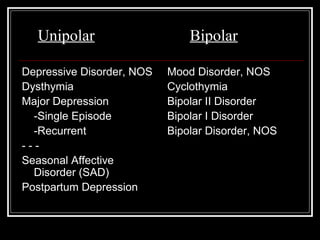
Unipolar & Bipolar Depression
Unipolar Bipolar
Depressive Disorder, NOS
Dysthymia
Major Depression
-Single Episode
-Recurrent
- - -
Seasonal Affective
Disorder (SAD)
Postpartum Depression
Mood Disorder, NOS
Cyclothymia
Bipolar II Disorder
Bipolar I Disorder
Bipolar Disorder, NOS
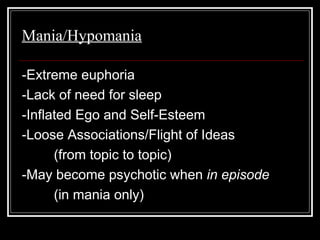
Mania/Hypomania
-Extreme euphoria
-Lack of need for sleep
-Inflated Ego and Self-Esteem
-Loose Associations/Flight of Ideas
(from topic to topic)
-May become psychotic when in episode
(in mania only)
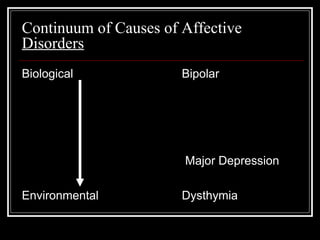
Continuum of Causes of Affective
Disorders
Biological Bipolar
Major Depression
Environmental Dysthymia
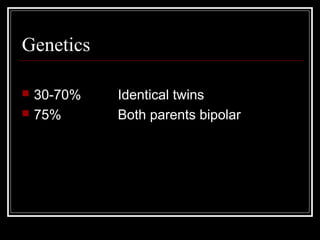
Genetics
 30-70% Identical twins
 75% Both parents bipolar
Mood Disorders
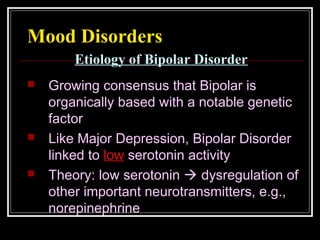
 Growing consensus that Bipolar is
organically based with a notable genetic
factor
 Like Major Depression, Bipolar Disorder
linked to low serotonin activity
 Theory: low serotonin  dysregulation of
other important neurotransmitters, e.g.,
norepinephrine
Etiology of Bipolar Disorder
Mood Disorders
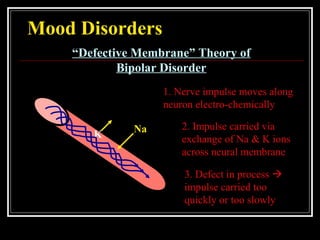
“Defective Membrane” Theory of
Bipolar Disorder
1. Nerve impulse moves along
neuron electro-chemically
2. Impulse carried via
exchange of Na & K ions
across neural membrane
Na
K
3. Defect in process 
impulse carried too
quickly or too slowly
GRK3 regulates sensitivity to
neurotransmitters
 Decreases the sensitivity of neurons
to neurotransmitters
 Acts as a brake to stress
 Maintains balance in the brain
GRK3 is a Gene For
Bipolar Disorder
 GRK3 is inherited with bipolar disorder
 GRK3 is turned on by amphetamine
 A mutation in GRK3 increases risk to
bipolar disorder 3 fold
Mood Disorders
 Genetic studies, especially of twins,
indicate a genetic predisposition for
bipolar disorder
 40% of identical twins concordant, vs. 5 to
10% of fraternal twins
Etiology of Bipolar Disorder
Epidemiology of Bipolar Disorder
 Prevalence: 1% of population Adults =
Adolescents
 Males = Females
 2-3 million American adults are diagnosed
with bipolar disorder
 NIMH estimates that one in very one
hundred people will develop the disorder
Controversy
 Severity and duration
 Onset before puberty is estimated to be
rare
 Developmental variability
 Retrospective study of adults
Vincent Van Gogh
“It isn’t possible to get
values and color. You
can’t be at the pole
and the equator at the
same time. You must
choose your own line,
as I hope to do, and it
will probably be color.”
Assessment/Diagnosis of Bipolar
Disorder
 Often very complicated; it mimics
many other disorders and has
comorbidity (presents with other
disorders)
 Alphabet soup diagnosis
 Half of bipolar children have
relatives with bipolar disorder
 It is important to first rule
out the possibility of any
other organic diagnosis:
 Thyroid disorder
 Seizure disorder
 Multiple sclerosis
 Infectious, toxic, and drug-
induced disorders
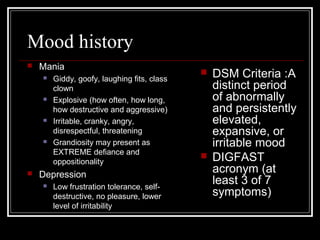
Mood history
 Mania
 Giddy, goofy, laughing fits, class
clown
 Explosive (how often, how long,
how destructive and aggressive)
 Irritable, cranky, angry,
disrespectful, threatening
 Grandiosity may present as
EXTREME defiance and
oppositionality
 Depression
 Low frustration tolerance, self-
destructive, no pleasure, lower
level of irritability
 DSM Criteria :A
distinct period
of abnormally
and persistently
elevated,
expansive, or
irritable mood
 DIGFAST
acronym (at
least 3 of 7
symptoms)
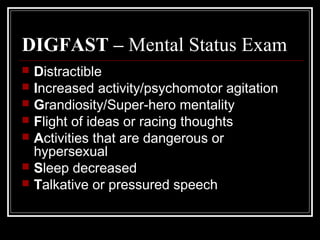
DIGFAST – Mental Status Exam
 Distractible
 Increased activity/psychomotor agitation
 Grandiosity/Super-hero mentality
 Flight of ideas or racing thoughts
 Activities that are dangerous or
hypersexual
 Sleep decreased
 Talkative or pressured speech
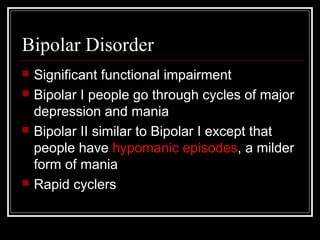
Bipolar Disorder
 Significant functional impairment
 Bipolar I people go through cycles of major
depression and mania
 Bipolar II similar to Bipolar I except that
people have hypomanic episodes, a milder
form of mania
 Rapid cyclers
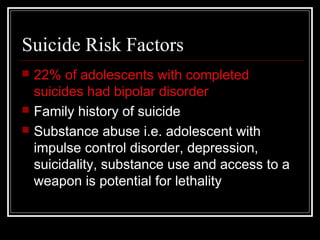
Suicide Risk Factors
 22% of adolescents with completed
suicides had bipolar disorder
 Family history of suicide
 Substance abuse i.e. adolescent with
impulse control disorder, depression,
suicidality, substance use and access to a
weapon is potential for lethality
 Major depression often presents first
(estimated that 20 - 40% of children
presenting with major depression within 5
years will be bipolar)
 Comorbidity
 70 - 90 % of adolescents have other
disorders
 ADHD, Conduct Disorder, Substance
abuse
Pediatric-Onset Bipolar Disorder
 Geller (American Journal of Psychiatry,
2001) followed up 72 depressed
prepubertal children into adulthood
 48.6% (N=35) developed bipolar disorder
by mean age 20.7 years
 Atypical presentation in juveniles-
exacerbation of disruptive behavior,
moodiness, low frustration tolerance,
explosive anger and difficulty sleeping at
night
 Comorbidity of ADHD/BPD more severe
presentation, often severe affect
dysregulation, marked impairment,
violent temper outbursts
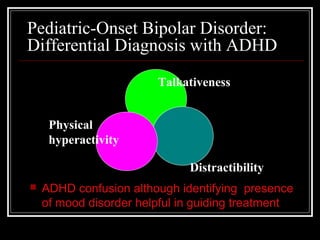
Pediatric-Onset Bipolar Disorder:
Differential Diagnosis with ADHD
 ADHD confusion although identifying presence
of mood disorder helpful in guiding treatment
Talkativeness
Physical
hyperactivity
Distractibility
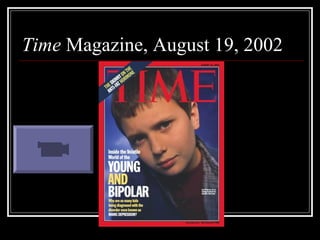
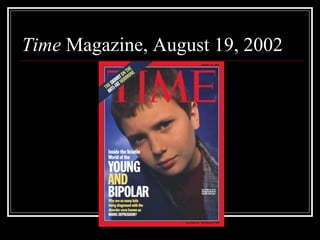
Time Magazine, August 19, 2002
Prioritizing Target Symptoms
1. Treat mania and/or psychosis
2. Treat depression
3. Anxiety and ADHD
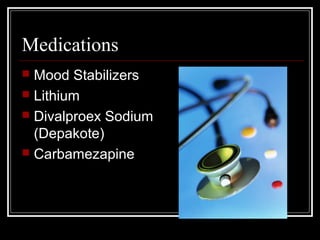
Medications
 Mood Stabilizers
 Lithium
 Divalproex Sodium
(Depakote)
 Carbamezapine
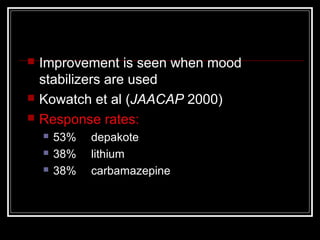
 Improvement is seen when mood
stabilizers are used
 Kowatch et al (JAACAP 2000)
 Response rates:
 53% depakote
 38% lithium
 38% carbamazepine
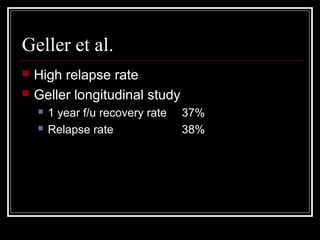
Geller et al.
 High relapse rate
 Geller longitudinal study
 1 year f/u recovery rate 37%
 Relapse rate 38%
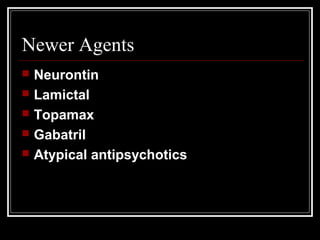
Newer Agents
 Neurontin
 Lamictal
 Topamax
 Gabatril
 Atypical antipsychotics
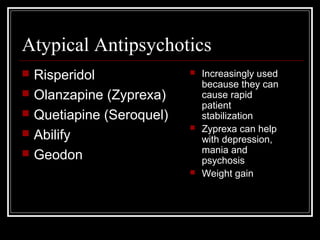
Atypical Antipsychotics
 Risperidol
 Olanzapine (Zyprexa)
 Quetiapine (Seroquel)
 Abilify
 Geodon
 Increasingly used
because they can
cause rapid
patient
stabilization
 Zyprexa can help
with depression,
mania and
psychosis
 Weight gain
Key Point
 Just because a child improves on a mood
stabilizer does not prove the diagnosis.
Mood stabilizers have been used for a long
time to help with aggression in children.
Multiple Modalities
 Psychotherapy
 Psychoeducation/Support
 School Support/Consultation
 Residential Placement, Acute Hospitalization
 Mood Charting
 Teach Good Sleep Hygiene
 Legal intervention
 Hope

Bipolar lecture

  • 1.
    Nirvana’s Lithium I'm sohappy 'cause today I've found my friends They're in my head I'm so ugly, but that's okay, 'cause so are you... We've broken our mirrors Sunday morning is everyday for all I care... And I'm not scared Light my candles in a daze... 'Cause I've found god - yeah, yeah, yeah I'm so lonely but that's okay I shaved my head... And I'm not sad And just maybe I'm to blame for all I've heard... But I'm not sure I'm so excited, I can't wait to meet you there... But I don't care I'm so horny but that's okay... My will is good - yeah, yeah, yeah I like it - I'm not gonna crack I miss you I'm not gonna crack I love you I'm not gonna crack I kill you I'm not gonna crack
  • 2.
    Bipolar Disorder  Alsoknown as manic depression, a mental illness that causes a person’s moods to swing from extremely happy and energized (mania) to extremely sad (depression)  Chronic illness; can be life-threatening  Most often diagnosed in adolescence
  • 3.
    Mood Disorders AKA: AffectiveDisorders Affect – “emotion” or “mood” Unipolar & Bipolar Depression
  • 4.
    Unipolar Bipolar Depressive Disorder,NOS Dysthymia Major Depression -Single Episode -Recurrent - - - Seasonal Affective Disorder (SAD) Postpartum Depression Mood Disorder, NOS Cyclothymia Bipolar II Disorder Bipolar I Disorder Bipolar Disorder, NOS
  • 5.
    Mania/Hypomania -Extreme euphoria -Lack ofneed for sleep -Inflated Ego and Self-Esteem -Loose Associations/Flight of Ideas (from topic to topic) -May become psychotic when in episode (in mania only)
  • 6.
    Continuum of Causesof Affective Disorders Biological Bipolar Major Depression Environmental Dysthymia
  • 7.
    Genetics  30-70% Identicaltwins  75% Both parents bipolar
  • 8.
    Mood Disorders  Growingconsensus that Bipolar is organically based with a notable genetic factor  Like Major Depression, Bipolar Disorder linked to low serotonin activity  Theory: low serotonin  dysregulation of other important neurotransmitters, e.g., norepinephrine Etiology of Bipolar Disorder
  • 9.
    Mood Disorders “Defective Membrane”Theory of Bipolar Disorder 1. Nerve impulse moves along neuron electro-chemically 2. Impulse carried via exchange of Na & K ions across neural membrane Na K 3. Defect in process  impulse carried too quickly or too slowly
  • 10.
    GRK3 regulates sensitivityto neurotransmitters  Decreases the sensitivity of neurons to neurotransmitters  Acts as a brake to stress  Maintains balance in the brain
  • 11.
    GRK3 is aGene For Bipolar Disorder  GRK3 is inherited with bipolar disorder  GRK3 is turned on by amphetamine  A mutation in GRK3 increases risk to bipolar disorder 3 fold
  • 12.
    Mood Disorders  Geneticstudies, especially of twins, indicate a genetic predisposition for bipolar disorder  40% of identical twins concordant, vs. 5 to 10% of fraternal twins Etiology of Bipolar Disorder
  • 13.
    Epidemiology of BipolarDisorder  Prevalence: 1% of population Adults = Adolescents  Males = Females  2-3 million American adults are diagnosed with bipolar disorder  NIMH estimates that one in very one hundred people will develop the disorder
  • 14.
    Controversy  Severity andduration  Onset before puberty is estimated to be rare  Developmental variability  Retrospective study of adults
  • 15.
    Vincent Van Gogh “Itisn’t possible to get values and color. You can’t be at the pole and the equator at the same time. You must choose your own line, as I hope to do, and it will probably be color.”
  • 16.
    Assessment/Diagnosis of Bipolar Disorder Often very complicated; it mimics many other disorders and has comorbidity (presents with other disorders)  Alphabet soup diagnosis  Half of bipolar children have relatives with bipolar disorder  It is important to first rule out the possibility of any other organic diagnosis:  Thyroid disorder  Seizure disorder  Multiple sclerosis  Infectious, toxic, and drug- induced disorders
  • 17.
    Mood history  Mania Giddy, goofy, laughing fits, class clown  Explosive (how often, how long, how destructive and aggressive)  Irritable, cranky, angry, disrespectful, threatening  Grandiosity may present as EXTREME defiance and oppositionality  Depression  Low frustration tolerance, self- destructive, no pleasure, lower level of irritability  DSM Criteria :A distinct period of abnormally and persistently elevated, expansive, or irritable mood  DIGFAST acronym (at least 3 of 7 symptoms)
  • 18.
    DIGFAST – MentalStatus Exam  Distractible  Increased activity/psychomotor agitation  Grandiosity/Super-hero mentality  Flight of ideas or racing thoughts  Activities that are dangerous or hypersexual  Sleep decreased  Talkative or pressured speech
  • 19.
    Bipolar Disorder  Significantfunctional impairment  Bipolar I people go through cycles of major depression and mania  Bipolar II similar to Bipolar I except that people have hypomanic episodes, a milder form of mania  Rapid cyclers
  • 20.
    Suicide Risk Factors 22% of adolescents with completed suicides had bipolar disorder  Family history of suicide  Substance abuse i.e. adolescent with impulse control disorder, depression, suicidality, substance use and access to a weapon is potential for lethality
  • 21.
     Major depressionoften presents first (estimated that 20 - 40% of children presenting with major depression within 5 years will be bipolar)  Comorbidity  70 - 90 % of adolescents have other disorders  ADHD, Conduct Disorder, Substance abuse
  • 22.
    Pediatric-Onset Bipolar Disorder Geller (American Journal of Psychiatry, 2001) followed up 72 depressed prepubertal children into adulthood  48.6% (N=35) developed bipolar disorder by mean age 20.7 years
  • 23.
     Atypical presentationin juveniles- exacerbation of disruptive behavior, moodiness, low frustration tolerance, explosive anger and difficulty sleeping at night  Comorbidity of ADHD/BPD more severe presentation, often severe affect dysregulation, marked impairment, violent temper outbursts
  • 24.
    Pediatric-Onset Bipolar Disorder: DifferentialDiagnosis with ADHD  ADHD confusion although identifying presence of mood disorder helpful in guiding treatment Talkativeness Physical hyperactivity Distractibility
  • 25.
  • 26.
  • 27.
    Prioritizing Target Symptoms 1.Treat mania and/or psychosis 2. Treat depression 3. Anxiety and ADHD
  • 28.
    Medications  Mood Stabilizers Lithium  Divalproex Sodium (Depakote)  Carbamezapine
  • 29.
     Improvement isseen when mood stabilizers are used  Kowatch et al (JAACAP 2000)  Response rates:  53% depakote  38% lithium  38% carbamazepine
  • 30.
    Geller et al. High relapse rate  Geller longitudinal study  1 year f/u recovery rate 37%  Relapse rate 38%
  • 31.
    Newer Agents  Neurontin Lamictal  Topamax  Gabatril  Atypical antipsychotics
  • 32.
    Atypical Antipsychotics  Risperidol Olanzapine (Zyprexa)  Quetiapine (Seroquel)  Abilify  Geodon  Increasingly used because they can cause rapid patient stabilization  Zyprexa can help with depression, mania and psychosis  Weight gain
  • 33.
    Key Point  Justbecause a child improves on a mood stabilizer does not prove the diagnosis. Mood stabilizers have been used for a long time to help with aggression in children.
  • 34.
    Multiple Modalities  Psychotherapy Psychoeducation/Support  School Support/Consultation  Residential Placement, Acute Hospitalization  Mood Charting  Teach Good Sleep Hygiene  Legal intervention  Hope