William Stallings Data and Computer Communications 7 th  Edition Chapter 1 Data Communications and Networks Overview
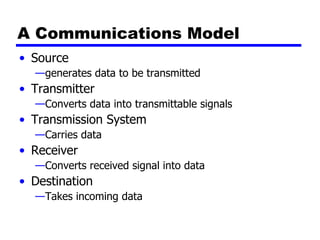
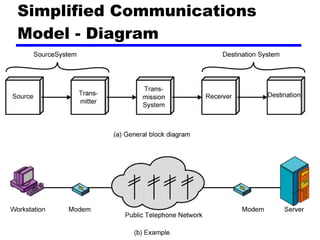
A Communications Model Source generates data to be transmitted Transmitter Converts data into transmittable signals Transmission System Carries data Receiver Converts received signal into data Destination Takes incoming data
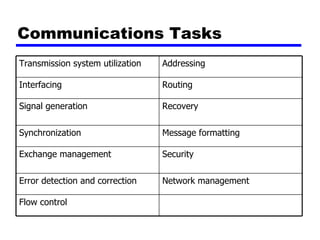
Communications Tasks Flow control Network management Error detection and correction Security Exchange management Message formatting Synchronization Recovery Signal generation Routing Interfacing Addressing Transmission system utilization
Simplified Communications Model - Diagram
Simplified Data Communications Model
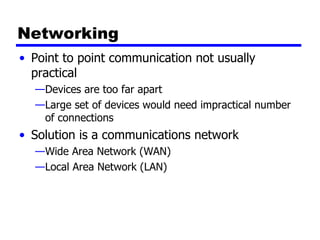
Networking Point to point communication not usually practical Devices are too far apart Large set of devices would need impractical number of connections Solution is a communications network Wide Area Network (WAN) Local Area Network (LAN)
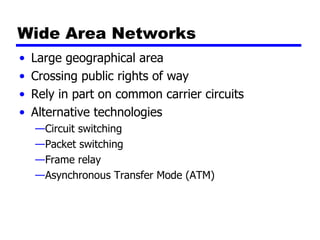
Wide Area Networks Large geographical area Crossing public rights of way Rely in part on common carrier circuits Alternative technologies Circuit switching Packet switching Frame relay Asynchronous Transfer Mode (ATM)
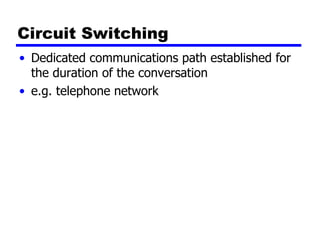
Circuit Switching Dedicated communications path established for the duration of the conversation e.g. telephone network
Packet Switching Data sent out of sequence Small chunks (packets) of data at a time Packets passed from node to node between source and destination Used for terminal to computer and computer to computer communications
Frame Relay Packet switching systems have large overheads to compensate for errors Modern systems are more reliable Errors can be caught in end system Most overhead for error control is stripped out
Asynchronous Transfer Mode ATM Evolution of frame relay Little overhead for error control Fixed packet (called cell) length Anything from 10Mbps to Gbps Constant data rate using packet switching technique
Local Area Networks Smaller scope Building or small campus Usually owned by same organization as attached devices Data rates much higher Usually broadcast systems Now some switched systems and ATM are being introduced
LAN Configurations Switched Switched Ethernet May be single or multiple switches ATM LAN Fibre Channel Wireless Mobility Ease of installation
Metropolitan Area Networks MAN Middle ground between LAN and WAN Private or public network High speed Large area
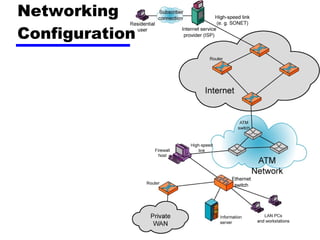
Networking Configuration

INTRODUCTION TO BASICS OF DATA COMMUNICATION"S

  • 1.
    William Stallings Dataand Computer Communications 7 th Edition Chapter 1 Data Communications and Networks Overview
  • 2.
    A Communications ModelSource generates data to be transmitted Transmitter Converts data into transmittable signals Transmission System Carries data Receiver Converts received signal into data Destination Takes incoming data
  • 3.
    Communications Tasks Flowcontrol Network management Error detection and correction Security Exchange management Message formatting Synchronization Recovery Signal generation Routing Interfacing Addressing Transmission system utilization
  • 4.
  • 5.
  • 6.
    Networking Point topoint communication not usually practical Devices are too far apart Large set of devices would need impractical number of connections Solution is a communications network Wide Area Network (WAN) Local Area Network (LAN)
  • 7.
    Wide Area NetworksLarge geographical area Crossing public rights of way Rely in part on common carrier circuits Alternative technologies Circuit switching Packet switching Frame relay Asynchronous Transfer Mode (ATM)
  • 8.
    Circuit Switching Dedicatedcommunications path established for the duration of the conversation e.g. telephone network
  • 9.
    Packet Switching Datasent out of sequence Small chunks (packets) of data at a time Packets passed from node to node between source and destination Used for terminal to computer and computer to computer communications
  • 10.
    Frame Relay Packetswitching systems have large overheads to compensate for errors Modern systems are more reliable Errors can be caught in end system Most overhead for error control is stripped out
  • 11.
    Asynchronous Transfer ModeATM Evolution of frame relay Little overhead for error control Fixed packet (called cell) length Anything from 10Mbps to Gbps Constant data rate using packet switching technique
  • 12.
    Local Area NetworksSmaller scope Building or small campus Usually owned by same organization as attached devices Data rates much higher Usually broadcast systems Now some switched systems and ATM are being introduced
  • 13.
    LAN Configurations SwitchedSwitched Ethernet May be single or multiple switches ATM LAN Fibre Channel Wireless Mobility Ease of installation
  • 14.
    Metropolitan Area NetworksMAN Middle ground between LAN and WAN Private or public network High speed Large area
  • 15.