1
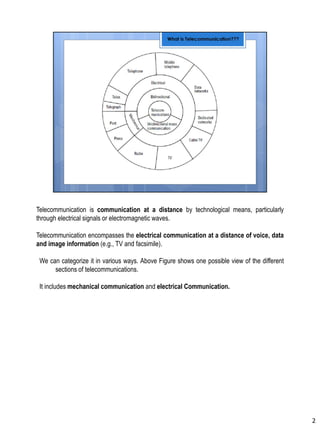
Telecommunication is communication at a distance by technological means, particularly
through electrical signals or electromagnetic waves.
Telecommunication encompasses the electrical communication at a distance of voice, data
and image information (e.g., TV and facsimile).
We can categorize it in various ways. Above Figure shows one possible view of the different
sections of telecommunications.
It includes mechanical communication and electrical Communication.
2
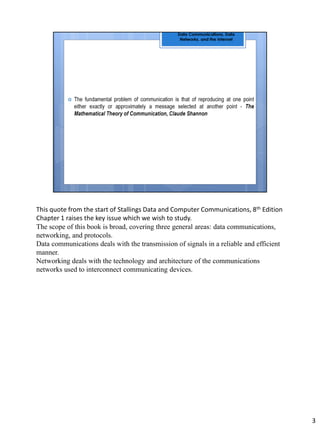
This quote from the start of Stallings Data and Computer Communications, 8th Edition
Chapter 1 raises the key issue which we wish to study.
The scope of this book is broad, covering three general areas: data communications,
networking, and protocols.
Data communications deals with the transmission of signals in a reliable and efficient
manner.
Networking deals with the technology and architecture of the communications
networks used to interconnect communicating devices.
3
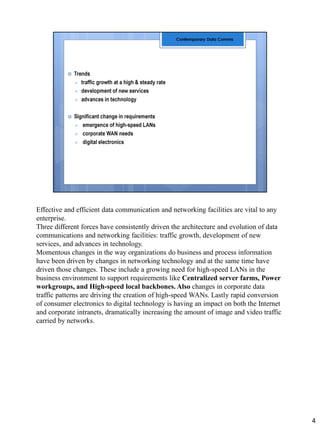
Effective and efficient data communication and networking facilities are vital to any
enterprise.
Three different forces have consistently driven the architecture and evolution of data
communications and networking facilities: traffic growth, development of new
services, and advances in technology.
Momentous changes in the way organizations do business and process information
have been driven by changes in networking technology and at the same time have
driven those changes. These include a growing need for high-speed LANs in the
business environment to support requirements like Centralized server farms, Power
workgroups, and High-speed local backbones. Also changes in corporate data
traffic patterns are driving the creation of high-speed WANs. Lastly rapid conversion
of consumer electronics to digital technology is having an impact on both the Internet
and corporate intranets, dramatically increasing the amount of image and video traffic
carried by networks.
4
The fundamental purpose of a communications system is the exchange of data
between two parties. This section introduces a simple model of communication,
illustrated in general and by specific example in Stallings DCC8e Figure 1.2. The key
elements of this model are:
•Source - generates data to be transmitted
•Transmitter - converts data into transmittable signals
•Transmission System - carries data from source to destination
•Receiver - converts received signal into data
•Destination - takes incoming data
5
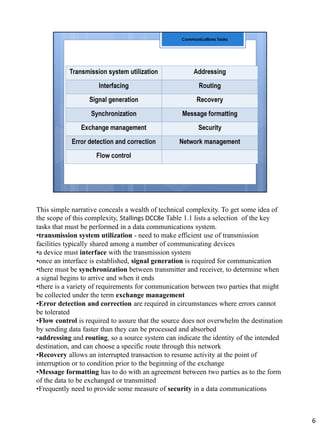
This simple narrative conceals a wealth of technical complexity. To get some idea of
the scope of this complexity, Stallings DCC8e Table 1.1 lists a selection of the key
tasks that must be performed in a data communications system.
•transmission system utilization - need to make efficient use of transmission
facilities typically shared among a number of communicating devices
•a device must interface with the transmission system
•once an interface is established, signal generation is required for communication
•there must be synchronization between transmitter and receiver, to determine when
a signal begins to arrive and when it ends
•there is a variety of requirements for communication between two parties that might
be collected under the term exchange management
•Error detection and correction are required in circumstances where errors cannot
be tolerated
•Flow control is required to assure that the source does not overwhelm the destination
by sending data faster than they can be processed and absorbed
•addressing and routing, so a source system can indicate the identity of the intended
destination, and can choose a specific route through this network
•Recovery allows an interrupted transaction to resume activity at the point of
interruption or to condition prior to the beginning of the exchange
•Message formatting has to do with an agreement between two parties as to the form
of the data to be exchanged or transmitted
•Frequently need to provide some measure of security in a data communications
6
system
•Network management capabilities are needed to configure the system, monitor its
status, react to failures and overloads, and plan intelligently for future growth
See have gone from the simple idea of data communication between source and
destination to a rather formidable list of data communications tasks.
6
The next section of the text on "Data Communications”, deals with the most
fundamental aspects of the communications function, focusing on the transmission of
signals in a reliable and efficient manner.
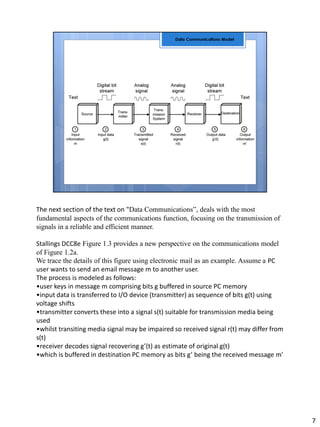
Stallings DCC8e Figure 1.3 provides a new perspective on the communications model
of Figure 1.2a.
We trace the details of this figure using electronic mail as an example. Assume a PC
user wants to send an email message m to another user.
The process is modeled as follows:
•user keys in message m comprising bits g buffered in source PC memory
•input data is transferred to I/O device (transmitter) as sequence of bits g(t) using
voltage shifts
•transmitter converts these into a signal s(t) suitable for transmission media being
used
•whilst transiting media signal may be impaired so received signal r(t) may differ from
s(t)
•receiver decodes signal recovering g’(t) as estimate of original g(t)
•which is buffered in destination PC memory as bits g’ being the received message m’
7
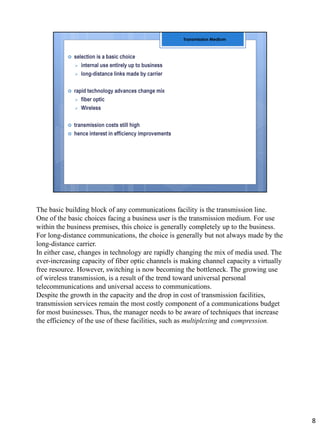
The basic building block of any communications facility is the transmission line.
One of the basic choices facing a business user is the transmission medium. For use
within the business premises, this choice is generally completely up to the business.
For long-distance communications, the choice is generally but not always made by the
long-distance carrier.
In either case, changes in technology are rapidly changing the mix of media used. The
ever-increasing capacity of fiber optic channels is making channel capacity a virtually
free resource. However, switching is now becoming the bottleneck. The growing use
of wireless transmission, is a result of the trend toward universal personal
telecommunications and universal access to communications.
Despite the growth in the capacity and the drop in cost of transmission facilities,
transmission services remain the most costly component of a communications budget
for most businesses. Thus, the manager needs to be aware of techniques that increase
the efficiency of the use of these facilities, such as multiplexing and compression.
8
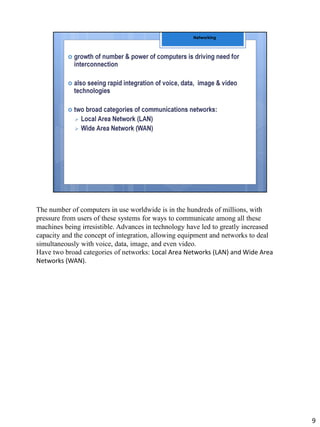
The number of computers in use worldwide is in the hundreds of millions, with
pressure from users of these systems for ways to communicate among all these
machines being irresistible. Advances in technology have led to greatly increased
capacity and the concept of integration, allowing equipment and networks to deal
simultaneously with voice, data, image, and even video.
Have two broad categories of networks: Local Area Networks (LAN) and Wide Area
Networks (WAN).
9
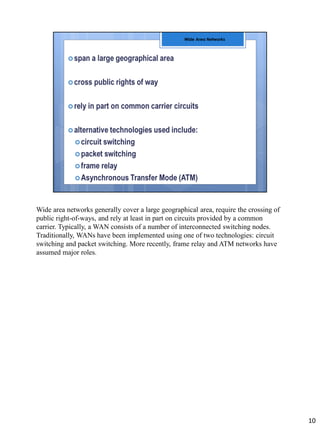
Wide area networks generally cover a large geographical area, require the crossing of
public right-of-ways, and rely at least in part on circuits provided by a common
carrier. Typically, a WAN consists of a number of interconnected switching nodes.
Traditionally, WANs have been implemented using one of two technologies: circuit
switching and packet switching. More recently, frame relay and ATM networks have
assumed major roles.
10
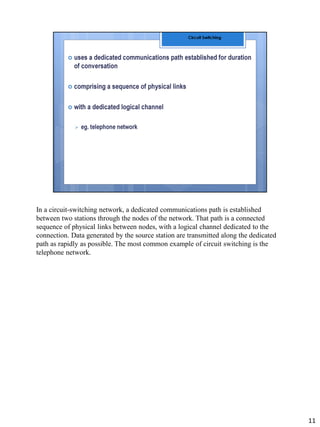
In a circuit-switching network, a dedicated communications path is established
between two stations through the nodes of the network. That path is a connected
sequence of physical links between nodes, with a logical channel dedicated to the
connection. Data generated by the source station are transmitted along the dedicated
path as rapidly as possible. The most common example of circuit switching is the
telephone network.
11
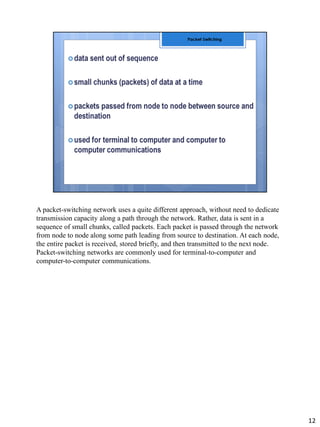
A packet-switching network uses a quite different approach, without need to dedicate
transmission capacity along a path through the network. Rather, data is sent in a
sequence of small chunks, called packets. Each packet is passed through the network
from node to node along some path leading from source to destination. At each node,
the entire packet is received, stored briefly, and then transmitted to the next node.
Packet-switching networks are commonly used for terminal-to-computer and
computer-to-computer communications.
12
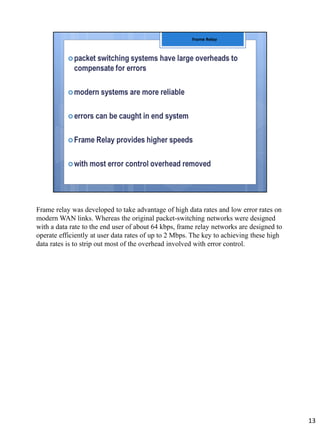
Frame relay was developed to take advantage of high data rates and low error rates on
modern WAN links. Whereas the original packet-switching networks were designed
with a data rate to the end user of about 64 kbps, frame relay networks are designed to
operate efficiently at user data rates of up to 2 Mbps. The key to achieving these high
data rates is to strip out most of the overhead involved with error control.
13
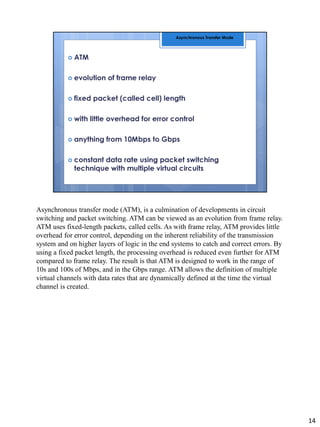
Asynchronous transfer mode (ATM), is a culmination of developments in circuit
switching and packet switching. ATM can be viewed as an evolution from frame relay.
ATM uses fixed-length packets, called cells. As with frame relay, ATM provides little
overhead for error control, depending on the inherent reliability of the transmission
system and on higher layers of logic in the end systems to catch and correct errors. By
using a fixed packet length, the processing overhead is reduced even further for ATM
compared to frame relay. The result is that ATM is designed to work in the range of
10s and 100s of Mbps, and in the Gbps range. ATM allows the definition of multiple
virtual channels with data rates that are dynamically defined at the time the virtual
channel is created.
14
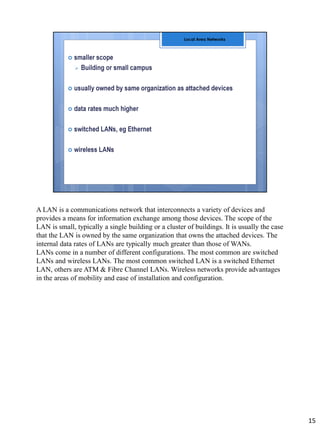
A LAN is a communications network that interconnects a variety of devices and
provides a means for information exchange among those devices. The scope of the
LAN is small, typically a single building or a cluster of buildings. It is usually the case
that the LAN is owned by the same organization that owns the attached devices. The
internal data rates of LANs are typically much greater than those of WANs.
LANs come in a number of different configurations. The most common are switched
LANs and wireless LANs. The most common switched LAN is a switched Ethernet
LAN, others are ATM & Fibre Channel LANs. Wireless networks provide advantages
in the areas of mobility and ease of installation and configuration.
15
Metropolitan Area Networks provide a middle ground between LANs and WANs,
typically spanning a city / metro area with higher speed connections.
16
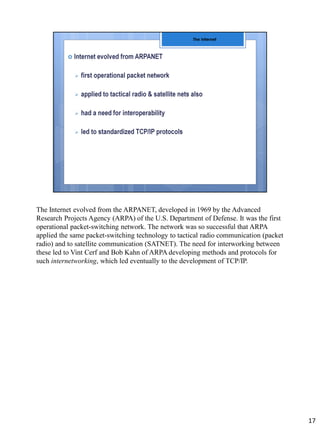
The Internet evolved from the ARPANET, developed in 1969 by the Advanced
Research Projects Agency (ARPA) of the U.S. Department of Defense. It was the first
operational packet-switching network. The network was so successful that ARPA
applied the same packet-switching technology to tactical radio communication (packet
radio) and to satellite communication (SATNET). The need for interworking between
these led to Vint Cerf and Bob Kahn of ARPA developing methods and protocols for
such internetworking, which led eventually to the development of TCP/IP.
17
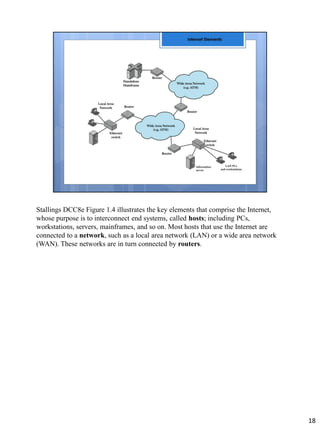
Stallings DCC8e Figure 1.4 illustrates the key elements that comprise the Internet,
whose purpose is to interconnect end systems, called hosts; including PCs,
workstations, servers, mainframes, and so on. Most hosts that use the Internet are
connected to a network, such as a local area network (LAN) or a wide area network
(WAN). These networks are in turn connected by routers.
18
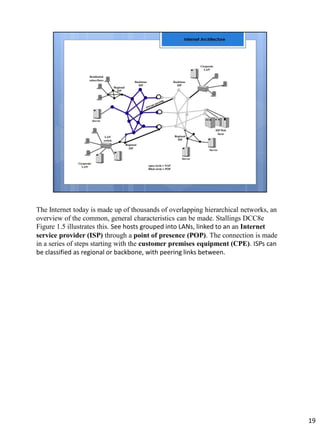
The Internet today is made up of thousands of overlapping hierarchical networks, an
overview of the common, general characteristics can be made. Stallings DCC8e
Figure 1.5 illustrates this. See hosts grouped into LANs, linked to an an Internet
service provider (ISP) through a point of presence (POP). The connection is made
in a series of steps starting with the customer premises equipment (CPE). ISPs can
be classified as regional or backbone, with peering links between.
19
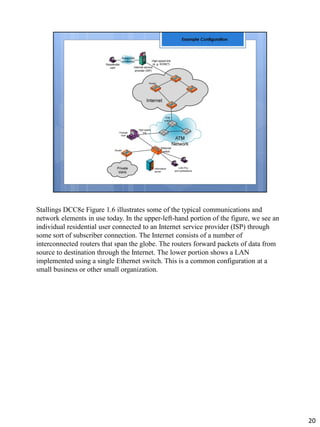
Stallings DCC8e Figure 1.6 illustrates some of the typical communications and
network elements in use today. In the upper-left-hand portion of the figure, we see an
individual residential user connected to an Internet service provider (ISP) through
some sort of subscriber connection. The Internet consists of a number of
interconnected routers that span the globe. The routers forward packets of data from
source to destination through the Internet. The lower portion shows a LAN
implemented using a single Ethernet switch. This is a common configuration at a
small business or other small organization.
20
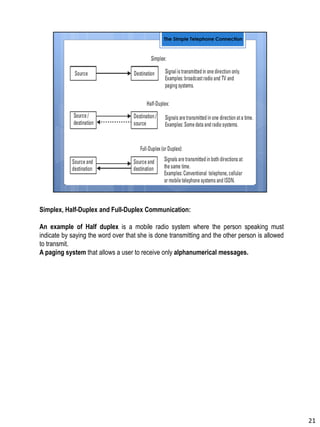
Simplex, Half-Duplex and Full-Duplex Communication:
An example of Half duplex is a mobile radio system where the person speaking must
indicate by saying the word over that she is done transmitting and the other person is allowed
to transmit.
A paging system that allows a user to receive only alphanumerical messages.
21
Chapter 1 summary.
22
23

Te 1 introduction to telecommunications_updated

  • 1.
  • 2.
    Telecommunication is communicationat a distance by technological means, particularly through electrical signals or electromagnetic waves. Telecommunication encompasses the electrical communication at a distance of voice, data and image information (e.g., TV and facsimile). We can categorize it in various ways. Above Figure shows one possible view of the different sections of telecommunications. It includes mechanical communication and electrical Communication. 2
  • 3.
    This quote fromthe start of Stallings Data and Computer Communications, 8th Edition Chapter 1 raises the key issue which we wish to study. The scope of this book is broad, covering three general areas: data communications, networking, and protocols. Data communications deals with the transmission of signals in a reliable and efficient manner. Networking deals with the technology and architecture of the communications networks used to interconnect communicating devices. 3
  • 4.
    Effective and efficientdata communication and networking facilities are vital to any enterprise. Three different forces have consistently driven the architecture and evolution of data communications and networking facilities: traffic growth, development of new services, and advances in technology. Momentous changes in the way organizations do business and process information have been driven by changes in networking technology and at the same time have driven those changes. These include a growing need for high-speed LANs in the business environment to support requirements like Centralized server farms, Power workgroups, and High-speed local backbones. Also changes in corporate data traffic patterns are driving the creation of high-speed WANs. Lastly rapid conversion of consumer electronics to digital technology is having an impact on both the Internet and corporate intranets, dramatically increasing the amount of image and video traffic carried by networks. 4
  • 5.
    The fundamental purposeof a communications system is the exchange of data between two parties. This section introduces a simple model of communication, illustrated in general and by specific example in Stallings DCC8e Figure 1.2. The key elements of this model are: •Source - generates data to be transmitted •Transmitter - converts data into transmittable signals •Transmission System - carries data from source to destination •Receiver - converts received signal into data •Destination - takes incoming data 5
  • 6.
    This simple narrativeconceals a wealth of technical complexity. To get some idea of the scope of this complexity, Stallings DCC8e Table 1.1 lists a selection of the key tasks that must be performed in a data communications system. •transmission system utilization - need to make efficient use of transmission facilities typically shared among a number of communicating devices •a device must interface with the transmission system •once an interface is established, signal generation is required for communication •there must be synchronization between transmitter and receiver, to determine when a signal begins to arrive and when it ends •there is a variety of requirements for communication between two parties that might be collected under the term exchange management •Error detection and correction are required in circumstances where errors cannot be tolerated •Flow control is required to assure that the source does not overwhelm the destination by sending data faster than they can be processed and absorbed •addressing and routing, so a source system can indicate the identity of the intended destination, and can choose a specific route through this network •Recovery allows an interrupted transaction to resume activity at the point of interruption or to condition prior to the beginning of the exchange •Message formatting has to do with an agreement between two parties as to the form of the data to be exchanged or transmitted •Frequently need to provide some measure of security in a data communications 6
  • 7.
    system •Network management capabilitiesare needed to configure the system, monitor its status, react to failures and overloads, and plan intelligently for future growth See have gone from the simple idea of data communication between source and destination to a rather formidable list of data communications tasks. 6
  • 8.
    The next sectionof the text on "Data Communications”, deals with the most fundamental aspects of the communications function, focusing on the transmission of signals in a reliable and efficient manner. Stallings DCC8e Figure 1.3 provides a new perspective on the communications model of Figure 1.2a. We trace the details of this figure using electronic mail as an example. Assume a PC user wants to send an email message m to another user. The process is modeled as follows: •user keys in message m comprising bits g buffered in source PC memory •input data is transferred to I/O device (transmitter) as sequence of bits g(t) using voltage shifts •transmitter converts these into a signal s(t) suitable for transmission media being used •whilst transiting media signal may be impaired so received signal r(t) may differ from s(t) •receiver decodes signal recovering g’(t) as estimate of original g(t) •which is buffered in destination PC memory as bits g’ being the received message m’ 7
  • 9.
    The basic buildingblock of any communications facility is the transmission line. One of the basic choices facing a business user is the transmission medium. For use within the business premises, this choice is generally completely up to the business. For long-distance communications, the choice is generally but not always made by the long-distance carrier. In either case, changes in technology are rapidly changing the mix of media used. The ever-increasing capacity of fiber optic channels is making channel capacity a virtually free resource. However, switching is now becoming the bottleneck. The growing use of wireless transmission, is a result of the trend toward universal personal telecommunications and universal access to communications. Despite the growth in the capacity and the drop in cost of transmission facilities, transmission services remain the most costly component of a communications budget for most businesses. Thus, the manager needs to be aware of techniques that increase the efficiency of the use of these facilities, such as multiplexing and compression. 8
  • 10.
    The number ofcomputers in use worldwide is in the hundreds of millions, with pressure from users of these systems for ways to communicate among all these machines being irresistible. Advances in technology have led to greatly increased capacity and the concept of integration, allowing equipment and networks to deal simultaneously with voice, data, image, and even video. Have two broad categories of networks: Local Area Networks (LAN) and Wide Area Networks (WAN). 9
  • 11.
    Wide area networksgenerally cover a large geographical area, require the crossing of public right-of-ways, and rely at least in part on circuits provided by a common carrier. Typically, a WAN consists of a number of interconnected switching nodes. Traditionally, WANs have been implemented using one of two technologies: circuit switching and packet switching. More recently, frame relay and ATM networks have assumed major roles. 10
  • 12.
    In a circuit-switchingnetwork, a dedicated communications path is established between two stations through the nodes of the network. That path is a connected sequence of physical links between nodes, with a logical channel dedicated to the connection. Data generated by the source station are transmitted along the dedicated path as rapidly as possible. The most common example of circuit switching is the telephone network. 11
  • 13.
    A packet-switching networkuses a quite different approach, without need to dedicate transmission capacity along a path through the network. Rather, data is sent in a sequence of small chunks, called packets. Each packet is passed through the network from node to node along some path leading from source to destination. At each node, the entire packet is received, stored briefly, and then transmitted to the next node. Packet-switching networks are commonly used for terminal-to-computer and computer-to-computer communications. 12
  • 14.
    Frame relay wasdeveloped to take advantage of high data rates and low error rates on modern WAN links. Whereas the original packet-switching networks were designed with a data rate to the end user of about 64 kbps, frame relay networks are designed to operate efficiently at user data rates of up to 2 Mbps. The key to achieving these high data rates is to strip out most of the overhead involved with error control. 13
  • 15.
    Asynchronous transfer mode(ATM), is a culmination of developments in circuit switching and packet switching. ATM can be viewed as an evolution from frame relay. ATM uses fixed-length packets, called cells. As with frame relay, ATM provides little overhead for error control, depending on the inherent reliability of the transmission system and on higher layers of logic in the end systems to catch and correct errors. By using a fixed packet length, the processing overhead is reduced even further for ATM compared to frame relay. The result is that ATM is designed to work in the range of 10s and 100s of Mbps, and in the Gbps range. ATM allows the definition of multiple virtual channels with data rates that are dynamically defined at the time the virtual channel is created. 14
  • 16.
    A LAN isa communications network that interconnects a variety of devices and provides a means for information exchange among those devices. The scope of the LAN is small, typically a single building or a cluster of buildings. It is usually the case that the LAN is owned by the same organization that owns the attached devices. The internal data rates of LANs are typically much greater than those of WANs. LANs come in a number of different configurations. The most common are switched LANs and wireless LANs. The most common switched LAN is a switched Ethernet LAN, others are ATM & Fibre Channel LANs. Wireless networks provide advantages in the areas of mobility and ease of installation and configuration. 15
  • 17.
    Metropolitan Area Networksprovide a middle ground between LANs and WANs, typically spanning a city / metro area with higher speed connections. 16
  • 18.
    The Internet evolvedfrom the ARPANET, developed in 1969 by the Advanced Research Projects Agency (ARPA) of the U.S. Department of Defense. It was the first operational packet-switching network. The network was so successful that ARPA applied the same packet-switching technology to tactical radio communication (packet radio) and to satellite communication (SATNET). The need for interworking between these led to Vint Cerf and Bob Kahn of ARPA developing methods and protocols for such internetworking, which led eventually to the development of TCP/IP. 17
  • 19.
    Stallings DCC8e Figure1.4 illustrates the key elements that comprise the Internet, whose purpose is to interconnect end systems, called hosts; including PCs, workstations, servers, mainframes, and so on. Most hosts that use the Internet are connected to a network, such as a local area network (LAN) or a wide area network (WAN). These networks are in turn connected by routers. 18
  • 20.
    The Internet todayis made up of thousands of overlapping hierarchical networks, an overview of the common, general characteristics can be made. Stallings DCC8e Figure 1.5 illustrates this. See hosts grouped into LANs, linked to an an Internet service provider (ISP) through a point of presence (POP). The connection is made in a series of steps starting with the customer premises equipment (CPE). ISPs can be classified as regional or backbone, with peering links between. 19
  • 21.
    Stallings DCC8e Figure1.6 illustrates some of the typical communications and network elements in use today. In the upper-left-hand portion of the figure, we see an individual residential user connected to an Internet service provider (ISP) through some sort of subscriber connection. The Internet consists of a number of interconnected routers that span the globe. The routers forward packets of data from source to destination through the Internet. The lower portion shows a LAN implemented using a single Ethernet switch. This is a common configuration at a small business or other small organization. 20
  • 22.
    Simplex, Half-Duplex andFull-Duplex Communication: An example of Half duplex is a mobile radio system where the person speaking must indicate by saying the word over that she is done transmitting and the other person is allowed to transmit. A paging system that allows a user to receive only alphanumerical messages. 21
  • 23.
  • 24.