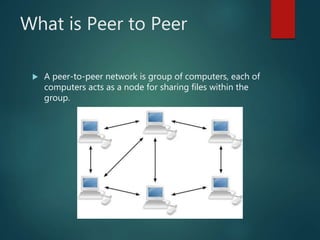
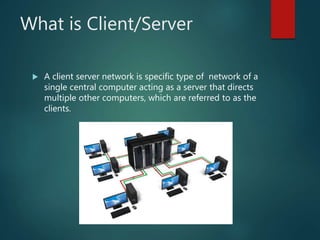
This document compares peer-to-peer (P2P) networks and client-server networks. In a P2P network, each computer acts as both a client and server, sharing files directly with other peers. Common P2P applications include file sharing, streaming media, and instant messaging. In contrast, a client-server network has one central server that directs multiple client computers. Key differences are that client-server networks are more expensive but have more computing power centralized on the server, while P2P networks distribute data across each peer.