RAMCO INSTITUTE OF TECHNOLOGY
Mr.M.LAKSHMANAN
Assistant Professor (Senior Grade)
Department of Mechanical Engineering
Unconventional Machining
Processes
UNIT -I
INTRODUCTION
MANUFACTURING
Technically,
• Application of physical and chemical
processes to alter the shape, size and
properties of the given material to make a
parts and products
Economically,
• Process of doing the value added activities
in order to convert the raw materials into
finished products.
• Primary Manufacturing Processes
The former ones provide basic shape and
size to the material as per designer’s
requirement. Casting, forming, powder
metallurgy
• Secondary Manufacturing Processes
Provide the final shape and size with tighter
control on dimension, surface
characteristics etc. Material removal
processes are mainly the secondary
manufacturing processes.
Material removal processes /
Machining Process
• “Conventional Machining Processes”
Examples of conventional machining
processes are turning, boring, milling,
shaping, slotting, grinding etc.
• “Non-Traditional Machining Processes”
Abrasive Jet Machining (AJM), Ultrasonic
Machining (USM), Water Jet and Abrasive
Water Jet Machining (WJM and AWJM),
Electro-discharge Machining (EDM)
Conventional Machining (CM)
• Conventional machining can be defined as a
process using mechanical (motion) energy.
• To remove the material from the workpiece
in the form of chips.
• To perform the operation relative motion is
required between the tool and work.
• The primary motion is cutting speed and
secondary motion is Feed.
Characteristics of CM
• Macroscopic chip formed due to the shear
deformation.
• Material removal takes place due to
application of cutting forces.
• Energy domain can be mainly Mechanical.
• Cutting tool is harder than work piece.
• Mechanism of metal removal is shearing .
Drawbacks of CM
• Cutting tool should be harder than the work
material.
• Removal of chips from the work zone will be
the problem.
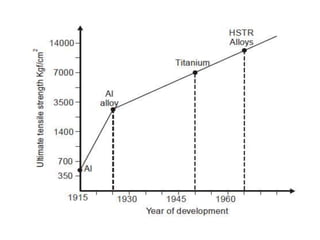
• Advanced materials like Titanium, FRC,
HSTR are difficult to machine.
Unconventional Machining Process
(UCM)
Need for UCM:
• To machine newly developed metals and non
metals which often have special properties
such as high strength, high hardness, high
toughness that make them difficult to machine
by ordinary CM.
• Lack of tool Materials.
• The need for unusual and complex part
geometries in the Aero space, Automobile,
marine industries and Electronic industries.
• To avoid surface damage.
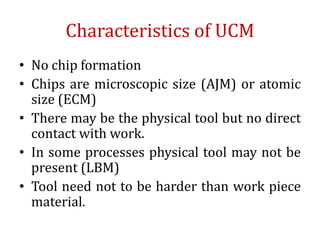
Characteristics of UCM
• No chip formation
• Chips are microscopic size (AJM) or atomic
size (ECM)
• There may be the physical tool but no direct
contact with work.
• In some processes physical tool may not be
present (LBM)
• Tool need not to be harder than work piece
material.
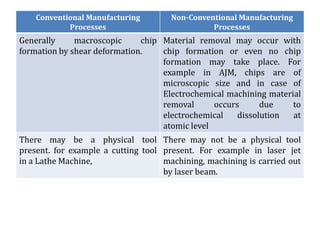
Conventional Manufacturing
Processes
Non-Conventional Manufacturing
Processes
Generally macroscopic chip
formation by shear deformation.
Material removal may occur with
chip formation or even no chip
formation may take place. For
example in AJM, chips are of
microscopic size and in case of
Electrochemical machining material
removal occurs due to
electrochemical dissolution at
atomic level
There may be a physical tool
present. for example a cutting tool
in a Lathe Machine,
There may not be a physical tool
present. For example in laser jet
machining, machining is carried out
by laser beam.
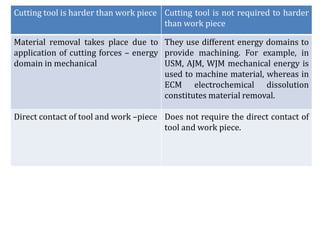
Cutting tool is harder than work piece Cutting tool is not required to harder
than work piece
Material removal takes place due to
application of cutting forces – energy
domain in mechanical
They use different energy domains to
provide machining. For example, in
USM, AJM, WJM mechanical energy is
used to machine material, whereas in
ECM electrochemical dissolution
constitutes material removal.
Direct contact of tool and work –piece Does not require the direct contact of
tool and work piece.
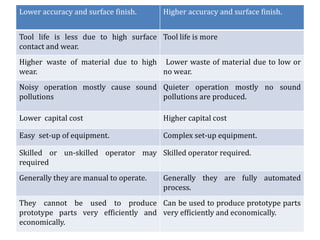
Lower accuracy and surface finish. Higher accuracy and surface finish.
Tool life is less due to high surface
contact and wear.
Tool life is more
Higher waste of material due to high
wear.
Lower waste of material due to low or
no wear.
Noisy operation mostly cause sound
pollutions
Quieter operation mostly no sound
pollutions are produced.
Lower capital cost Higher capital cost
Easy set-up of equipment. Complex set-up equipment.
Skilled or un-skilled operator may
required
Skilled operator required.
Generally they are manual to operate. Generally they are fully automated
process.
They cannot be used to produce
prototype parts very efficiently and
economically.
Can be used to produce prototype parts
very efficiently and economically.
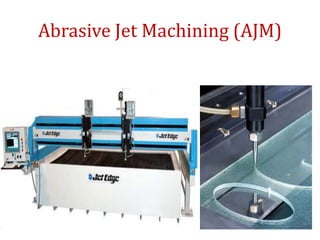
Abrasive Jet Machining (AJM)
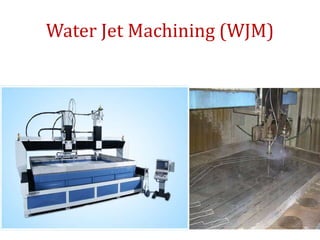
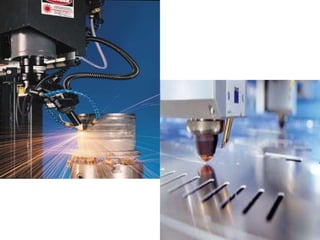
Water Jet Machining (WJM)
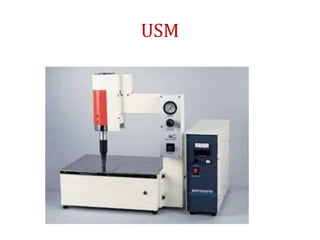
USM
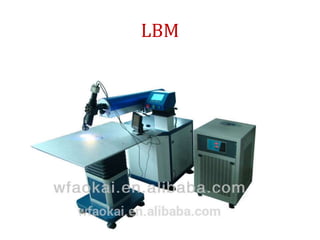
LBM
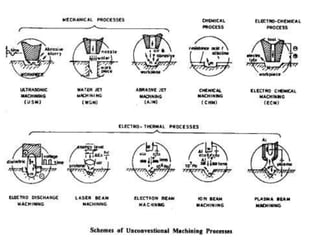
Classification of UCM
• Mechanical Energy Based processes
• Thermal Energy Based processes
• Electrical Energy Based processes
• Chemical Energy Based processes
Mechanical Energy Based processes
Mechanical energy is used to remove the
material by erosion and chipping.
• Ultrasonic Machining (USM)
• Abrasive Jet Machining (AJM)
• Water Jet Machining (WJM)
• Abrasive Water Jet Machining (AWJM)
Thermal Energy Based processes
Heat energy is used to remove the material by
Melting and Vaporization.
• Plasma Arc Machining (PAM)
• Laser Beam Machining (LBM)
• Electron Beam Machining (EBM)
Electrical Energy Based processes
Heat energy available in electric spark, when spark is
developed between two electrical contacts a small
amount of material is removed from each contact
by Melting and Vaporization.
• Electrical Discharge Machining (EDM)
• Wire cut Electrical Discharge Machining (W-EDM)
• Electrical Discharge Grinding (EDG)
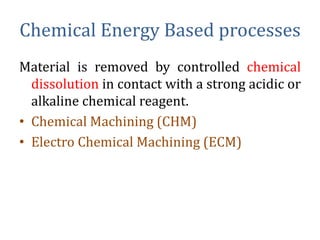
Chemical Energy Based processes
Material is removed by controlled chemical
dissolution in contact with a strong acidic or
alkaline chemical reagent.
• Chemical Machining (CHM)
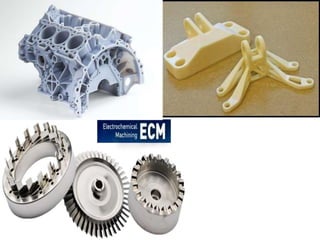
• Electro Chemical Machining (ECM)
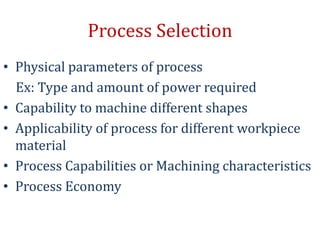
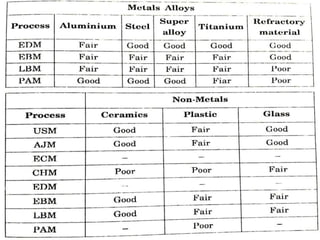
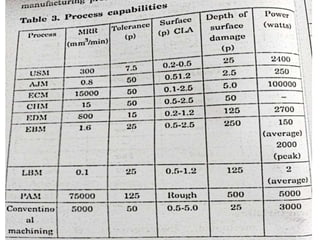
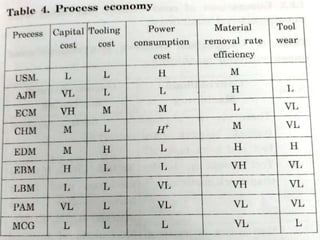
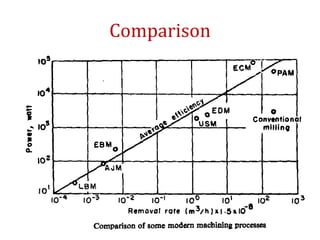
Process Selection
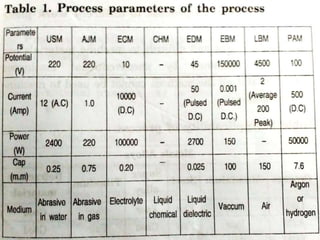
• Physical parameters of process
Ex: Type and amount of power required
• Capability to machine different shapes
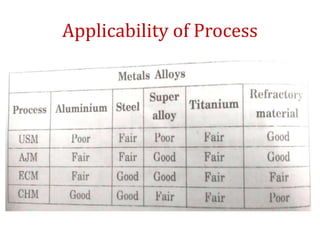
• Applicability of process for different workpiece
material
• Process Capabilities or Machining characteristics
• Process Economy
Applicability of Process
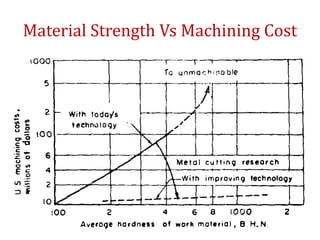
Material Strength Vs Machining Cost
Comparison
NPTEL:
• Lecture - 35 Non Traditional Manufacturing
https://www.youtube.com/watch?v=cxU1zUOp
GLk

Introduction to Unconventional Machining Processes

  • 1.
    RAMCO INSTITUTE OFTECHNOLOGY Mr.M.LAKSHMANAN Assistant Professor (Senior Grade) Department of Mechanical Engineering
  • 2.
  • 3.
    MANUFACTURING Technically, • Application ofphysical and chemical processes to alter the shape, size and properties of the given material to make a parts and products Economically, • Process of doing the value added activities in order to convert the raw materials into finished products.
  • 4.
    • Primary ManufacturingProcesses The former ones provide basic shape and size to the material as per designer’s requirement. Casting, forming, powder metallurgy • Secondary Manufacturing Processes Provide the final shape and size with tighter control on dimension, surface characteristics etc. Material removal processes are mainly the secondary manufacturing processes.
  • 5.
    Material removal processes/ Machining Process • “Conventional Machining Processes” Examples of conventional machining processes are turning, boring, milling, shaping, slotting, grinding etc. • “Non-Traditional Machining Processes” Abrasive Jet Machining (AJM), Ultrasonic Machining (USM), Water Jet and Abrasive Water Jet Machining (WJM and AWJM), Electro-discharge Machining (EDM)
  • 6.
    Conventional Machining (CM) •Conventional machining can be defined as a process using mechanical (motion) energy. • To remove the material from the workpiece in the form of chips. • To perform the operation relative motion is required between the tool and work. • The primary motion is cutting speed and secondary motion is Feed.
  • 7.
    Characteristics of CM •Macroscopic chip formed due to the shear deformation. • Material removal takes place due to application of cutting forces. • Energy domain can be mainly Mechanical. • Cutting tool is harder than work piece. • Mechanism of metal removal is shearing .
  • 8.
    Drawbacks of CM •Cutting tool should be harder than the work material. • Removal of chips from the work zone will be the problem. • Advanced materials like Titanium, FRC, HSTR are difficult to machine.
  • 9.
    Unconventional Machining Process (UCM) Needfor UCM: • To machine newly developed metals and non metals which often have special properties such as high strength, high hardness, high toughness that make them difficult to machine by ordinary CM. • Lack of tool Materials. • The need for unusual and complex part geometries in the Aero space, Automobile, marine industries and Electronic industries. • To avoid surface damage.
  • 11.
    Characteristics of UCM •No chip formation • Chips are microscopic size (AJM) or atomic size (ECM) • There may be the physical tool but no direct contact with work. • In some processes physical tool may not be present (LBM) • Tool need not to be harder than work piece material.
  • 12.
    Conventional Manufacturing Processes Non-Conventional Manufacturing Processes Generallymacroscopic chip formation by shear deformation. Material removal may occur with chip formation or even no chip formation may take place. For example in AJM, chips are of microscopic size and in case of Electrochemical machining material removal occurs due to electrochemical dissolution at atomic level There may be a physical tool present. for example a cutting tool in a Lathe Machine, There may not be a physical tool present. For example in laser jet machining, machining is carried out by laser beam.
  • 13.
    Cutting tool isharder than work piece Cutting tool is not required to harder than work piece Material removal takes place due to application of cutting forces – energy domain in mechanical They use different energy domains to provide machining. For example, in USM, AJM, WJM mechanical energy is used to machine material, whereas in ECM electrochemical dissolution constitutes material removal. Direct contact of tool and work –piece Does not require the direct contact of tool and work piece.
  • 14.
    Lower accuracy andsurface finish. Higher accuracy and surface finish. Tool life is less due to high surface contact and wear. Tool life is more Higher waste of material due to high wear. Lower waste of material due to low or no wear. Noisy operation mostly cause sound pollutions Quieter operation mostly no sound pollutions are produced. Lower capital cost Higher capital cost Easy set-up of equipment. Complex set-up equipment. Skilled or un-skilled operator may required Skilled operator required. Generally they are manual to operate. Generally they are fully automated process. They cannot be used to produce prototype parts very efficiently and economically. Can be used to produce prototype parts very efficiently and economically.
  • 15.
  • 16.
  • 17.
  • 18.
  • 22.
    Classification of UCM •Mechanical Energy Based processes • Thermal Energy Based processes • Electrical Energy Based processes • Chemical Energy Based processes
  • 23.
    Mechanical Energy Basedprocesses Mechanical energy is used to remove the material by erosion and chipping. • Ultrasonic Machining (USM) • Abrasive Jet Machining (AJM) • Water Jet Machining (WJM) • Abrasive Water Jet Machining (AWJM)
  • 24.
    Thermal Energy Basedprocesses Heat energy is used to remove the material by Melting and Vaporization. • Plasma Arc Machining (PAM) • Laser Beam Machining (LBM) • Electron Beam Machining (EBM)
  • 25.
    Electrical Energy Basedprocesses Heat energy available in electric spark, when spark is developed between two electrical contacts a small amount of material is removed from each contact by Melting and Vaporization. • Electrical Discharge Machining (EDM) • Wire cut Electrical Discharge Machining (W-EDM) • Electrical Discharge Grinding (EDG)
  • 26.
    Chemical Energy Basedprocesses Material is removed by controlled chemical dissolution in contact with a strong acidic or alkaline chemical reagent. • Chemical Machining (CHM) • Electro Chemical Machining (ECM)
  • 27.
    Process Selection • Physicalparameters of process Ex: Type and amount of power required • Capability to machine different shapes • Applicability of process for different workpiece material • Process Capabilities or Machining characteristics • Process Economy
  • 29.
  • 33.
    Material Strength VsMachining Cost
  • 34.
  • 36.
    NPTEL: • Lecture -35 Non Traditional Manufacturing https://www.youtube.com/watch?v=cxU1zUOp GLk