NAME - ANEESHA AGARWAL
CLASS – X
SEC – A
ROLL NO. – 7
REG. NO.- B114084140007
TOPIC – WATER
Water Recycling
Water recycling is reusing treated wastewater for
beneficial purposes such as agricultural and landscape
irrigation, industrial processes, toilet flushing, and
replenishing a ground water basin (referred to as ground
water recharge). Water recycling offers resource and
financial savings.
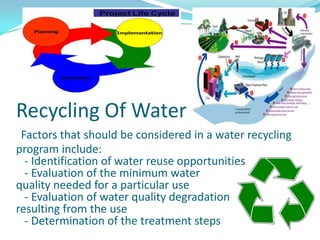
Recycling Of Water
Factors that should be considered in a water recycling
program include:
- Identification of water reuse opportunities
- Evaluation of the minimum water
quality needed for a particular use
- Evaluation of water quality degradation
resulting from the use
- Determination of the treatment steps
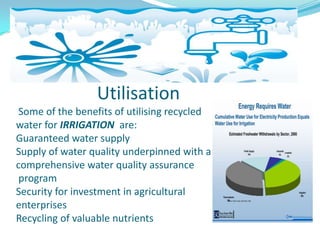
Utilisation
Some of the benefits of utilising recycled
water for IRRIGATION are:
Guaranteed water supply
Supply of water quality underpinned with a
comprehensive water quality assurance
program
Security for investment in agricultural
enterprises
Recycling of valuable nutrients
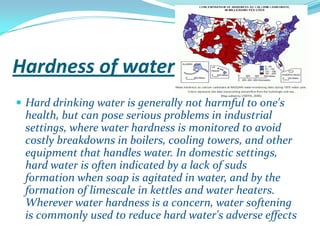
Hardness of water
 Hard drinking water is generally not harmful to one's

health, but can pose serious problems in industrial
settings, where water hardness is monitored to avoid
costly breakdowns in boilers, cooling towers, and other
equipment that handles water. In domestic settings,
hard water is often indicated by a lack of suds
formation when soap is agitated in water, and by the
formation of limescale in kettles and water heaters.
Wherever water hardness is a concern, water softening
is commonly used to reduce hard water's adverse effects
SOURCES OF HARDNESS
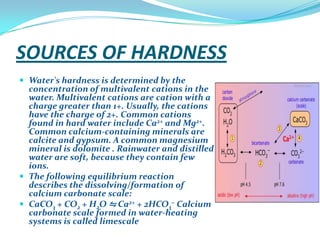
 Water's hardness is determined by the

concentration of multivalent cations in the
water. Multivalent cations are cation with a
charge greater than 1+. Usually, the cations
have the charge of 2+. Common cations
found in hard water include Ca2+ and Mg2+.
Common calcium-containing minerals are
calcite and gypsum. A common magnesium
mineral is dolomite . Rainwater and distilled
water are soft, because they contain few
ions.
 The following equilibrium reaction
describes the dissolving/formation of
calcium carbonate scale:
 CaCO3 + CO2 + H2O ⇋ Ca2+ + 2HCO3− Calcium
carbonate scale formed in water-heating
systems is called limescale
EFFECTS OF HARDWATER
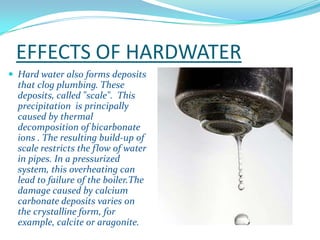
 Hard water also forms deposits

that clog plumbing. These
deposits, called "scale". This
precipitation is principally
caused by thermal
decomposition of bicarbonate
ions . The resulting build-up of
scale restricts the flow of water
in pipes. In a pressurized
system, this overheating can
lead to failure of the boiler.The
damage caused by calcium
carbonate deposits varies on
the crystalline form, for
example, calcite or aragonite.
WATER
RESOURCES
Water resources are sources of water that are useful or
potentially useful. Uses of water
include agricultural,industrial, household, recreational
and environmental activities. The majority of human
uses require fresh water.
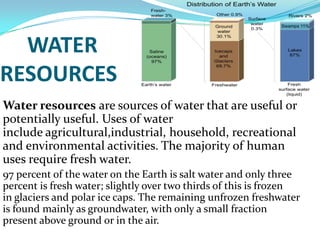
97 percent of the water on the Earth is salt water and only three
percent is fresh water; slightly over two thirds of this is frozen
in glaciers and polar ice caps. The remaining unfrozen freshwater
is found mainly as groundwater, with only a small fraction
present above ground or in the air.
HYDRO POWER

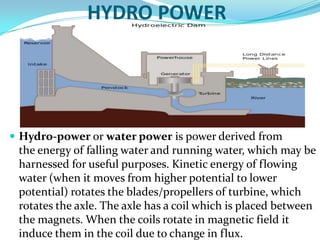
 Hydro-power or water power is power derived from

the energy of falling water and running water, which may be
harnessed for useful purposes. Kinetic energy of flowing
water (when it moves from higher potential to lower
potential) rotates the blades/propellers of turbine, which
rotates the axle. The axle has a coil which is placed between
the magnets. When the coils rotate in magnetic field it
induce them in the coil due to change in flux.
TIDAL ENERGY
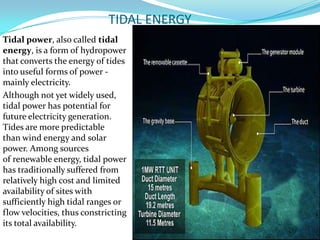
Tidal power, also called tidal
energy, is a form of hydropower
that converts the energy of tides
into useful forms of power mainly electricity.
Although not yet widely used,
tidal power has potential for
future electricity generation.
Tides are more predictable
than wind energy and solar
power. Among sources
of renewable energy, tidal power
has traditionally suffered from
relatively high cost and limited
availability of sites with
sufficiently high tidal ranges or
flow velocities, thus constricting
its total availability.
NARMADA BACHAO ANDOLAN

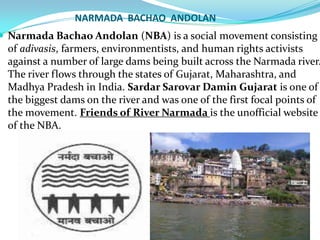
 Narmada Bachao Andolan (NBA) is a social movement consisting

of adivasis, farmers, environmentists, and human rights activists
against a number of large dams being built across the Narmada river.
The river flows through the states of Gujarat, Maharashtra, and
Madhya Pradesh in India. Sardar Sarovar Damin Gujarat is one of
the biggest dams on the river and was one of the first focal points of
the movement. Friends of River Narmada is the unofficial website
of the NBA.
PEOPLE INVOLVED

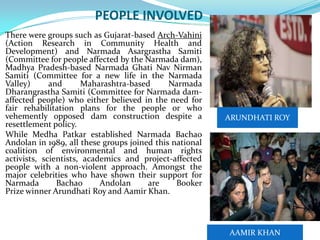
 There were groups such as Gujarat-based Arch-Vahini

(Action Research in Community Health and
Development) and Narmada Asargrastha Samiti
(Committee for people affected by the Narmada dam),
Madhya Pradesh-based Narmada Ghati Nav Nirman
Samiti (Committee for a new life in the Narmada
Valley)
and
Maharashtra-based
Narmada
Dharangrastha Samiti (Committee for Narmada damaffected people) who either believed in the need for
fair rehabilitation plans for the people or who
vehemently opposed dam construction despite a
resettlement policy.
 While Medha Patkar established Narmada Bachao
Andolan in 1989, all these groups joined this national
coalition of environmental and human rights
activists, scientists, academics and project-affected
people with a non-violent approach. Amongst the
major celebrities who have shown their support for
Narmada
Bachao
Andolan
are
Booker
Prize winner Arundhati Roy and Aamir Khan.

ARUNDHATI ROY

AAMIR KHAN
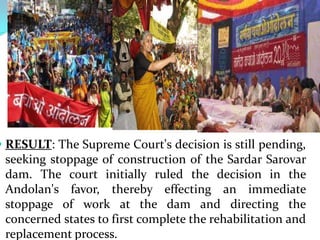
 RESULT: The Supreme Court's decision is still pending,
seeking stoppage of construction of the Sardar Sarovar

dam. The court initially ruled the decision in the
Andolan's favor, thereby effecting an immediate
stoppage of work at the dam and directing the
concerned states to first complete the rehabilitation and
replacement process.
SUSTAINABILITY OF GROUND WATER
Groundwater is the water located
beneath the earth's surface
in soil pore spaces and in the fractures of
rock formations. An aquifer is a layer of
porous substrate that contains and
transmits groundwater. Groundwater
makes up about twenty percent of the
world's freshwater supply, which is about
0.61% of the entire world's water, including
oceans and permanent ice. Global
groundwater storage is roughly equal to
the total amount of freshwater stored in
the snow and ice pack, including the north
and south poles.
OVERUTILISATION
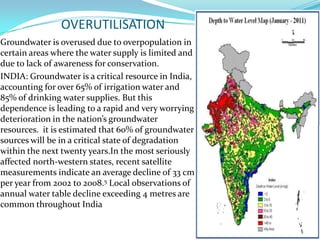
Groundwater is overused due to overpopulation in
certain areas where the water supply is limited and
due to lack of awareness for conservation.
INDIA: Groundwater is a critical resource in India,
accounting for over 65% of irrigation water and
85% of drinking water supplies. But this
dependence is leading to a rapid and very worrying
deterioration in the nation’s groundwater
resources. it is estimated that 60% of groundwater
sources will be in a critical state of degradation
within the next twenty years.In the most seriously
affected north-western states, recent satellite
measurements indicate an average decline of 33 cm
per year from 2002 to 2008.5 Local observations of
annual water table decline exceeding 4 metres are
common throughout India
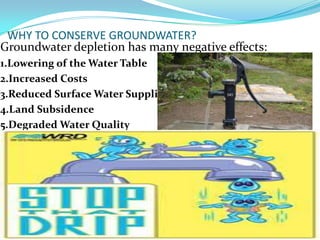
WHY TO CONSERVE GROUNDWATER?
Groundwater depletion has many negative effects:
1.Lowering of the Water Table
2.Increased Costs
3.Reduced Surface Water Supplies
4.Land Subsidence
5.Degraded Water Quality
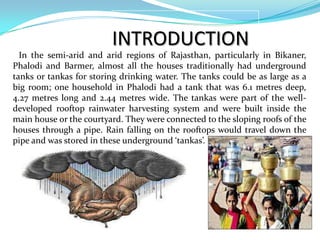
INTRODUCTION
In the semi-arid and arid regions of Rajasthan, particularly in Bikaner,
Phalodi and Barmer, almost all the houses traditionally had underground
tanks or tankas for storing drinking water. The tanks could be as large as a
big room; one household in Phalodi had a tank that was 6.1 metres deep,
4.27 metres long and 2.44 metres wide. The tankas were part of the welldeveloped rooftop rainwater harvesting system and were built inside the
main house or the courtyard. They were connected to the sloping roofs of the
houses through a pipe. Rain falling on the rooftops would travel down the
pipe and was stored in these underground ‘tankas’.
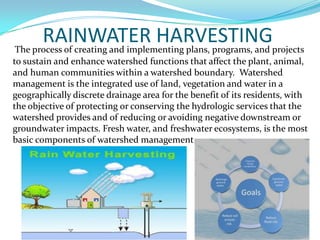
RAINWATER HARVESTINGprojects
The process of creating and implementing plans, programs, and
to sustain and enhance watershed functions that affect the plant, animal,
and human communities within a watershed boundary. Watershed
management is the integrated use of land, vegetation and water in a
geographically discrete drainage area for the benefit of its residents, with
the objective of protecting or conserving the hydrologic services that the
watershed provides and of reducing or avoiding negative downstream or
groundwater impacts. Fresh water, and freshwater ecosystems, is the most
basic components of watershed management.
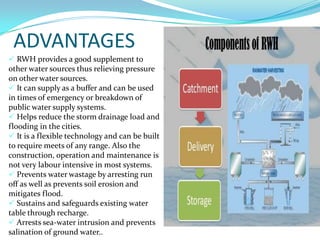
ADVANTAGES
 RWH provides a good supplement to
other water sources thus relieving pressure
on other water sources.
 It can supply as a buffer and can be used
in times of emergency or breakdown of
public water supply systems.
 Helps reduce the storm drainage load and
flooding in the cities.
 It is a flexible technology and can be built
to require meets of any range. Also the
construction, operation and maintenance is
not very labour intensive in most systems.
 Prevents water wastage by arresting run
off as well as prevents soil erosion and
mitigates flood.
 Sustains and safeguards existing water
table through recharge.
 Arrests sea-water intrusion and prevents
salination of ground water..
Watershed
management
Watershed management is the study of the relevant characteristics of a
watershed aimed at the sustainable distribution of its resources and the
process of creating and implementing plans, programs, and projects to
sustain and enhance watershed functions that affect the plant, animal,
and human communities within a watershed boundary. Features of a
watershed that agencies seek to manage include water supply, water
quality, drainage, stormwater,runoff,water rights, and the overall
planning and utilization of watersheds.
INDIA: Integrated Watershed Management Programme
(IWMP) is a modified programme. The main objectives of the IWMP
are to restore the ecological balance by harnessing, conserving and
developing degraded natural resources such as soil, vegetative cover
and water. The outcomes are prevention of soil run-off, regeneration
of natural vegetation, rain water harvesting and recharging of the
ground water table. This enables multi-cropping and the introduction
of diverse agro-based activities, which help to provide sustainable
livelihoods to the people residing in the watershed area.
THE END

Aneesha Agarwal

  • 1.
    NAME - ANEESHAAGARWAL CLASS – X SEC – A ROLL NO. – 7 REG. NO.- B114084140007 TOPIC – WATER
  • 2.
    Water Recycling Water recyclingis reusing treated wastewater for beneficial purposes such as agricultural and landscape irrigation, industrial processes, toilet flushing, and replenishing a ground water basin (referred to as ground water recharge). Water recycling offers resource and financial savings.
  • 3.
    Recycling Of Water Factorsthat should be considered in a water recycling program include: - Identification of water reuse opportunities - Evaluation of the minimum water quality needed for a particular use - Evaluation of water quality degradation resulting from the use - Determination of the treatment steps
  • 4.
    Utilisation Some of thebenefits of utilising recycled water for IRRIGATION are: Guaranteed water supply Supply of water quality underpinned with a comprehensive water quality assurance program Security for investment in agricultural enterprises Recycling of valuable nutrients
  • 5.
    Hardness of water Hard drinking water is generally not harmful to one's health, but can pose serious problems in industrial settings, where water hardness is monitored to avoid costly breakdowns in boilers, cooling towers, and other equipment that handles water. In domestic settings, hard water is often indicated by a lack of suds formation when soap is agitated in water, and by the formation of limescale in kettles and water heaters. Wherever water hardness is a concern, water softening is commonly used to reduce hard water's adverse effects
  • 6.
    SOURCES OF HARDNESS Water's hardness is determined by the concentration of multivalent cations in the water. Multivalent cations are cation with a charge greater than 1+. Usually, the cations have the charge of 2+. Common cations found in hard water include Ca2+ and Mg2+. Common calcium-containing minerals are calcite and gypsum. A common magnesium mineral is dolomite . Rainwater and distilled water are soft, because they contain few ions.  The following equilibrium reaction describes the dissolving/formation of calcium carbonate scale:  CaCO3 + CO2 + H2O ⇋ Ca2+ + 2HCO3− Calcium carbonate scale formed in water-heating systems is called limescale
  • 7.
    EFFECTS OF HARDWATER Hard water also forms deposits that clog plumbing. These deposits, called "scale". This precipitation is principally caused by thermal decomposition of bicarbonate ions . The resulting build-up of scale restricts the flow of water in pipes. In a pressurized system, this overheating can lead to failure of the boiler.The damage caused by calcium carbonate deposits varies on the crystalline form, for example, calcite or aragonite.
  • 8.
    WATER RESOURCES Water resources aresources of water that are useful or potentially useful. Uses of water include agricultural,industrial, household, recreational and environmental activities. The majority of human uses require fresh water. 97 percent of the water on the Earth is salt water and only three percent is fresh water; slightly over two thirds of this is frozen in glaciers and polar ice caps. The remaining unfrozen freshwater is found mainly as groundwater, with only a small fraction present above ground or in the air.
  • 9.
    HYDRO POWER  Hydro-poweror water power is power derived from the energy of falling water and running water, which may be harnessed for useful purposes. Kinetic energy of flowing water (when it moves from higher potential to lower potential) rotates the blades/propellers of turbine, which rotates the axle. The axle has a coil which is placed between the magnets. When the coils rotate in magnetic field it induce them in the coil due to change in flux.
  • 10.
    TIDAL ENERGY Tidal power,also called tidal energy, is a form of hydropower that converts the energy of tides into useful forms of power mainly electricity. Although not yet widely used, tidal power has potential for future electricity generation. Tides are more predictable than wind energy and solar power. Among sources of renewable energy, tidal power has traditionally suffered from relatively high cost and limited availability of sites with sufficiently high tidal ranges or flow velocities, thus constricting its total availability.
  • 11.
    NARMADA BACHAO ANDOLAN Narmada Bachao Andolan (NBA) is a social movement consisting of adivasis, farmers, environmentists, and human rights activists against a number of large dams being built across the Narmada river. The river flows through the states of Gujarat, Maharashtra, and Madhya Pradesh in India. Sardar Sarovar Damin Gujarat is one of the biggest dams on the river and was one of the first focal points of the movement. Friends of River Narmada is the unofficial website of the NBA.
  • 12.
    PEOPLE INVOLVED  Therewere groups such as Gujarat-based Arch-Vahini (Action Research in Community Health and Development) and Narmada Asargrastha Samiti (Committee for people affected by the Narmada dam), Madhya Pradesh-based Narmada Ghati Nav Nirman Samiti (Committee for a new life in the Narmada Valley) and Maharashtra-based Narmada Dharangrastha Samiti (Committee for Narmada damaffected people) who either believed in the need for fair rehabilitation plans for the people or who vehemently opposed dam construction despite a resettlement policy.  While Medha Patkar established Narmada Bachao Andolan in 1989, all these groups joined this national coalition of environmental and human rights activists, scientists, academics and project-affected people with a non-violent approach. Amongst the major celebrities who have shown their support for Narmada Bachao Andolan are Booker Prize winner Arundhati Roy and Aamir Khan. ARUNDHATI ROY AAMIR KHAN
  • 13.
     RESULT: TheSupreme Court's decision is still pending, seeking stoppage of construction of the Sardar Sarovar dam. The court initially ruled the decision in the Andolan's favor, thereby effecting an immediate stoppage of work at the dam and directing the concerned states to first complete the rehabilitation and replacement process.
  • 14.
    SUSTAINABILITY OF GROUNDWATER Groundwater is the water located beneath the earth's surface in soil pore spaces and in the fractures of rock formations. An aquifer is a layer of porous substrate that contains and transmits groundwater. Groundwater makes up about twenty percent of the world's freshwater supply, which is about 0.61% of the entire world's water, including oceans and permanent ice. Global groundwater storage is roughly equal to the total amount of freshwater stored in the snow and ice pack, including the north and south poles.
  • 15.
    OVERUTILISATION Groundwater is overuseddue to overpopulation in certain areas where the water supply is limited and due to lack of awareness for conservation. INDIA: Groundwater is a critical resource in India, accounting for over 65% of irrigation water and 85% of drinking water supplies. But this dependence is leading to a rapid and very worrying deterioration in the nation’s groundwater resources. it is estimated that 60% of groundwater sources will be in a critical state of degradation within the next twenty years.In the most seriously affected north-western states, recent satellite measurements indicate an average decline of 33 cm per year from 2002 to 2008.5 Local observations of annual water table decline exceeding 4 metres are common throughout India
  • 16.
    WHY TO CONSERVEGROUNDWATER? Groundwater depletion has many negative effects: 1.Lowering of the Water Table 2.Increased Costs 3.Reduced Surface Water Supplies 4.Land Subsidence 5.Degraded Water Quality
  • 17.
    INTRODUCTION In the semi-aridand arid regions of Rajasthan, particularly in Bikaner, Phalodi and Barmer, almost all the houses traditionally had underground tanks or tankas for storing drinking water. The tanks could be as large as a big room; one household in Phalodi had a tank that was 6.1 metres deep, 4.27 metres long and 2.44 metres wide. The tankas were part of the welldeveloped rooftop rainwater harvesting system and were built inside the main house or the courtyard. They were connected to the sloping roofs of the houses through a pipe. Rain falling on the rooftops would travel down the pipe and was stored in these underground ‘tankas’.
  • 18.
    RAINWATER HARVESTINGprojects The processof creating and implementing plans, programs, and to sustain and enhance watershed functions that affect the plant, animal, and human communities within a watershed boundary. Watershed management is the integrated use of land, vegetation and water in a geographically discrete drainage area for the benefit of its residents, with the objective of protecting or conserving the hydrologic services that the watershed provides and of reducing or avoiding negative downstream or groundwater impacts. Fresh water, and freshwater ecosystems, is the most basic components of watershed management.
  • 19.
    ADVANTAGES  RWH providesa good supplement to other water sources thus relieving pressure on other water sources.  It can supply as a buffer and can be used in times of emergency or breakdown of public water supply systems.  Helps reduce the storm drainage load and flooding in the cities.  It is a flexible technology and can be built to require meets of any range. Also the construction, operation and maintenance is not very labour intensive in most systems.  Prevents water wastage by arresting run off as well as prevents soil erosion and mitigates flood.  Sustains and safeguards existing water table through recharge.  Arrests sea-water intrusion and prevents salination of ground water..
  • 20.
    Watershed management Watershed management isthe study of the relevant characteristics of a watershed aimed at the sustainable distribution of its resources and the process of creating and implementing plans, programs, and projects to sustain and enhance watershed functions that affect the plant, animal, and human communities within a watershed boundary. Features of a watershed that agencies seek to manage include water supply, water quality, drainage, stormwater,runoff,water rights, and the overall planning and utilization of watersheds. INDIA: Integrated Watershed Management Programme (IWMP) is a modified programme. The main objectives of the IWMP are to restore the ecological balance by harnessing, conserving and developing degraded natural resources such as soil, vegetative cover and water. The outcomes are prevention of soil run-off, regeneration of natural vegetation, rain water harvesting and recharging of the ground water table. This enables multi-cropping and the introduction of diverse agro-based activities, which help to provide sustainable livelihoods to the people residing in the watershed area.
  • 21.