The Design Studio Andrew Middleton Head of Innovation & Professional Development, QESS (CC) pimousse3000
Course Planning Where do you start? … then what? … and other challenges
Introducing a Design Studio approach Curriculum Design, …Plan, …Develop, …Deliver? In contrast The Design Studio  method will, share experience be enjoyable create a consistent, supported process encourage consistency clarity formal collaboration enhance  project revealed Academic, inexperience detachment diverse practice inconsistency uncertainty isolation
Objective for the  Design Studio An approach that is, Highly usable Agile – works for different needs,  situations, people Collaborative, creative and critical Resulting in, pedagogic and curriculum innovation and an engaging teaching and learning experience
Suitable for the approval of, new courses annually reviewed provision, and 5 Yearly Review Applications
Devices to support Curriculum Design Collaboration What could a designed approach look like? Who's there? What happens? What is produced? What happens next?
The Design Team members Design Facilitator:  experienced mentor and advocate Academic Lead:  responsibility for taking it forward Student Designer:  an equal design partner Academic peers:  sharing experience Quality Adviser:  advising on process Administrative adviser:   logistics and processes LTA adviser:  supporting innovation E-learning adviser:  supporting best use of Blackboard etc Information adviser:  readings and resources Learning adviser:  embedding learning literacies Professional & Employer representatives:  employability
Viewpoints University of Ulster’s Viewpoints method http://tinyurl.com/bpx54xj Using ‘Lenses’ – approaching the design by considering principle-based themes e.g. assessment, employability, learner engagement, etc Collaboration workshops
Module timeline worksheet Teams work together around the module (or course) design worksheet
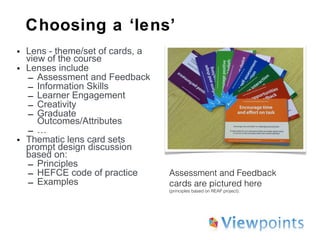
Choosing a ‘lens’ Lens - theme/set of cards, a view of the course Lenses include Assessment and Feedback Information Skills Learner Engagement  Creativity  Graduate Outcomes/Attributes … Thematic lens card sets prompt design discussion based on: Principles HEFCE code of practice Examples Assessment and Feedback cards are pictured here (principles based on REAP project).
Choosing an objective The team decide on an objective for their session and write it at the top of the module worksheet The ‘objective’ guides the design team through the process This is different to learning outcomes which can also be stated
Reading the front of the cards The team read the principles on the front of the cards, choosing ones appropriate to their objective* * The ‘objective’ of their design focus
Mapping the cards to the timeline The team take their selected cards and map them to the appropriate point on the timeline (e.g. at the induction phase, during first few weeks of course)
Reading examples on cards The course team turn the cards over and read the examples/ideas on the back.
Choosing relevant examples The team tick any examples that align with their course outcomes
Adding in own ideas/comments The team write on any of their own ideas or comments, in order to tailor the examples to their own module.
Sample finished worksheets
Discussion the benefits of a structured, collaborative design approach; the actual methods used and the roles involved; the use of lenses or themes; where next.
Where next? Work with pilot teams Refine, develop and release the materials for use at scale over semester 2 Partners/designers wanted!

Introducing the design studio

  • 1.
    The Design StudioAndrew Middleton Head of Innovation & Professional Development, QESS (CC) pimousse3000
  • 2.
    Course Planning Wheredo you start? … then what? … and other challenges
  • 3.
    Introducing a DesignStudio approach Curriculum Design, …Plan, …Develop, …Deliver? In contrast The Design Studio method will, share experience be enjoyable create a consistent, supported process encourage consistency clarity formal collaboration enhance project revealed Academic, inexperience detachment diverse practice inconsistency uncertainty isolation
  • 4.
    Objective for the Design Studio An approach that is, Highly usable Agile – works for different needs, situations, people Collaborative, creative and critical Resulting in, pedagogic and curriculum innovation and an engaging teaching and learning experience
  • 5.
    Suitable for theapproval of, new courses annually reviewed provision, and 5 Yearly Review Applications
  • 6.
    Devices to supportCurriculum Design Collaboration What could a designed approach look like? Who's there? What happens? What is produced? What happens next?
  • 7.
    The Design Teammembers Design Facilitator: experienced mentor and advocate Academic Lead: responsibility for taking it forward Student Designer: an equal design partner Academic peers: sharing experience Quality Adviser: advising on process Administrative adviser: logistics and processes LTA adviser: supporting innovation E-learning adviser: supporting best use of Blackboard etc Information adviser: readings and resources Learning adviser: embedding learning literacies Professional & Employer representatives: employability
  • 8.
    Viewpoints University ofUlster’s Viewpoints method http://tinyurl.com/bpx54xj Using ‘Lenses’ – approaching the design by considering principle-based themes e.g. assessment, employability, learner engagement, etc Collaboration workshops
  • 9.
    Module timeline worksheetTeams work together around the module (or course) design worksheet
  • 10.
    Choosing a ‘lens’Lens - theme/set of cards, a view of the course Lenses include Assessment and Feedback Information Skills Learner Engagement Creativity Graduate Outcomes/Attributes … Thematic lens card sets prompt design discussion based on: Principles HEFCE code of practice Examples Assessment and Feedback cards are pictured here (principles based on REAP project).
  • 11.
    Choosing an objectiveThe team decide on an objective for their session and write it at the top of the module worksheet The ‘objective’ guides the design team through the process This is different to learning outcomes which can also be stated
  • 12.
    Reading the frontof the cards The team read the principles on the front of the cards, choosing ones appropriate to their objective* * The ‘objective’ of their design focus
  • 13.
    Mapping the cardsto the timeline The team take their selected cards and map them to the appropriate point on the timeline (e.g. at the induction phase, during first few weeks of course)
  • 14.
    Reading examples oncards The course team turn the cards over and read the examples/ideas on the back.
  • 15.
    Choosing relevant examplesThe team tick any examples that align with their course outcomes
  • 16.
    Adding in ownideas/comments The team write on any of their own ideas or comments, in order to tailor the examples to their own module.
  • 17.
  • 18.
    Discussion the benefitsof a structured, collaborative design approach; the actual methods used and the roles involved; the use of lenses or themes; where next.
  • 19.
    Where next? Workwith pilot teams Refine, develop and release the materials for use at scale over semester 2 Partners/designers wanted!

Editor's Notes

  • #2 QESS are devising a methodology to support staff with responsibilities to lead on and contribute to Course Planning It comes in response to the Academic Quality Framework and findings from ‘enhance’
  • #3 Have you ever led or contributed to a Curriculum Planning activity before? How did it go? How will you make a start in creating your plan? What one thing more than any other will ensure success for you?
  • #4 All are important but Design provides a starting point to ensure we identify and address priorities and requirements Curriculum design across the University is not widely understood or consistently practised and this has resulted in inconsistent approaches being taken, a lack of enthusiasm and a lack of systematic support. All of these deter innovation, miss the opportunity to systematically create a platform for inspiring teaching and, most importantly, deliver a curriculum that is often not engaging our students effectively. A suitable curriculum design process is needed to support the enhancement-led Academic Quality Framework (AQF) contributing to a designed, managed and inspiring student experience.
  • #5 A highly usable, agile, coherent and sustainable institutional approach to curriculum design that results in pedagogic and curriculum innovation and an engaging teaching and learning experience
  • #10 Click to add notes
  • #11 Click to add notes
  • #12 Click to add notes
  • #13 Click to add notes
  • #14 Click to add notes
  • #15 Click to add notes
  • #16 Click to add notes
  • #17 Click to add notes
  • #18 Click to add notes