Andrew Middleton
Head of Academic Practice & Learning Innovation
Student engagement with reflection
Re-imagining PPDP for the Social Age
Simon and his camera CC BY-NC-ND 2.0
Graham Holden
Director of Learning & Teaching
@GrahamJHolden @andrewmid
#shult15
"[The] changing external higher education landscape; the
changing needs of employers and the changing demands and
expectations of our students, necessitate a step change in the
way the University supports the transition of students into and
through its undergraduate and postgraduate provision and
beyond."
Learning and Teaching Strategy 2020
Joshua Tree National Park CC BY-2.0
‘The best thing any education can bequeath is the habit of
reflection and questioning.’
AC Grayling, 2000
So why is it so difficult to engage our students with
reflection and PPDP?
What do you think?
Simon Powell CC BY-2.0
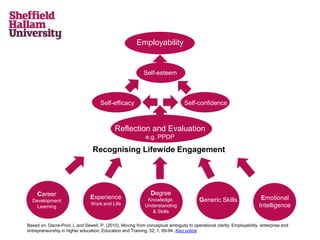
Based on: Dacre-Pool, L and Sewell, P, (2010), Moving from conceptual ambiguity to operational clarity: Employability, enterprise and
entrepreneurship in higher education, Education and Training, 52, 1, 89-94. Also online
Employability
Degree
Knowledge,
Understanding
& Skills
Career
Development
Learning
Experience
Work and Life
Generic Skills Emotional
Intelligence
Reflection and Evaluation
e.g. PPDP
Self-efficacy Self-confidence
Self-esteem
Recognising Lifewide Engagement
Learning ecologies
Transform the ways in which
students engage with, reflect on,
and record their journeys to
‘becoming professional’.
Ashley Holmes (CC BY-NC-ND 2.0)
An integrated and lifewide view
of PPDP and employability
PPDP needs to be habitual and develop thinking approaches
that are fit for life
PPDP needs to be established during pre-enrolment so that
the rich baseline data of transition into university helps to form
the reflective habit
PPDP needs to be understood as relevant from Day 1
Course-long and course-wide engagement with PPDP
means that PPDP becomes a key tool in tutoring
Daniel Go CC BY-NC-2.0
PPDP needs to be concretised; that is it needs to be
removed from the abstract and made real
Conclusion
Re-imagining Personal & Professional Development Planning requires
that universities develop PPDP as a lifewide learning practice:
Habitual learner engagement from first contact
reflecting on action in and out of the classroom
Peggy2012CreativeLenz (CC BY 2.0))

Student engagement with reflection – Re-imagining PPDP for the Social Age

  • 1.
    Andrew Middleton Head ofAcademic Practice & Learning Innovation Student engagement with reflection Re-imagining PPDP for the Social Age Simon and his camera CC BY-NC-ND 2.0 Graham Holden Director of Learning & Teaching @GrahamJHolden @andrewmid #shult15
  • 2.
    "[The] changing externalhigher education landscape; the changing needs of employers and the changing demands and expectations of our students, necessitate a step change in the way the University supports the transition of students into and through its undergraduate and postgraduate provision and beyond." Learning and Teaching Strategy 2020 Joshua Tree National Park CC BY-2.0
  • 3.
    ‘The best thingany education can bequeath is the habit of reflection and questioning.’ AC Grayling, 2000 So why is it so difficult to engage our students with reflection and PPDP? What do you think? Simon Powell CC BY-2.0
  • 4.
    Based on: Dacre-Pool,L and Sewell, P, (2010), Moving from conceptual ambiguity to operational clarity: Employability, enterprise and entrepreneurship in higher education, Education and Training, 52, 1, 89-94. Also online Employability Degree Knowledge, Understanding & Skills Career Development Learning Experience Work and Life Generic Skills Emotional Intelligence Reflection and Evaluation e.g. PPDP Self-efficacy Self-confidence Self-esteem Recognising Lifewide Engagement
  • 5.
    Learning ecologies Transform theways in which students engage with, reflect on, and record their journeys to ‘becoming professional’. Ashley Holmes (CC BY-NC-ND 2.0)
  • 6.
    An integrated andlifewide view of PPDP and employability PPDP needs to be habitual and develop thinking approaches that are fit for life PPDP needs to be established during pre-enrolment so that the rich baseline data of transition into university helps to form the reflective habit PPDP needs to be understood as relevant from Day 1 Course-long and course-wide engagement with PPDP means that PPDP becomes a key tool in tutoring Daniel Go CC BY-NC-2.0 PPDP needs to be concretised; that is it needs to be removed from the abstract and made real
  • 7.
    Conclusion Re-imagining Personal &Professional Development Planning requires that universities develop PPDP as a lifewide learning practice: Habitual learner engagement from first contact reflecting on action in and out of the classroom Peggy2012CreativeLenz (CC BY 2.0))

Editor's Notes

  • #4 5 minute discussion In pairs 5 minute report back - pick answers from 5 tables
  • #6 Accommodating difference: Contexts Perceptions Experience Stages Aspirations Journeys Interpretations….
  • #7 An integrated and lifewide view of PPDP (and employability) It seems clear, in reflecting on the points raised so far, that PPDP, and employability more generally, need to be re-imagined and re-branded. and that: * PPDP needs to be habitual, consistently part of a student's life at university and beyond. It needs to develop thinking approaches that are fit for life. To do this PPDP and employability, and other metacognitive capabilities, need to be fostered alongside the curriculum, with curriculum activity being triggers for reflection on learning. * PPDP needs to be established during pre-enrolment so that the rich baseline data of transition into university helps to form the reflective habit. * PPDP needs to be understood as relevant from Day 1, therefore attention needs to be given to recognising new learner engagement and peer mentoring through social media may provide answers for how this is achieved. * Course-long and course-wide engagement with PPDP means that PPDP becomes a key tool in tutoring. Students should be expected to recall, reflect in and on their academic and lifewide experiences and apply lessons from them continuously. This should include feedback on assignments, work experiences and placements for example. It also suggests that curriculum design should seek to be accommodate models of authentic learning more consistently. * PPDP needs to be concretised; that is it needs to be removed from the abstract and made real. The expectation that all professionals in the digital and social age should have a professional profile should be established and the digital capability of students and staff should be developed to support this. The LinkedIn University project has already begun to address this, but more is needed.