Tools to support effective
assessment and feedback; the
Viewpoints Project Approach

Dr Alan Masson and Catherine O’Donnell
Viewpoints Project, University of Ulster


11th May 2012
Overview
• Introduction and background context to the Viewpoints project

• Viewpoints framework and themes overview

• Typical walkthrough of the Assessment and Feedback workshop approach

• Role of the principles in the workshop process

• Some hands-on activities

• Brief sharing of experiences and evaluation findings from Viewpoints

• Questions and close
Introduction and background context
Viewpoints Project Overview
1. Viewpoints is a JISC-funded institutional curriculum
   design project.
2. Its remit is to create a user-friendly reflective workshop
   to promote and enhance effective curriculum design.
3. The tools use a learner timeline with established
   principles of best practice to help staff consider areas
   such as:
   • Assessment and Feedback (REAP)
   • Information Skills (SCONUL Pillars)
   • Student Interactions (8 Learning Event Model)
Viewpoints Project – Ulster context
 University introduced a new T&L strategy
   Streamlined curriculum approval processes
   Identified needs for curriculum innovation

 Viewpoints Project provided an opportunity to promote
  innovation and reflection in the curriculum design process

 Project outputs are now institutionally embedded and
  aligned
Assessment and Feedback at Ulster
• The University has recently adopted
  a set of Principles for Assessment
  and Feedback for Learning

  (
  http://ee.ulster.ac.uk/assessment_and_feedback/
  )

• The Viewpoints project has
  supported the development and
  implementation of these Principles
Viewpoints framework and themes
             overview
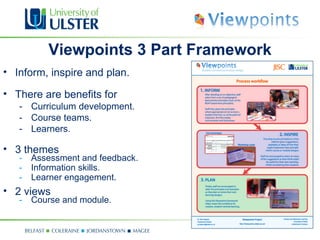
Viewpoints 3 Part Framework
• Inform, inspire and plan.

• There are benefits for
   - Curriculum development.
   - Course teams.
   - Learners.

• 3 themes
   -   Assessment and feedback.
   -   Information skills.
   -   Learner engagement.
• 2 views
   -   Course and module.
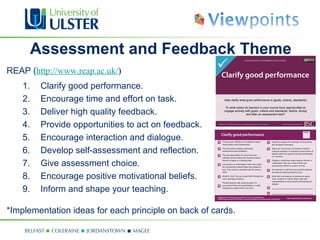
Assessment and Feedback Theme
REAP (http://www.reap.ac.uk/)
    1.    Clarify good performance.
    2.    Encourage time and effort on task.
    3.    Deliver high quality feedback.
    4.    Provide opportunities to act on feedback.
    5.    Encourage interaction and dialogue.
    6.    Develop self-assessment and reflection.
    7.    Give assessment choice.
    8.    Encourage positive motivational beliefs.
    9.    Inform and shape your teaching.

*Implementation ideas for each principle on back of cards.
Learner Engagement Theme
  The principles of learner engagement are based upon the
  8 Learning Events Model developed by LabSET, University of Liège, Belgium.
    1.   Receive.
    2.   Create.
    3.   Debate.
    4.   Explore.
    5.   Imitate.
    6.   Experiment.
    7.   Practice.
    8.   Meta-Learn.

*Implementation ideas for each principle
on back of cards.

                                 http://www.flickr.com/photos/viewpointsproject/
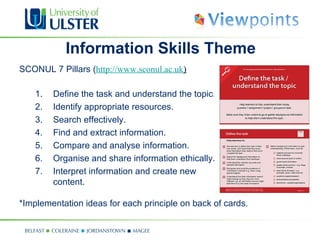
Information Skills Theme
SCONUL 7 Pillars (http://www.sconul.ac.uk)

    1.   Define the task and understand the topic.
    2.   Identify appropriate resources.
    3.   Search effectively.
    4.   Find and extract information.
    5.   Compare and analyse information.
    6.   Organise and share information ethically.
    7.   Interpret information and create new
         content.

*Implementation ideas for each principle on back of cards.
Typical walkthrough of
the Assessment and Feedback
     workshop approach
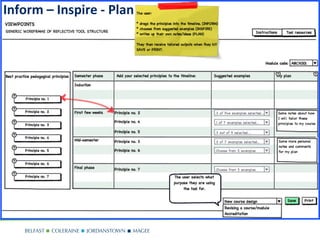
Learner timeline worksheet & resources
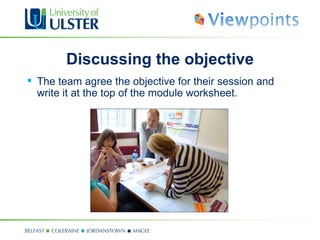
Discussing the objective
 The team agree the objective for their session and
  write it at the top of the module worksheet.
Reading the front of the cards
 The team read the principles on the front of the
  cards, choosing ones appropriate to their objective.
Mapping the cards to the learner timeline
    The team take their selected cards and map them to the
     appropriate point on the timeline (e.g. at the induction
     phase, during first few weeks of course)
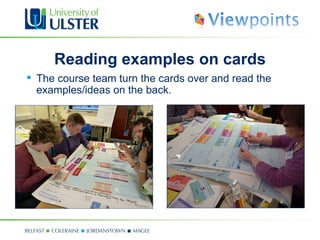
Reading examples on cards
 The course team turn the cards over and read the
  examples/ideas on the back.
Choosing relevant examples
 The team select any
  examples that would fit with
  their course objective and
  their teaching practice.
Adding in own ideas/comments
 The team write on any of their own ideas or comments,
  in order to tailor the examples to their own module.
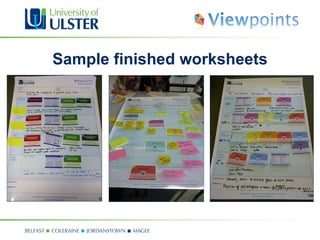
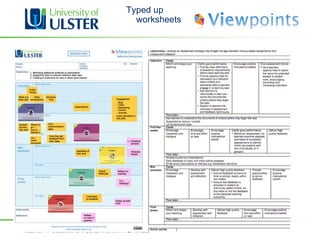
Sample finished worksheets
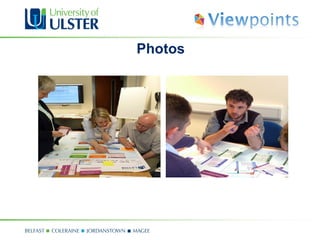
Photos
Typed up
  worksheets
Task 1
          Choose 2 assessment and feedback principles that might help
          you consider the following objective/challenge.

     1.    Clarify good performance.
     2.    Encourage time and effort on task.
     3.    Deliver high quality feedback.
     4.    Provide opportunities to act on feedback.
     5.    Encourage interaction and dialogue.

Objective:
Support Year 1 students’ transition to Higher Education.
Challenge:
Develop an assessment and feedback that provides a supportive learning
environment for students in their transition to Higher Education.
Task 2
Vote for your first preference principle, the principle you feel will most
  help you achieve the objective/challenge.


    3.   Clarify good performance.
    4.   Encourage time and effort on task.
    5.   Deliver high quality feedback.
    6.   Provide opportunities to act on feedback.
    7.   Encourage interaction and dialogue.
Task 3
Consider then vote where on the learner timeline this principle could
  have most benefit

7. Induction
8. First few weeks
9. Mid semester
10.Final phase


Think about implementation ideas that could have the most benefit
   across the learner timeline.
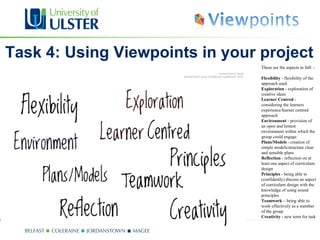
Task 4: Using Viewpoints in your project
                                 These are the aspects in full: -

                                 Flexibility - flexibility of the
                                 approach used
                                 Exploration - exploration of
                                 creative ideas
                                 Learner Centred -
                                 considering the learners
                                 experience/learner centred
                                 approach
                                 Environment - provision of
                                 an open and honest
                                 environment within which the
                                 group could engage
                                 Plans/Models - creation of
                                 simple models/structure clear
                                 and sensible plans
                                 Reflection - reflection on at
                                 least one aspect of curriculum
                                 design
                                 Principles - being able to
                                 (confidently) discuss an aspect
                                 of curriculum design with the
                                 knowledge of using sound
                                 principles
                                 Teamwork – being able to
                                 work effectively as a member
                                 of the group
                                 Creativity - new term for task
Task 5:

Using the text box type one benefit the Viewpoints approach /
resources could have your

*Course/subject
*Learner
*You
Role of the principles in the workshop
              process
Inform – Inspire - Plan
Viewpoints process overview
 Card sorting / storyboarding metaphor

 Timeline and “challenge” provides context for
  workshop

 Phases of workshop introduce more complex
  “questions” - role of principles as prompts shifts
  through these phases
Principles
 Provide framework to describe key learner
  “interactions” (focus)
 Too many or too few may stifle reflection and
  debate
 Relate to the learner experience
 Action based (verb-like)
    More consistent meaning v conceptual entities
    (i.e. lecture)
    Defers decisions about “how” to later
Role of Viewpoints principles
 Provide palette of verb like entities with shared
  meanings
These principles provide structured prompts:
 individual and group reflection;
 Discussion and debate;
 Introduce possible ideas for consideration;
 Provide things to prioritise / position / action;
 Personal annotation and use as basis of a plan
Brief sharing of experiences and
evaluation findings from Viewpoints
Project.
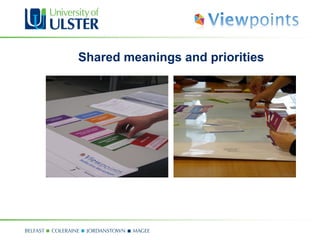
Shared meanings and priorities
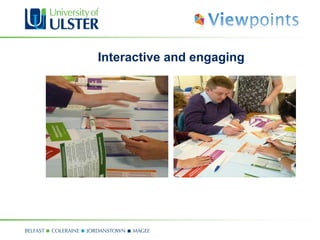
Interactive and engaging
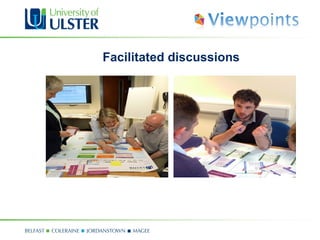
Facilitated discussions
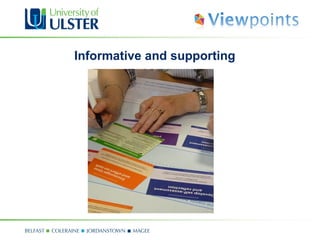
Informative and supporting
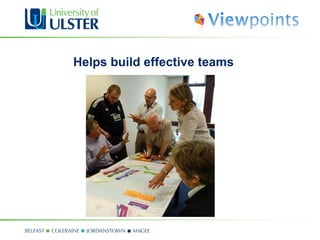
Helps build effective teams
www.wordle.net
www.wordle.net
Some Quotes
“Thought provoking.”
“Good to see the plan in front of you.”
“Short sessions exploring ideas - very useful.”
“Enjoyed it – not too time-consuming and time used very well.”
“Good material supplied to encourage wider consideration.”
"Got the team to brainstorm about the way forward in relation
to creativity.”
“Better face to face interaction with course team.”
Some Quotes
“Easy tool – visually descriptive, illustrative”
“…Resources excellent prompts”
“Suggestion cards act as a good prompt”
“Cards aided formulation of ideas”
“Accessible and easy to use. Comprehensive
and guiding.”
“Look at the holistic approach.”
“Group participation/engagement on ideas”
“Being given the time to reflect.”
“Useful prompts and discussion.”
Questions and close (10 minutes)
Further information
Viewpoints project blog: http://viewpoints.ulster.ac.uk

Viewpoints resources site: http://viewpoints.ulster.ac.uk/resources
Dr Alan Masson, Project Director - aj.masson@ulster.ac.uk
Catherine O’Donnell, Academic E-Learning Consultant - c.odonnell@ulster.ac.uk

Dr Vilinda Ross, Research Fellow - v.ross@ulster.ac.uk

11 may12

  • 1.
    Tools to supporteffective assessment and feedback; the Viewpoints Project Approach Dr Alan Masson and Catherine O’Donnell Viewpoints Project, University of Ulster 11th May 2012
  • 2.
    Overview • Introduction andbackground context to the Viewpoints project • Viewpoints framework and themes overview • Typical walkthrough of the Assessment and Feedback workshop approach • Role of the principles in the workshop process • Some hands-on activities • Brief sharing of experiences and evaluation findings from Viewpoints • Questions and close
  • 3.
  • 4.
    Viewpoints Project Overview 1.Viewpoints is a JISC-funded institutional curriculum design project. 2. Its remit is to create a user-friendly reflective workshop to promote and enhance effective curriculum design. 3. The tools use a learner timeline with established principles of best practice to help staff consider areas such as: • Assessment and Feedback (REAP) • Information Skills (SCONUL Pillars) • Student Interactions (8 Learning Event Model)
  • 5.
    Viewpoints Project –Ulster context  University introduced a new T&L strategy Streamlined curriculum approval processes Identified needs for curriculum innovation  Viewpoints Project provided an opportunity to promote innovation and reflection in the curriculum design process  Project outputs are now institutionally embedded and aligned
  • 6.
    Assessment and Feedbackat Ulster • The University has recently adopted a set of Principles for Assessment and Feedback for Learning ( http://ee.ulster.ac.uk/assessment_and_feedback/ ) • The Viewpoints project has supported the development and implementation of these Principles
  • 7.
    Viewpoints framework andthemes overview
  • 8.
    Viewpoints 3 PartFramework • Inform, inspire and plan. • There are benefits for - Curriculum development. - Course teams. - Learners. • 3 themes - Assessment and feedback. - Information skills. - Learner engagement. • 2 views - Course and module.
  • 9.
    Assessment and FeedbackTheme REAP (http://www.reap.ac.uk/) 1. Clarify good performance. 2. Encourage time and effort on task. 3. Deliver high quality feedback. 4. Provide opportunities to act on feedback. 5. Encourage interaction and dialogue. 6. Develop self-assessment and reflection. 7. Give assessment choice. 8. Encourage positive motivational beliefs. 9. Inform and shape your teaching. *Implementation ideas for each principle on back of cards.
  • 10.
    Learner Engagement Theme The principles of learner engagement are based upon the 8 Learning Events Model developed by LabSET, University of Liège, Belgium. 1. Receive. 2. Create. 3. Debate. 4. Explore. 5. Imitate. 6. Experiment. 7. Practice. 8. Meta-Learn. *Implementation ideas for each principle on back of cards. http://www.flickr.com/photos/viewpointsproject/
  • 11.
    Information Skills Theme SCONUL7 Pillars (http://www.sconul.ac.uk) 1. Define the task and understand the topic. 2. Identify appropriate resources. 3. Search effectively. 4. Find and extract information. 5. Compare and analyse information. 6. Organise and share information ethically. 7. Interpret information and create new content. *Implementation ideas for each principle on back of cards.
  • 12.
    Typical walkthrough of theAssessment and Feedback workshop approach
  • 13.
  • 14.
    Discussing the objective The team agree the objective for their session and write it at the top of the module worksheet.
  • 15.
    Reading the frontof the cards  The team read the principles on the front of the cards, choosing ones appropriate to their objective.
  • 16.
    Mapping the cardsto the learner timeline  The team take their selected cards and map them to the appropriate point on the timeline (e.g. at the induction phase, during first few weeks of course)
  • 17.
    Reading examples oncards  The course team turn the cards over and read the examples/ideas on the back.
  • 18.
    Choosing relevant examples The team select any examples that would fit with their course objective and their teaching practice.
  • 19.
    Adding in ownideas/comments  The team write on any of their own ideas or comments, in order to tailor the examples to their own module.
  • 20.
  • 21.
  • 22.
    Typed up worksheets
  • 23.
    Task 1 Choose 2 assessment and feedback principles that might help you consider the following objective/challenge. 1. Clarify good performance. 2. Encourage time and effort on task. 3. Deliver high quality feedback. 4. Provide opportunities to act on feedback. 5. Encourage interaction and dialogue. Objective: Support Year 1 students’ transition to Higher Education. Challenge: Develop an assessment and feedback that provides a supportive learning environment for students in their transition to Higher Education.
  • 24.
    Task 2 Vote foryour first preference principle, the principle you feel will most help you achieve the objective/challenge. 3. Clarify good performance. 4. Encourage time and effort on task. 5. Deliver high quality feedback. 6. Provide opportunities to act on feedback. 7. Encourage interaction and dialogue.
  • 25.
    Task 3 Consider thenvote where on the learner timeline this principle could have most benefit 7. Induction 8. First few weeks 9. Mid semester 10.Final phase Think about implementation ideas that could have the most benefit across the learner timeline.
  • 26.
    Task 4: UsingViewpoints in your project These are the aspects in full: - Flexibility - flexibility of the approach used Exploration - exploration of creative ideas Learner Centred - considering the learners experience/learner centred approach Environment - provision of an open and honest environment within which the group could engage Plans/Models - creation of simple models/structure clear and sensible plans Reflection - reflection on at least one aspect of curriculum design Principles - being able to (confidently) discuss an aspect of curriculum design with the knowledge of using sound principles Teamwork – being able to work effectively as a member of the group Creativity - new term for task
  • 27.
    Task 5: Using thetext box type one benefit the Viewpoints approach / resources could have your *Course/subject *Learner *You
  • 28.
    Role of theprinciples in the workshop process
  • 29.
  • 30.
    Viewpoints process overview Card sorting / storyboarding metaphor  Timeline and “challenge” provides context for workshop  Phases of workshop introduce more complex “questions” - role of principles as prompts shifts through these phases
  • 31.
    Principles  Provide frameworkto describe key learner “interactions” (focus)  Too many or too few may stifle reflection and debate  Relate to the learner experience  Action based (verb-like) More consistent meaning v conceptual entities (i.e. lecture) Defers decisions about “how” to later
  • 32.
    Role of Viewpointsprinciples  Provide palette of verb like entities with shared meanings These principles provide structured prompts:  individual and group reflection;  Discussion and debate;  Introduce possible ideas for consideration;  Provide things to prioritise / position / action;  Personal annotation and use as basis of a plan
  • 33.
    Brief sharing ofexperiences and evaluation findings from Viewpoints Project.
  • 34.
  • 35.
  • 36.
  • 37.
  • 38.
  • 39.
  • 40.
  • 41.
    Some Quotes “Thought provoking.” “Goodto see the plan in front of you.” “Short sessions exploring ideas - very useful.” “Enjoyed it – not too time-consuming and time used very well.” “Good material supplied to encourage wider consideration.” "Got the team to brainstorm about the way forward in relation to creativity.” “Better face to face interaction with course team.”
  • 42.
    Some Quotes “Easy tool– visually descriptive, illustrative” “…Resources excellent prompts” “Suggestion cards act as a good prompt” “Cards aided formulation of ideas” “Accessible and easy to use. Comprehensive and guiding.” “Look at the holistic approach.” “Group participation/engagement on ideas” “Being given the time to reflect.” “Useful prompts and discussion.”
  • 43.
    Questions and close(10 minutes)
  • 44.
    Further information Viewpoints projectblog: http://viewpoints.ulster.ac.uk Viewpoints resources site: http://viewpoints.ulster.ac.uk/resources Dr Alan Masson, Project Director - aj.masson@ulster.ac.uk Catherine O’Donnell, Academic E-Learning Consultant - c.odonnell@ulster.ac.uk Dr Vilinda Ross, Research Fellow - v.ross@ulster.ac.uk

Editor's Notes

  • #2 Alan 12.00-12.10
  • #3 Alan 12.00-12.10
  • #4 Alan 12.00-12.10
  • #8 Alan 12.00-12.10
  • #9 Alan 12.00-12.10
  • #10 Alan 12.00-12.10
  • #11 11/14/11 Alan 12.00-12.10
  • #12 11/14/11 Alan 12.00-12.10
  • #13 Catherine 12.10-12.20
  • #14 Catherine 12.10-12.20
  • #15 Catherine 12.10-12.20
  • #16 Catherine 12.10-12.20
  • #17 Catherine 12.10-12.20
  • #18 Catherine 12.10-12.20
  • #19 Catherine 12.10-12.20
  • #20 Catherine 12.10-12.20
  • #21 Catherine 12.10-12.20
  • #22 Catherine 12.10-12.20
  • #23 Catherine 12.10-12.20
  • #24 Circulate the pdf A&F cards Catherine 12.29-12.31 5 principles
  • #25 Catherine 12.31-12.35
  • #26 Consider, vote and show of hands Catherine 12.31-12.35
  • #27 If you think Viewpoints could be useful in your project / institution Indicate what you think top 3 most USEFUL ASPECTs in order of preference are/might be Type these into the text box and mark with 1, 2 or 3 Catherine 12.35-40
  • #28 Alan 12.40-12.50
  • #29 Alan 12.40-12.50
  • #34 11/14/11
  • #35 11/14/11
  • #36 11/14/11
  • #37 11/14/11
  • #38 11/14/11
  • #39 11/14/11
  • #40 11/14/11
  • #41 11/14/11 Quote made from one participant (and made into a tagcloud in Wordle) Quote reads “Visual, interactive, fun, productive, collaborative” (Participant at the SEDA Conference, May 2011)
  • #42 11/14/11
  • #43 11/14/11