Approaches to Curriculum & Learning Design
Helen Beetham, Sheila MacNeill
21 November 2022
#jiscexperts22
Session overview
• Overview of project - Background, rationale, how you can engage(10 mins)
• Activity 1 – Developing a shared process model (20 mins)
• Activity 2 – Space, place and modes of participation (10 mins)
• Activity 3 – Thinking ahead (10 mins)
• Feedback and next steps (10 mins)
Review of learning and curriculum design 2022
• Literature review: past projects; models and frameworks in use;
studies of curriculum practice from the last 2 years
• Survey of current curriculum practice in higher education
• Interviews and vignettes
Outputs
• Survey report
• Summary of models in use
• Recommendations to HE curriculum providers and to Jisc & partners
Definitions
• Curriculum Design: reviewing, planning and developing a course of study
Formal departmental and institutional process; mapping to graduate
outcomes, benchmarks and professional standards; producing documentation
• Learning Design: defining how learning will be supported within each course,
module or unit
Defining activities, tools and technologies, core content, class sessions and
groupings, mode(s) of participation, assignments and assessments,
opportunities for interaction and feedback; producing learning materials
• Terms are often used interchangeably and processes often overlap or iterate
We use 'Curriculum and Learning Design' to mean all the processes of
planning and designing a course of study and how students will learn
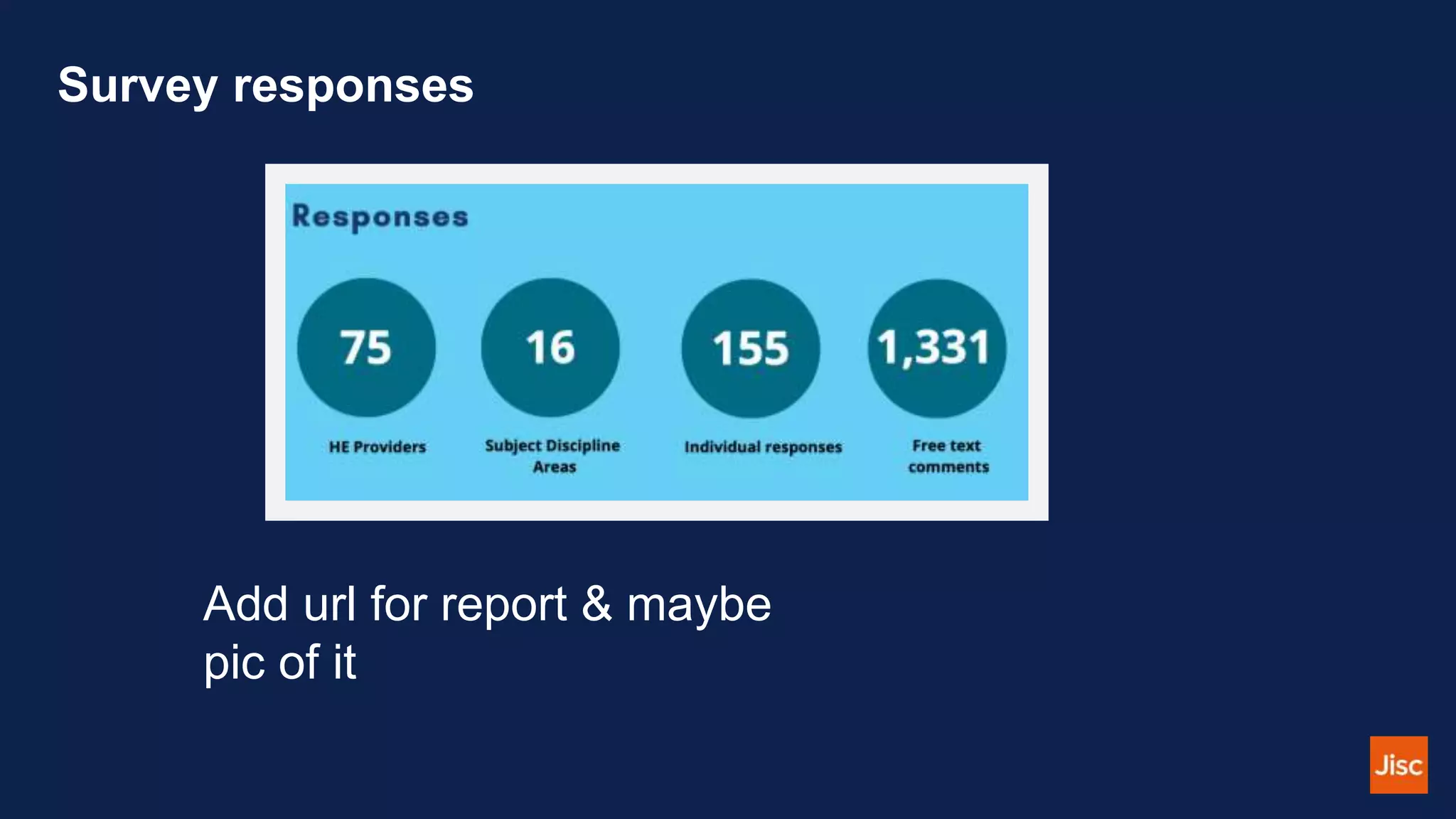
Survey responses
Add url for report & maybe
pic of it
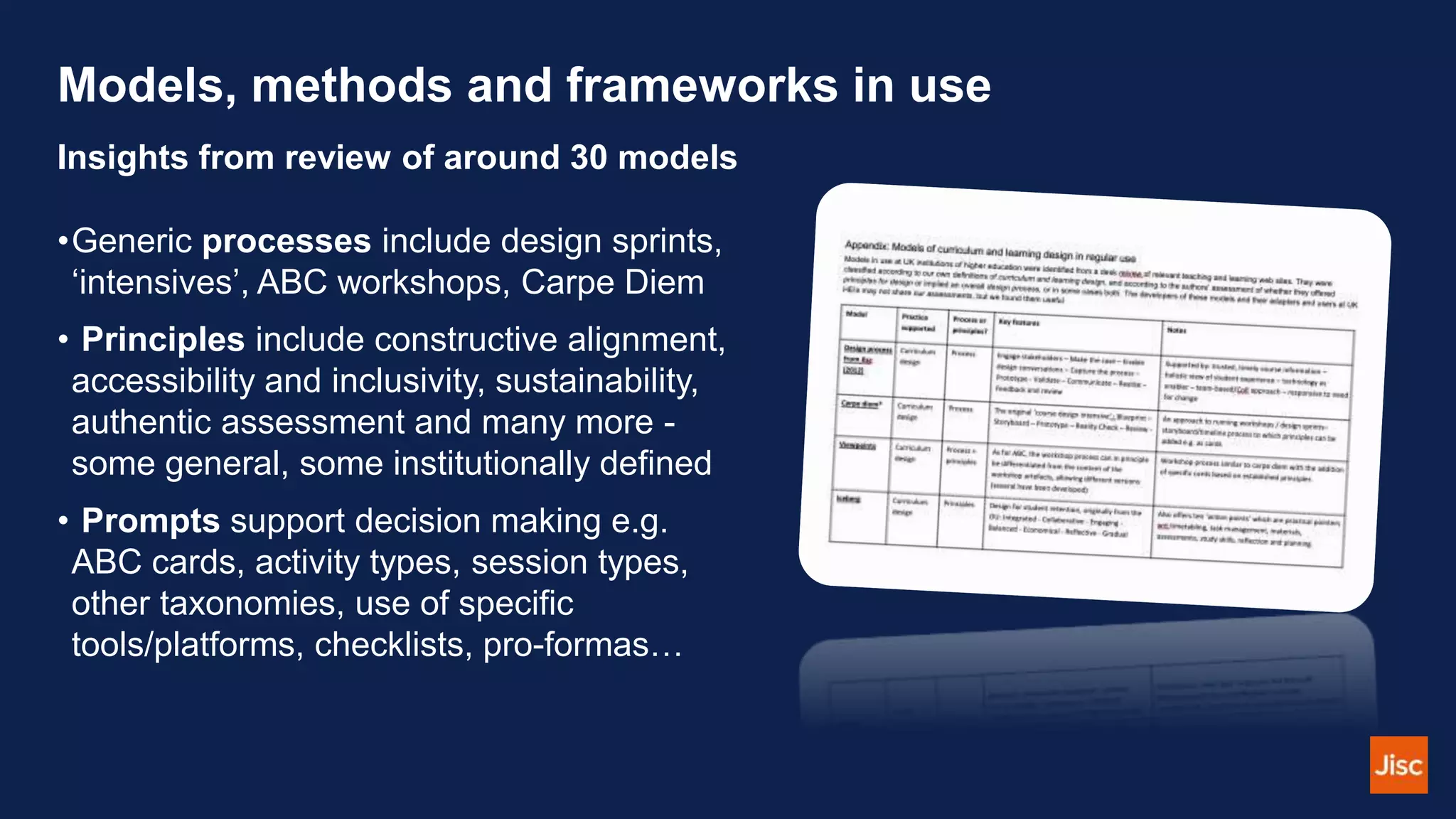
Models, methods and frameworks in use
Insights from review of around 30 models
•Generic processes include design sprints,
‘intensives’, ABC workshops, Carpe Diem
• Principles include constructive alignment,
accessibility and inclusivity, sustainability,
authentic assessment and many more -
some general, some institutionally defined
• Prompts support decision making e.g.
ABC cards, activity types, session types,
other taxonomies, use of specific
tools/platforms, checklists, pro-formas…
Recommendations & focus of phase 2
Explore challenges and opportunities (based on current
practice), and develop:
• core learning/curriculum design process
• guidance on the pedagogies of diverse spaces, places and
modes of participation
• whole curriculum design through a pedagogical lens
• Implications for organisational planning e.g. staff workload,
estates, platforms, digital divide…
• exemplar case studies
• terminology/definitions to reflect real world challenges and
practices
Activity 1: Developing a process model
Insert footer
8
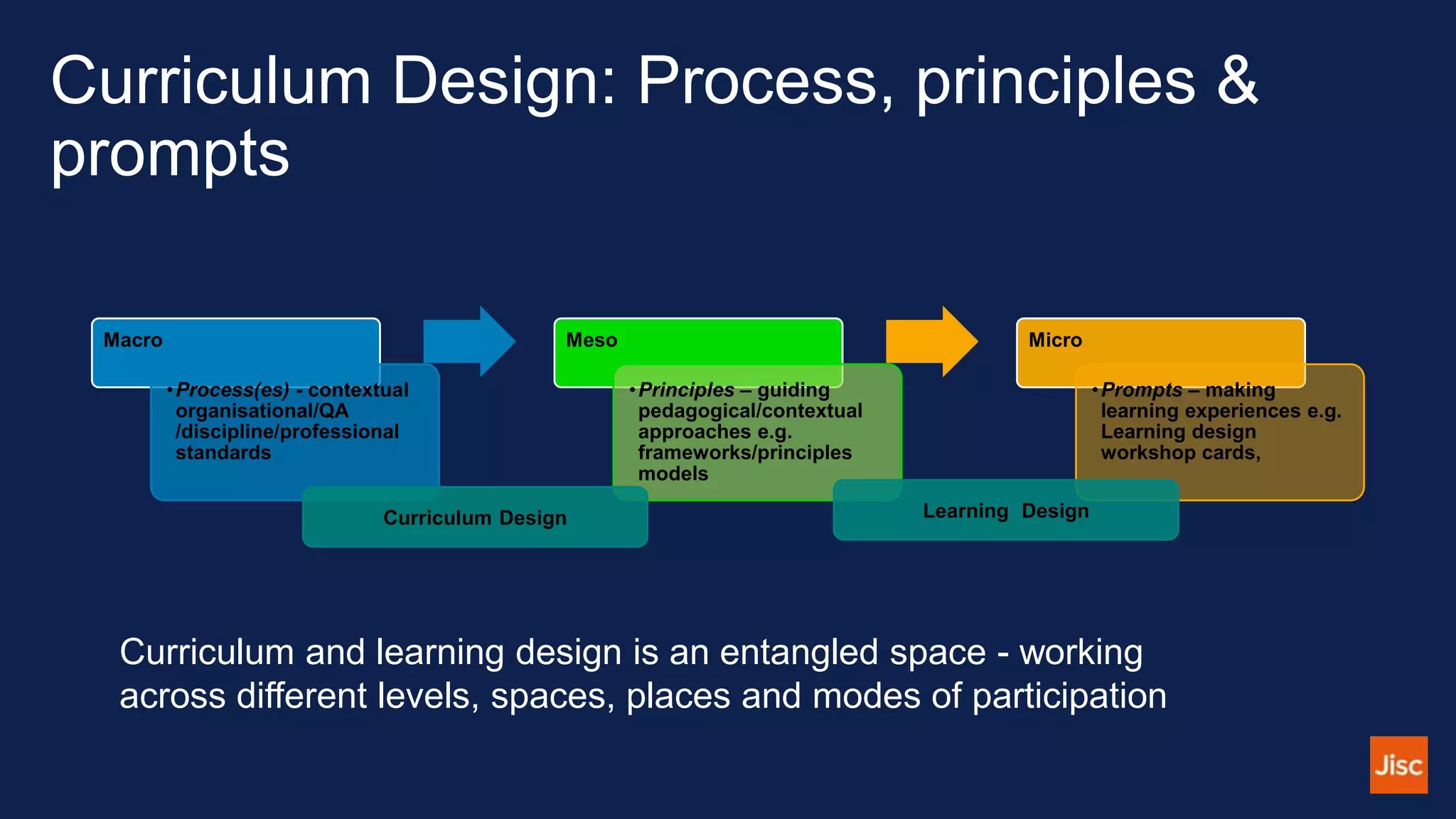
Macro
•Process(es) - contextual
organisational/QA
/discipline/professional
standards
Meso
•Principles – guiding
pedagogical/contextual
approaches e.g.
frameworks/principles
models
Micro
•Prompts – making
learning experiences e.g.
Learning design
workshop cards,
Curriculum Design: Process, principles &
prompts
Curriculum Design Learning Design
Curriculum and learning design is an entangled space - working
across different levels, spaces, places and modes of participation
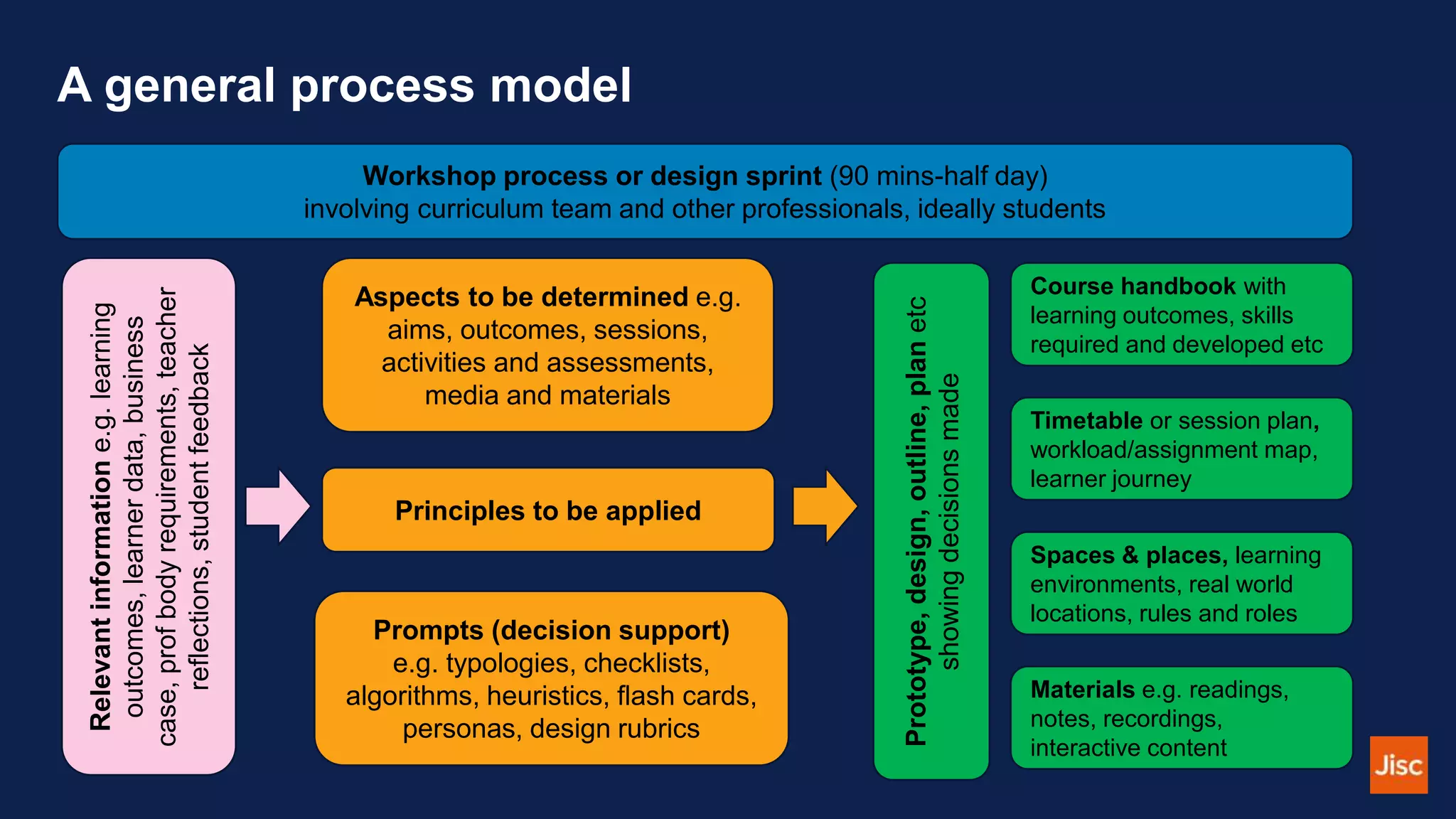
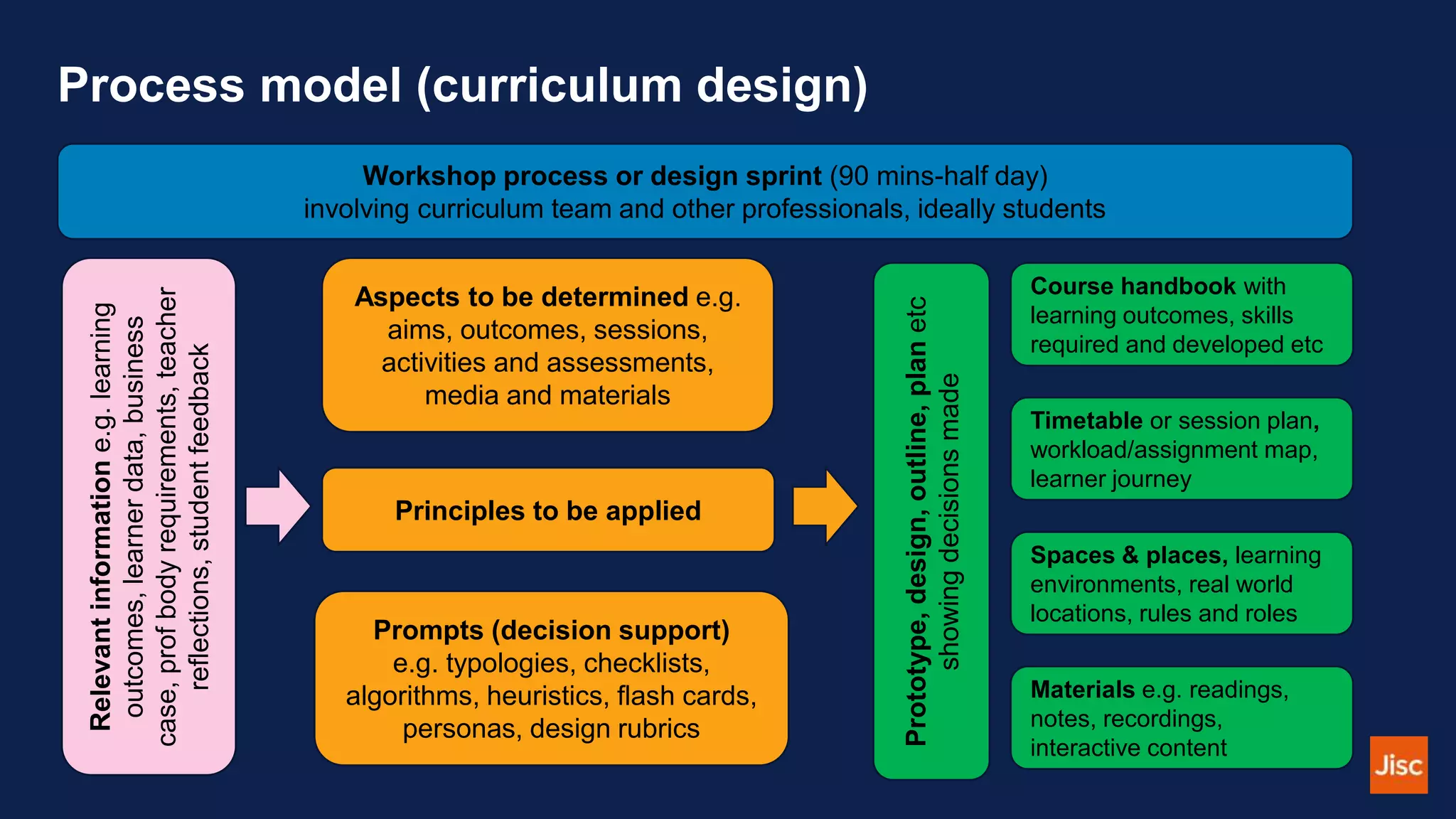
A general process model
Workshop process or design sprint (90 mins-half day)
involving curriculum team and other professionals, ideally students
Relevant
information
e.g.
learning
outcomes,
learner
data,
business
case,
prof
body
requirements,
teacher
reflections,
student
feedback
Aspects to be determined e.g.
aims, outcomes, sessions,
activities and assessments,
media and materials
Principles to be applied
Prompts (decision support)
e.g. typologies, checklists,
algorithms, heuristics, flash cards,
personas, design rubrics
Prototype,
design,
outline,
plan
etc
showing
decisions
made
Course handbook with
learning outcomes, skills
required and developed etc
Timetable or session plan,
workload/assignment map,
learner journey
Spaces & places, learning
environments, real world
locations, rules and roles
Materials e.g. readings,
notes, recordings,
interactive content
Over to you
bit.ly/LCDExperts
• Edit the generic model
• Upload your own process
model or framework
Activity 2: Pedagogies of time, place, modes of
interaction
Insert footer
12
Process model (curriculum design)
Workshop process or design sprint (90 mins-half day)
involving curriculum team and other professionals, ideally students
Relevant
information
e.g.
learning
outcomes,
learner
data,
business
case,
prof
body
requirements,
teacher
reflections,
student
feedback
Aspects to be determined e.g.
aims, outcomes, sessions,
activities and assessments,
media and materials
Principles to be applied
Prompts (decision support)
e.g. typologies, checklists,
algorithms, heuristics, flash cards,
personas, design rubrics
Prototype,
design,
outline,
plan
etc
showing
decisions
made
Course handbook with
learning outcomes, skills
required and developed etc
Timetable or session plan,
workload/assignment map,
learner journey
Spaces & places, learning
environments, real world
locations, rules and roles
Materials e.g. readings,
notes, recordings,
interactive content
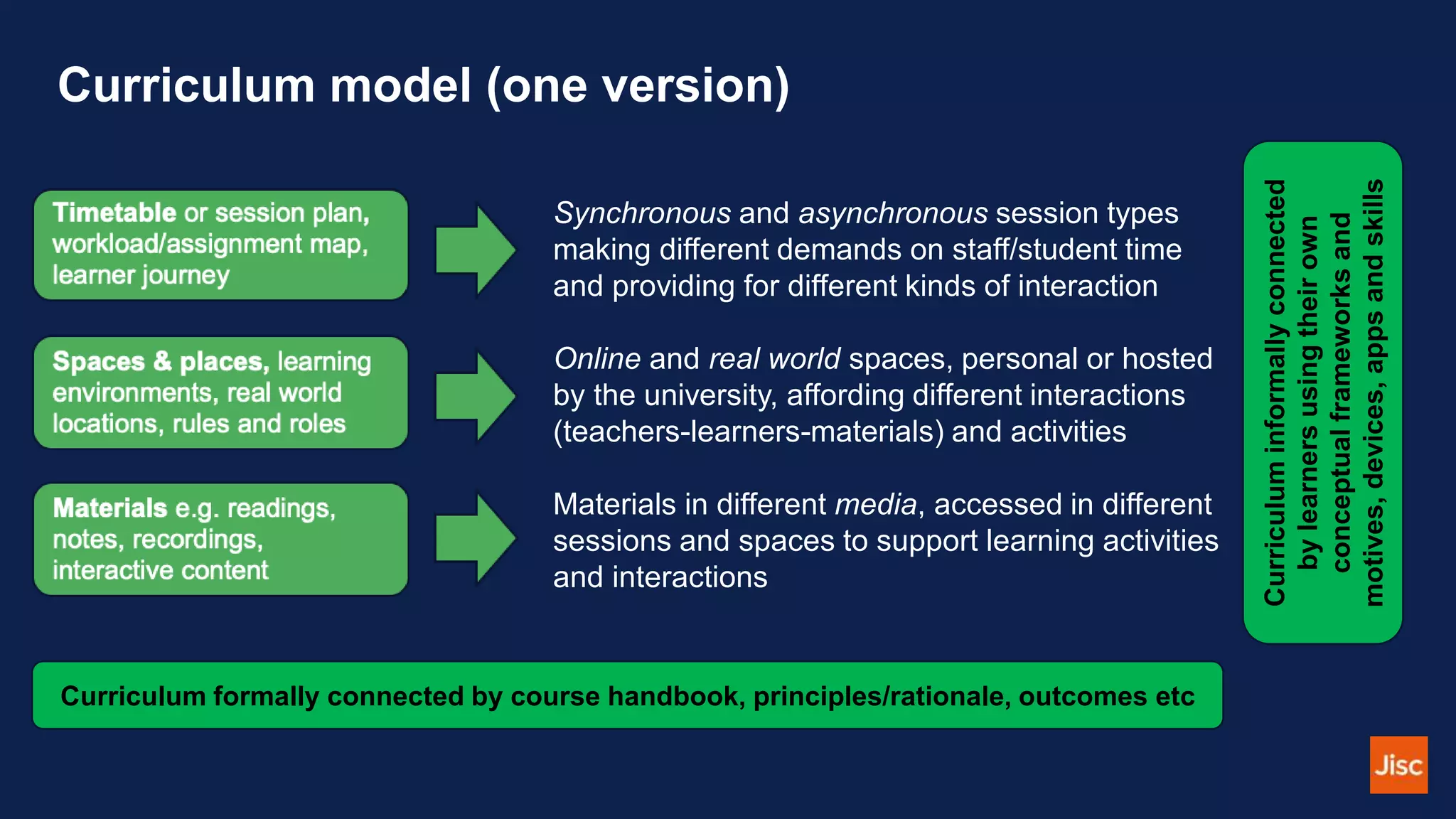
Curriculum model (one version)
Synchronous and asynchronous session types
making different demands on staff/student time
and providing for different kinds of interaction
Online and real world spaces, personal or hosted
by the university, affording different interactions
(teachers-learners-materials) and activities
Materials in different media, accessed in different
sessions and spaces to support learning activities
and interactions
Curriculum formally connected by course handbook, principles/rationale, outcomes etc
Curriculum
informally
connected
by
learners
using
their
own
conceptual
frameworks
and
motives,
devices,
apps
and
skills
Managing learning in time and space
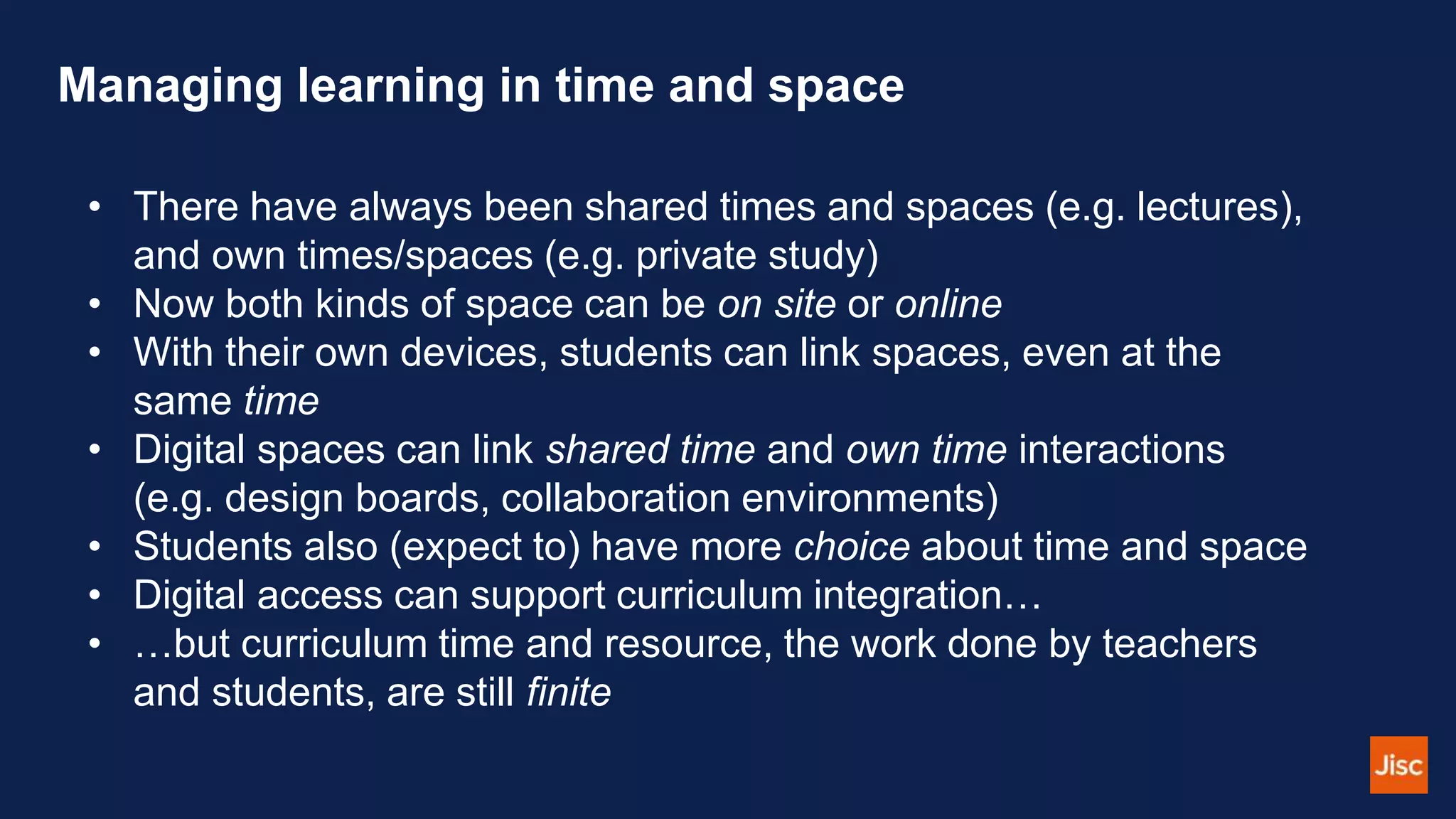
• There have always been shared times and spaces (e.g. lectures),
and own times/spaces (e.g. private study)
• Now both kinds of space can be on site or online
• With their own devices, students can link spaces, even at the
same time
• Digital spaces can link shared time and own time interactions
(e.g. design boards, collaboration environments)
• Students also (expect to) have more choice about time and space
• Digital access can support curriculum integration…
• …but curriculum time and resource, the work done by teachers
and students, are still finite
Everything is blended
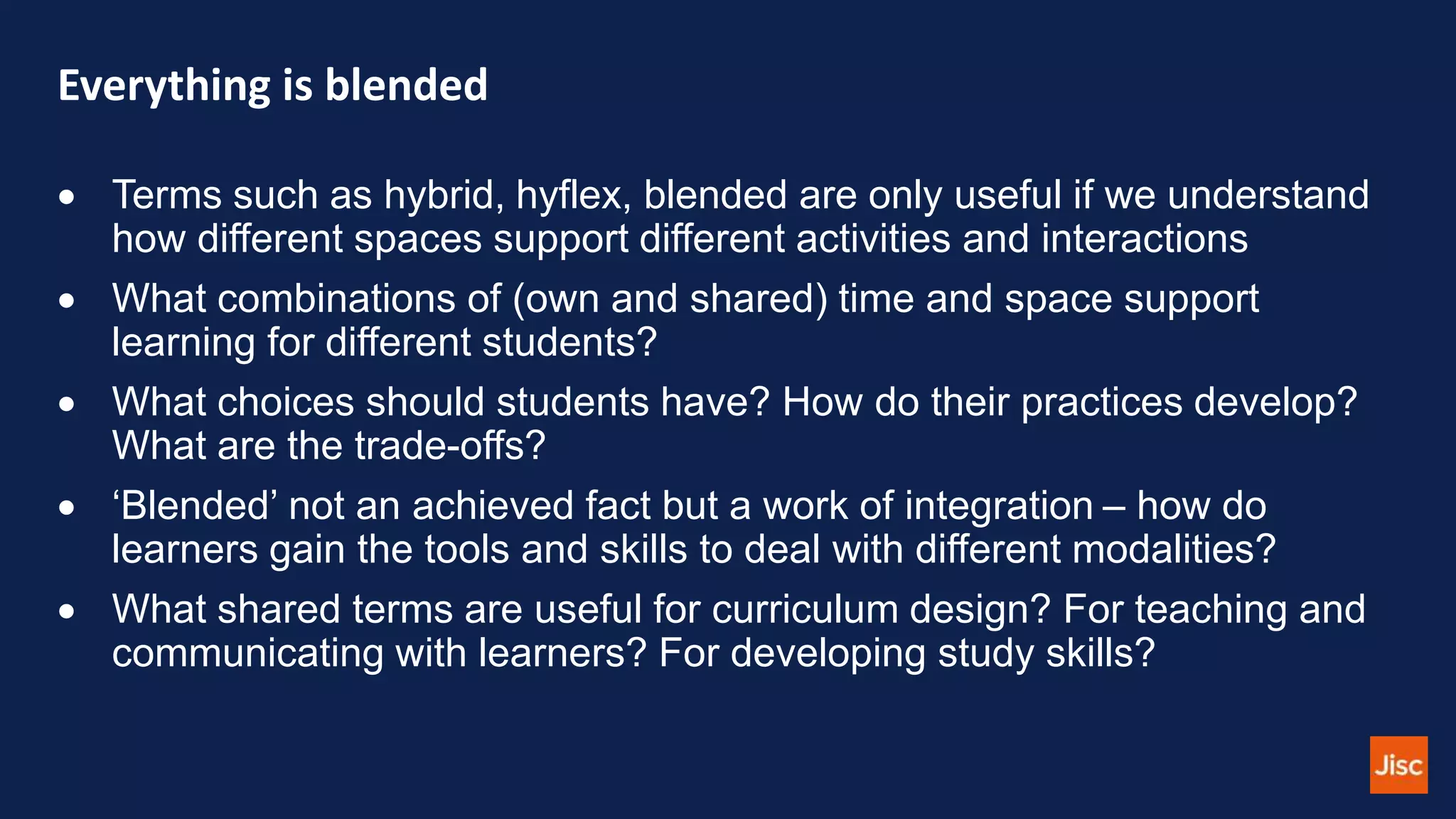
 Terms such as hybrid, hyflex, blended are only useful if we understand
how different spaces support different activities and interactions
 What combinations of (own and shared) time and space support
learning for different students?
 What choices should students have? How do their practices develop?
What are the trade-offs?
 ‘Blended’ not an achieved fact but a work of integration – how do
learners gain the tools and skills to deal with different modalities?
 What shared terms are useful for curriculum design? For teaching and
communicating with learners? For developing study skills?
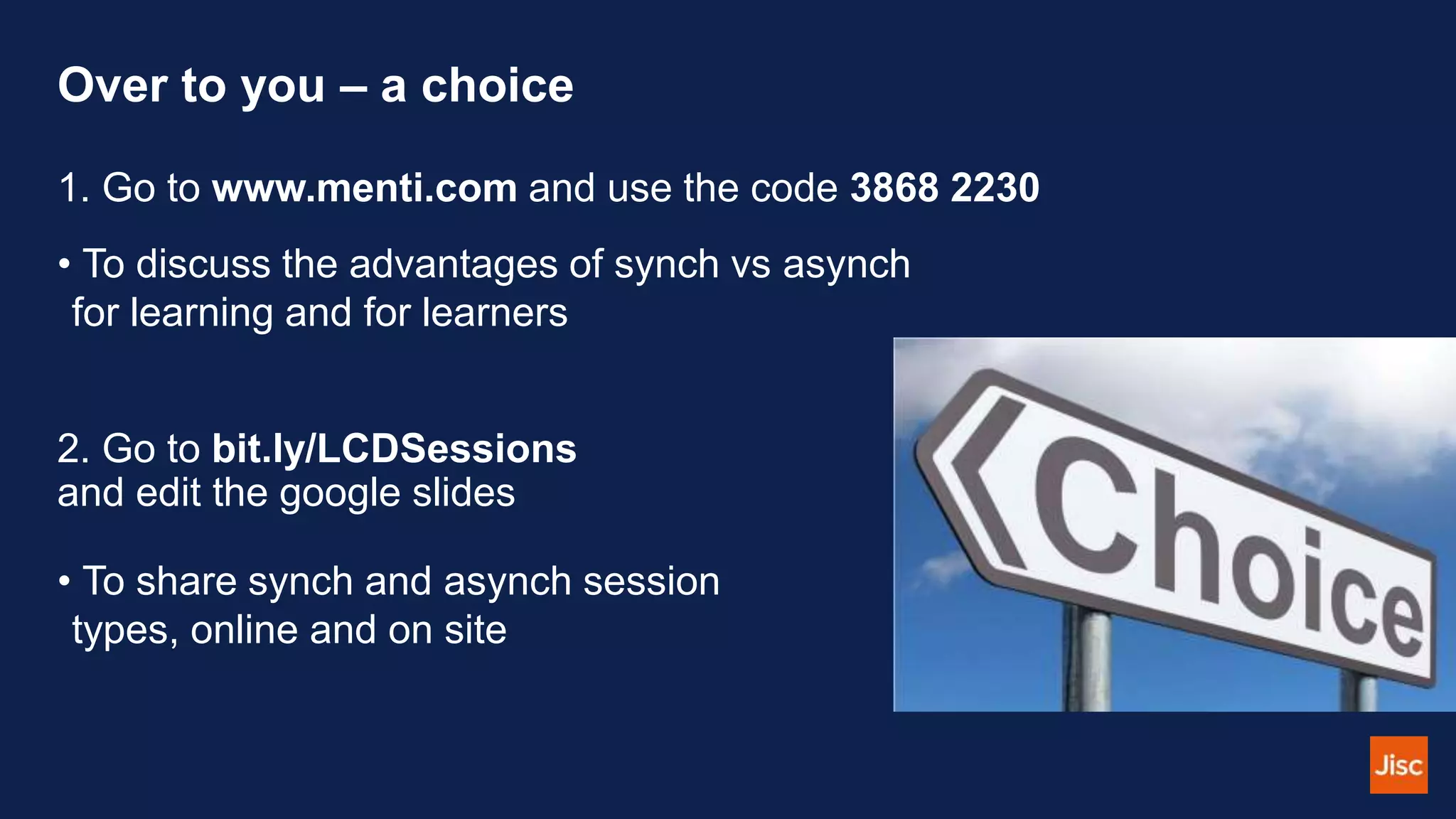
Over to you – a choice
1. Go to www.menti.com and use the code 3868 2230
• To discuss the advantages of synch vs asynch
for learning and for learners
2. Go to bit.ly/LCDSessions
and edit the google slides
• To share synch and asynch session
types, online and on site
A pedagogy first approach can inform:
o timetabling, student calendars and learning journeys,
assessment management
o staff workload allocation
o estates planning
o virtual estate (digital platform) development
o developing organisational and individual digital capabilities
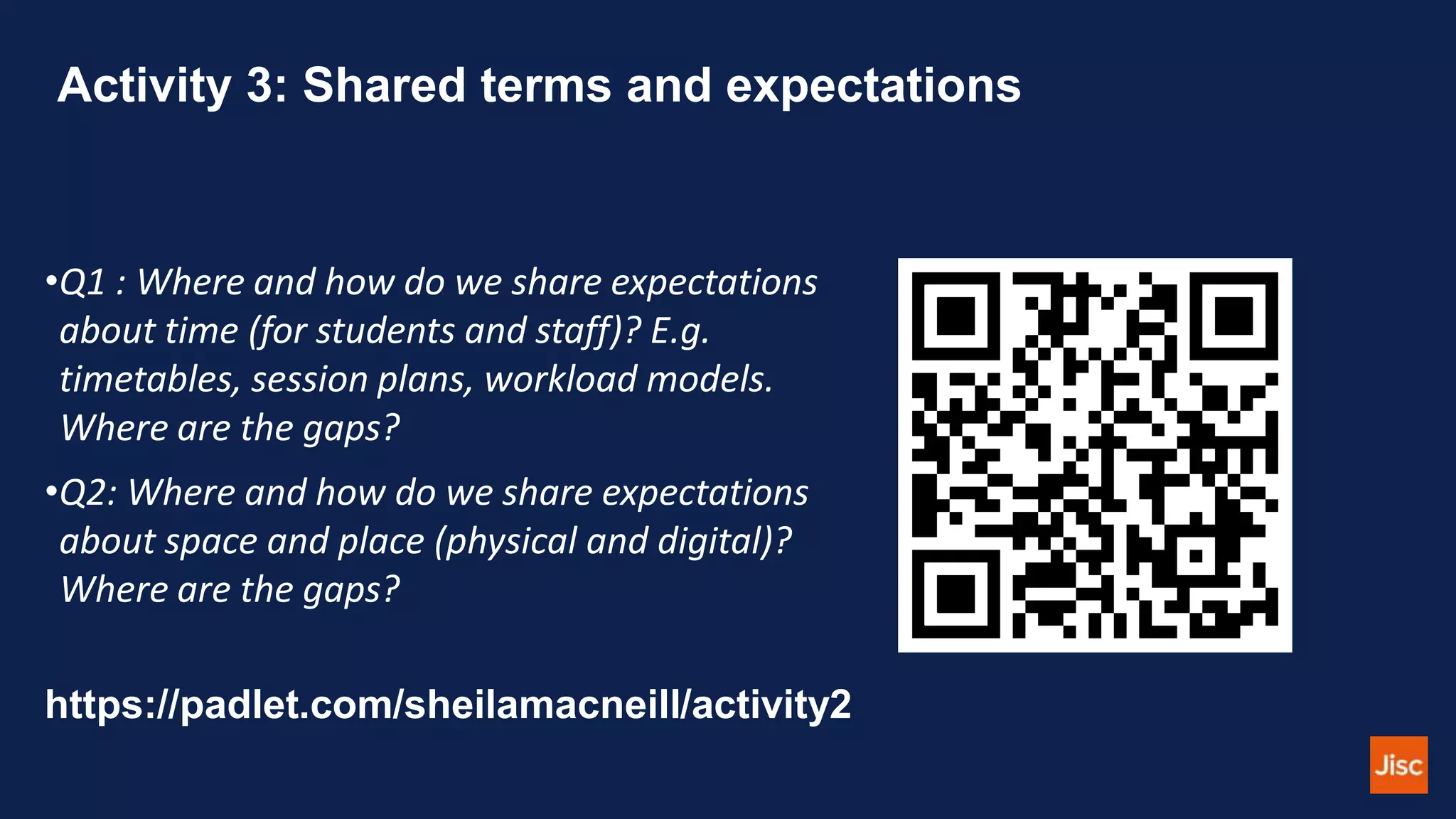
Activity 3: Shared terms and expectations
•Q1 : Where and how do we share expectations
about time (for students and staff)? E.g.
timetables, session plans, workload models.
Where are the gaps?
•Q2: Where and how do we share expectations
about space and place (physical and digital)?
Where are the gaps?
https://padlet.com/sheilamacneill/activity2
Get in touch …
Sarah Knight
sarah.knight@jisc.ac.uk
Helen Beetham
helen.beetham@gmail.com
Sheila MacNeill
sheilamacneill@me.com
Except where otherwise noted,
this work is licensed under CC-BY
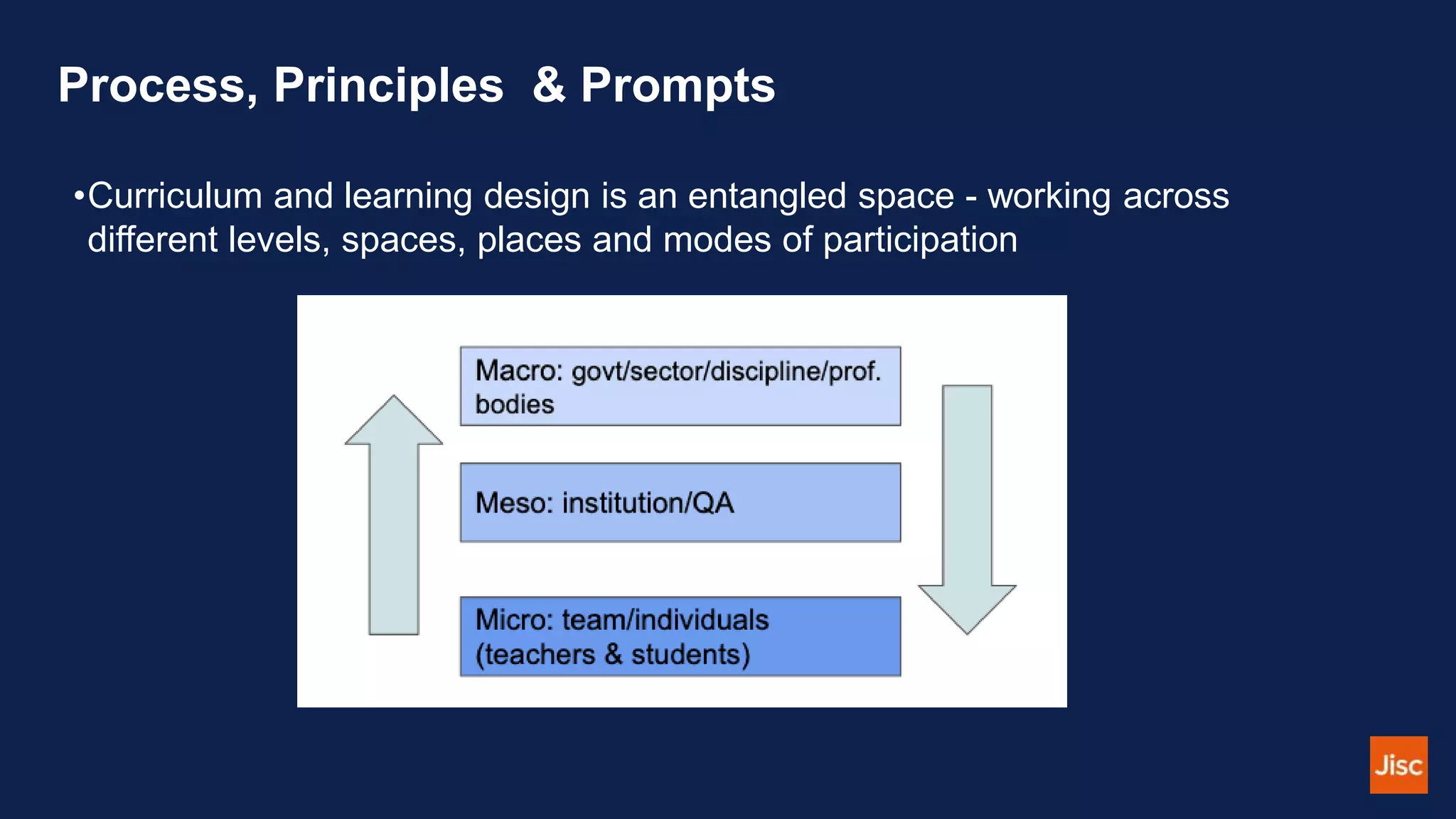
Process, Principles & Prompts
•Curriculum and learning design is an entangled space - working across
different levels, spaces, places and modes of participation

Approaches to curriculum and learning design

  • 1.
    Approaches to Curriculum& Learning Design Helen Beetham, Sheila MacNeill 21 November 2022 #jiscexperts22
  • 2.
    Session overview • Overviewof project - Background, rationale, how you can engage(10 mins) • Activity 1 – Developing a shared process model (20 mins) • Activity 2 – Space, place and modes of participation (10 mins) • Activity 3 – Thinking ahead (10 mins) • Feedback and next steps (10 mins)
  • 3.
    Review of learningand curriculum design 2022 • Literature review: past projects; models and frameworks in use; studies of curriculum practice from the last 2 years • Survey of current curriculum practice in higher education • Interviews and vignettes Outputs • Survey report • Summary of models in use • Recommendations to HE curriculum providers and to Jisc & partners
  • 4.
    Definitions • Curriculum Design:reviewing, planning and developing a course of study Formal departmental and institutional process; mapping to graduate outcomes, benchmarks and professional standards; producing documentation • Learning Design: defining how learning will be supported within each course, module or unit Defining activities, tools and technologies, core content, class sessions and groupings, mode(s) of participation, assignments and assessments, opportunities for interaction and feedback; producing learning materials • Terms are often used interchangeably and processes often overlap or iterate We use 'Curriculum and Learning Design' to mean all the processes of planning and designing a course of study and how students will learn
  • 5.
    Survey responses Add urlfor report & maybe pic of it
  • 6.
    Models, methods andframeworks in use Insights from review of around 30 models •Generic processes include design sprints, ‘intensives’, ABC workshops, Carpe Diem • Principles include constructive alignment, accessibility and inclusivity, sustainability, authentic assessment and many more - some general, some institutionally defined • Prompts support decision making e.g. ABC cards, activity types, session types, other taxonomies, use of specific tools/platforms, checklists, pro-formas…
  • 7.
    Recommendations & focusof phase 2 Explore challenges and opportunities (based on current practice), and develop: • core learning/curriculum design process • guidance on the pedagogies of diverse spaces, places and modes of participation • whole curriculum design through a pedagogical lens • Implications for organisational planning e.g. staff workload, estates, platforms, digital divide… • exemplar case studies • terminology/definitions to reflect real world challenges and practices
  • 8.
    Activity 1: Developinga process model Insert footer 8
  • 9.
    Macro •Process(es) - contextual organisational/QA /discipline/professional standards Meso •Principles– guiding pedagogical/contextual approaches e.g. frameworks/principles models Micro •Prompts – making learning experiences e.g. Learning design workshop cards, Curriculum Design: Process, principles & prompts Curriculum Design Learning Design Curriculum and learning design is an entangled space - working across different levels, spaces, places and modes of participation
  • 10.
    A general processmodel Workshop process or design sprint (90 mins-half day) involving curriculum team and other professionals, ideally students Relevant information e.g. learning outcomes, learner data, business case, prof body requirements, teacher reflections, student feedback Aspects to be determined e.g. aims, outcomes, sessions, activities and assessments, media and materials Principles to be applied Prompts (decision support) e.g. typologies, checklists, algorithms, heuristics, flash cards, personas, design rubrics Prototype, design, outline, plan etc showing decisions made Course handbook with learning outcomes, skills required and developed etc Timetable or session plan, workload/assignment map, learner journey Spaces & places, learning environments, real world locations, rules and roles Materials e.g. readings, notes, recordings, interactive content
  • 11.
    Over to you bit.ly/LCDExperts •Edit the generic model • Upload your own process model or framework
  • 12.
    Activity 2: Pedagogiesof time, place, modes of interaction Insert footer 12
  • 13.
    Process model (curriculumdesign) Workshop process or design sprint (90 mins-half day) involving curriculum team and other professionals, ideally students Relevant information e.g. learning outcomes, learner data, business case, prof body requirements, teacher reflections, student feedback Aspects to be determined e.g. aims, outcomes, sessions, activities and assessments, media and materials Principles to be applied Prompts (decision support) e.g. typologies, checklists, algorithms, heuristics, flash cards, personas, design rubrics Prototype, design, outline, plan etc showing decisions made Course handbook with learning outcomes, skills required and developed etc Timetable or session plan, workload/assignment map, learner journey Spaces & places, learning environments, real world locations, rules and roles Materials e.g. readings, notes, recordings, interactive content
  • 14.
    Curriculum model (oneversion) Synchronous and asynchronous session types making different demands on staff/student time and providing for different kinds of interaction Online and real world spaces, personal or hosted by the university, affording different interactions (teachers-learners-materials) and activities Materials in different media, accessed in different sessions and spaces to support learning activities and interactions Curriculum formally connected by course handbook, principles/rationale, outcomes etc Curriculum informally connected by learners using their own conceptual frameworks and motives, devices, apps and skills
  • 15.
    Managing learning intime and space • There have always been shared times and spaces (e.g. lectures), and own times/spaces (e.g. private study) • Now both kinds of space can be on site or online • With their own devices, students can link spaces, even at the same time • Digital spaces can link shared time and own time interactions (e.g. design boards, collaboration environments) • Students also (expect to) have more choice about time and space • Digital access can support curriculum integration… • …but curriculum time and resource, the work done by teachers and students, are still finite
  • 16.
    Everything is blended Terms such as hybrid, hyflex, blended are only useful if we understand how different spaces support different activities and interactions  What combinations of (own and shared) time and space support learning for different students?  What choices should students have? How do their practices develop? What are the trade-offs?  ‘Blended’ not an achieved fact but a work of integration – how do learners gain the tools and skills to deal with different modalities?  What shared terms are useful for curriculum design? For teaching and communicating with learners? For developing study skills?
  • 17.
    Over to you– a choice 1. Go to www.menti.com and use the code 3868 2230 • To discuss the advantages of synch vs asynch for learning and for learners 2. Go to bit.ly/LCDSessions and edit the google slides • To share synch and asynch session types, online and on site
  • 18.
    A pedagogy firstapproach can inform: o timetabling, student calendars and learning journeys, assessment management o staff workload allocation o estates planning o virtual estate (digital platform) development o developing organisational and individual digital capabilities
  • 19.
    Activity 3: Sharedterms and expectations •Q1 : Where and how do we share expectations about time (for students and staff)? E.g. timetables, session plans, workload models. Where are the gaps? •Q2: Where and how do we share expectations about space and place (physical and digital)? Where are the gaps? https://padlet.com/sheilamacneill/activity2
  • 20.
    Get in touch… Sarah Knight sarah.knight@jisc.ac.uk Helen Beetham helen.beetham@gmail.com Sheila MacNeill sheilamacneill@me.com Except where otherwise noted, this work is licensed under CC-BY
  • 21.
    Process, Principles &Prompts •Curriculum and learning design is an entangled space - working across different levels, spaces, places and modes of participation