Social Media
for Learning
Curriculum Design Studio
Andrew Middleton
Head of Innovation & Professional Development, QESS
Sheffield Hallam University
(CC) pimousse3000
Sue Beckingham
Faculty of Arts, Computing & Sciences
Sheffield Hallam University
@andrewmid @suebecks
Session purpose
Look at the potential of social media for
learning by populating the Social Media for
Learning framework
Develop a SM4L curriculum design tool
together
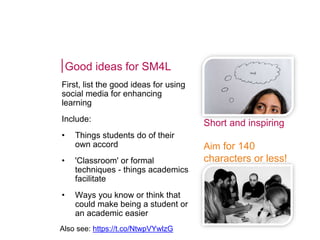
Good ideas for SM4L
First, list the good ideas for using
social media for enhancing
learning
Include:
• Things students do of their
own accord
• 'Classroom' or formal
techniques - things academics
facilitate
• Ways you know or think that
could make being a student or
an academic easier
Short and inspiring
Aim for 140
characters or less!
Also see: https://t.co/NtwpVYwlzG
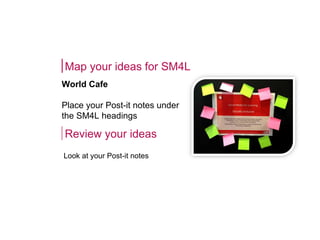
Map your ideas for SM4L
World Cafe
Place your Post-it notes under
the SM4L headings
Review your ideas
Look at your Post-it notes
Socially Inclusive
Social Media for Learning
Supporting and validating learning through mutually
beneficial, jointly enterprising and communally
constructive communities of practice
Fostering a sense of belonging, being and becoming
Promoting collegiality
Social Media for Learning Framework produced by Andrew Middleton & Sue Beckingham, Sheffield Hallam University
Social Media for Learning
Life-wide and Lifelong
Connecting formal, non-formal and informal
learning progression
Developing online presence
Developing digital literacies
Social Media for Learning Framework produced by Andrew Middleton & Sue Beckingham, Sheffield Hallam University
Social Media for Learning
Media Neutral
Learning across and through rich, multiple
media
Social Media for Learning Framework produced by Andrew Middleton & Sue Beckingham, Sheffield Hallam University
Social Media for Learning
Learner-centred
Promoting self-regulation, self-expression, self-
efficacy and confidence
Accommodating niche interests and activities,
the ‘long tail’ of education
Social Media for Learning Framework produced by Andrew Middleton & Sue Beckingham, Sheffield Hallam University
Social Media for Learning
Co-operative
Promotes working together productively and
critically with peers (co-creation) in self-
organising, robust networks that are scalable,
loosely structured, self-validating,
and knowledge-forming
Social Media for Learning Framework produced by Andrew Middleton & Sue Beckingham, Sheffield Hallam University
Social Media for Learning
Open and Accessible
Supporting spatial, temporal and social openness
Promoting open engagement in terms of access
being geographically extended, inclusive, controlled
by the learner, gratis, open market or unconstrained
freedom
Social Media for Learning Framework produced by Andrew Middleton & Sue Beckingham, Sheffield Hallam University
Social Media for Learning
Authentically Situated
Making connections across learning, social and
professional networks
Being scholarly and establishing professional
online presence and digital identity
Social Media for Learning Framework produced by Andrew Middleton & Sue Beckingham, Sheffield Hallam University

Social Media for Learning (SM4L) framework v1 - world cafe

  • 1.
    Social Media for Learning CurriculumDesign Studio Andrew Middleton Head of Innovation & Professional Development, QESS Sheffield Hallam University (CC) pimousse3000 Sue Beckingham Faculty of Arts, Computing & Sciences Sheffield Hallam University @andrewmid @suebecks
  • 2.
    Session purpose Look atthe potential of social media for learning by populating the Social Media for Learning framework Develop a SM4L curriculum design tool together
  • 3.
    Good ideas forSM4L First, list the good ideas for using social media for enhancing learning Include: • Things students do of their own accord • 'Classroom' or formal techniques - things academics facilitate • Ways you know or think that could make being a student or an academic easier Short and inspiring Aim for 140 characters or less! Also see: https://t.co/NtwpVYwlzG
  • 4.
    Map your ideasfor SM4L World Cafe Place your Post-it notes under the SM4L headings Review your ideas Look at your Post-it notes
  • 5.
    Socially Inclusive Social Mediafor Learning Supporting and validating learning through mutually beneficial, jointly enterprising and communally constructive communities of practice Fostering a sense of belonging, being and becoming Promoting collegiality Social Media for Learning Framework produced by Andrew Middleton & Sue Beckingham, Sheffield Hallam University
  • 6.
    Social Media forLearning Life-wide and Lifelong Connecting formal, non-formal and informal learning progression Developing online presence Developing digital literacies Social Media for Learning Framework produced by Andrew Middleton & Sue Beckingham, Sheffield Hallam University
  • 7.
    Social Media forLearning Media Neutral Learning across and through rich, multiple media Social Media for Learning Framework produced by Andrew Middleton & Sue Beckingham, Sheffield Hallam University
  • 8.
    Social Media forLearning Learner-centred Promoting self-regulation, self-expression, self- efficacy and confidence Accommodating niche interests and activities, the ‘long tail’ of education Social Media for Learning Framework produced by Andrew Middleton & Sue Beckingham, Sheffield Hallam University
  • 9.
    Social Media forLearning Co-operative Promotes working together productively and critically with peers (co-creation) in self- organising, robust networks that are scalable, loosely structured, self-validating, and knowledge-forming Social Media for Learning Framework produced by Andrew Middleton & Sue Beckingham, Sheffield Hallam University
  • 10.
    Social Media forLearning Open and Accessible Supporting spatial, temporal and social openness Promoting open engagement in terms of access being geographically extended, inclusive, controlled by the learner, gratis, open market or unconstrained freedom Social Media for Learning Framework produced by Andrew Middleton & Sue Beckingham, Sheffield Hallam University
  • 11.
    Social Media forLearning Authentically Situated Making connections across learning, social and professional networks Being scholarly and establishing professional online presence and digital identity Social Media for Learning Framework produced by Andrew Middleton & Sue Beckingham, Sheffield Hallam University

Editor's Notes

  • #2 QESS are devising a methodology to support staff with responsibilities to lead on and contribute to Course Planning It comes in response to the Academic Quality Framework and findings from ‘enhance’
  • #3 Aims of the Session To consider methods to inspire and inform academics and collaborative design groups in producing innovative curricula Session Learning Outcomes By the end of this session, delegates will be able to: · Engage academics, learning support staff, students, employers and other curriculum design collaborators in activities that lead to innovative, principle-based pedagogy · Position creativity, innovation and sound pedagogy in relation to each other in the context of curriculum design Session Outline · Approaches to conducting collaborative curriculum design activities that support, challenge and involve diverse groupings of stakeholders and which lead to high quality, authentic curricula. To do this the session will introduce, explore and build upon the Viewpoints method (O’Donnell et al., 2011) and principle-based transformation (Nicol & Draper, 2009). · How creative thinking strategies can be used to generate “concrete and detailed” scenarios (Carroll 2000, p.46) to inspire innovative and engaging pedagogy and how these can empower academics leading curriculum design activities. The session will explain and demonstrate how the use of scenarios and principle-based approaches can lead to radically innovative pedagogies by engendering multi-stakeholder confidence and risk-free thinking. · How curriculum enhancement and innovation can be appreciated in terms of disruptive innovation in contrast to change that is evolutionary or supplemental or in contrast to simple conceptions of best practice. Session Activities and Approximate Timings · Introduction and setting the context of running the Curriculum Design Studio at Sheffield Hallam University (10 minutes) · Participants consider the key features of principle-based ‘design lens’ tools produced to support foci including Embedding Employability, Digital Literacy, and Learner Engagement (25 minutes) · Reflecting on principle-based design and how it provides a constructive framework for diverse design collaborators (10 minutes) · Constructing scenarios to concretise design activities – considering key features of a well-formed, useful scenario (Carroll, 2000) and the benefits of this to curriculum design (10 minutes) · Small group activity: Facilitating the design of pedagogy to promote learner engagement and authentic learning by using two sets of principle-based design lenses together towards constructing a scenario statement to support communication and critical evaluation of ideas (20 minutes) · Considering how educational developer colleagues can work together around institutional design priorities to construct useful design lens and related resource-bases (10 minutes) · Concluding discussion to evaluate the approaches (5 minutes). References Bryson, C., & Hand, L. (2007). The role of engagement in inspiring teaching and learning. Innovations in Education and Teaching International, 44(4), 349–362. Carroll, J.M. (2000). Five reasons for scenario-based design. Interacting with Computers 13, 43 – 60. Herrington, J. (2006) Authentic e-learning in higher education: design principles for authentic learning environments and tasks. Online at: http://researchrepository.murdoch.edu.au/5247 Nicol, D., and Draper, S. (2009). A blueprint for transformational organisational change in higher education.: REAP as a case study. In: Mayes, T., Morrison, D., Mellar, H., Bullen, P. and Oliver, M., (eds) Transforming higher education through technology-enhanced learning. York: Higher Education Academy. O’Donnell, C., Masson, A., and Harrison, J. (2011).Encouraging creativity and reflection in the curriculum. SEDA Spring Teaching Learning and Assessment Conference 2011, "Academics for the 21st Century", 5th May 2011 - 06 May 2011, Holyrood Hotel, Edinburgh.