Unit 1 Language vs. speech Phonetics vs. phonology Speech sounds and segments Speech sounds or phones vs. phonemes Phonemes vs. allophones Segmental features vs. suprasegmental features Areas of phonetics Applications of phonetics and its relation to other fields I.P.A. Letters vs. sounds – Spelling vs. transcription Broad vs. narrow transcription / phonemic vs. phonetic transcription
Language vs. speech LANGUAGE A language is a system of conventional signals used for communication by a whole community. SPEECH Speech is a manifestation of language and spoken language is normally a continuum of sound. SPEECH ACT Speech act is a manifestation of language by which one or more speakers exchange information
Phonetics vs. phonology PHONETICS The phonetics of a language concerns the concrete characteristics (articulatory, acoustics, auditory) of the sounds used in languages. Units of speech: speech sounds, phones (that form a continuum or speech chain which is analysed by dividing it in segments (‘mesa’: 4 phones segments, that is, the 4 sounds [m], [e], [s], [a]) PHONOLOGY Concerns how sounds function in a systematic way in a particular language. It studies and describes the abstract linguistic units: phonemes, and analyses its distinctive features (rasgos distintivos o pertinentes), above all its capacity of producing changes in meaning.
Speech sounds and segments In phonetics, speech sounds or phones are the minimum units of speech, which form the speech chain. SEGMENTS SPEECH SOUNDS = PHONES Segments are sound units, e.g. the word “man” is pronounced with a first segment “m”, a second segment “æ” and a third segment “n”.
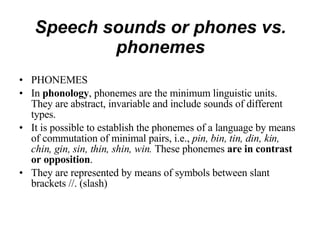
Speech sounds or phones vs. phonemes PHONEMES In  phonology , phonemes are the minimum linguistic units. They are abstract, invariable and include sounds of different types. It is possible to establish the phonemes of a language by means of commutation of minimal pairs, i.e.,  pin, bin, tin, din, kin, chin, gin, sin, thin, shin, win.  These phonemes  are in contrast or opposition . They are represented by means of symbols between slant brackets //. (slash)
Phonemes vs. allophones ALLOPHONES The different  phonetic  realizations of a phoneme are known as its allophones or allophonic variations).  They are represented by means of symbols between square brackets []. Allophones  are in complementary distribution  and present phonetic similarity. Phonemes are : Abstract, invariableContrastive function (change meaning in the same context by commutation of minimal pairs, are in contrast or opposition)Represented between slant brackets // (slash) Allophones (sounds)are:  Concrete (real realization of a phoneme, allophonic variations)Complementary distribution, each one in a phonetic context (Don’t change meaning)Phonetic similarityRepresented between square brackets []
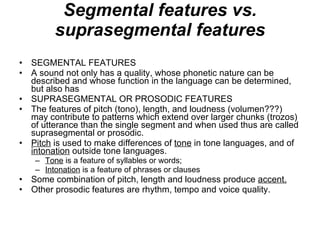
Segmental features vs. suprasegmental features SEGMENTAL FEATURES A sound not only has a quality, whose phonetic nature can be described and whose function in the language can be determined, but also has SUPRASEGMENTAL OR PROSODIC FEATURES The features of pitch (tono), length, and loudness (volumen???) may contribute to patterns which extend over larger chunks (trozos) of utterance than the single segment and when used thus are called suprasegmental or prosodic. Pitch  is used to make differences of  tone  in tone languages, and of  intonation  outside tone languages. Tone  is a feature of syllables or words; Intonation  is a feature of phrases or clauses Some combination of pitch, length and loudness produce  accent. Other prosodic features are rhythm, tempo and voice quality.
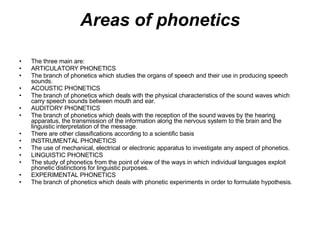
Areas of phonetics The three main are: ARTICULATORY PHONETICS The branch of phonetics which studies the organs of speech and their use in producing speech sounds. ACOUSTIC PHONETICS The branch of phonetics which deals with the physical characteristics of the sound waves which carry speech sounds between mouth and ear. AUDITORY PHONETICS The branch of phonetics which deals with the reception of the sound waves by the hearing apparatus, the transmission of the information along the nervous system to the brain and the linguistic interpretation of the message. There are other classifications according to a scientific basis INSTRUMENTAL PHONETICS The use of mechanical, electrical or electronic apparatus to investigate any aspect of phonetics. LINGUISTIC PHONETICS The study of phonetics from the point of view of the ways in which individual languages exploit phonetic distinctions for linguistic purposes. EXPERIMENTAL PHONETICS The branch of phonetics which deals with phonetic experiments in order to formulate hypothesis.
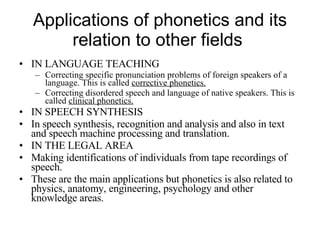
Applications of phonetics and its relation to other fields   IN LANGUAGE TEACHING Correcting specific pronunciation problems of foreign speakers of a language. This is called  corrective phonetics. Correcting disordered speech and language of native speakers. This is called  clinical phonetics. IN SPEECH SYNTHESIS In speech synthesis, recognition and analysis and also in text and speech machine processing and translation. IN THE LEGAL AREA Making identifications of individuals from tape recordings of speech. These are the main applications but phonetics is also related to physics, anatomy, engineering, psychology and other knowledge areas.
I.P.A. INTERNATIONAL PHONETIC ALPHABET The most prominent phonetic alphabet in contemporary use, first promulgated by the International Phonetic Association in 1888. The IPA aims to provide virtually distinctive symbols for all speech sounds which are phonologically distinct in any language. It is formed by symbols and diacritics. The diacritics modify the symbols in order to reflect the real nature of the sounds.  INTERNATIONAL PHONETIC ASSOCIATION An international organization for the study of phonetics, founded in France in 1886 by a group of European phoneticians, linguists and language teachers, whose best-known work was the creation of the International Phonetic Alphabet. There are others phonetic alphabets: RFE Revista de Filología Española, created in 1915 to be used in the linguistic Spanish community. It is not very different from IPA, except for a bigger number of  diacritics in RFE. SAMPA more modern than IPA.
Letters vs. sounds – Spelling vs. transcription LETTERS AND SOUNDS Because of the notoriously confusing nature of English spelling, it is particularly important to learn to think of English pronunciation in terms of phonemes rather than letters of the alphabet. For example, the word “enough” begins with the same vowel phoneme as that at the beginning of “inept”, although the former begins with the letter “e” and the latter with the letter “i”. SPELLING AND TRANSCRIPTION Spelling is the sequence of letters composing a word; transcription is the representation of speech sounds by means of phonetic symbols.
Broad vs. narrow transcription / phonemic vs. phonetic transcription PHONETIC, ALLOPHONIC OR NARROW TRANSCRIPTIONS indicate detailed sound values. PHONOLOGICAL, PHONEMIC OR BROAD TRANSCRIPTIONS indicate the sequence of significant functional elements.

Unit 1

  • 1.
    Unit 1 Languagevs. speech Phonetics vs. phonology Speech sounds and segments Speech sounds or phones vs. phonemes Phonemes vs. allophones Segmental features vs. suprasegmental features Areas of phonetics Applications of phonetics and its relation to other fields I.P.A. Letters vs. sounds – Spelling vs. transcription Broad vs. narrow transcription / phonemic vs. phonetic transcription
  • 2.
    Language vs. speechLANGUAGE A language is a system of conventional signals used for communication by a whole community. SPEECH Speech is a manifestation of language and spoken language is normally a continuum of sound. SPEECH ACT Speech act is a manifestation of language by which one or more speakers exchange information
  • 3.
    Phonetics vs. phonologyPHONETICS The phonetics of a language concerns the concrete characteristics (articulatory, acoustics, auditory) of the sounds used in languages. Units of speech: speech sounds, phones (that form a continuum or speech chain which is analysed by dividing it in segments (‘mesa’: 4 phones segments, that is, the 4 sounds [m], [e], [s], [a]) PHONOLOGY Concerns how sounds function in a systematic way in a particular language. It studies and describes the abstract linguistic units: phonemes, and analyses its distinctive features (rasgos distintivos o pertinentes), above all its capacity of producing changes in meaning.
  • 4.
    Speech sounds andsegments In phonetics, speech sounds or phones are the minimum units of speech, which form the speech chain. SEGMENTS SPEECH SOUNDS = PHONES Segments are sound units, e.g. the word “man” is pronounced with a first segment “m”, a second segment “æ” and a third segment “n”.
  • 5.
    Speech sounds orphones vs. phonemes PHONEMES In phonology , phonemes are the minimum linguistic units. They are abstract, invariable and include sounds of different types. It is possible to establish the phonemes of a language by means of commutation of minimal pairs, i.e., pin, bin, tin, din, kin, chin, gin, sin, thin, shin, win. These phonemes are in contrast or opposition . They are represented by means of symbols between slant brackets //. (slash)
  • 6.
    Phonemes vs. allophonesALLOPHONES The different phonetic realizations of a phoneme are known as its allophones or allophonic variations). They are represented by means of symbols between square brackets []. Allophones are in complementary distribution and present phonetic similarity. Phonemes are : Abstract, invariableContrastive function (change meaning in the same context by commutation of minimal pairs, are in contrast or opposition)Represented between slant brackets // (slash) Allophones (sounds)are: Concrete (real realization of a phoneme, allophonic variations)Complementary distribution, each one in a phonetic context (Don’t change meaning)Phonetic similarityRepresented between square brackets []
  • 7.
    Segmental features vs.suprasegmental features SEGMENTAL FEATURES A sound not only has a quality, whose phonetic nature can be described and whose function in the language can be determined, but also has SUPRASEGMENTAL OR PROSODIC FEATURES The features of pitch (tono), length, and loudness (volumen???) may contribute to patterns which extend over larger chunks (trozos) of utterance than the single segment and when used thus are called suprasegmental or prosodic. Pitch is used to make differences of tone in tone languages, and of intonation outside tone languages. Tone is a feature of syllables or words; Intonation is a feature of phrases or clauses Some combination of pitch, length and loudness produce accent. Other prosodic features are rhythm, tempo and voice quality.
  • 8.
    Areas of phoneticsThe three main are: ARTICULATORY PHONETICS The branch of phonetics which studies the organs of speech and their use in producing speech sounds. ACOUSTIC PHONETICS The branch of phonetics which deals with the physical characteristics of the sound waves which carry speech sounds between mouth and ear. AUDITORY PHONETICS The branch of phonetics which deals with the reception of the sound waves by the hearing apparatus, the transmission of the information along the nervous system to the brain and the linguistic interpretation of the message. There are other classifications according to a scientific basis INSTRUMENTAL PHONETICS The use of mechanical, electrical or electronic apparatus to investigate any aspect of phonetics. LINGUISTIC PHONETICS The study of phonetics from the point of view of the ways in which individual languages exploit phonetic distinctions for linguistic purposes. EXPERIMENTAL PHONETICS The branch of phonetics which deals with phonetic experiments in order to formulate hypothesis.
  • 9.
    Applications of phoneticsand its relation to other fields IN LANGUAGE TEACHING Correcting specific pronunciation problems of foreign speakers of a language. This is called corrective phonetics. Correcting disordered speech and language of native speakers. This is called clinical phonetics. IN SPEECH SYNTHESIS In speech synthesis, recognition and analysis and also in text and speech machine processing and translation. IN THE LEGAL AREA Making identifications of individuals from tape recordings of speech. These are the main applications but phonetics is also related to physics, anatomy, engineering, psychology and other knowledge areas.
  • 10.
    I.P.A. INTERNATIONAL PHONETICALPHABET The most prominent phonetic alphabet in contemporary use, first promulgated by the International Phonetic Association in 1888. The IPA aims to provide virtually distinctive symbols for all speech sounds which are phonologically distinct in any language. It is formed by symbols and diacritics. The diacritics modify the symbols in order to reflect the real nature of the sounds. INTERNATIONAL PHONETIC ASSOCIATION An international organization for the study of phonetics, founded in France in 1886 by a group of European phoneticians, linguists and language teachers, whose best-known work was the creation of the International Phonetic Alphabet. There are others phonetic alphabets: RFE Revista de Filología Española, created in 1915 to be used in the linguistic Spanish community. It is not very different from IPA, except for a bigger number of diacritics in RFE. SAMPA more modern than IPA.
  • 11.
    Letters vs. sounds– Spelling vs. transcription LETTERS AND SOUNDS Because of the notoriously confusing nature of English spelling, it is particularly important to learn to think of English pronunciation in terms of phonemes rather than letters of the alphabet. For example, the word “enough” begins with the same vowel phoneme as that at the beginning of “inept”, although the former begins with the letter “e” and the latter with the letter “i”. SPELLING AND TRANSCRIPTION Spelling is the sequence of letters composing a word; transcription is the representation of speech sounds by means of phonetic symbols.
  • 12.
    Broad vs. narrowtranscription / phonemic vs. phonetic transcription PHONETIC, ALLOPHONIC OR NARROW TRANSCRIPTIONS indicate detailed sound values. PHONOLOGICAL, PHONEMIC OR BROAD TRANSCRIPTIONS indicate the sequence of significant functional elements.