CS 551/652:
  Structure of Spoken Language

Lecture 2: Spectrogram Reading and
       Introductory Phonetics

        John-Paul Hosom
           Fall 2008
Spectrogram Reading
Why bother??
What’s the point of spectrogram reading? Do people read
spectrograms as part of their job? Do computers “read” spectrograms
in order to recognize speech?
There are some jobs that require spectrogram reading (e.g. phonetic
time alignment), but not many. Automatic speech recognition
systems do not process speech in this way.
Primary reason for spectrogram reading:
   If you’re going to work on a problem, it’s advisable to
   understand the nature of that problem. Spectrogram reading
   provides a direct method for “hands-on” learning of the
   characteristics of speech. Studying phonetics, signal processing,
   or techniques in speech recognition/speech synthesis does not
   fully convey of the complexity and structure of spoken language.
                                                                       2
A great website on spectrogram reading:

       http://home.cc.umanitoba.ca/~robh/

includes “how to” tips on spectrogram reading, a monthly
“mystery spectrogram”, and archives of past months’ spectrograms.


                                                                3
Phonetics: Introduction
Phonology:
      A description of the systems and patterns of sounds
      that occur in a language (abstract), often involving
      comparisons between languages and/or evolution of
      a language over time.

Phonetics:
       A branch of phonology that deals with individual speech
       sounds, their production, and their written representation.

Phoneme:
      • A unit of speech that can be used to differentiate words
        (e.g. “cat” /k ae t/ vs. “bat” /b ae t/).
      • Phonemes identify minimal pairs in a language.
      • The set of phonemes in a language subject to interpretation;
         most languages have 20 to 40 phonemes.
                                                                     4
Phonetics: Introduction
Allophone:
       A speech sound constituting one of the systematic phonetic
       variants of a given phoneme. Different allophones are
       predictable from environment (e.g. “toe”, “caught”,
       “fitness”, “writer”; “sill”, “still”, “spill”)

Phone:
         An acoustic realization of a phoneme. (Many different
         phones may represent the same phoneme.)


“The phoneme /s/ consists of more than 100 allophones”
         − Pickett, The Acoustics of Speech Communication, p. 7.

Phonemes indicated by / /; phones (allophones) indicated by [ ].
                                                                    5
Phonetics: Introduction
Syllable:
       • Unit of speech containing one or more phonemes.
       • A vowel in a syllable is called the syllable nucleus.
       • Most syllables contain one vowel (or diphthong);
          some contain only a lateral (“bott/le”) or nasal
          (“butt/on”) as the most intense sound.
       • Syllable boundaries sometimes ambiguous
          (“tas/ty” vs. “tast/y” vs. “ta/sty”)

Coarticulation:
       The “blending” of two or more adjacent phones, causing
       a non-distinct boundary between them. Coarticulation
       is caused by smooth changes in the articulators (lips,
       tongue, jaw) over time.

                                                                 6
Phonetics: Introduction
Coarticulation Example:


       y           uw             aa         r


                    “you are”: /y uw aa r/
                                                 7
Phonetics: Introduction (adapted from Schane, p. 4-6)
• Speech signal is continuous; we perceive discrete entities.
  (How many sound units are in the word “cat”?)
• One assumption of phonology: utterances can be represented as
  sequence of discrete units.
• Are such units purely an “invention” of linguistics?
  Spoonerisms (“belly jeans” vs. “jelly beans”) and rhymes
  indicate small units of language (Reverend William Archibald Spooner (1844-1930))
• Utterances of the same word(s) have many differences… we’re
  usually only interested in those differences that are “linguistically
  significant” or that are “perceived as different”.
• Implies a somewhat subjective nature to phonology, whereas
  we want an objective measure of perceived or produced units.

                                                                                      8
Phonetics: Distinctive Phonetic Features
• Phonemes do not differ randomly from one another; there
  are relationships among phonemes (e.g. /p/ vs. /t/ vs. /ah/)
• A (distinctive) feature is a “phonetic property that can be
  used to classify sounds” [Ladefoged, p. 42]
• Typically, features are associated with aspects of articulation
• Features may be binary or multi-valued
• Capital letters indicate feature name: Manner
  square brackets [] indicate feature value: [+fricative]


                                                                    9
Phonetics: Distinctive Phonetic Features

• Exact set of features and feature values depends on goals
  (no “right” or “wrong” set of features or values)
• Distinctive features provide a vocabulary for describing speech
• Are distinctive features purely an “invention” of linguistics?
   memory tasks show that when people forget a phoneme, they
   usually remember a phoneme with similar distinctive features


                                                                    10
Phonetics: Distinctive Phonetic Features


                                    nasal tract
             velic port                              (hard) palate
                                oral tract          alveolar ridge
velum (soft palate)                                  lips
         tongue
                                                      teeth
         pharynx
            glottis                                tongue tip
          (vocal folds and
space between vocal cords)

vocal folds (larynx)
= vocal cords
               The Speech Production Apparatus (from Olive, p. 23)
                                                                     11
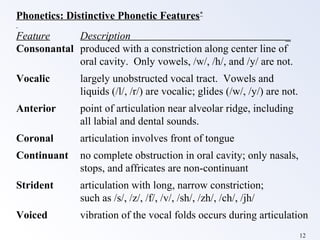
Phonetics: Distinctive Phonetic Features*
Feature     Description                                       _
Consonantal produced with a constriction along center line of
            oral cavity. Only vowels, /w/, /h/, and /y/ are not.
Vocalic       largely unobstructed vocal tract. Vowels and
              liquids (/l/, /r/) are vocalic; glides (/w/, /y/) are not.
Anterior      point of articulation near alveolar ridge, including
              all labial and dental sounds.
Coronal       articulation involves front of tongue
Continuant    no complete obstruction in oral cavity; only nasals,
              stops, and affricates are non-continuant
Strident      articulation with long, narrow constriction;
              such as /s/, /z/, /f/, /v/, /sh/, /zh/, /ch/, /jh/
Voiced        vibration of the vocal folds occurs during articulation
                                                                           12
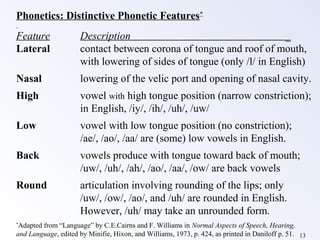
Phonetics: Distinctive Phonetic Features*
Feature               Description                                      _
Lateral               contact between corona of tongue and roof of mouth,
                      with lowering of sides of tongue (only /l/ in English)
Nasal                 lowering of the velic port and opening of nasal cavity.
High                  vowel with high tongue position (narrow constriction);
                      in English, /iy/, /ih/, /uh/, /uw/
Low                   vowel with low tongue position (no constriction);
                      /ae/, /ao/, /aa/ are (some) low vowels in English.
Back                  vowels produce with tongue toward back of mouth;
                      /uw/, /uh/, /ah/, /ao/, /aa/, /ow/ are back vowels
Round                 articulation involving rounding of the lips; only
                      /uw/, /ow/, /ao/, and /uh/ are rounded in English.
                      However, /uh/ may take an unrounded form.
*
 Adapted from “Language” by C.E.Cairns and F. Williams in Normal Aspects of Speech, Hearing,
and Language, edited by Minifie, Hixon, and Williams, 1973, p. 424, as printed in Daniloff p. 51. 13
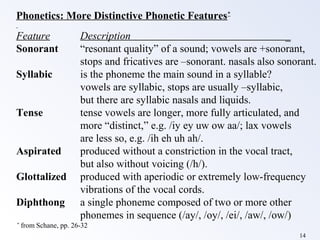
Phonetics: More Distinctive Phonetic Features*
Feature                Description                                       _
Sonorant               “resonant quality” of a sound; vowels are +sonorant,
                       stops and fricatives are –sonorant. nasals also sonorant.
Syllabic               is the phoneme the main sound in a syllable?
                       vowels are syllabic, stops are usually –syllabic,
                       but there are syllabic nasals and liquids.
Tense                  tense vowels are longer, more fully articulated, and
                       more “distinct,” e.g. /iy ey uw ow aa/; lax vowels
                       are less so, e.g. /ih eh uh ah/.
Aspirated              produced without a constriction in the vocal tract,
                       but also without voicing (/h/).
Glottalized            produced with aperiodic or extremely low-frequency
                       vibrations of the vocal cords.
Diphthong              a single phoneme composed of two or more other
                       phonemes in sequence (/ay/, /oy/, /ei/, /aw/, /ow/)
*
    from Schane, pp. 26-32
                                                                           14
Phonetics: Distinctive Phonetic Features
Physiological Features:
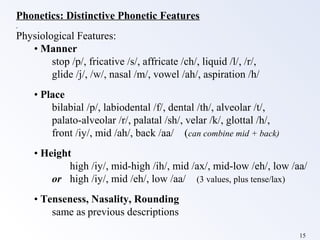
   • Manner
        stop /p/, fricative /s/, affricate /ch/, liquid /l/, /r/,
        glide /j/, /w/, nasal /m/, vowel /ah/, aspiration /h/
    • Place
        bilabial /p/, labiodental /f/, dental /th/, alveolar /t/,
        palato-alveolar /r/, palatal /sh/, velar /k/, glottal /h/,
        front /iy/, mid /ah/, back /aa/ (can combine mid + back)
    • Height
            high /iy/, mid-high /ih/, mid /ax/, mid-low /eh/, low /aa/
        or high /iy/, mid /eh/, low /aa/ (3 values, plus tense/lax)
    • Tenseness, Nasality, Rounding
        same as previous descriptions

                                                                     15
Phonetics: Distinctive Feature Relationships: Vowels

                               Front                                  Back
                 Unrounded            Rounded          Unrounded               Rounded

      High           i (iy)                ü                i (ix)             u (uw)
      Mid            e (eh)                ö               ^ (ah)              o (ow)
      Low            æ (ae)                œ               a (aa)              ⊃ (ao)

                  Front, –Round             Back, +Round               Back, –Round
                 Tense         Lax         Tense           Lax         Tense         Lax

      High          iy          ih           uw             uh                        ix
      Mid           ey          eh           ow                                    ah, ax†
      Low                       ae             ao                         aa
 *
     from Schane, pp. 12-13. †/ax/ is slightly more centralized than /ah/, and shorter in duration
                                                                                              16
Phonetics: Distinctive Phonetic Features: The Case of /ae/
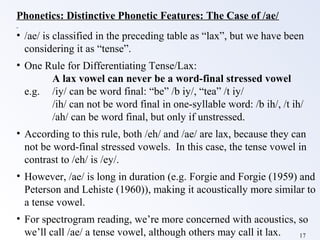
• /ae/ is classified in the preceding table as “lax”, but we have been
  considering it as “tense”.
• One Rule for Differentiating Tense/Lax:
       A lax vowel can never be a word-final stressed vowel
  e.g. /iy/ can be word final: “be” /b iy/, “tea” /t iy/
       /ih/ can not be word final in one-syllable word: /b ih/, /t ih/
       /ah/ can be word final, but only if unstressed.
• According to this rule, both /eh/ and /ae/ are lax, because they can
  not be word-final stressed vowels. In this case, the tense vowel in
  contrast to /eh/ is /ey/.
• However, /ae/ is long in duration (e.g. Forgie and Forgie (1959) and
  Peterson and Lehiste (1960)), making it acoustically more similar to
  a tense vowel.
• For spectrogram reading, we’re more concerned with acoustics, so
  we’ll call /ae/ a tense vowel, although others may call it lax. 17
Phonetics: Distinctive Phonetic Features: The Case of /ae/
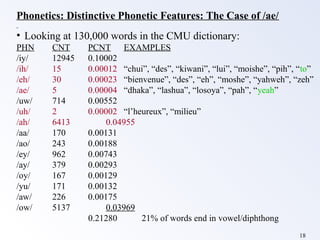
• Looking at 130,000 words in the CMU dictionary:
PHN    CNT     PCNT EXAMPLES
/iy/   12945   0.10002
/ih/   15      0.00012 “chui”, “des”, “kiwani”, “lui”, “moishe”, “pih”, “to”
/eh/   30      0.00023 “bienvenue”, “des”, “eh”, “moshe”, “yahweh”, “zeh”
/ae/   5       0.00004 “dhaka”, “lashua”, “losoya”, “pah”, “yeah”
/uw/   714     0.00552
/uh/   2       0.00002 “l’heureux”, “milieu”
/ah/   6413        0.04955
/aa/   170     0.00131
/ao/   243     0.00188
/ey/   962     0.00743
/ay/   379     0.00293
/oy/   167     0.00129
/yu/   171     0.00132
/aw/   226     0.00175
/ow/   5137        0.03969
               0.21280      21% of words end in vowel/diphthong
                                                                        18
Phonetics: Distinctive Feature Relationships: Vowels

              Front                  Central                 Back
             iy                  ju                                   uw
   High
                      ih                                    uh
                 ey                   ix                              ow
                                               oy
          Mid
                                               ax     aw
                           eh          ay                              ao
                                               ah
                  Low
                                ae                               aa

  from Ladefoged, pp. 38, 81, 218 with correction to /aw/
                                                                            19
Phonetics: Distinctive Feature Relationships: Consonants
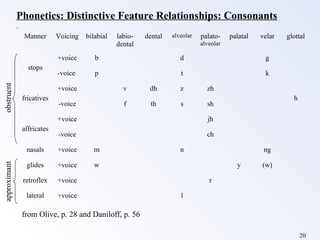
               Manner       Voicing   bilabial   labio-   dental   alveolar   palato-    palatal   velar   glottal
                                                 dental                       alveolar

                            +voice       b                            d                             g
                 stops
                            -voice       p                            t                             k
obstruent


                            +voice                 v       dh         z         zh
               fricatives                                                                                    h
                            -voice                 f        th        s         sh

                            +voice                                              jh
               affricates
                            -voice                                              ch

                nasals      +voice       m                            n                             ng

                glides      +voice       w                                                 y       (w)
approximant


               retroflex    +voice                                               r

                lateral     +voice                                    l

               from Olive, p. 28 and Daniloff, p. 56

                                                                                                                 20
Phonetics: Distinctive Feature Relationships: Consonants

                         Labial   Coronal                 Dorsal

              +nasal      m          n                     ng
  -sibilant
              -nasal     p b        t d                   k g         stop

                                              ch jh
  +sibilant
                                    s z       sh zh
                                                                    fricative
                         f v      th dh
  -sibilant   -lateral    w          r           y
                                                                   approximant
              +lateral                l
                                  +anterior   -anterior

      from Ladefoged, p. 44

                                                                                 21
Approximants: Terminology
• “Approximants” are NOT the same as “Semi-Vowels”
  (although Rabiner states they are the same…). American
  English /r/ is debatable, but we’ll exclude it from the
  Semi-Vowels for consistency. (Ladefoged p. 229)

• Approximants can be divided into two groups: Liquids and Glides
  Liquid = {/l/, /r/}, Glide = {/w/, /y/}
  (Again, Rabiner confuses things by mixing up these sets)

• Lateral = {/l/}

• Retroflex = {/r/, /er/, /axr/}.
  (In some cases, /er/ is considered a retroflex but /r/ isn’t;
  we’ll keep things simple by calling /r/ a retroflex).

• Central Approximants = {/r/, /w/, /y/},
  Lateral Approximant = {/l/}
                                                                  22
Approximants: Terminology


                           Approximant


   Semi-Vowel / Glide                           Liquid


   /y/               /w/           Retroflex          Lateral


                                 /r, er, axr/              /l/
  central approximants                             lateral approximant


                                                                   23

Phonetics

  • 1.
    CS 551/652: Structure of Spoken Language Lecture 2: Spectrogram Reading and Introductory Phonetics John-Paul Hosom Fall 2008
  • 2.
    Spectrogram Reading Why bother?? What’sthe point of spectrogram reading? Do people read spectrograms as part of their job? Do computers “read” spectrograms in order to recognize speech? There are some jobs that require spectrogram reading (e.g. phonetic time alignment), but not many. Automatic speech recognition systems do not process speech in this way. Primary reason for spectrogram reading: If you’re going to work on a problem, it’s advisable to understand the nature of that problem. Spectrogram reading provides a direct method for “hands-on” learning of the characteristics of speech. Studying phonetics, signal processing, or techniques in speech recognition/speech synthesis does not fully convey of the complexity and structure of spoken language. 2
  • 3.
    A great websiteon spectrogram reading: http://home.cc.umanitoba.ca/~robh/ includes “how to” tips on spectrogram reading, a monthly “mystery spectrogram”, and archives of past months’ spectrograms. 3
  • 4.
    Phonetics: Introduction Phonology: A description of the systems and patterns of sounds that occur in a language (abstract), often involving comparisons between languages and/or evolution of a language over time. Phonetics: A branch of phonology that deals with individual speech sounds, their production, and their written representation. Phoneme: • A unit of speech that can be used to differentiate words (e.g. “cat” /k ae t/ vs. “bat” /b ae t/). • Phonemes identify minimal pairs in a language. • The set of phonemes in a language subject to interpretation; most languages have 20 to 40 phonemes. 4
  • 5.
    Phonetics: Introduction Allophone: A speech sound constituting one of the systematic phonetic variants of a given phoneme. Different allophones are predictable from environment (e.g. “toe”, “caught”, “fitness”, “writer”; “sill”, “still”, “spill”) Phone: An acoustic realization of a phoneme. (Many different phones may represent the same phoneme.) “The phoneme /s/ consists of more than 100 allophones” − Pickett, The Acoustics of Speech Communication, p. 7. Phonemes indicated by / /; phones (allophones) indicated by [ ]. 5
  • 6.
    Phonetics: Introduction Syllable: • Unit of speech containing one or more phonemes. • A vowel in a syllable is called the syllable nucleus. • Most syllables contain one vowel (or diphthong); some contain only a lateral (“bott/le”) or nasal (“butt/on”) as the most intense sound. • Syllable boundaries sometimes ambiguous (“tas/ty” vs. “tast/y” vs. “ta/sty”) Coarticulation: The “blending” of two or more adjacent phones, causing a non-distinct boundary between them. Coarticulation is caused by smooth changes in the articulators (lips, tongue, jaw) over time. 6
  • 7.
    Phonetics: Introduction Coarticulation Example: y uw aa r “you are”: /y uw aa r/ 7
  • 8.
    Phonetics: Introduction (adaptedfrom Schane, p. 4-6) • Speech signal is continuous; we perceive discrete entities. (How many sound units are in the word “cat”?) • One assumption of phonology: utterances can be represented as sequence of discrete units. • Are such units purely an “invention” of linguistics? Spoonerisms (“belly jeans” vs. “jelly beans”) and rhymes indicate small units of language (Reverend William Archibald Spooner (1844-1930)) • Utterances of the same word(s) have many differences… we’re usually only interested in those differences that are “linguistically significant” or that are “perceived as different”. • Implies a somewhat subjective nature to phonology, whereas we want an objective measure of perceived or produced units. 8
  • 9.
    Phonetics: Distinctive PhoneticFeatures • Phonemes do not differ randomly from one another; there are relationships among phonemes (e.g. /p/ vs. /t/ vs. /ah/) • A (distinctive) feature is a “phonetic property that can be used to classify sounds” [Ladefoged, p. 42] • Typically, features are associated with aspects of articulation • Features may be binary or multi-valued • Capital letters indicate feature name: Manner square brackets [] indicate feature value: [+fricative] 9
  • 10.
    Phonetics: Distinctive PhoneticFeatures • Exact set of features and feature values depends on goals (no “right” or “wrong” set of features or values) • Distinctive features provide a vocabulary for describing speech • Are distinctive features purely an “invention” of linguistics? memory tasks show that when people forget a phoneme, they usually remember a phoneme with similar distinctive features 10
  • 11.
    Phonetics: Distinctive PhoneticFeatures nasal tract velic port (hard) palate oral tract alveolar ridge velum (soft palate) lips tongue teeth pharynx glottis tongue tip (vocal folds and space between vocal cords) vocal folds (larynx) = vocal cords The Speech Production Apparatus (from Olive, p. 23) 11
  • 12.
    Phonetics: Distinctive PhoneticFeatures* Feature Description _ Consonantal produced with a constriction along center line of oral cavity. Only vowels, /w/, /h/, and /y/ are not. Vocalic largely unobstructed vocal tract. Vowels and liquids (/l/, /r/) are vocalic; glides (/w/, /y/) are not. Anterior point of articulation near alveolar ridge, including all labial and dental sounds. Coronal articulation involves front of tongue Continuant no complete obstruction in oral cavity; only nasals, stops, and affricates are non-continuant Strident articulation with long, narrow constriction; such as /s/, /z/, /f/, /v/, /sh/, /zh/, /ch/, /jh/ Voiced vibration of the vocal folds occurs during articulation 12
  • 13.
    Phonetics: Distinctive PhoneticFeatures* Feature Description _ Lateral contact between corona of tongue and roof of mouth, with lowering of sides of tongue (only /l/ in English) Nasal lowering of the velic port and opening of nasal cavity. High vowel with high tongue position (narrow constriction); in English, /iy/, /ih/, /uh/, /uw/ Low vowel with low tongue position (no constriction); /ae/, /ao/, /aa/ are (some) low vowels in English. Back vowels produce with tongue toward back of mouth; /uw/, /uh/, /ah/, /ao/, /aa/, /ow/ are back vowels Round articulation involving rounding of the lips; only /uw/, /ow/, /ao/, and /uh/ are rounded in English. However, /uh/ may take an unrounded form. * Adapted from “Language” by C.E.Cairns and F. Williams in Normal Aspects of Speech, Hearing, and Language, edited by Minifie, Hixon, and Williams, 1973, p. 424, as printed in Daniloff p. 51. 13
  • 14.
    Phonetics: More DistinctivePhonetic Features* Feature Description _ Sonorant “resonant quality” of a sound; vowels are +sonorant, stops and fricatives are –sonorant. nasals also sonorant. Syllabic is the phoneme the main sound in a syllable? vowels are syllabic, stops are usually –syllabic, but there are syllabic nasals and liquids. Tense tense vowels are longer, more fully articulated, and more “distinct,” e.g. /iy ey uw ow aa/; lax vowels are less so, e.g. /ih eh uh ah/. Aspirated produced without a constriction in the vocal tract, but also without voicing (/h/). Glottalized produced with aperiodic or extremely low-frequency vibrations of the vocal cords. Diphthong a single phoneme composed of two or more other phonemes in sequence (/ay/, /oy/, /ei/, /aw/, /ow/) * from Schane, pp. 26-32 14
  • 15.
    Phonetics: Distinctive PhoneticFeatures Physiological Features: • Manner stop /p/, fricative /s/, affricate /ch/, liquid /l/, /r/, glide /j/, /w/, nasal /m/, vowel /ah/, aspiration /h/ • Place bilabial /p/, labiodental /f/, dental /th/, alveolar /t/, palato-alveolar /r/, palatal /sh/, velar /k/, glottal /h/, front /iy/, mid /ah/, back /aa/ (can combine mid + back) • Height high /iy/, mid-high /ih/, mid /ax/, mid-low /eh/, low /aa/ or high /iy/, mid /eh/, low /aa/ (3 values, plus tense/lax) • Tenseness, Nasality, Rounding same as previous descriptions 15
  • 16.
    Phonetics: Distinctive FeatureRelationships: Vowels Front Back Unrounded Rounded Unrounded Rounded High i (iy) ü i (ix) u (uw) Mid e (eh) ö ^ (ah) o (ow) Low æ (ae) œ a (aa) ⊃ (ao) Front, –Round Back, +Round Back, –Round Tense Lax Tense Lax Tense Lax High iy ih uw uh ix Mid ey eh ow ah, ax† Low ae ao aa * from Schane, pp. 12-13. †/ax/ is slightly more centralized than /ah/, and shorter in duration 16
  • 17.
    Phonetics: Distinctive PhoneticFeatures: The Case of /ae/ • /ae/ is classified in the preceding table as “lax”, but we have been considering it as “tense”. • One Rule for Differentiating Tense/Lax: A lax vowel can never be a word-final stressed vowel e.g. /iy/ can be word final: “be” /b iy/, “tea” /t iy/ /ih/ can not be word final in one-syllable word: /b ih/, /t ih/ /ah/ can be word final, but only if unstressed. • According to this rule, both /eh/ and /ae/ are lax, because they can not be word-final stressed vowels. In this case, the tense vowel in contrast to /eh/ is /ey/. • However, /ae/ is long in duration (e.g. Forgie and Forgie (1959) and Peterson and Lehiste (1960)), making it acoustically more similar to a tense vowel. • For spectrogram reading, we’re more concerned with acoustics, so we’ll call /ae/ a tense vowel, although others may call it lax. 17
  • 18.
    Phonetics: Distinctive PhoneticFeatures: The Case of /ae/ • Looking at 130,000 words in the CMU dictionary: PHN CNT PCNT EXAMPLES /iy/ 12945 0.10002 /ih/ 15 0.00012 “chui”, “des”, “kiwani”, “lui”, “moishe”, “pih”, “to” /eh/ 30 0.00023 “bienvenue”, “des”, “eh”, “moshe”, “yahweh”, “zeh” /ae/ 5 0.00004 “dhaka”, “lashua”, “losoya”, “pah”, “yeah” /uw/ 714 0.00552 /uh/ 2 0.00002 “l’heureux”, “milieu” /ah/ 6413 0.04955 /aa/ 170 0.00131 /ao/ 243 0.00188 /ey/ 962 0.00743 /ay/ 379 0.00293 /oy/ 167 0.00129 /yu/ 171 0.00132 /aw/ 226 0.00175 /ow/ 5137 0.03969 0.21280 21% of words end in vowel/diphthong 18
  • 19.
    Phonetics: Distinctive FeatureRelationships: Vowels Front Central Back iy ju uw High ih uh ey ix ow oy Mid ax aw eh ay ao ah Low ae aa from Ladefoged, pp. 38, 81, 218 with correction to /aw/ 19
  • 20.
    Phonetics: Distinctive FeatureRelationships: Consonants Manner Voicing bilabial labio- dental alveolar palato- palatal velar glottal dental alveolar +voice b d g stops -voice p t k obstruent +voice v dh z zh fricatives h -voice f th s sh +voice jh affricates -voice ch nasals +voice m n ng glides +voice w y (w) approximant retroflex +voice r lateral +voice l from Olive, p. 28 and Daniloff, p. 56 20
  • 21.
    Phonetics: Distinctive FeatureRelationships: Consonants Labial Coronal Dorsal +nasal m n ng -sibilant -nasal p b t d k g stop ch jh +sibilant s z sh zh fricative f v th dh -sibilant -lateral w r y approximant +lateral l +anterior -anterior from Ladefoged, p. 44 21
  • 22.
    Approximants: Terminology • “Approximants”are NOT the same as “Semi-Vowels” (although Rabiner states they are the same…). American English /r/ is debatable, but we’ll exclude it from the Semi-Vowels for consistency. (Ladefoged p. 229) • Approximants can be divided into two groups: Liquids and Glides Liquid = {/l/, /r/}, Glide = {/w/, /y/} (Again, Rabiner confuses things by mixing up these sets) • Lateral = {/l/} • Retroflex = {/r/, /er/, /axr/}. (In some cases, /er/ is considered a retroflex but /r/ isn’t; we’ll keep things simple by calling /r/ a retroflex). • Central Approximants = {/r/, /w/, /y/}, Lateral Approximant = {/l/} 22
  • 23.
    Approximants: Terminology Approximant Semi-Vowel / Glide Liquid /y/ /w/ Retroflex Lateral /r, er, axr/ /l/ central approximants lateral approximant 23