Lecture 1: Introduction to Reinforcement Learning
Lecture 1: Introduction to Reinforcement
Learning
David Silver
Lecture 1: Introduction to Reinforcement Learning
Outline
1 Admin
2 About Reinforcement Learning
3 The Reinforcement Learning Problem
4 Inside An RL Agent
5 Problems within Reinforcement Learning
Lecture 1: Introduction to Reinforcement Learning
Admin
Class Information
Thursdays 9:30 to 11:00am
Website:
http://www.cs.ucl.ac.uk/staff/D.Silver/web/Teaching.html
Group:
http://groups.google.com/group/csml-advanced-topics
Contact me: d.silver@cs.ucl.ac.uk
Lecture 1: Introduction to Reinforcement Learning
Admin
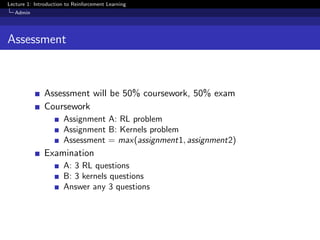
Assessment
Assessment will be 50% coursework, 50% exam
Coursework
Assignment A: RL problem
Assignment B: Kernels problem
Assessment = max(assignment1, assignment2)
Examination
A: 3 RL questions
B: 3 kernels questions
Answer any 3 questions
Lecture 1: Introduction to Reinforcement Learning
Admin
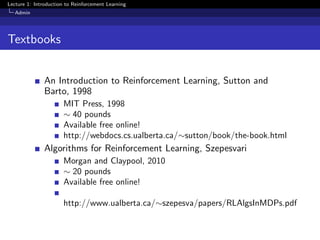
Textbooks
An Introduction to Reinforcement Learning, Sutton and
Barto, 1998
MIT Press, 1998
∼ 40 pounds
Available free online!
http://webdocs.cs.ualberta.ca/∼sutton/book/the-book.html
Algorithms for Reinforcement Learning, Szepesvari
Morgan and Claypool, 2010
∼ 20 pounds
Available free online!
http://www.ualberta.ca/∼szepesva/papers/RLAlgsInMDPs.pdf
Lecture 1: Introduction to Reinforcement Learning
About RL
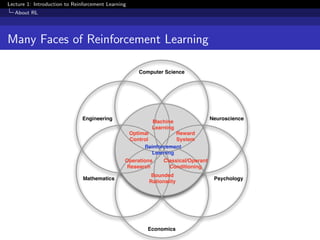
Many Faces of Reinforcement Learning
Computer Science
Economics
Mathematics
Engineering Neuroscience
Psychology
Machine
Learning
Classical/Operant
Conditioning
Optimal
Control
Reward
System
Operations
Research
Bounded
Rationality
Reinforcement
Learning
Lecture 1: Introduction to Reinforcement Learning
About RL
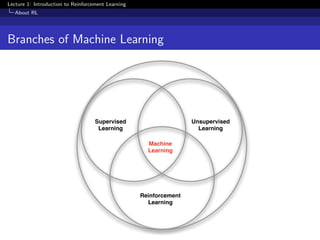
Branches of Machine Learning
Reinforcement
Learning
Supervised
Learning
Unsupervised
Learning
Machine
Learning
Lecture 1: Introduction to Reinforcement Learning
About RL
Characteristics of Reinforcement Learning
What makes reinforcement learning different from other machine
learning paradigms?
There is no supervisor, only a reward signal
Feedback is delayed, not instantaneous
Time really matters (sequential, non i.i.d data)
Agent’s actions affect the subsequent data it receives
Lecture 1: Introduction to Reinforcement Learning
About RL
Examples of Reinforcement Learning
Fly stunt manoeuvres in a helicopter
Defeat the world champion at Backgammon
Manage an investment portfolio
Control a power station
Make a humanoid robot walk
Play many different Atari games better than humans
Lecture 1: Introduction to Reinforcement Learning
About RL
Helicopter Manoeuvres
Lecture 1: Introduction to Reinforcement Learning
About RL
Bipedal Robots
Lecture 1: Introduction to Reinforcement Learning
About RL
Atari
Lecture 1: Introduction to Reinforcement Learning
The RL Problem
Reward
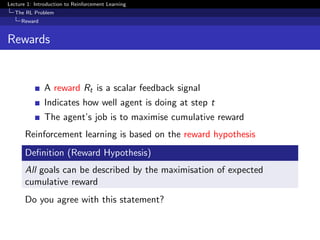
Rewards
A reward Rt is a scalar feedback signal
Indicates how well agent is doing at step t
The agent’s job is to maximise cumulative reward
Reinforcement learning is based on the reward hypothesis
Definition (Reward Hypothesis)
All goals can be described by the maximisation of expected
cumulative reward
Do you agree with this statement?
Lecture 1: Introduction to Reinforcement Learning
The RL Problem
Reward
Examples of Rewards
Fly stunt manoeuvres in a helicopter
+ve reward for following desired trajectory
−ve reward for crashing
Defeat the world champion at Backgammon
+/−ve reward for winning/losing a game
Manage an investment portfolio
+ve reward for each $ in bank
Control a power station
+ve reward for producing power
−ve reward for exceeding safety thresholds
Make a humanoid robot walk
+ve reward for forward motion
−ve reward for falling over
Play many different Atari games better than humans
+/−ve reward for increasing/decreasing score
Lecture 1: Introduction to Reinforcement Learning
The RL Problem
Reward
Sequential Decision Making
Goal: select actions to maximise total future reward
Actions may have long term consequences
Reward may be delayed
It may be better to sacrifice immediate reward to gain more
long-term reward
Examples:
A financial investment (may take months to mature)
Refuelling a helicopter (might prevent a crash in several hours)
Blocking opponent moves (might help winning chances many
moves from now)
Lecture 1: Introduction to Reinforcement Learning
The RL Problem
Environments
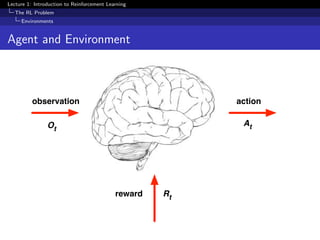
Agent and Environment
observation
reward
action
At
Rt
Ot
Lecture 1: Introduction to Reinforcement Learning
The RL Problem
Environments
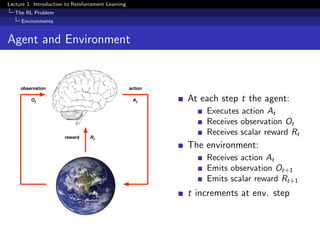
Agent and Environment
observation
reward
action
At
Rt
Ot
At each step t the agent:
Executes action At
Receives observation Ot
Receives scalar reward Rt
The environment:
Receives action At
Emits observation Ot+1
Emits scalar reward Rt+1
t increments at env. step
Lecture 1: Introduction to Reinforcement Learning
The RL Problem
State
History and State
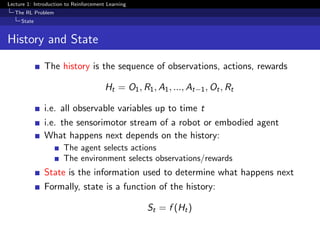
The history is the sequence of observations, actions, rewards
Ht = O1, R1, A1, ..., At−1, Ot, Rt
i.e. all observable variables up to time t
i.e. the sensorimotor stream of a robot or embodied agent
What happens next depends on the history:
The agent selects actions
The environment selects observations/rewards
State is the information used to determine what happens next
Formally, state is a function of the history:
St = f (Ht)
Lecture 1: Introduction to Reinforcement Learning
The RL Problem
State
Environment State
observation
reward
action
At
Rt
Ot
St
eenvironment state
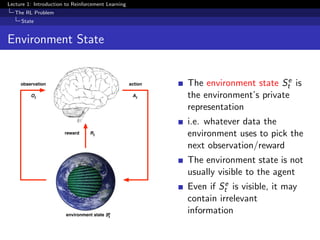
The environment state Se
t is
the environment’s private
representation
i.e. whatever data the
environment uses to pick the
next observation/reward
The environment state is not
usually visible to the agent
Even if Se
t is visible, it may
contain irrelevant
information
Lecture 1: Introduction to Reinforcement Learning
The RL Problem
State
Agent State
observation
reward
action
At
Rt
Ot
St
a
agent state
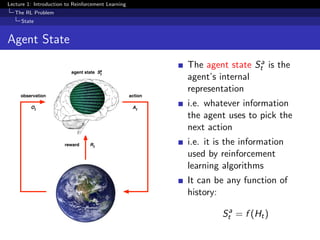
The agent state Sa
t is the
agent’s internal
representation
i.e. whatever information
the agent uses to pick the
next action
i.e. it is the information
used by reinforcement
learning algorithms
It can be any function of
history:
Sa
t = f (Ht)
Lecture 1: Introduction to Reinforcement Learning
The RL Problem
State
Information State
An information state (a.k.a. Markov state) contains all useful
information from the history.
Definition
A state St is Markov if and only if
P[St+1 | St] = P[St+1 | S1, ..., St]
“The future is independent of the past given the present”
H1:t → St → Ht+1:∞
Once the state is known, the history may be thrown away
i.e. The state is a sufficient statistic of the future
The environment state Se
t is Markov
The history Ht is Markov
Lecture 1: Introduction to Reinforcement Learning
The RL Problem
State
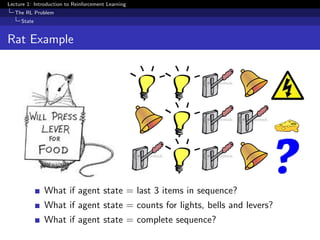
Rat Example
What if agent state = last 3 items in sequence?
What if agent state = counts for lights, bells and levers?
What if agent state = complete sequence?
Lecture 1: Introduction to Reinforcement Learning
The RL Problem
State
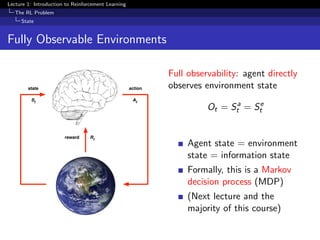
Fully Observable Environments
state
reward
action
At
Rt
St
Full observability: agent directly
observes environment state
Ot = Sa
t = Se
t
Agent state = environment
state = information state
Formally, this is a Markov
decision process (MDP)
(Next lecture and the
majority of this course)
Lecture 1: Introduction to Reinforcement Learning
The RL Problem
State
Partially Observable Environments
Partial observability: agent indirectly observes environment:
A robot with camera vision isn’t told its absolute location
A trading agent only observes current prices
A poker playing agent only observes public cards
Now agent state = environment state
Formally this is a partially observable Markov decision process
(POMDP)
Agent must construct its own state representation Sa
t , e.g.
Complete history: Sa
t = Ht
Beliefs of environment state: Sa
t = (P[Se
t = s1
], ..., P[Se
t = sn
])
Recurrent neural network: Sa
t = σ(Sa
t−1Ws + OtWo)
Lecture 1: Introduction to Reinforcement Learning
Inside An RL Agent
Major Components of an RL Agent
An RL agent may include one or more of these components:
Policy: agent’s behaviour function
Value function: how good is each state and/or action
Model: agent’s representation of the environment
Lecture 1: Introduction to Reinforcement Learning
Inside An RL Agent
Policy
A policy is the agent’s behaviour
It is a map from state to action, e.g.
Deterministic policy: a = π(s)
Stochastic policy: π(a|s) = P[At = a|St = s]
Lecture 1: Introduction to Reinforcement Learning
Inside An RL Agent
Value Function
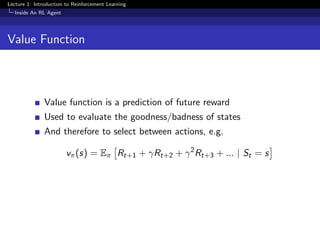
Value function is a prediction of future reward
Used to evaluate the goodness/badness of states
And therefore to select between actions, e.g.
vπ(s) = Eπ Rt+1 + γRt+2 + γ2
Rt+3 + ... | St = s
Lecture 1: Introduction to Reinforcement Learning
Inside An RL Agent
Example: Value Function in Atari
Lecture 1: Introduction to Reinforcement Learning
Inside An RL Agent
Model
A model predicts what the environment will do next
P predicts the next state
R predicts the next (immediate) reward, e.g.
Pa
ss = P[St+1 = s | St = s, At = a]
Ra
s = E [Rt+1 | St = s, At = a]
Lecture 1: Introduction to Reinforcement Learning
Inside An RL Agent
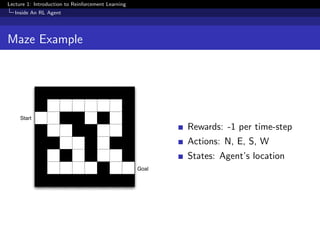
Maze Example
Start
Goal
Rewards: -1 per time-step
Actions: N, E, S, W
States: Agent’s location
Lecture 1: Introduction to Reinforcement Learning
Inside An RL Agent
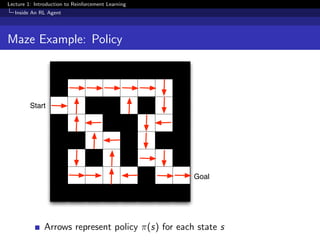
Maze Example: Policy
Start
Goal
Arrows represent policy π(s) for each state s
Lecture 1: Introduction to Reinforcement Learning
Inside An RL Agent
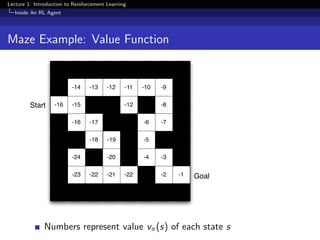
Maze Example: Value Function
-14 -13 -12 -11 -10 -9
-16 -15 -12 -8
-16 -17 -6 -7
-18 -19 -5
-24 -20 -4 -3
-23 -22 -21 -22 -2 -1
Start
Goal
Numbers represent value vπ(s) of each state s
Lecture 1: Introduction to Reinforcement Learning
Inside An RL Agent
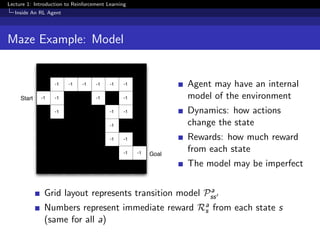
Maze Example: Model
-1 -1 -1 -1 -1 -1
-1 -1 -1 -1
-1 -1 -1
-1
-1 -1
-1 -1
Start
Goal
Agent may have an internal
model of the environment
Dynamics: how actions
change the state
Rewards: how much reward
from each state
The model may be imperfect
Grid layout represents transition model Pa
ss
Numbers represent immediate reward Ra
s from each state s
(same for all a)
Lecture 1: Introduction to Reinforcement Learning
Inside An RL Agent
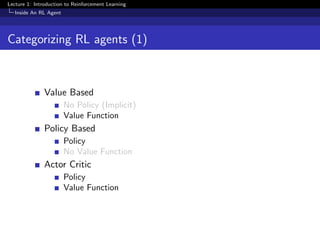
Categorizing RL agents (1)
Value Based
No Policy (Implicit)
Value Function
Policy Based
Policy
No Value Function
Actor Critic
Policy
Value Function
Lecture 1: Introduction to Reinforcement Learning
Inside An RL Agent
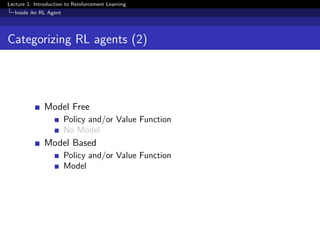
Categorizing RL agents (2)
Model Free
Policy and/or Value Function
No Model
Model Based
Policy and/or Value Function
Model
Lecture 1: Introduction to Reinforcement Learning
Inside An RL Agent
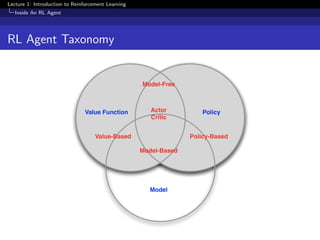
RL Agent Taxonomy
Model
Value Function PolicyActor
Critic
Value-Based Policy-Based
Model-Free
Model-Based
Lecture 1: Introduction to Reinforcement Learning
Problems within RL
Learning and Planning
Two fundamental problems in sequential decision making
Reinforcement Learning:
The environment is initially unknown
The agent interacts with the environment
The agent improves its policy
Planning:
A model of the environment is known
The agent performs computations with its model (without any
external interaction)
The agent improves its policy
a.k.a. deliberation, reasoning, introspection, pondering,
thought, search
Lecture 1: Introduction to Reinforcement Learning
Problems within RL
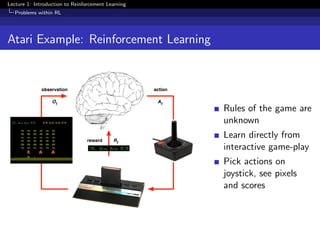
Atari Example: Reinforcement Learning
observation
reward
action
At
Rt
Ot
Rules of the game are
unknown
Learn directly from
interactive game-play
Pick actions on
joystick, see pixels
and scores
Lecture 1: Introduction to Reinforcement Learning
Problems within RL
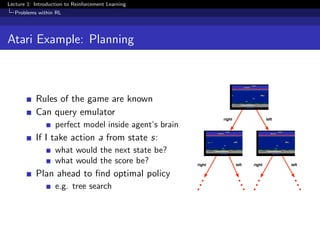
Atari Example: Planning
Rules of the game are known
Can query emulator
perfect model inside agent’s brain
If I take action a from state s:
what would the next state be?
what would the score be?
Plan ahead to find optimal policy
e.g. tree search
right left
right rightleft left
Lecture 1: Introduction to Reinforcement Learning
Problems within RL
Exploration and Exploitation (1)
Reinforcement learning is like trial-and-error learning
The agent should discover a good policy
From its experiences of the environment
Without losing too much reward along the way
Lecture 1: Introduction to Reinforcement Learning
Problems within RL
Exploration and Exploitation (2)
Exploration finds more information about the environment
Exploitation exploits known information to maximise reward
It is usually important to explore as well as exploit
Lecture 1: Introduction to Reinforcement Learning
Problems within RL
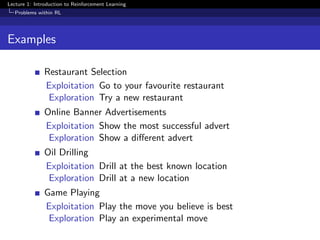
Examples
Restaurant Selection
Exploitation Go to your favourite restaurant
Exploration Try a new restaurant
Online Banner Advertisements
Exploitation Show the most successful advert
Exploration Show a different advert
Oil Drilling
Exploitation Drill at the best known location
Exploration Drill at a new location
Game Playing
Exploitation Play the move you believe is best
Exploration Play an experimental move
Lecture 1: Introduction to Reinforcement Learning
Problems within RL
Prediction and Control
Prediction: evaluate the future
Given a policy
Control: optimise the future
Find the best policy
Lecture 1: Introduction to Reinforcement Learning
Problems within RL
Gridworld Example: Prediction
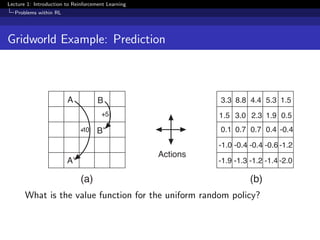
3.3 8.8 4.4 5.3 1.5
1.5 3.0 2.3 1.9 0.5
0.1 0.7 0.7 0.4 -0.4
-1.0 -0.4 -0.4 -0.6 -1.2
-1.9 -1.3 -1.2 -1.4 -2.0
A B
A’
B’+10
+5
Actions
(a) (b)
What is the value function for the uniform random policy?
Lecture 1: Introduction to Reinforcement Learning
Problems within RL
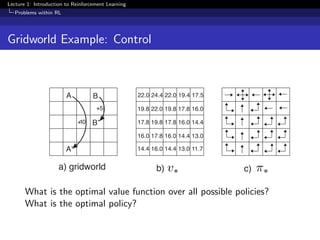
Gridworld Example: Control
a) gridworld b) V* c) *
22.0 24.4 22.0 19.4 17.5
19.8 22.0 19.8 17.8 16.0
17.8 19.8 17.8 16.0 14.4
16.0 17.8 16.0 14.4 13.0
14.4 16.0 14.4 13.0 11.7
A B
A’
B’+10
+5
πv⇤ ⇡⇤
What is the optimal value function over all possible policies?
What is the optimal policy?
Lecture 1: Introduction to Reinforcement Learning
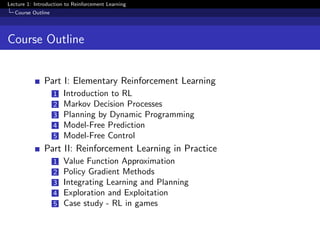
Course Outline
Course Outline
Part I: Elementary Reinforcement Learning
1 Introduction to RL
2 Markov Decision Processes
3 Planning by Dynamic Programming
4 Model-Free Prediction
5 Model-Free Control
Part II: Reinforcement Learning in Practice
1 Value Function Approximation
2 Policy Gradient Methods
3 Integrating Learning and Planning
4 Exploration and Exploitation
5 Case study - RL in games

Intro rl

  • 1.
    Lecture 1: Introductionto Reinforcement Learning Lecture 1: Introduction to Reinforcement Learning David Silver
  • 2.
    Lecture 1: Introductionto Reinforcement Learning Outline 1 Admin 2 About Reinforcement Learning 3 The Reinforcement Learning Problem 4 Inside An RL Agent 5 Problems within Reinforcement Learning
  • 3.
    Lecture 1: Introductionto Reinforcement Learning Admin Class Information Thursdays 9:30 to 11:00am Website: http://www.cs.ucl.ac.uk/staff/D.Silver/web/Teaching.html Group: http://groups.google.com/group/csml-advanced-topics Contact me: d.silver@cs.ucl.ac.uk
  • 4.
    Lecture 1: Introductionto Reinforcement Learning Admin Assessment Assessment will be 50% coursework, 50% exam Coursework Assignment A: RL problem Assignment B: Kernels problem Assessment = max(assignment1, assignment2) Examination A: 3 RL questions B: 3 kernels questions Answer any 3 questions
  • 5.
    Lecture 1: Introductionto Reinforcement Learning Admin Textbooks An Introduction to Reinforcement Learning, Sutton and Barto, 1998 MIT Press, 1998 ∼ 40 pounds Available free online! http://webdocs.cs.ualberta.ca/∼sutton/book/the-book.html Algorithms for Reinforcement Learning, Szepesvari Morgan and Claypool, 2010 ∼ 20 pounds Available free online! http://www.ualberta.ca/∼szepesva/papers/RLAlgsInMDPs.pdf
  • 6.
    Lecture 1: Introductionto Reinforcement Learning About RL Many Faces of Reinforcement Learning Computer Science Economics Mathematics Engineering Neuroscience Psychology Machine Learning Classical/Operant Conditioning Optimal Control Reward System Operations Research Bounded Rationality Reinforcement Learning
  • 7.
    Lecture 1: Introductionto Reinforcement Learning About RL Branches of Machine Learning Reinforcement Learning Supervised Learning Unsupervised Learning Machine Learning
  • 8.
    Lecture 1: Introductionto Reinforcement Learning About RL Characteristics of Reinforcement Learning What makes reinforcement learning different from other machine learning paradigms? There is no supervisor, only a reward signal Feedback is delayed, not instantaneous Time really matters (sequential, non i.i.d data) Agent’s actions affect the subsequent data it receives
  • 9.
    Lecture 1: Introductionto Reinforcement Learning About RL Examples of Reinforcement Learning Fly stunt manoeuvres in a helicopter Defeat the world champion at Backgammon Manage an investment portfolio Control a power station Make a humanoid robot walk Play many different Atari games better than humans
  • 10.
    Lecture 1: Introductionto Reinforcement Learning About RL Helicopter Manoeuvres
  • 11.
    Lecture 1: Introductionto Reinforcement Learning About RL Bipedal Robots
  • 12.
    Lecture 1: Introductionto Reinforcement Learning About RL Atari
  • 13.
    Lecture 1: Introductionto Reinforcement Learning The RL Problem Reward Rewards A reward Rt is a scalar feedback signal Indicates how well agent is doing at step t The agent’s job is to maximise cumulative reward Reinforcement learning is based on the reward hypothesis Definition (Reward Hypothesis) All goals can be described by the maximisation of expected cumulative reward Do you agree with this statement?
  • 14.
    Lecture 1: Introductionto Reinforcement Learning The RL Problem Reward Examples of Rewards Fly stunt manoeuvres in a helicopter +ve reward for following desired trajectory −ve reward for crashing Defeat the world champion at Backgammon +/−ve reward for winning/losing a game Manage an investment portfolio +ve reward for each $ in bank Control a power station +ve reward for producing power −ve reward for exceeding safety thresholds Make a humanoid robot walk +ve reward for forward motion −ve reward for falling over Play many different Atari games better than humans +/−ve reward for increasing/decreasing score
  • 15.
    Lecture 1: Introductionto Reinforcement Learning The RL Problem Reward Sequential Decision Making Goal: select actions to maximise total future reward Actions may have long term consequences Reward may be delayed It may be better to sacrifice immediate reward to gain more long-term reward Examples: A financial investment (may take months to mature) Refuelling a helicopter (might prevent a crash in several hours) Blocking opponent moves (might help winning chances many moves from now)
  • 16.
    Lecture 1: Introductionto Reinforcement Learning The RL Problem Environments Agent and Environment observation reward action At Rt Ot
  • 17.
    Lecture 1: Introductionto Reinforcement Learning The RL Problem Environments Agent and Environment observation reward action At Rt Ot At each step t the agent: Executes action At Receives observation Ot Receives scalar reward Rt The environment: Receives action At Emits observation Ot+1 Emits scalar reward Rt+1 t increments at env. step
  • 18.
    Lecture 1: Introductionto Reinforcement Learning The RL Problem State History and State The history is the sequence of observations, actions, rewards Ht = O1, R1, A1, ..., At−1, Ot, Rt i.e. all observable variables up to time t i.e. the sensorimotor stream of a robot or embodied agent What happens next depends on the history: The agent selects actions The environment selects observations/rewards State is the information used to determine what happens next Formally, state is a function of the history: St = f (Ht)
  • 19.
    Lecture 1: Introductionto Reinforcement Learning The RL Problem State Environment State observation reward action At Rt Ot St eenvironment state The environment state Se t is the environment’s private representation i.e. whatever data the environment uses to pick the next observation/reward The environment state is not usually visible to the agent Even if Se t is visible, it may contain irrelevant information
  • 20.
    Lecture 1: Introductionto Reinforcement Learning The RL Problem State Agent State observation reward action At Rt Ot St a agent state The agent state Sa t is the agent’s internal representation i.e. whatever information the agent uses to pick the next action i.e. it is the information used by reinforcement learning algorithms It can be any function of history: Sa t = f (Ht)
  • 21.
    Lecture 1: Introductionto Reinforcement Learning The RL Problem State Information State An information state (a.k.a. Markov state) contains all useful information from the history. Definition A state St is Markov if and only if P[St+1 | St] = P[St+1 | S1, ..., St] “The future is independent of the past given the present” H1:t → St → Ht+1:∞ Once the state is known, the history may be thrown away i.e. The state is a sufficient statistic of the future The environment state Se t is Markov The history Ht is Markov
  • 22.
    Lecture 1: Introductionto Reinforcement Learning The RL Problem State Rat Example What if agent state = last 3 items in sequence? What if agent state = counts for lights, bells and levers? What if agent state = complete sequence?
  • 23.
    Lecture 1: Introductionto Reinforcement Learning The RL Problem State Fully Observable Environments state reward action At Rt St Full observability: agent directly observes environment state Ot = Sa t = Se t Agent state = environment state = information state Formally, this is a Markov decision process (MDP) (Next lecture and the majority of this course)
  • 24.
    Lecture 1: Introductionto Reinforcement Learning The RL Problem State Partially Observable Environments Partial observability: agent indirectly observes environment: A robot with camera vision isn’t told its absolute location A trading agent only observes current prices A poker playing agent only observes public cards Now agent state = environment state Formally this is a partially observable Markov decision process (POMDP) Agent must construct its own state representation Sa t , e.g. Complete history: Sa t = Ht Beliefs of environment state: Sa t = (P[Se t = s1 ], ..., P[Se t = sn ]) Recurrent neural network: Sa t = σ(Sa t−1Ws + OtWo)
  • 25.
    Lecture 1: Introductionto Reinforcement Learning Inside An RL Agent Major Components of an RL Agent An RL agent may include one or more of these components: Policy: agent’s behaviour function Value function: how good is each state and/or action Model: agent’s representation of the environment
  • 26.
    Lecture 1: Introductionto Reinforcement Learning Inside An RL Agent Policy A policy is the agent’s behaviour It is a map from state to action, e.g. Deterministic policy: a = π(s) Stochastic policy: π(a|s) = P[At = a|St = s]
  • 27.
    Lecture 1: Introductionto Reinforcement Learning Inside An RL Agent Value Function Value function is a prediction of future reward Used to evaluate the goodness/badness of states And therefore to select between actions, e.g. vπ(s) = Eπ Rt+1 + γRt+2 + γ2 Rt+3 + ... | St = s
  • 28.
    Lecture 1: Introductionto Reinforcement Learning Inside An RL Agent Example: Value Function in Atari
  • 29.
    Lecture 1: Introductionto Reinforcement Learning Inside An RL Agent Model A model predicts what the environment will do next P predicts the next state R predicts the next (immediate) reward, e.g. Pa ss = P[St+1 = s | St = s, At = a] Ra s = E [Rt+1 | St = s, At = a]
  • 30.
    Lecture 1: Introductionto Reinforcement Learning Inside An RL Agent Maze Example Start Goal Rewards: -1 per time-step Actions: N, E, S, W States: Agent’s location
  • 31.
    Lecture 1: Introductionto Reinforcement Learning Inside An RL Agent Maze Example: Policy Start Goal Arrows represent policy π(s) for each state s
  • 32.
    Lecture 1: Introductionto Reinforcement Learning Inside An RL Agent Maze Example: Value Function -14 -13 -12 -11 -10 -9 -16 -15 -12 -8 -16 -17 -6 -7 -18 -19 -5 -24 -20 -4 -3 -23 -22 -21 -22 -2 -1 Start Goal Numbers represent value vπ(s) of each state s
  • 33.
    Lecture 1: Introductionto Reinforcement Learning Inside An RL Agent Maze Example: Model -1 -1 -1 -1 -1 -1 -1 -1 -1 -1 -1 -1 -1 -1 -1 -1 -1 -1 Start Goal Agent may have an internal model of the environment Dynamics: how actions change the state Rewards: how much reward from each state The model may be imperfect Grid layout represents transition model Pa ss Numbers represent immediate reward Ra s from each state s (same for all a)
  • 34.
    Lecture 1: Introductionto Reinforcement Learning Inside An RL Agent Categorizing RL agents (1) Value Based No Policy (Implicit) Value Function Policy Based Policy No Value Function Actor Critic Policy Value Function
  • 35.
    Lecture 1: Introductionto Reinforcement Learning Inside An RL Agent Categorizing RL agents (2) Model Free Policy and/or Value Function No Model Model Based Policy and/or Value Function Model
  • 36.
    Lecture 1: Introductionto Reinforcement Learning Inside An RL Agent RL Agent Taxonomy Model Value Function PolicyActor Critic Value-Based Policy-Based Model-Free Model-Based
  • 37.
    Lecture 1: Introductionto Reinforcement Learning Problems within RL Learning and Planning Two fundamental problems in sequential decision making Reinforcement Learning: The environment is initially unknown The agent interacts with the environment The agent improves its policy Planning: A model of the environment is known The agent performs computations with its model (without any external interaction) The agent improves its policy a.k.a. deliberation, reasoning, introspection, pondering, thought, search
  • 38.
    Lecture 1: Introductionto Reinforcement Learning Problems within RL Atari Example: Reinforcement Learning observation reward action At Rt Ot Rules of the game are unknown Learn directly from interactive game-play Pick actions on joystick, see pixels and scores
  • 39.
    Lecture 1: Introductionto Reinforcement Learning Problems within RL Atari Example: Planning Rules of the game are known Can query emulator perfect model inside agent’s brain If I take action a from state s: what would the next state be? what would the score be? Plan ahead to find optimal policy e.g. tree search right left right rightleft left
  • 40.
    Lecture 1: Introductionto Reinforcement Learning Problems within RL Exploration and Exploitation (1) Reinforcement learning is like trial-and-error learning The agent should discover a good policy From its experiences of the environment Without losing too much reward along the way
  • 41.
    Lecture 1: Introductionto Reinforcement Learning Problems within RL Exploration and Exploitation (2) Exploration finds more information about the environment Exploitation exploits known information to maximise reward It is usually important to explore as well as exploit
  • 42.
    Lecture 1: Introductionto Reinforcement Learning Problems within RL Examples Restaurant Selection Exploitation Go to your favourite restaurant Exploration Try a new restaurant Online Banner Advertisements Exploitation Show the most successful advert Exploration Show a different advert Oil Drilling Exploitation Drill at the best known location Exploration Drill at a new location Game Playing Exploitation Play the move you believe is best Exploration Play an experimental move
  • 43.
    Lecture 1: Introductionto Reinforcement Learning Problems within RL Prediction and Control Prediction: evaluate the future Given a policy Control: optimise the future Find the best policy
  • 44.
    Lecture 1: Introductionto Reinforcement Learning Problems within RL Gridworld Example: Prediction 3.3 8.8 4.4 5.3 1.5 1.5 3.0 2.3 1.9 0.5 0.1 0.7 0.7 0.4 -0.4 -1.0 -0.4 -0.4 -0.6 -1.2 -1.9 -1.3 -1.2 -1.4 -2.0 A B A’ B’+10 +5 Actions (a) (b) What is the value function for the uniform random policy?
  • 45.
    Lecture 1: Introductionto Reinforcement Learning Problems within RL Gridworld Example: Control a) gridworld b) V* c) * 22.0 24.4 22.0 19.4 17.5 19.8 22.0 19.8 17.8 16.0 17.8 19.8 17.8 16.0 14.4 16.0 17.8 16.0 14.4 13.0 14.4 16.0 14.4 13.0 11.7 A B A’ B’+10 +5 πv⇤ ⇡⇤ What is the optimal value function over all possible policies? What is the optimal policy?
  • 46.
    Lecture 1: Introductionto Reinforcement Learning Course Outline Course Outline Part I: Elementary Reinforcement Learning 1 Introduction to RL 2 Markov Decision Processes 3 Planning by Dynamic Programming 4 Model-Free Prediction 5 Model-Free Control Part II: Reinforcement Learning in Practice 1 Value Function Approximation 2 Policy Gradient Methods 3 Integrating Learning and Planning 4 Exploration and Exploitation 5 Case study - RL in games