Artificial Intelligence
Problem-Solving Agent
• In which we look at how an agent can decide
what to do by systematically considering the
outcomes of various sequences of actions that
it might take.
- Stuart Russell & Peter Norvig
3
Problem solving agent
• A kind of Goal-based agent.
• Decide what to do by searching sequences of
actions that lead to desirable states.
Problem Definition
• Initial state : starting point
• Operator: description of an action
• State space: all states reachable from the initial state
by any sequence action
• Path: sequence of actions leading from one state to
another
• Goal test: which the agent can apply to a single state
description to determine if it is a goal state
• Path cost function: assign a cost to a path which the
sum of the costs of the individual actions along the
path.
What is Search?
• Search is the systematic examination of states to find
path from the start/root state to the goal state.
• The set of possible states, together
with operators defining their connectivity the search
space.
• The output of a search algorithm is a solution, that is, a
path from the initial state to a state that satisfies the goal
test.
• In real life search usually results from a lack of
knowledge. In AI too search is merely a offensive
instrument with which to attack problems that we can't
seem to solve any better way.
Search groups
Search techniques fall into three groups:
1. Methods which find any start - goal path,
2. Methods which find the best path,
3. Search methods in the face of opponent.
Search
• An agent with several immediate options of
unknown value can decide what to do by first
examining different possible sequences of
actions that lead to states of known value, and
then choosing the best one. This process is
called search.
• A search-algorithm takes a problem as input
and returns a solution in the form of an action
sequence.
Problem formulation
• What are the possible states of the world
relevant for solving the problem?
• What information is accessible to the agent?
• How can the agent progress from state to
state?
• Follows goal-formulation.
Well-defined problems and solutions
• A problem is a collection of information that the agent will use
to decide what to do.
• Information needed to define a problem:
– The initial state that the agent knows itself to be in.
– The set of possible actions available to the agent.
• Operator denotes the description of an action in terms
of which state will be reached by carrying out the
action in a particular state.
• Also called Successor function S. Given a particular
state x, S (x) returns the set of states reachable from x by
any single action.
State space and
a path
• State space is the set of all states reachable
from the initial state by any sequence of
actions.
• Path in the state space is simply any sequence
of actions leading from one state to another.
Search Space Definitions
• Problem formulation
– Describe a general problem as a search problem
• Solution
– Sequence of actions that transitions the world from the initial
state to a goal state
• Solution cost (additive)
– Sum of the cost of operators
– Alternative: sum of distances, number of steps, etc.
• Search
– Process of looking for a solution
– Search algorithm takes problem as input and returns solution
– We are searching through a space of possible states
• Execution
– Process of executing sequence of actions (solution)
Goal-formulation
• What is the goal state?
• What are important characteristics of the goal
state?
• How does the agent know that it has reached
the goal?
• Are there several possible goal states?
– Are they equal or are some more preferable?
Goal
• We will consider a goal to be a set of world
states – just those states in which the goal is
satisfied.
• Actions can be viewed as causing transitions
between world states.
Looking for Parking
• Going home; need to find street parking
• Formulate Goal:
Car is parked
• Formulate Problem:
States: street with parking and car at that street
Actions: drive between street segments
• Find solution:
Sequence of street segments, ending with a street
with parking
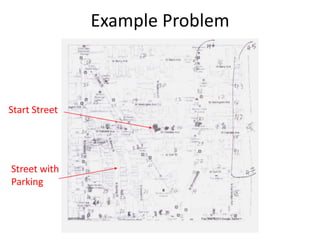
Example Problem
Start Street
Street with
Parking
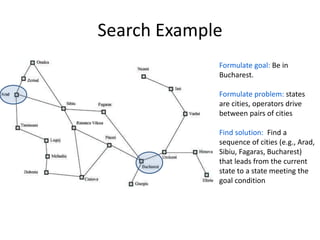
Search Example
Formulate goal: Be in
Bucharest.
Formulate problem: states
are cities, operators drive
between pairs of cities
Find solution: Find a
sequence of cities (e.g., Arad,
Sibiu, Fagaras, Bucharest)
that leads from the current
state to a state meeting the
goal condition
Problem Formulation
A search problem is defined by the
1.Initial state (e.g., Arad)
2.Operators (e.g., Arad -> Zerind, Arad -> Sibiu, etc.)
3.Goal test (e.g., at Bucharest)
4.Solution cost (e.g., path cost)
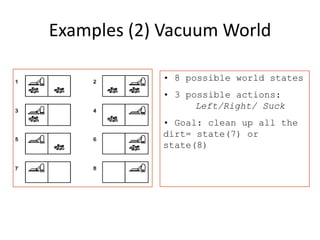
Examples (2) Vacuum World
• 8 possible world states
• 3 possible actions:
Left/Right/ Suck
• Goal: clean up all the
dirt= state(7) or
state(8)
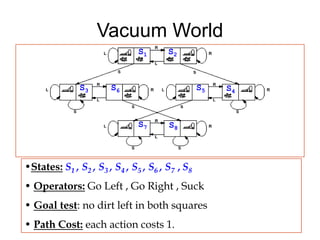
Vacuum World
•States: S1 , S2 , S3 , S4 , S5 , S6 , S7 , S8
• Operators: Go Left , Go Right , Suck
• Goal test: no dirt left in both squares
• Path Cost: each action costs 1.
S1 S2
S3 S6 S5 S4
S7 S8
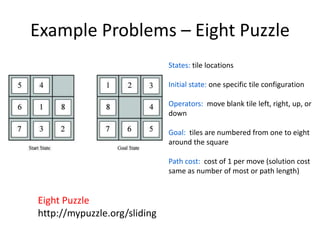
Example Problems – Eight Puzzle
States: tile locations
Initial state: one specific tile configuration
Operators: move blank tile left, right, up, or
down
Goal: tiles are numbered from one to eight
around the square
Path cost: cost of 1 per move (solution cost
same as number of most or path length)
Eight Puzzle
http://mypuzzle.org/sliding
Single-State problem and
Multiple-States problem
• World is accessible  agent’s sensors give
enough information about which state it is in
(so, it knows what each of its action does),
then it calculate exactly which state it will be
after any sequence of actions. Single-State
problem
• world is inaccessible  agent has limited
access to the world state, so it may have no
sensors at all. It knows only that initial state is
one of the set {1,2,3,4,5,6,7,8}. Multiple-
States problem
Think of the graph defined as follows:
– the nodes denote descriptions of a state of the world, e.g.,
which blocks are on top of what in a blocks scene, and
where the links represent actions that change from one
state to the other.
– A path through such a graph (from a start node to a goal
node) is a "plan of action" to achieve some desired goal
state from some known starting state. It is this type of
graph that is of more general interest in AI.
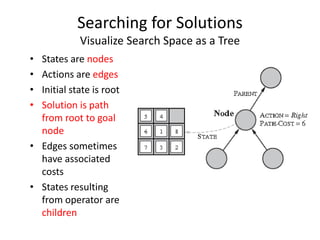
Searching for Solutions
Visualize Search Space as a Tree
• States are nodes
• Actions are edges
• Initial state is root
• Solution is path
from root to goal
node
• Edges sometimes
have associated
costs
• States resulting
from operator are
children
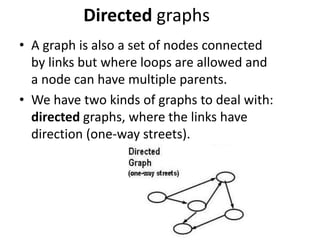
Directed graphs
• A graph is also a set of nodes connected
by links but where loops are allowed and
a node can have multiple parents.
• We have two kinds of graphs to deal with:
directed graphs, where the links have
direction (one-way streets).
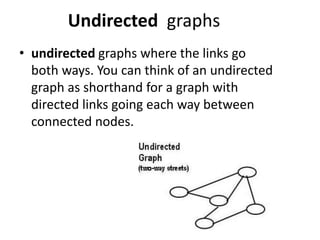
Undirected graphs
• undirected graphs where the links go
both ways. You can think of an undirected
graph as shorthand for a graph with
directed links going each way between
connected nodes.
Searching for solutions:
Graphs or trees
• The map of all paths within a state-space is
a graph of nodes which are connected by links.
• Now if we trace out all possible paths through the graph,
and terminate paths before they return to nodes already
visited on that path, we produce a search tree.
• Like graphs, trees have nodes, but they are linked
by branches.
• The start node is called the root and nodes at the other
ends are leaves.
• Nodes have generations of descendents.
• The aim of search is not to produce complete physical trees
in memory, but rather explore as little of the virtual tree
looking for root-goal paths.
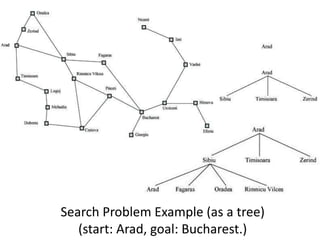
Search Problem Example (as a tree)
(start: Arad, goal: Bucharest.)

Artificial intelligence(04)

  • 1.
  • 2.
    Problem-Solving Agent • Inwhich we look at how an agent can decide what to do by systematically considering the outcomes of various sequences of actions that it might take. - Stuart Russell & Peter Norvig
  • 3.
    3 Problem solving agent •A kind of Goal-based agent. • Decide what to do by searching sequences of actions that lead to desirable states.
  • 4.
    Problem Definition • Initialstate : starting point • Operator: description of an action • State space: all states reachable from the initial state by any sequence action • Path: sequence of actions leading from one state to another • Goal test: which the agent can apply to a single state description to determine if it is a goal state • Path cost function: assign a cost to a path which the sum of the costs of the individual actions along the path.
  • 5.
    What is Search? •Search is the systematic examination of states to find path from the start/root state to the goal state. • The set of possible states, together with operators defining their connectivity the search space. • The output of a search algorithm is a solution, that is, a path from the initial state to a state that satisfies the goal test. • In real life search usually results from a lack of knowledge. In AI too search is merely a offensive instrument with which to attack problems that we can't seem to solve any better way.
  • 6.
    Search groups Search techniquesfall into three groups: 1. Methods which find any start - goal path, 2. Methods which find the best path, 3. Search methods in the face of opponent.
  • 7.
    Search • An agentwith several immediate options of unknown value can decide what to do by first examining different possible sequences of actions that lead to states of known value, and then choosing the best one. This process is called search. • A search-algorithm takes a problem as input and returns a solution in the form of an action sequence.
  • 8.
    Problem formulation • Whatare the possible states of the world relevant for solving the problem? • What information is accessible to the agent? • How can the agent progress from state to state? • Follows goal-formulation.
  • 9.
    Well-defined problems andsolutions • A problem is a collection of information that the agent will use to decide what to do. • Information needed to define a problem: – The initial state that the agent knows itself to be in. – The set of possible actions available to the agent. • Operator denotes the description of an action in terms of which state will be reached by carrying out the action in a particular state. • Also called Successor function S. Given a particular state x, S (x) returns the set of states reachable from x by any single action.
  • 10.
    State space and apath • State space is the set of all states reachable from the initial state by any sequence of actions. • Path in the state space is simply any sequence of actions leading from one state to another.
  • 11.
    Search Space Definitions •Problem formulation – Describe a general problem as a search problem • Solution – Sequence of actions that transitions the world from the initial state to a goal state • Solution cost (additive) – Sum of the cost of operators – Alternative: sum of distances, number of steps, etc. • Search – Process of looking for a solution – Search algorithm takes problem as input and returns solution – We are searching through a space of possible states • Execution – Process of executing sequence of actions (solution)
  • 12.
    Goal-formulation • What isthe goal state? • What are important characteristics of the goal state? • How does the agent know that it has reached the goal? • Are there several possible goal states? – Are they equal or are some more preferable?
  • 13.
    Goal • We willconsider a goal to be a set of world states – just those states in which the goal is satisfied. • Actions can be viewed as causing transitions between world states.
  • 14.
    Looking for Parking •Going home; need to find street parking • Formulate Goal: Car is parked • Formulate Problem: States: street with parking and car at that street Actions: drive between street segments • Find solution: Sequence of street segments, ending with a street with parking
  • 15.
  • 16.
    Search Example Formulate goal:Be in Bucharest. Formulate problem: states are cities, operators drive between pairs of cities Find solution: Find a sequence of cities (e.g., Arad, Sibiu, Fagaras, Bucharest) that leads from the current state to a state meeting the goal condition
  • 17.
    Problem Formulation A searchproblem is defined by the 1.Initial state (e.g., Arad) 2.Operators (e.g., Arad -> Zerind, Arad -> Sibiu, etc.) 3.Goal test (e.g., at Bucharest) 4.Solution cost (e.g., path cost)
  • 18.
    Examples (2) VacuumWorld • 8 possible world states • 3 possible actions: Left/Right/ Suck • Goal: clean up all the dirt= state(7) or state(8)
  • 19.
    Vacuum World •States: S1, S2 , S3 , S4 , S5 , S6 , S7 , S8 • Operators: Go Left , Go Right , Suck • Goal test: no dirt left in both squares • Path Cost: each action costs 1. S1 S2 S3 S6 S5 S4 S7 S8
  • 20.
    Example Problems –Eight Puzzle States: tile locations Initial state: one specific tile configuration Operators: move blank tile left, right, up, or down Goal: tiles are numbered from one to eight around the square Path cost: cost of 1 per move (solution cost same as number of most or path length) Eight Puzzle http://mypuzzle.org/sliding
  • 21.
    Single-State problem and Multiple-Statesproblem • World is accessible  agent’s sensors give enough information about which state it is in (so, it knows what each of its action does), then it calculate exactly which state it will be after any sequence of actions. Single-State problem • world is inaccessible  agent has limited access to the world state, so it may have no sensors at all. It knows only that initial state is one of the set {1,2,3,4,5,6,7,8}. Multiple- States problem
  • 22.
    Think of thegraph defined as follows: – the nodes denote descriptions of a state of the world, e.g., which blocks are on top of what in a blocks scene, and where the links represent actions that change from one state to the other. – A path through such a graph (from a start node to a goal node) is a "plan of action" to achieve some desired goal state from some known starting state. It is this type of graph that is of more general interest in AI.
  • 23.
    Searching for Solutions VisualizeSearch Space as a Tree • States are nodes • Actions are edges • Initial state is root • Solution is path from root to goal node • Edges sometimes have associated costs • States resulting from operator are children
  • 24.
    Directed graphs • Agraph is also a set of nodes connected by links but where loops are allowed and a node can have multiple parents. • We have two kinds of graphs to deal with: directed graphs, where the links have direction (one-way streets).
  • 25.
    Undirected graphs • undirectedgraphs where the links go both ways. You can think of an undirected graph as shorthand for a graph with directed links going each way between connected nodes.
  • 26.
    Searching for solutions: Graphsor trees • The map of all paths within a state-space is a graph of nodes which are connected by links. • Now if we trace out all possible paths through the graph, and terminate paths before they return to nodes already visited on that path, we produce a search tree. • Like graphs, trees have nodes, but they are linked by branches. • The start node is called the root and nodes at the other ends are leaves. • Nodes have generations of descendents. • The aim of search is not to produce complete physical trees in memory, but rather explore as little of the virtual tree looking for root-goal paths.
  • 27.
    Search Problem Example(as a tree) (start: Arad, goal: Bucharest.)