ARTIFICAL INTELLIGENCE
(R18 III(II Sem))
Department of computer science and
engineering (AI/ML)
Session 21
by
Asst.Prof.M.Gokilavani
VITS
4/25/2023 Dpaertment of CSE ( AL & ML) 1
TEXTBOOK:
• Artificial Intelligence A modern Approach, Third
Edition, Stuart Russell and Peter Norvig, Pearson
Education.
REFERENCES:
• Artificial Intelligence, 3rd Edn, E. Rich and K.Knight
(TMH).
• Artificial Intelligence, 3rd Edn, Patrick Henny
Winston, Pearson Education.
• Artificial Intelligence, Shivani Goel, Pearson
Education.
• Artificial Intelligence and Expert Systems- Patterson,
Pearson Education.
4/25/2023 Dpaertment of CSE ( AL & ML) 2
Topics covered in session 21
4/25/2023 Dpaertment of CSE ( AL & ML) 3
Logic and Knowledge Representation
First-Order Logic: Representation, Syntax and
Semantics of First-Order Logic, Using First-Order Logic,
Knowledge Engineering in First-Order Logic.
Inference in First-Order Logic: Propositional vs. First-
Order Inference, Unification and Lifting, Forward
Chaining, Backward Chaining, Resolution.
Knowledge Representation: Ontological Engineering,
Categories and Objects, Events. Mental Events and
Mental Objects, Reasoning Systems for Categories,
Reasoning with Default Information.
First order logic
• In the topic of Propositional logic, we have seen that how to
represent statements using propositional logic.
• But unfortunately, in propositional logic, we can only
represent the facts, which are either true or false.
• PL is not sufficient to represent the complex sentences or
natural language statements.
• The propositional logic has very limited expressive power.
4/25/2023 4
Dpaertment of CSE ( AL & ML)
First order logic
• Consider the following sentence, which we
cannot represent using PL logic.
"Some humans are intelligent", or
"Sachin likes cricket."
• To represent the above statements, PL logic is
not sufficient, so we required some more
powerful logic, such as first-order logic.
4/25/2023 5
Dpaertment of CSE ( AL & ML)
First order logic
• First-order logic is also known as Predicate logic or First-order
predicate logic.
• First-order logic is a powerful language that develops information
about the objects in a more easy way and can also express the
relationship between those objects.
• First-order logic (like natural language) does not only assume that
the world contains facts like propositional logic but also assumes the
following things in the world:
– Objects: A, B, people, numbers, colors, wars, theories, squares,
pits, Wumpus.
– Relations: It can be unary relation such as: red, round, is
adjacent, or n-any relation such as: the sister of, brother of, has
color, comes between
– Function: Father of, best friend, third inning of, end of, ......
• As a natural language, first-order logic also has two main parts:
– Syntax
– Semantics
4/25/2023 6
Dpaertment of CSE ( AL & ML)
Syntax of First-Order logic
• The syntax of FOL determines which collection of
symbols is a logical expression in first-order logic.
• The basic syntactic elements of first-order logic are
symbols. We write statements in short-hand notation
in FOL.
Example: John likes all kind of food
Conversion of Facts into FOL.
4/25/2023 7
Dpaertment of CSE ( AL & ML)
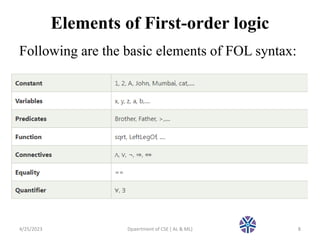
Elements of First-order logic
Following are the basic elements of FOL syntax:
4/25/2023 8
Dpaertment of CSE ( AL & ML)
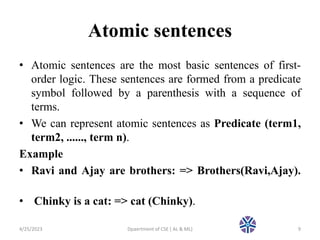
Atomic sentences
• Atomic sentences are the most basic sentences of first-
order logic. These sentences are formed from a predicate
symbol followed by a parenthesis with a sequence of
terms.
• We can represent atomic sentences as Predicate (term1,
term2, ......, term n).
Example
• Ravi and Ajay are brothers: => Brothers(Ravi,Ajay).
• Chinky is a cat: => cat (Chinky).
4/25/2023 9
Dpaertment of CSE ( AL & ML)
Complex Sentences
• Complex sentences are made by combining
atomic sentences using connectives.
• First-order logic statements can be divided
into two parts:
– Subject: Subject is the main part of the statement.
– Predicate: A predicate can be defined as a relation,
which binds two atoms together in a statement.
4/25/2023 10
Dpaertment of CSE ( AL & ML)
Complex Sentences
• Consider the statement: "x is an integer.", it
consists of two parts, the first part x is the
subject of the statement and second part "is an
integer," is known as a predicate.
4/25/2023 11
Dpaertment of CSE ( AL & ML)
Quantifiers in First-order logic
• A quantifier is a language element which
generates quantification, and quantification
specifies the quantity of specimen in the universe
of discourse.
• These are the symbols that permit to determine or
identify the range and scope of the variable in the
logical expression. There are two types of
quantifier:
– Universal Quantifier, (for all, everyone, everything)
– Existential quantifier, (for some, at least one).
4/25/2023 12
Dpaertment of CSE ( AL & ML)
Universal Quantifier
• Universal quantifier is a symbol of logical
representation, which specifies that the statement
within its range is true for everything or every
instance of a particular thing.
• The Universal quantifier is represented by a
symbol ∀, which resembles an inverted A.
• If x is a variable, then ∀x is read as:
• For all x
• For each x
• For every x.
4/25/2023 13
Dpaertment of CSE ( AL & ML)
Example
• All man drink coffee.
• Let a variable x which refers to a cat so all x can berepresented
in UOD as below:
4/25/2023 14
Dpaertment of CSE ( AL & ML)
Existential Quantifier
• Existential quantifiers are the type of quantifiers,
which express that the statement within its scope
is true for at least one instance of something.
• It is denoted by the logical operator ∃, which
resembles as inverted E. When it is used with a
predicate variable then it is called as an existential
quantifier.
• If x is a variable, then existential quantifier will
be ∃x or ∃(x). And it will be read as:
• There exists a 'x.'
• For some 'x.'
• For at least one 'x.'
4/25/2023 15
Dpaertment of CSE ( AL & ML)
4/25/2023 Dpaertment of CSE ( AL & ML) 16
Points to remember
• The main connective for universal
quantifier ∀ is implication →.
• The main connective for existential
quantifier ∃ is and ∧.
4/25/2023 Dpaertment of CSE ( AL & ML) 17
Properties of Quantifiers
• In universal quantifier, ∀x∀y is similar to
∀y∀x.
• In Existential quantifier, ∃x∃y is similar to
∃y∃x.
• ∃x∀y is not similar to ∀y∃x.
4/25/2023 Dpaertment of CSE ( AL & ML) 18
Example 1
All birds fly.
In this question the predicate is "fly(bird)."
And since there are all birds who fly so it will be
represented as follows.
∀x bird(x) →fly(x).
4/25/2023 Dpaertment of CSE ( AL & ML) 19
Example 2
Every man respects his parent.
In this question, the predicate is
"respect(x, y)," where x=man, and y= parent.
Since there is every man so will use ∀, and it
will be represented as follows:
∀x man(x) → respects (x, parent).
4/25/2023 Dpaertment of CSE ( AL & ML) 20
Example 3
• Some boys play cricket.
4/25/2023 Dpaertment of CSE ( AL & ML) 21
Example 3
Some boys play cricket.
In this question, the predicate is "play(x, y),"
where x= boys, and y= game. Since there are
some boys so we will use ∃, and it will be
represented as:
∃x boys(x) → play(x, cricket).
4/25/2023 Dpaertment of CSE ( AL & ML) 22
Topics to be covered in next session 22
• First Order Logic (FOL)
Thank you!!!
4/25/2023 Dpaertment of CSE ( AL & ML) 23

AI_Session 21 First order logic.pptx

  • 1.
    ARTIFICAL INTELLIGENCE (R18 III(IISem)) Department of computer science and engineering (AI/ML) Session 21 by Asst.Prof.M.Gokilavani VITS 4/25/2023 Dpaertment of CSE ( AL & ML) 1
  • 2.
    TEXTBOOK: • Artificial IntelligenceA modern Approach, Third Edition, Stuart Russell and Peter Norvig, Pearson Education. REFERENCES: • Artificial Intelligence, 3rd Edn, E. Rich and K.Knight (TMH). • Artificial Intelligence, 3rd Edn, Patrick Henny Winston, Pearson Education. • Artificial Intelligence, Shivani Goel, Pearson Education. • Artificial Intelligence and Expert Systems- Patterson, Pearson Education. 4/25/2023 Dpaertment of CSE ( AL & ML) 2
  • 3.
    Topics covered insession 21 4/25/2023 Dpaertment of CSE ( AL & ML) 3 Logic and Knowledge Representation First-Order Logic: Representation, Syntax and Semantics of First-Order Logic, Using First-Order Logic, Knowledge Engineering in First-Order Logic. Inference in First-Order Logic: Propositional vs. First- Order Inference, Unification and Lifting, Forward Chaining, Backward Chaining, Resolution. Knowledge Representation: Ontological Engineering, Categories and Objects, Events. Mental Events and Mental Objects, Reasoning Systems for Categories, Reasoning with Default Information.
  • 4.
    First order logic •In the topic of Propositional logic, we have seen that how to represent statements using propositional logic. • But unfortunately, in propositional logic, we can only represent the facts, which are either true or false. • PL is not sufficient to represent the complex sentences or natural language statements. • The propositional logic has very limited expressive power. 4/25/2023 4 Dpaertment of CSE ( AL & ML)
  • 5.
    First order logic •Consider the following sentence, which we cannot represent using PL logic. "Some humans are intelligent", or "Sachin likes cricket." • To represent the above statements, PL logic is not sufficient, so we required some more powerful logic, such as first-order logic. 4/25/2023 5 Dpaertment of CSE ( AL & ML)
  • 6.
    First order logic •First-order logic is also known as Predicate logic or First-order predicate logic. • First-order logic is a powerful language that develops information about the objects in a more easy way and can also express the relationship between those objects. • First-order logic (like natural language) does not only assume that the world contains facts like propositional logic but also assumes the following things in the world: – Objects: A, B, people, numbers, colors, wars, theories, squares, pits, Wumpus. – Relations: It can be unary relation such as: red, round, is adjacent, or n-any relation such as: the sister of, brother of, has color, comes between – Function: Father of, best friend, third inning of, end of, ...... • As a natural language, first-order logic also has two main parts: – Syntax – Semantics 4/25/2023 6 Dpaertment of CSE ( AL & ML)
  • 7.
    Syntax of First-Orderlogic • The syntax of FOL determines which collection of symbols is a logical expression in first-order logic. • The basic syntactic elements of first-order logic are symbols. We write statements in short-hand notation in FOL. Example: John likes all kind of food Conversion of Facts into FOL. 4/25/2023 7 Dpaertment of CSE ( AL & ML)
  • 8.
    Elements of First-orderlogic Following are the basic elements of FOL syntax: 4/25/2023 8 Dpaertment of CSE ( AL & ML)
  • 9.
    Atomic sentences • Atomicsentences are the most basic sentences of first- order logic. These sentences are formed from a predicate symbol followed by a parenthesis with a sequence of terms. • We can represent atomic sentences as Predicate (term1, term2, ......, term n). Example • Ravi and Ajay are brothers: => Brothers(Ravi,Ajay). • Chinky is a cat: => cat (Chinky). 4/25/2023 9 Dpaertment of CSE ( AL & ML)
  • 10.
    Complex Sentences • Complexsentences are made by combining atomic sentences using connectives. • First-order logic statements can be divided into two parts: – Subject: Subject is the main part of the statement. – Predicate: A predicate can be defined as a relation, which binds two atoms together in a statement. 4/25/2023 10 Dpaertment of CSE ( AL & ML)
  • 11.
    Complex Sentences • Considerthe statement: "x is an integer.", it consists of two parts, the first part x is the subject of the statement and second part "is an integer," is known as a predicate. 4/25/2023 11 Dpaertment of CSE ( AL & ML)
  • 12.
    Quantifiers in First-orderlogic • A quantifier is a language element which generates quantification, and quantification specifies the quantity of specimen in the universe of discourse. • These are the symbols that permit to determine or identify the range and scope of the variable in the logical expression. There are two types of quantifier: – Universal Quantifier, (for all, everyone, everything) – Existential quantifier, (for some, at least one). 4/25/2023 12 Dpaertment of CSE ( AL & ML)
  • 13.
    Universal Quantifier • Universalquantifier is a symbol of logical representation, which specifies that the statement within its range is true for everything or every instance of a particular thing. • The Universal quantifier is represented by a symbol ∀, which resembles an inverted A. • If x is a variable, then ∀x is read as: • For all x • For each x • For every x. 4/25/2023 13 Dpaertment of CSE ( AL & ML)
  • 14.
    Example • All mandrink coffee. • Let a variable x which refers to a cat so all x can berepresented in UOD as below: 4/25/2023 14 Dpaertment of CSE ( AL & ML)
  • 15.
    Existential Quantifier • Existentialquantifiers are the type of quantifiers, which express that the statement within its scope is true for at least one instance of something. • It is denoted by the logical operator ∃, which resembles as inverted E. When it is used with a predicate variable then it is called as an existential quantifier. • If x is a variable, then existential quantifier will be ∃x or ∃(x). And it will be read as: • There exists a 'x.' • For some 'x.' • For at least one 'x.' 4/25/2023 15 Dpaertment of CSE ( AL & ML)
  • 16.
    4/25/2023 Dpaertment ofCSE ( AL & ML) 16
  • 17.
    Points to remember •The main connective for universal quantifier ∀ is implication →. • The main connective for existential quantifier ∃ is and ∧. 4/25/2023 Dpaertment of CSE ( AL & ML) 17
  • 18.
    Properties of Quantifiers •In universal quantifier, ∀x∀y is similar to ∀y∀x. • In Existential quantifier, ∃x∃y is similar to ∃y∃x. • ∃x∀y is not similar to ∀y∃x. 4/25/2023 Dpaertment of CSE ( AL & ML) 18
  • 19.
    Example 1 All birdsfly. In this question the predicate is "fly(bird)." And since there are all birds who fly so it will be represented as follows. ∀x bird(x) →fly(x). 4/25/2023 Dpaertment of CSE ( AL & ML) 19
  • 20.
    Example 2 Every manrespects his parent. In this question, the predicate is "respect(x, y)," where x=man, and y= parent. Since there is every man so will use ∀, and it will be represented as follows: ∀x man(x) → respects (x, parent). 4/25/2023 Dpaertment of CSE ( AL & ML) 20
  • 21.
    Example 3 • Someboys play cricket. 4/25/2023 Dpaertment of CSE ( AL & ML) 21
  • 22.
    Example 3 Some boysplay cricket. In this question, the predicate is "play(x, y)," where x= boys, and y= game. Since there are some boys so we will use ∃, and it will be represented as: ∃x boys(x) → play(x, cricket). 4/25/2023 Dpaertment of CSE ( AL & ML) 22
  • 23.
    Topics to becovered in next session 22 • First Order Logic (FOL) Thank you!!! 4/25/2023 Dpaertment of CSE ( AL & ML) 23