OU Neurology
Introduction to Head CT
Imaging
Ryan Hakimi, DO, MS
Assistant Professor
Director, Critical Care Neurology
Emmaculate Fields, APRN-CNP
Clinical Instructor
Department of Neurology
The University of Oklahoma Health Sciences Center
OU Neurology
DISCLOSURES
FINANCIAL DISCLOSURE
Nothing to disclose
UNLABELED/UNAPPROVED USES
DISCLOSURE
Nothing to disclose
Some slides have been adapted from
teaching modules at OU, UIC, and NSA
OU Neurology
LEARNING OBJECTIVES
Upon completion of this course, participants
will be able to:
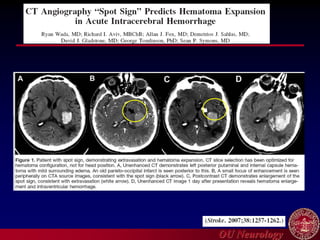
Understand the basics of head CT imaging
Identify and describe basic cerebral
anatomy
Develop an approach to head CT
interpretation
Identify pathologic lesions found on head
CT
OU Neurology
CT BASICS
 CT uses x-rays
 Provides axial brain view
 CT scan measures density of the tissue being
studied
OU Neurology
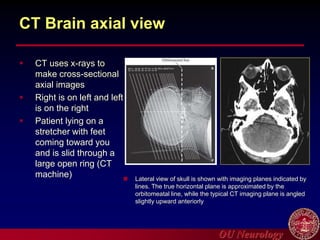
CT Brain axial view
 CT uses x-rays to
make cross-sectional
axial images
 Right is on left and left
is on the right
 Patient lying on a
stretcher with feet
coming toward you
and is slid through a
large open ring (CT
machine)  Lateral view of skull is shown with imaging planes indicated by
lines. The true horizontal plane is approximated by the
orbitomeatal line, while the typical CT imaging plane is angled
slightly upward anteriorly
OU Neurology
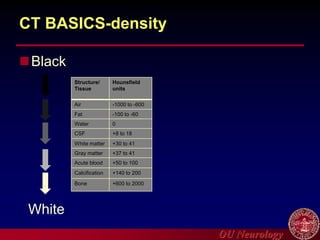
CT BASICS-density
Black
Structure/
Tissue
Hounsfield
units
Air -1000 to -600
Fat -100 to -60
Water 0
CSF +8 to 18
White matter +30 to 41
Gray matter +37 to 41
Acute blood +50 to 100
Calcification +140 to 200
Bone +600 to 2000
White
OU Neurology
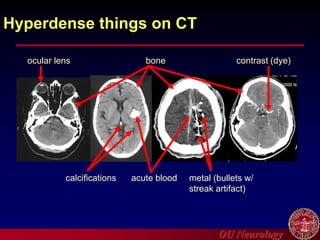
Hyperdense things on CT
acute blood
ocular lens
calcifications
contrast (dye)
bone
metal (bullets w/
streak artifact)
OU Neurology
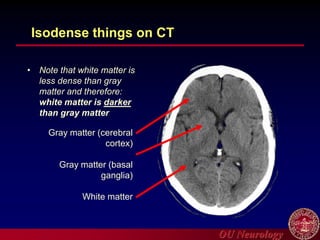
Isodense things on CT
• Note that white matter is
less dense than gray
matter and therefore:
white matter is darker
than gray matter
Gray matter (cerebral
cortex)
Gray matter (basal
ganglia)
White matter
OU Neurology
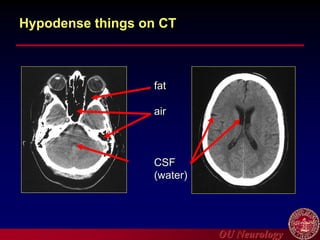
Hypodense things on CT
fat
air
CSF
(water)
OU Neurology
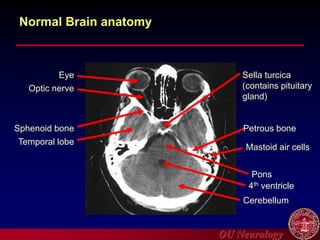
Sella turcica
(contains pituitary
gland)
Petrous bone
Mastoid air cells
Pons
4th ventricle
Cerebellum
Eye
Optic nerve
Sphenoid bone
Temporal lobe
Normal Brain anatomy
OU Neurology
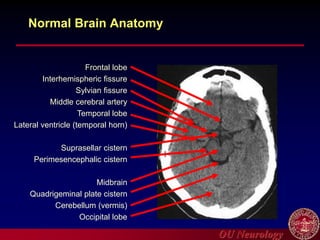
Normal Brain Anatomy
Frontal lobe
Interhemispheric fissure
Sylvian fissure
Middle cerebral artery
Temporal lobe
Lateral ventricle (temporal horn)
Suprasellar cistern
Perimesencephalic cistern
Midbrain
Quadrigeminal plate cistern
Cerebellum (vermis)
Occipital lobe
OU Neurology
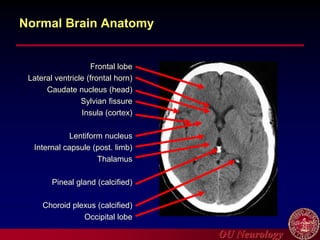
Normal Brain Anatomy
Lateral ventricle (frontal horn)
Frontal lobe
Caudate nucleus (head)
Sylvian fissure
Insula (cortex)
Lentiform nucleus
Internal capsule (post. limb)
Thalamus
Pineal gland (calcified)
Choroid plexus (calcified)
Occipital lobe
OU Neurology
Approach to Reading a CT scan- ABBBC
 A- Air-filled structures (sinuses, mastoid air cells)
 B- Bones (fractures)
 B- Blood (subarachnoid, intracerebral, subdural,
epidural hematoma)
 B- Brain tissue (infarction, edema, masses, brain
shift
 C- CSF spaces (sulci, ventricles, cisterns,
hydrocephalus, atrophy)
OU Neurology
A- Air-filled Structures
 Normal air spaces are black both on bone and brain
window (frontal, maxillary, ethmoid, and sphenoid
sinuses)
 Mastoids are spongy bone filled with tiny pockets of air
When these pockets are opacified you will see a (gray or
white) shade
 Air-fluid levels in the setting of trauma suggest a fracture
 Mastoid opacification without trauma indicates
mastoiditis
OU Neurology
B- Bones
Useful when trauma is suspected
Window your image for bone reading
Recognize normal suture structures
(usually visible on both sides)
If fracture suspected, inspect the opposite
side for similar finding
If not present then look for abnormalities
associated with the fracture
(air/pneumocephalus, black spots within the
hemorrhage)
OU Neurology
B- Blood
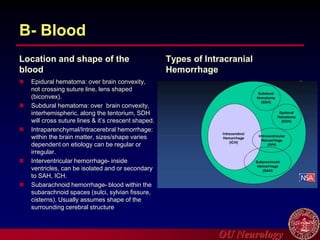
Location and shape of the
blood
 Epidural hematoma: over brain convexity,
not crossing suture line, lens shaped
(biconvex).
 Subdural hematoma: over brain convexity,
interhemispheric, along the tentorium, SDH
will cross suture lines & it’s crescent shaped.
 Intraparenchymal/Intracerebral hemorrhage:
within the brain matter, sizes/shape varies
dependent on etiology can be regular or
irregular.
 Interventricular hemorrhage- inside
ventricles, can be isolated and or secondary
to SAH, ICH.
 Subarachnoid hemorrhage- blood within the
subarachnoid spaces (sulci, sylvian fissure,
cisterns). Usually assumes shape of the
surrounding cerebral structure
Types of Intracranial
Hemorrhage
OU Neurology
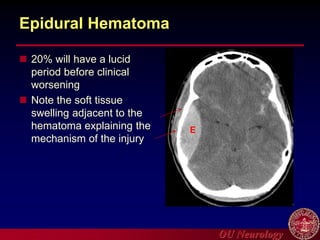
Epidural Hematoma
 20% will have a lucid
period before clinical
worsening
 Note the soft tissue
swelling adjacent to the
hematoma explaining the
mechanism of the injury
E
OU Neurology
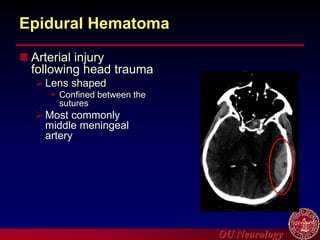
Epidural Hematoma
 Arterial injury
following head trauma
Lens shaped
 Confined between the
sutures
Most commonly
middle meningeal
artery
OU Neurology
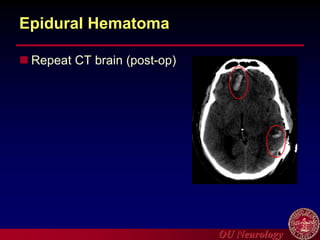
Epidural Hematoma
 Repeat CT brain (post-op)
OU Neurology
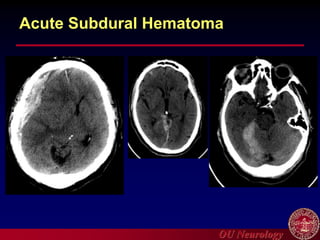
Subdural Hematoma (SDH)
Differentiate between acute, subacute,
chronic, or acute on chronic
Acute SDH
 Bright white on CT
 Can only be removed with a craniotomy
 Doesn’t always require surgery, depends on the
patient’s neurological examination and
comorbidities
 Usually related to shearing of bridging veins
between the dura and brain
OU Neurology
Acute Subdural Hematoma
OU Neurology
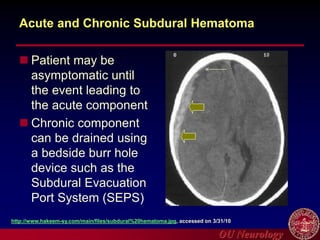
Acute and Chronic Subdural Hematoma
 Patient may be
asymptomatic until
the event leading to
the acute component
 Chronic component
can be drained using
a bedside burr hole
device such as the
Subdural Evacuation
Port System (SEPS)
http://www.hakeem-sy.com/main/files/subdural%20hematoma.jpg, accessed on 3/31/10
OU Neurology
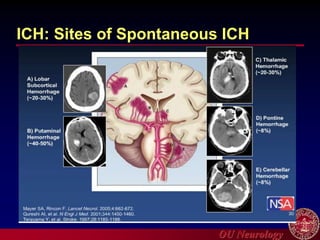
ICH: Sites of Spontaneous ICH
OU Neurology
OU Neurology
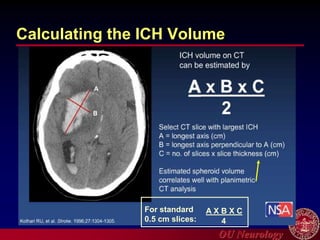
Calculating the ICH Volume
A X B X C
4
For standard
0.5 cm slices:
OU Neurology
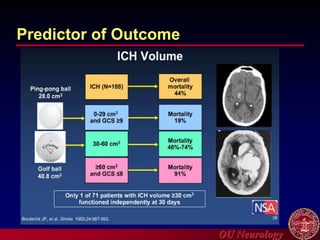
Predictor of Outcome
OU Neurology
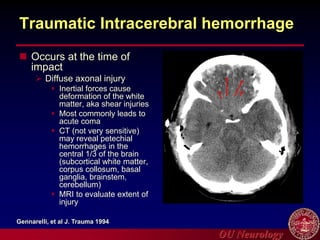
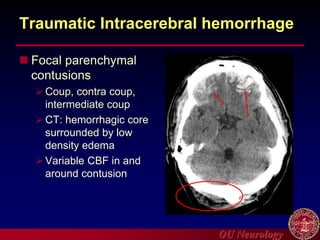
Traumatic Intracerebral hemorrhage
 Occurs at the time of
impact
 Diffuse axonal injury
 Inertial forces cause
deformation of the white
matter, aka shear injuries
 Most commonly leads to
acute coma
 CT (not very sensitive)
may reveal petechial
hemorrhages in the
central 1/3 of the brain
(subcortical white matter,
corpus collosum, basal
ganglia, brainstem,
cerebellum)
 MRI to evaluate extent of
injury
Gennarelli, et al J. Trauma 1994
OU Neurology
Traumatic Intracerebral hemorrhage
 Focal parenchymal
contusions
Coup, contra coup,
intermediate coup
CT: hemorrhagic core
surrounded by low
density edema
Variable CBF in and
around contusion
OU Neurology
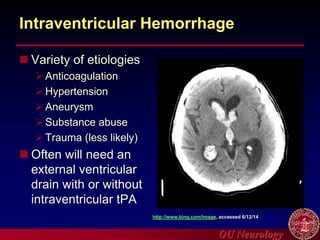
Intraventricular Hemorrhage
 Variety of etiologies
Anticoagulation
Hypertension
Aneurysm
Substance abuse
Trauma (less likely)
 Often will need an
external ventricular
drain with or without
intraventricular tPA
http://www.bing.com/image, accessed 6/12/14
OU Neurology
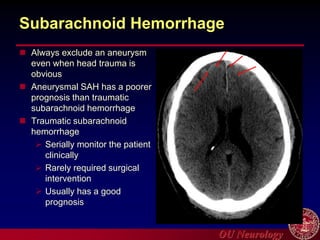
Subarachnoid Hemorrhage
 Always exclude an aneurysm
even when head trauma is
obvious
 Aneurysmal SAH has a poorer
prognosis than traumatic
subarachnoid hemorrhage
 Traumatic subarachnoid
hemorrhage
 Serially monitor the patient
clinically
 Rarely required surgical
intervention
 Usually has a good
prognosis
OU Neurology
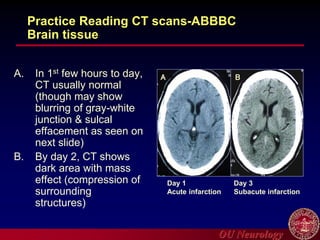
Practice Reading CT scans-ABBBC
Brain tissue
A. In 1st few hours to day,
CT usually normal
(though may show
blurring of gray-white
junction & sulcal
effacement as seen on
next slide)
B. By day 2, CT shows
dark area with mass
effect (compression of
surrounding
structures)
Day 3
Subacute infarction
Day 1
Acute infarction
A B
OU Neurology
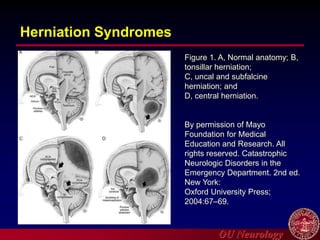
Figure 1. A, Normal anatomy; B,
tonsillar herniation;
C, uncal and subfalcine
herniation; and
D, central herniation.
By permission of Mayo
Foundation for Medical
Education and Research. All
rights reserved. Catastrophic
Neurologic Disorders in the
Emergency Department. 2nd ed.
New York:
Oxford University Press;
2004:67–69.
Herniation Syndromes
OU Neurology
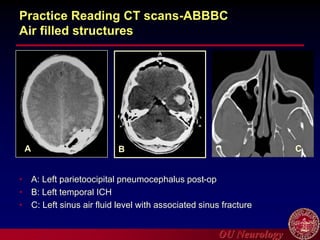
Practice Reading CT scans-ABBBC
Air filled structures
• A: Left parietoocipital pneumocephalus post-op
• B: Left temporal ICH
• C: Left sinus air fluid level with associated sinus fracture
A B C
OU Neurology
Thank you

Intro Head CT.ppt

  • 1.
    OU Neurology Introduction toHead CT Imaging Ryan Hakimi, DO, MS Assistant Professor Director, Critical Care Neurology Emmaculate Fields, APRN-CNP Clinical Instructor Department of Neurology The University of Oklahoma Health Sciences Center
  • 2.
    OU Neurology DISCLOSURES FINANCIAL DISCLOSURE Nothingto disclose UNLABELED/UNAPPROVED USES DISCLOSURE Nothing to disclose Some slides have been adapted from teaching modules at OU, UIC, and NSA
  • 3.
    OU Neurology LEARNING OBJECTIVES Uponcompletion of this course, participants will be able to: Understand the basics of head CT imaging Identify and describe basic cerebral anatomy Develop an approach to head CT interpretation Identify pathologic lesions found on head CT
  • 4.
    OU Neurology CT BASICS CT uses x-rays  Provides axial brain view  CT scan measures density of the tissue being studied
  • 5.
    OU Neurology CT Brainaxial view  CT uses x-rays to make cross-sectional axial images  Right is on left and left is on the right  Patient lying on a stretcher with feet coming toward you and is slid through a large open ring (CT machine)  Lateral view of skull is shown with imaging planes indicated by lines. The true horizontal plane is approximated by the orbitomeatal line, while the typical CT imaging plane is angled slightly upward anteriorly
  • 6.
    OU Neurology CT BASICS-density Black Structure/ Tissue Hounsfield units Air-1000 to -600 Fat -100 to -60 Water 0 CSF +8 to 18 White matter +30 to 41 Gray matter +37 to 41 Acute blood +50 to 100 Calcification +140 to 200 Bone +600 to 2000 White
  • 7.
    OU Neurology Hyperdense thingson CT acute blood ocular lens calcifications contrast (dye) bone metal (bullets w/ streak artifact)
  • 8.
    OU Neurology Isodense thingson CT • Note that white matter is less dense than gray matter and therefore: white matter is darker than gray matter Gray matter (cerebral cortex) Gray matter (basal ganglia) White matter
  • 9.
    OU Neurology Hypodense thingson CT fat air CSF (water)
  • 10.
    OU Neurology Sella turcica (containspituitary gland) Petrous bone Mastoid air cells Pons 4th ventricle Cerebellum Eye Optic nerve Sphenoid bone Temporal lobe Normal Brain anatomy
  • 11.
    OU Neurology Normal BrainAnatomy Frontal lobe Interhemispheric fissure Sylvian fissure Middle cerebral artery Temporal lobe Lateral ventricle (temporal horn) Suprasellar cistern Perimesencephalic cistern Midbrain Quadrigeminal plate cistern Cerebellum (vermis) Occipital lobe
  • 12.
    OU Neurology Normal BrainAnatomy Lateral ventricle (frontal horn) Frontal lobe Caudate nucleus (head) Sylvian fissure Insula (cortex) Lentiform nucleus Internal capsule (post. limb) Thalamus Pineal gland (calcified) Choroid plexus (calcified) Occipital lobe
  • 13.
    OU Neurology Approach toReading a CT scan- ABBBC  A- Air-filled structures (sinuses, mastoid air cells)  B- Bones (fractures)  B- Blood (subarachnoid, intracerebral, subdural, epidural hematoma)  B- Brain tissue (infarction, edema, masses, brain shift  C- CSF spaces (sulci, ventricles, cisterns, hydrocephalus, atrophy)
  • 14.
    OU Neurology A- Air-filledStructures  Normal air spaces are black both on bone and brain window (frontal, maxillary, ethmoid, and sphenoid sinuses)  Mastoids are spongy bone filled with tiny pockets of air When these pockets are opacified you will see a (gray or white) shade  Air-fluid levels in the setting of trauma suggest a fracture  Mastoid opacification without trauma indicates mastoiditis
  • 15.
    OU Neurology B- Bones Usefulwhen trauma is suspected Window your image for bone reading Recognize normal suture structures (usually visible on both sides) If fracture suspected, inspect the opposite side for similar finding If not present then look for abnormalities associated with the fracture (air/pneumocephalus, black spots within the hemorrhage)
  • 16.
    OU Neurology B- Blood Locationand shape of the blood  Epidural hematoma: over brain convexity, not crossing suture line, lens shaped (biconvex).  Subdural hematoma: over brain convexity, interhemispheric, along the tentorium, SDH will cross suture lines & it’s crescent shaped.  Intraparenchymal/Intracerebral hemorrhage: within the brain matter, sizes/shape varies dependent on etiology can be regular or irregular.  Interventricular hemorrhage- inside ventricles, can be isolated and or secondary to SAH, ICH.  Subarachnoid hemorrhage- blood within the subarachnoid spaces (sulci, sylvian fissure, cisterns). Usually assumes shape of the surrounding cerebral structure Types of Intracranial Hemorrhage
  • 17.
    OU Neurology Epidural Hematoma 20% will have a lucid period before clinical worsening  Note the soft tissue swelling adjacent to the hematoma explaining the mechanism of the injury E
  • 18.
    OU Neurology Epidural Hematoma Arterial injury following head trauma Lens shaped  Confined between the sutures Most commonly middle meningeal artery
  • 19.
    OU Neurology Epidural Hematoma Repeat CT brain (post-op)
  • 20.
    OU Neurology Subdural Hematoma(SDH) Differentiate between acute, subacute, chronic, or acute on chronic Acute SDH  Bright white on CT  Can only be removed with a craniotomy  Doesn’t always require surgery, depends on the patient’s neurological examination and comorbidities  Usually related to shearing of bridging veins between the dura and brain
  • 21.
  • 22.
    OU Neurology Acute andChronic Subdural Hematoma  Patient may be asymptomatic until the event leading to the acute component  Chronic component can be drained using a bedside burr hole device such as the Subdural Evacuation Port System (SEPS) http://www.hakeem-sy.com/main/files/subdural%20hematoma.jpg, accessed on 3/31/10
  • 23.
    OU Neurology ICH: Sitesof Spontaneous ICH
  • 24.
  • 25.
    OU Neurology Calculating theICH Volume A X B X C 4 For standard 0.5 cm slices:
  • 26.
  • 27.
    OU Neurology Traumatic Intracerebralhemorrhage  Occurs at the time of impact  Diffuse axonal injury  Inertial forces cause deformation of the white matter, aka shear injuries  Most commonly leads to acute coma  CT (not very sensitive) may reveal petechial hemorrhages in the central 1/3 of the brain (subcortical white matter, corpus collosum, basal ganglia, brainstem, cerebellum)  MRI to evaluate extent of injury Gennarelli, et al J. Trauma 1994
  • 28.
    OU Neurology Traumatic Intracerebralhemorrhage  Focal parenchymal contusions Coup, contra coup, intermediate coup CT: hemorrhagic core surrounded by low density edema Variable CBF in and around contusion
  • 29.
    OU Neurology Intraventricular Hemorrhage Variety of etiologies Anticoagulation Hypertension Aneurysm Substance abuse Trauma (less likely)  Often will need an external ventricular drain with or without intraventricular tPA http://www.bing.com/image, accessed 6/12/14
  • 30.
    OU Neurology Subarachnoid Hemorrhage Always exclude an aneurysm even when head trauma is obvious  Aneurysmal SAH has a poorer prognosis than traumatic subarachnoid hemorrhage  Traumatic subarachnoid hemorrhage  Serially monitor the patient clinically  Rarely required surgical intervention  Usually has a good prognosis
  • 31.
    OU Neurology Practice ReadingCT scans-ABBBC Brain tissue A. In 1st few hours to day, CT usually normal (though may show blurring of gray-white junction & sulcal effacement as seen on next slide) B. By day 2, CT shows dark area with mass effect (compression of surrounding structures) Day 3 Subacute infarction Day 1 Acute infarction A B
  • 32.
    OU Neurology Figure 1.A, Normal anatomy; B, tonsillar herniation; C, uncal and subfalcine herniation; and D, central herniation. By permission of Mayo Foundation for Medical Education and Research. All rights reserved. Catastrophic Neurologic Disorders in the Emergency Department. 2nd ed. New York: Oxford University Press; 2004:67–69. Herniation Syndromes
  • 33.
    OU Neurology Practice ReadingCT scans-ABBBC Air filled structures • A: Left parietoocipital pneumocephalus post-op • B: Left temporal ICH • C: Left sinus air fluid level with associated sinus fracture A B C
  • 34.