JENISHIA M
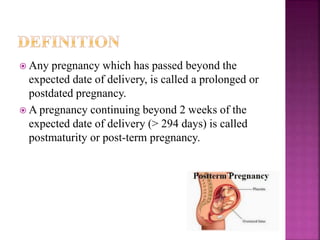
 Any pregnancy which has passed beyond the
expected date of delivery, is called a prolonged or
postdated pregnancy.
 A pregnancy continuing beyond 2 weeks of the
expected date of delivery (> 294 days) is called
postmaturity or post-term pregnancy.
 The incidence of pregnancies continuing beyond
42 completed weeks (> 294 days) ranges between
4% and 14%. The average is about 10%.
 Wrong dates—due to inaccurate LMP (most
common)
 Biological variability (Hereditary) may be seen in
the family
 Maternal factors: Primiparity, previous prolonged
pregnancy, sedentary habit, elderly multiparae
 Fetal factors: Congenital anomalies: Anencephaly
→ abnormal fetal HPA axis and adrenal hypoplasia
→ diminished fetal cortisol response
 Placental factors: Sulfatase deficiency → low
estrogen.
 Menstrual History
 The suggested clinical findings when a pregnancy
overruns the expected date by 2 weeks are:
 Weight record: Regular periodic weight checking reveals
stationary or even falling weight.
 Girth of the abdomen: It diminishes gradually because of
diminishing liquor.
 History of false pain: Appearance of false pain followed by
its subsidence is suggestive.
 Obstetric palpation: The following findings, taken together
are helpful. These are : height of the uterus, size of the fetus
and hardness of the skull bones. As the liquor amnii
diminishes, the uterus feels “full of fetus”— a feature
usually associated with postmaturity.
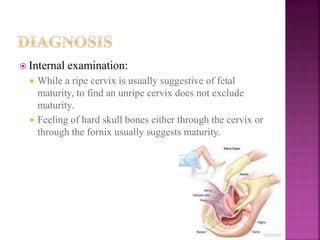
 Internal examination:
 While a ripe cervix is usually suggestive of fetal
maturity, to find an unripe cervix does not exclude
maturity.
 Feeling of hard skull bones either through the cervix or
through the fornix usually suggests maturity.
 To confirm the fetal maturity
 To detect placental insufficiency
Assessment of fetal maturity:
 Sonography
 Amniocentesis(rare)
 NST and Biophysical profile (twice weekly)
 General appearance: Baby looks thin and old. Skin is
wrinkled. There is absence of vernix caseosa. Body and
the cord are stained with greenish yellow color. Head is
hard without much evidence of molding. Nails are
protruding beyond the nail beds;
 Weight often more than 3 kg and length is about 54 cm.
Both are variable and even an IUGR baby may be
born.
 Liquor amnii: Scanty and may be stained with
meconium.
 Placenta: There is evidence of aging of the placenta
manifested by excessive infarction and calcification.
 Cord: There is diminished quantity of Wharton’s jelly
which may precipitate cord compression.
 FETAL: During pregnancy—There is diminished
placental function, oligohydramnios and meconium
stained liquor. These lead to fetal hypoxia and fetal
distress.
 During labor
 Fetal hypoxia and acidosis
 Labor dysfunction
 Meconium aspiration;
 Risks of cord compression due to oligohydramnios
 Shoulder dystocia
 Increased incidence of birth trauma due to big size baby and
non-molding of head due to hardening of skull bones
 Increased incidence of operative delivery. The main clinical
significance of post-term pregnancy is dysmaturity or
macrosomia.
 Following birth
 Chemical pneumonitis, atelectasis and pulmonary
hypertension are due to meconium aspiration
 Hypoxia (low Apgar scores) and respiratory failure
 Hypoglycemia and polycythemia and
 Increased NICU admissions.
 Perinatal morbidity and mortality is calculated in
terms of stillbirth. The risk of stillbirth is increased
by about threefold from 37 weeks (0.4 per 1,000)
to 43 weeks (11.5 per 1,000).
MATERNAL
 There is increased morbidity, incidental to hazards
of induction, instrumental and operative delivery.
Postmaturity itself does not put the mother at risk
 Carefully assess the fetus to identify risk.
 Perform a careful risk assessment upon admission.
 Closely monitor fetal status.
 Prevent birth complications.
 Assist with induction of labor
 Prepare for a difficult delivery
 Notify the pediatric staff of the potential for a birth-
injured baby.
 Provide physical and emotional support.
 Provide client and family education.
PROLONGED PREGNANCY.pptx

PROLONGED PREGNANCY.pptx

  • 1.
  • 2.
     Any pregnancywhich has passed beyond the expected date of delivery, is called a prolonged or postdated pregnancy.  A pregnancy continuing beyond 2 weeks of the expected date of delivery (> 294 days) is called postmaturity or post-term pregnancy.
  • 3.
     The incidenceof pregnancies continuing beyond 42 completed weeks (> 294 days) ranges between 4% and 14%. The average is about 10%.
  • 4.
     Wrong dates—dueto inaccurate LMP (most common)  Biological variability (Hereditary) may be seen in the family  Maternal factors: Primiparity, previous prolonged pregnancy, sedentary habit, elderly multiparae  Fetal factors: Congenital anomalies: Anencephaly → abnormal fetal HPA axis and adrenal hypoplasia → diminished fetal cortisol response  Placental factors: Sulfatase deficiency → low estrogen.
  • 5.
     Menstrual History The suggested clinical findings when a pregnancy overruns the expected date by 2 weeks are:  Weight record: Regular periodic weight checking reveals stationary or even falling weight.  Girth of the abdomen: It diminishes gradually because of diminishing liquor.  History of false pain: Appearance of false pain followed by its subsidence is suggestive.  Obstetric palpation: The following findings, taken together are helpful. These are : height of the uterus, size of the fetus and hardness of the skull bones. As the liquor amnii diminishes, the uterus feels “full of fetus”— a feature usually associated with postmaturity.
  • 6.
     Internal examination: While a ripe cervix is usually suggestive of fetal maturity, to find an unripe cervix does not exclude maturity.  Feeling of hard skull bones either through the cervix or through the fornix usually suggests maturity.
  • 7.
     To confirmthe fetal maturity  To detect placental insufficiency Assessment of fetal maturity:  Sonography  Amniocentesis(rare)  NST and Biophysical profile (twice weekly)
  • 8.
     General appearance:Baby looks thin and old. Skin is wrinkled. There is absence of vernix caseosa. Body and the cord are stained with greenish yellow color. Head is hard without much evidence of molding. Nails are protruding beyond the nail beds;  Weight often more than 3 kg and length is about 54 cm. Both are variable and even an IUGR baby may be born.  Liquor amnii: Scanty and may be stained with meconium.  Placenta: There is evidence of aging of the placenta manifested by excessive infarction and calcification.  Cord: There is diminished quantity of Wharton’s jelly which may precipitate cord compression.
  • 10.
     FETAL: Duringpregnancy—There is diminished placental function, oligohydramnios and meconium stained liquor. These lead to fetal hypoxia and fetal distress.  During labor  Fetal hypoxia and acidosis  Labor dysfunction  Meconium aspiration;  Risks of cord compression due to oligohydramnios  Shoulder dystocia  Increased incidence of birth trauma due to big size baby and non-molding of head due to hardening of skull bones  Increased incidence of operative delivery. The main clinical significance of post-term pregnancy is dysmaturity or macrosomia.
  • 11.
     Following birth Chemical pneumonitis, atelectasis and pulmonary hypertension are due to meconium aspiration  Hypoxia (low Apgar scores) and respiratory failure  Hypoglycemia and polycythemia and  Increased NICU admissions.  Perinatal morbidity and mortality is calculated in terms of stillbirth. The risk of stillbirth is increased by about threefold from 37 weeks (0.4 per 1,000) to 43 weeks (11.5 per 1,000).
  • 12.
    MATERNAL  There isincreased morbidity, incidental to hazards of induction, instrumental and operative delivery. Postmaturity itself does not put the mother at risk
  • 13.
     Carefully assessthe fetus to identify risk.  Perform a careful risk assessment upon admission.  Closely monitor fetal status.  Prevent birth complications.  Assist with induction of labor  Prepare for a difficult delivery  Notify the pediatric staff of the potential for a birth- injured baby.  Provide physical and emotional support.  Provide client and family education.