An intrauterine device (IUD) is a long-acting reversible contraceptive device that is inserted into the uterus to prevent pregnancy for an extended period of time. There are two main types - non-medicated IUDs which cause inflammation to produce a sterile environment, and medicated IUDs which release copper ions or progesterone. Copper IUDs like the Cu-7 and T-shaped devices release copper ions that have spermicidal and spermatocidal effects as well as inhibiting sperm binding and fertilized egg implantation. Potential future IUD designs include membrane-controlled drug reservoirs and biodegradable polymer matrix systems to provide consistent drug release over time. While highly effective, IUD
• What isan Intrauterine Contraceptive Devices (IUD)?
IUD’s are medicated or non-medicated devices which exerts
it’s contraceptive action in the uterine cavity continuously for a
prolonged period of time without requiring patients motivation.
• How Does an IUD Work?
An IUD prevents sperm from meeting an egg.
An IUD may stop a fertilized egg from growing inside the
uterus.
3.
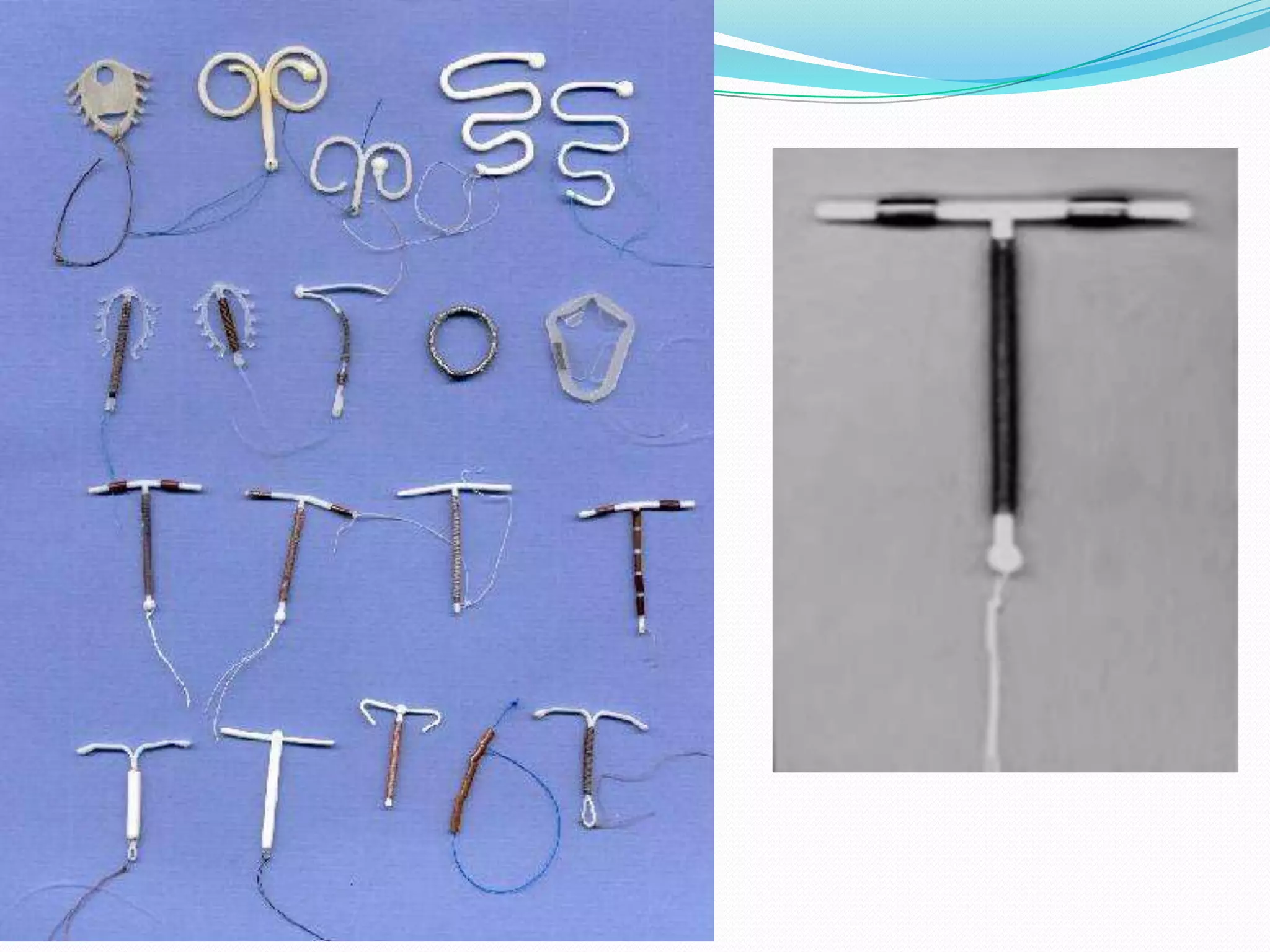
Types of IUD’s:
1.Non-medicated IUD’s:
Contraceptive action by producing sterile inflammatory
response in Endometrium. These are available in ring shaped
IUD’s made up of s.s and plastic fabricated form
polyethylene, polypropylene.
2. Medicated IUD’s:
- Copper IUD’s
- Progesterone releasing IUD’s
4.
Copper bearing IUD’s:
A)7-Shaped IUD:
- Further development of the concept of intra-uterine
contraception by metallic copper has resulted in copper barring
IUD, which contains 89mg copper wire, wound around the
vertical limb of a 7-shaped polypropylene device, to give an
effective surface of approximately 200mm2 used for 3years as
intra-uterine contraceptive treatment.
• This device release copper ion at a mean daily dose of
9.87µg/day continuously in the uterine cavity for up to
40months.
• The Cu-7 appears to be substantially smaller then other.
5.
• It canbe easily inserted because of it’s special 7-configuration
in addition to its small size.
• Insertion can usually be accomplished without the need for
cervical dilation and further more removal is generally
painless.
B) T-Shaped IUD’s:
• T-shaped IUD containing 200mm2 contraceptive copper wire
winding around the vertical leg of a T-shaped polyethylene
device in the manner as copper-7 device.
• It is used for 3years of contraceptive treatment.
• This T-shaped device has a volume of 0.16cm3,which is
almost twice as large as the 7-shaped device.
7.
C) New developmentof copper bearing IUD’s:
The Cu-T-380A with 2 collars of copper positioned on the
transverse arms of the letter T. Each collar provides an
additional surface area of 30mm2. It has relatively small
surface area of copper but effective than Cu-T-200.
Another new version of copper bearing IUD:
The combined multi load copper IUD (MLCU-250) was also
introduced.
It is a compromise between Cu-T IUD, but without the central
plastic membrane and has a surface area of 250mm2 copper
wire.
The blunt apex of the device fits into the vault of the uterine
cavity without penetrating the endometrial walls and its two
arms studded side arms fully adapt to the contours of the
uterine cavity.
Potential development
1) Membranecontrolled reservoir-type drug delivery system:
These drug delivery devices consist of a polymeric membrane
that both encapsulates and controls the release of
contraceptive agent
a)Single component system:
In this system the contraceptive agent is encapsulated in its
pure solid form in a capsule fabricated form bio-compatible
polymeric materials (silicon elastomers and polyethylene-
polymers)
The release of contraceptive agent such as progesterone
follows essentially zero-order kinetics.
10.
b)Multi component system:
In this system a constant drug release profile is maintained by encapsulating
a liquid medium saturated with excess drug profiles in a rate-controlling
polymeric membrane.
2)Polymer matrix diffusion controlled drug delivery devices:
This drug delivery device is prepared by homogenously dispersing the drug
particles in a crossed linked polymeric matrix.
a)Retrievable matrix device:
This drug delivery system is designed for feasibility of retrieval at
termination of treatment. It can be easily fabricated from silicone elastomers
by premixing a drug in powder form with a semisolid silicone elastomers
before vulcanization at room or low temperature or from polyethylene by
dry mixing. The rate of drug release is not constant but time dependent.
11.
b)Bio-degradable matrix device:
This drug delivery system is designed to eliminate the need for
retrieving at the end of treatment it can be prepared by
dissolving such a poly lactic acid, in a common organic solvent
to dryness, to produce drug dispersing biodegradable matrix
devices of varying shapes and sizes,
The rate of drug-release from this type of drug delivery system
is a combination of polymer hydrolysis and drug diffusion.
12.
MECHANISM OF ANTIFERTILITYACTION OF COPPER:
• Copper is known to be cytotoxic in high concentration it
enhances the spermatocidal and spermato depressive
action of an IUD.
• The copper concentration in endometrial epithelium and
superficial stromata inhibits the binding of steroids of
their receptors.
• Cupric ion inhibits the binding of 17-β- estradiol to human
endometrial cytosol.
• Cupric ions shows only little effect on sperm motility.
• Copper wire was also “Blastocystocidal”.
13.
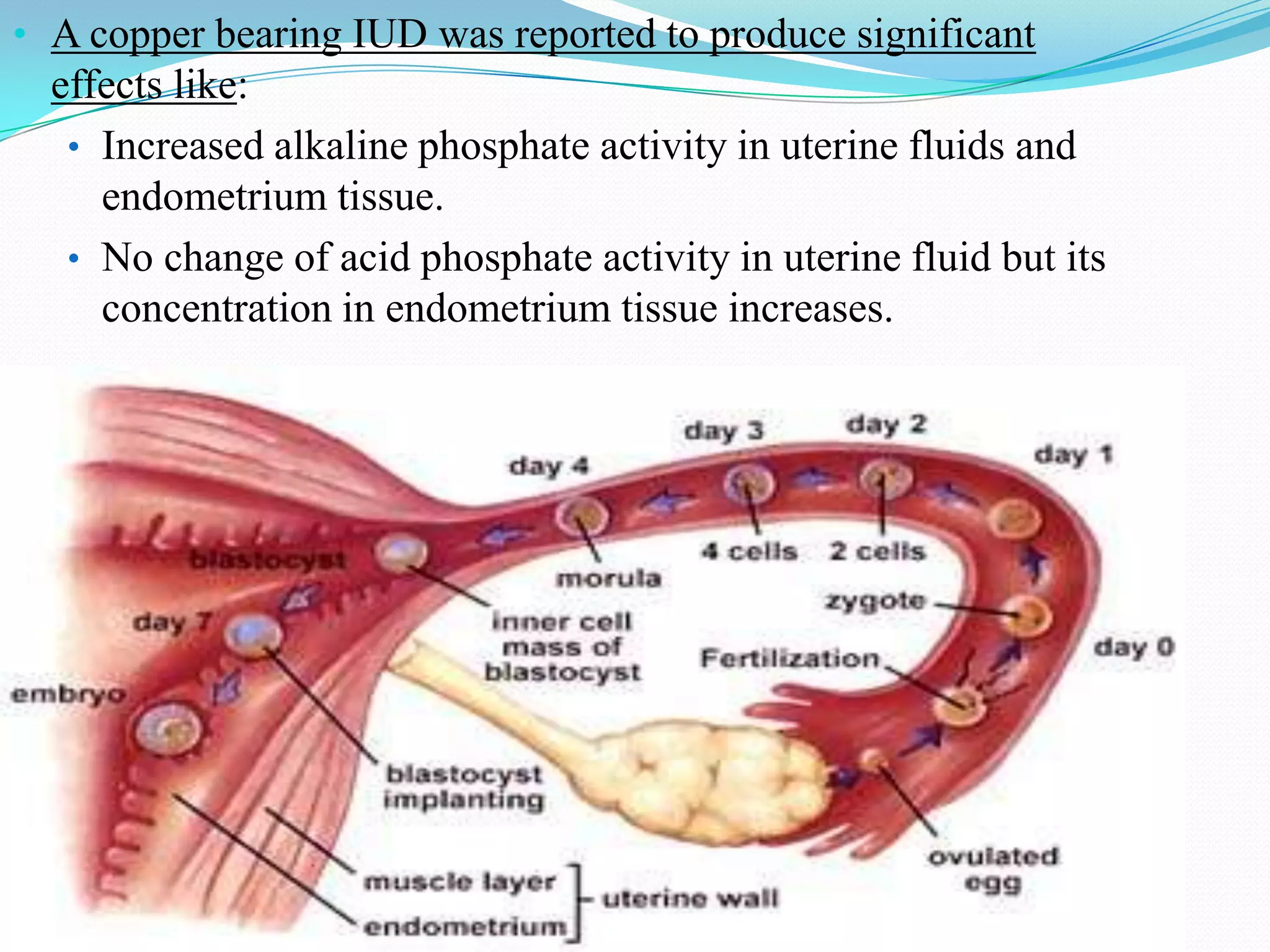
• A copperbearing IUD was reported to produce significant
effects like:
• Increased alkaline phosphate activity in uterine fluids and
endometrium tissue.
• No change of acid phosphate activity in uterine fluid but its
concentration in endometrium tissue increases.
14.
Advantages of theIUD:
Provides long-term birth control.
Cost effective.
Can be removed when a woman would like to become
pregnant.
Convenient - a woman does not need to remember it daily
or weekly.
15.
Disadvantages of anIUD:
Between 2 and 10% fall out, most commonly in the first
year of use.
Increased risk of miscarriage if an IUD is left in the uterus
during pregnancy.
In rare cases, the IUD may attach to or perforate the wall
of the uterus.
With the copper IUD, a woman may experience heavier
bleeding and cramping with periods.






![ocuserts [ocular inserts]](https://cdn.slidesharecdn.com/ss_thumbnails/tarunppt-copy2-210523054503-thumbnail.jpg?width=640&height=640&fit=bounds)


