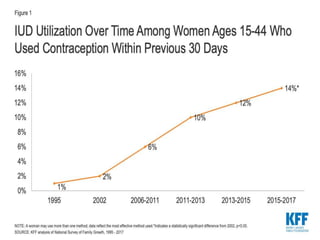
INTRA-UTERINE
CONTRACEPTIVE DEVICES
GUIDE: MAJ KIRTI MAAN
BY : NCDT SHIWANI THAKUR
INTRA UTERINE
CONTRACEPTIVE DEVICES
 An Intrauterine Device is a small
object is inserted through the cervix
an placed in the uterus to prevent
pregnancy.
 A small string hangs down from the
IUD into the upper part of the vagina.
HISTORY
 The first IUCD was developed in 1909
by German physician Richard Richter,
of Waldenburg. His device was made
of silkworm gut and was not widely
used.
 Jack Lippes developed Lippes Loop in
1960s,which became the best known
and most widely used IUCD.
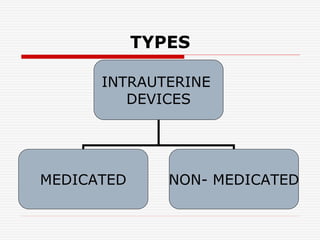
TYPES
INTRAUTERINE
DEVICES
MEDICATED NON- MEDICATED
IUCDs
 Made of polyethylene
 Release either metal ions (copper)
or hormones (progestogens)
MECHANISM OF ACTION
 IUD causes a foreign- body reaction

in uterus causing cellular and
biochemical changes in endometrium.

 Medicated IUDs produce other local

effects. Copper seems to enhance
cellular response in the endometrium.
CONTD…
 Hormone releasing devices increase
the viscosity of the cervical mucus
and thereby prevent sperm from
entering cervix.
 They also maintain high levels of
oestrogen, thereby sustaining an
endometrium unfavourable to
implantation.
FIRST GENERATION IUCDs
 The first generation IUDs comprise
the inert or non- medicated devices.
 Different shapes and sizes- loops,
spirals, coils, rings, and bows.
 Made of polyethylene and polymers
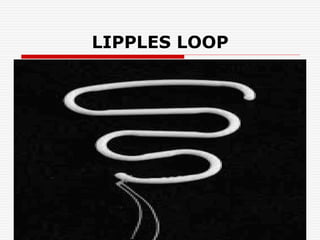
LIPPLES LOOP
 It is double-S shaped device, a plastic
material that is non-toxic, non tissue
reactive.
 It contains barium sulphate to allow
X- ray observation.
 Sizes A,B,C and D
LIPPLES LOOP
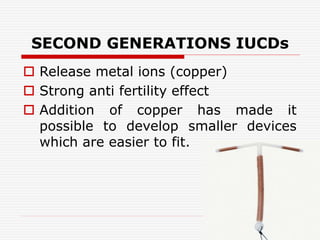
SECOND GENERATIONS IUCDs
 Release metal ions (copper)
 Strong anti fertility effect
 Addition of copper has made it
possible to develop smaller devices
which are easier to fit.
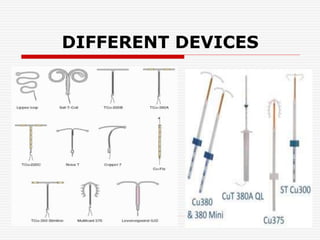
DIFFERENT DEVICES
COMMERCIALLY AVAILABLE
DEVICES
 EARLIER DEVICES
1. Copper - 7
2. Copper T- 200
 NEWER DEVICES
1. Cu-T-220 C
2. Cu-T-380 A
3. Nova T
4. ML-Cu-250
5. ML-Cu-375
DESCRIPTION OF DEVICES
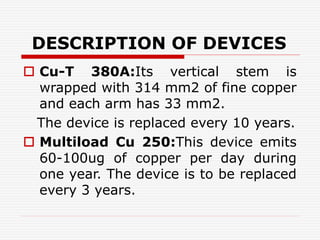
 Cu-T 380A:Its vertical stem is
wrapped with 314 mm2 of fine copper
and each arm has 33 mm2.
The device is replaced every 10 years.
 Multiload Cu 250:This device emits
60-100ug of copper per day during
one year. The device is to be replaced
every 3 years.
ADVANTAGES
 Low expulsion rate
 Increased contraceptive
 Better tolerated by nullipara
 Easier to fit in nullipara
 Lower incidence of side effects, e.g.,
pain and bleeding
THIRD GENERATION IUCDs
 Release of a hormone
 Most widely used hormonal device is-
progestasert , which is a T-shaped
device filled with 38 mg progesterone
 The hormone is released slowly in
uterus at rate of 65mcg daily.
DESCRIPTION OF DEVICES
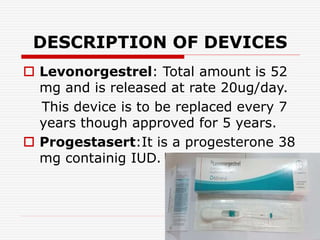
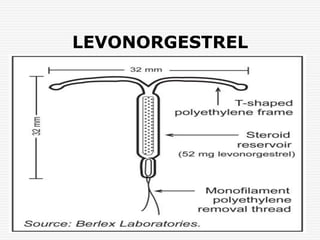
 Levonorgestrel: Total amount is 52
mg and is released at rate 20ug/day.
This device is to be replaced every 7
years though approved for 5 years.
 Progestasert:It is a progesterone 38
mg containig IUD.
LEVONORGESTREL
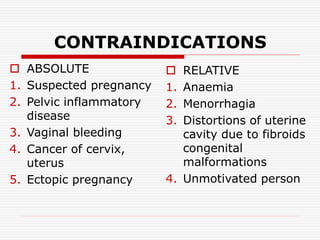
CONTRAINDICATIONS
 ABSOLUTE
1. Suspected pregnancy
2. Pelvic inflammatory
disease
3. Vaginal bleeding
4. Cancer of cervix,
uterus
5. Ectopic pregnancy
 RELATIVE
1. Anaemia
2. Menorrhagia
3. Distortions of uterine
cavity due to fibroids
congenital
malformations
4. Unmotivated person
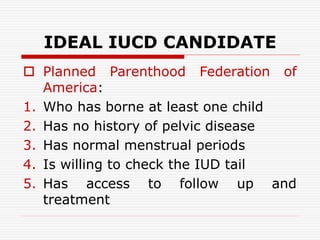
IDEAL IUCD CANDIDATE
 Planned Parenthood Federation of
America:
1. Who has borne at least one child
2. Has no history of pelvic disease
3. Has normal menstrual periods
4. Is willing to check the IUD tail
5. Has access to follow up and
treatment
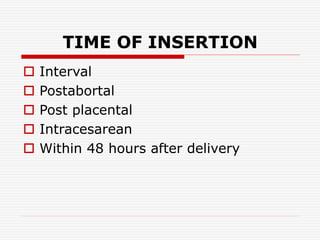
TIME OF INSERTION
 Interval
 Postabortal
 Post placental
 Intracesarean
 Within 48 hours after delivery
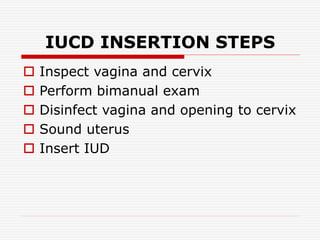
IUCD INSERTION STEPS
 Inspect vagina and cervix
 Perform bimanual exam
 Disinfect vagina and opening to cervix
 Sound uterus
 Insert IUD
METHODS OF INSERTION
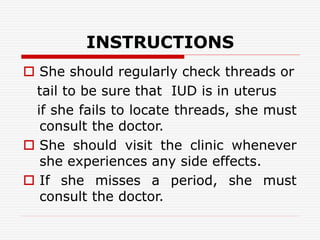
INSTRUCTIONS
 She should regularly check threads or
tail to be sure that IUD is in uterus
if she fails to locate threads, she must
consult the doctor.
 She should visit the clinic whenever
she experiences any side effects.
 If she misses a period, she must
consult the doctor.
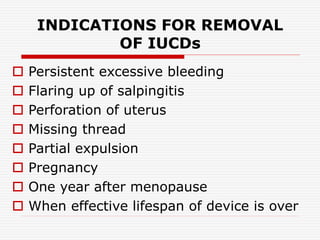
INDICATIONS FOR REMOVAL
OF IUCDs
 Persistent excessive bleeding
 Flaring up of salpingitis
 Perforation of uterus
 Missing thread
 Partial expulsion
 Pregnancy
 One year after menopause
 When effective lifespan of device is over
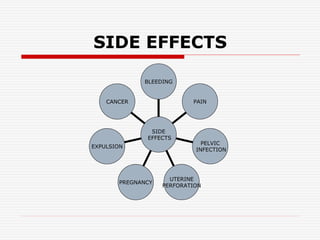
SIDE EFFECTS
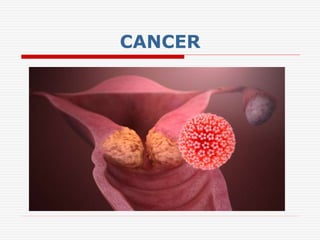
CANCER
EXPULSION
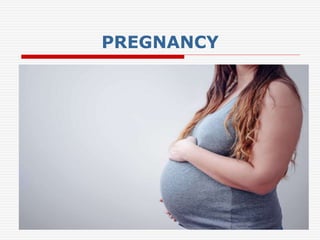
PREGNANCY
UTERINE
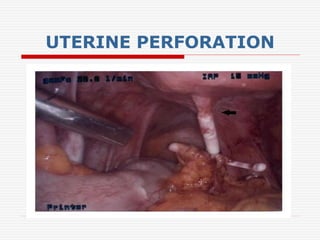
PERFORATION
PELVIC
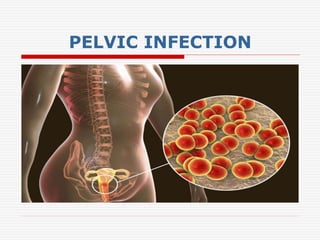
INFECTION
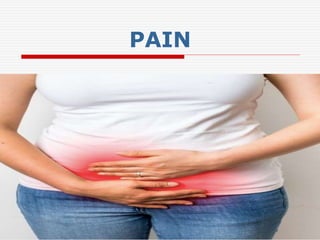
PAIN
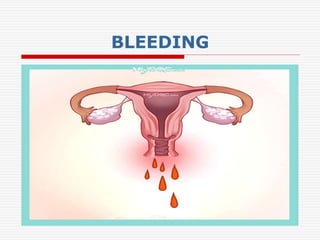
BLEEDING
SIDE
EFFECTS
PAIN
BLEEDING
PELVIC INFECTION
UTERINE PERFORATION
CANCER
PREGNANCY
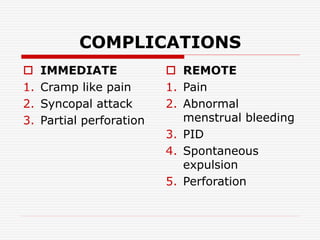
COMPLICATIONS
 IMMEDIATE
1. Cramp like pain
2. Syncopal attack
3. Partial perforation
 REMOTE
1. Pain
2. Abnormal
menstrual bleeding
3. PID
4. Spontaneous
expulsion
5. Perforation
The Nursing Personnel at PHC level
can impart Family Planning during
 Village health days through ASHA and
AWWs
 Antenatal and postnatal sessions in
health facilities
 Post partum visits
 During home visits to families
ROLE OF NURSE
 The nursing staff is a key element in
the implementation, execution and
continuity of family planning
practices.
 Give accurate information and
respond to questions
 Inform about side effects and
encourage for follow up visits.
CONCLUSION
INTRA-UTERINE DEVICES.ppt

INTRA-UTERINE DEVICES.ppt

  • 1.
    INTRA-UTERINE CONTRACEPTIVE DEVICES GUIDE: MAJKIRTI MAAN BY : NCDT SHIWANI THAKUR
  • 2.
    INTRA UTERINE CONTRACEPTIVE DEVICES An Intrauterine Device is a small object is inserted through the cervix an placed in the uterus to prevent pregnancy.  A small string hangs down from the IUD into the upper part of the vagina.
  • 3.
    HISTORY  The firstIUCD was developed in 1909 by German physician Richard Richter, of Waldenburg. His device was made of silkworm gut and was not widely used.  Jack Lippes developed Lippes Loop in 1960s,which became the best known and most widely used IUCD.
  • 6.
  • 7.
    IUCDs  Made ofpolyethylene  Release either metal ions (copper) or hormones (progestogens)
  • 8.
    MECHANISM OF ACTION IUD causes a foreign- body reaction in uterus causing cellular and biochemical changes in endometrium.  Medicated IUDs produce other local effects. Copper seems to enhance cellular response in the endometrium.
  • 9.
    CONTD…  Hormone releasingdevices increase the viscosity of the cervical mucus and thereby prevent sperm from entering cervix.  They also maintain high levels of oestrogen, thereby sustaining an endometrium unfavourable to implantation.
  • 10.
    FIRST GENERATION IUCDs The first generation IUDs comprise the inert or non- medicated devices.  Different shapes and sizes- loops, spirals, coils, rings, and bows.  Made of polyethylene and polymers
  • 11.
    LIPPLES LOOP  Itis double-S shaped device, a plastic material that is non-toxic, non tissue reactive.  It contains barium sulphate to allow X- ray observation.  Sizes A,B,C and D
  • 12.
  • 13.
    SECOND GENERATIONS IUCDs Release metal ions (copper)  Strong anti fertility effect  Addition of copper has made it possible to develop smaller devices which are easier to fit.
  • 14.
  • 15.
    COMMERCIALLY AVAILABLE DEVICES  EARLIERDEVICES 1. Copper - 7 2. Copper T- 200  NEWER DEVICES 1. Cu-T-220 C 2. Cu-T-380 A 3. Nova T 4. ML-Cu-250 5. ML-Cu-375
  • 16.
    DESCRIPTION OF DEVICES Cu-T 380A:Its vertical stem is wrapped with 314 mm2 of fine copper and each arm has 33 mm2. The device is replaced every 10 years.  Multiload Cu 250:This device emits 60-100ug of copper per day during one year. The device is to be replaced every 3 years.
  • 17.
    ADVANTAGES  Low expulsionrate  Increased contraceptive  Better tolerated by nullipara  Easier to fit in nullipara  Lower incidence of side effects, e.g., pain and bleeding
  • 18.
    THIRD GENERATION IUCDs Release of a hormone  Most widely used hormonal device is- progestasert , which is a T-shaped device filled with 38 mg progesterone  The hormone is released slowly in uterus at rate of 65mcg daily.
  • 19.
    DESCRIPTION OF DEVICES Levonorgestrel: Total amount is 52 mg and is released at rate 20ug/day. This device is to be replaced every 7 years though approved for 5 years.  Progestasert:It is a progesterone 38 mg containig IUD.
  • 20.
  • 21.
    CONTRAINDICATIONS  ABSOLUTE 1. Suspectedpregnancy 2. Pelvic inflammatory disease 3. Vaginal bleeding 4. Cancer of cervix, uterus 5. Ectopic pregnancy  RELATIVE 1. Anaemia 2. Menorrhagia 3. Distortions of uterine cavity due to fibroids congenital malformations 4. Unmotivated person
  • 22.
    IDEAL IUCD CANDIDATE Planned Parenthood Federation of America: 1. Who has borne at least one child 2. Has no history of pelvic disease 3. Has normal menstrual periods 4. Is willing to check the IUD tail 5. Has access to follow up and treatment
  • 23.
    TIME OF INSERTION Interval  Postabortal  Post placental  Intracesarean  Within 48 hours after delivery
  • 24.
    IUCD INSERTION STEPS Inspect vagina and cervix  Perform bimanual exam  Disinfect vagina and opening to cervix  Sound uterus  Insert IUD
  • 25.
  • 26.
    INSTRUCTIONS  She shouldregularly check threads or tail to be sure that IUD is in uterus if she fails to locate threads, she must consult the doctor.  She should visit the clinic whenever she experiences any side effects.  If she misses a period, she must consult the doctor.
  • 27.
    INDICATIONS FOR REMOVAL OFIUCDs  Persistent excessive bleeding  Flaring up of salpingitis  Perforation of uterus  Missing thread  Partial expulsion  Pregnancy  One year after menopause  When effective lifespan of device is over
  • 28.
  • 29.
  • 30.
  • 31.
  • 32.
  • 33.
  • 34.
  • 35.
    COMPLICATIONS  IMMEDIATE 1. Cramplike pain 2. Syncopal attack 3. Partial perforation  REMOTE 1. Pain 2. Abnormal menstrual bleeding 3. PID 4. Spontaneous expulsion 5. Perforation
  • 36.
    The Nursing Personnelat PHC level can impart Family Planning during  Village health days through ASHA and AWWs  Antenatal and postnatal sessions in health facilities  Post partum visits  During home visits to families
  • 37.
    ROLE OF NURSE The nursing staff is a key element in the implementation, execution and continuity of family planning practices.  Give accurate information and respond to questions  Inform about side effects and encourage for follow up visits.
  • 38.