Banking Basics!
Why The Bank? Banks and credit unions are safe and convenient places to keep your money.Most account balances are insured up to $100,000 by the Federal Deposit Insurance Corporation (FDIC).Banks are for-profit.How do they earn money?Credit Unions are non-profit.Owned and controlled by their members
Savings AccountsYour money earns interest,which is a return on your money.Annual Percentage Rate (APR) is the amount your money would earn if left on deposit for one year.Savings accounts usually carry an APR of 1% or 2%. Example: @ an APR of 1%,			$1,000 would earn $10 in a year
Types of InterestSimple Interest: determined by initial deposit only.Compound Interest: you earn interest on your initial deposit as well as on the interest you earn.Compound interest is better!
Certificates of Deposit (CDs)Offer a guaranteed interest rate for a specified amount of time.You choose the length of time that your money is deposited (months to years)The longer the term, the higher the interest rateIf you withdraw money early,    you will pay a penalty
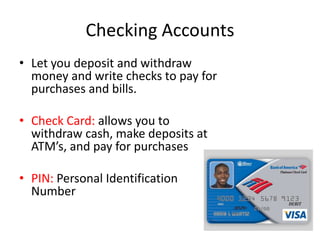
Checking AccountsLet you deposit and withdraw money and write checks to pay for purchases and bills.Check Card: allows you to withdraw cash, make deposits at ATM’s, and pay for purchasesPIN: Personal Identification Number
Types of Checking AccountsFree CheckingNo monthly feesNo minimum balance requirementsStudent AccountsNo or low minimum balance requirementsJoint AccountsAllow co-owners to have equal access to the account
Overdraft ProtectionBouncing A Check or Overdrafting: making a purchase that exceeds what you have in your account You will pay a fee to the business ($30+), as well as a fee to your bank ($20+)Hurts your credit with the bankOverdraft Protection: banks will honor your check or check card purchases even if they exceed your account balanceYou pay a fee to the bank for each overdraft ($10 - $20)
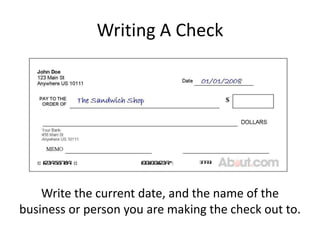
Writing A CheckWrite the current date, and the name of the business or person you are making the check out to.
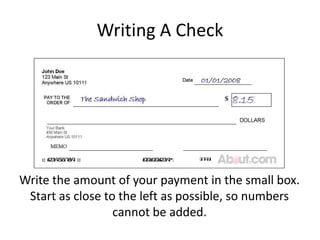
Writing A CheckWrite the amount of your payment in the small box. Start as close to the left as possible, so numbers cannot be added.
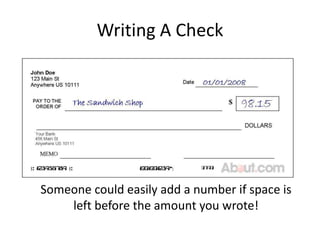
Writing A CheckSomeone could easily add a number if space is left before the amount you wrote!
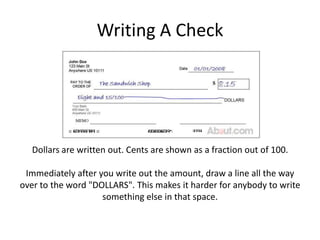
Writing A CheckDollars are written out. Cents are shown as a fraction out of 100.Immediately after you write out the amount, draw a line all the way over to the word "DOLLARS". This makes it harder for anybody to write something else in that space.
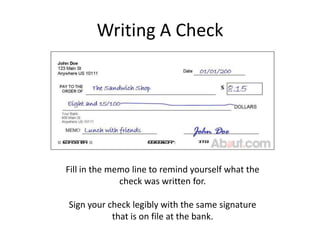
Writing A CheckFill in the memo line to remind yourself what the check was written for.Sign your check legibly with the same signature that is on file at the bank.
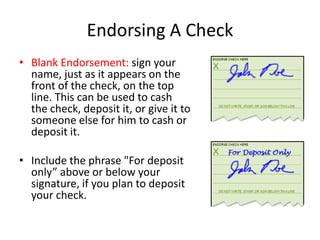
Endorsing A CheckBlank Endorsement: sign your name, just as it appears on the front of the check, on the top line. This can be used to cash the check, deposit it, or give it to someone else for him to cash or deposit it.Include the phrase "For deposit only” above or below your signature, if you plan to deposit your check.
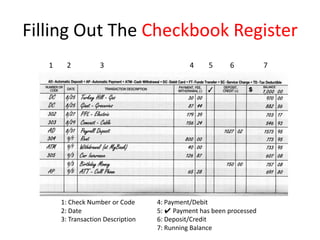
Filling Out The Checkbook Register12345671: Check Number or Code		4: Payment/Debit2: Date					5: ✔ Payment has been processed3: Transaction Description		6: Deposit/Credit 						7: Running Balance

Banking Basics PowerPoint

  • 1.
  • 2.
    Why The Bank?Banks and credit unions are safe and convenient places to keep your money.Most account balances are insured up to $100,000 by the Federal Deposit Insurance Corporation (FDIC).Banks are for-profit.How do they earn money?Credit Unions are non-profit.Owned and controlled by their members
  • 3.
    Savings AccountsYour moneyearns interest,which is a return on your money.Annual Percentage Rate (APR) is the amount your money would earn if left on deposit for one year.Savings accounts usually carry an APR of 1% or 2%. Example: @ an APR of 1%, $1,000 would earn $10 in a year
  • 4.
    Types of InterestSimpleInterest: determined by initial deposit only.Compound Interest: you earn interest on your initial deposit as well as on the interest you earn.Compound interest is better!
  • 5.
    Certificates of Deposit(CDs)Offer a guaranteed interest rate for a specified amount of time.You choose the length of time that your money is deposited (months to years)The longer the term, the higher the interest rateIf you withdraw money early, you will pay a penalty
  • 6.
    Checking AccountsLet youdeposit and withdraw money and write checks to pay for purchases and bills.Check Card: allows you to withdraw cash, make deposits at ATM’s, and pay for purchasesPIN: Personal Identification Number
  • 7.
    Types of CheckingAccountsFree CheckingNo monthly feesNo minimum balance requirementsStudent AccountsNo or low minimum balance requirementsJoint AccountsAllow co-owners to have equal access to the account
  • 8.
    Overdraft ProtectionBouncing ACheck or Overdrafting: making a purchase that exceeds what you have in your account You will pay a fee to the business ($30+), as well as a fee to your bank ($20+)Hurts your credit with the bankOverdraft Protection: banks will honor your check or check card purchases even if they exceed your account balanceYou pay a fee to the bank for each overdraft ($10 - $20)
  • 9.
    Writing A CheckWritethe current date, and the name of the business or person you are making the check out to.
  • 10.
    Writing A CheckWritethe amount of your payment in the small box. Start as close to the left as possible, so numbers cannot be added.
  • 11.
    Writing A CheckSomeonecould easily add a number if space is left before the amount you wrote!
  • 12.
    Writing A CheckDollarsare written out. Cents are shown as a fraction out of 100.Immediately after you write out the amount, draw a line all the way over to the word "DOLLARS". This makes it harder for anybody to write something else in that space.
  • 13.
    Writing A CheckFillin the memo line to remind yourself what the check was written for.Sign your check legibly with the same signature that is on file at the bank.
  • 14.
    Endorsing A CheckBlankEndorsement: sign your name, just as it appears on the front of the check, on the top line. This can be used to cash the check, deposit it, or give it to someone else for him to cash or deposit it.Include the phrase "For deposit only” above or below your signature, if you plan to deposit your check.
  • 15.
    Filling Out TheCheckbook Register12345671: Check Number or Code 4: Payment/Debit2: Date 5: ✔ Payment has been processed3: Transaction Description 6: Deposit/Credit 7: Running Balance