Behavioral
More Than a Gut Feeling
Interviewing
Jonathan “JJ” Jarrell, PHR
Regional Human Resource Manager
Customized Distribution
Brainstorm:
Interview Questions
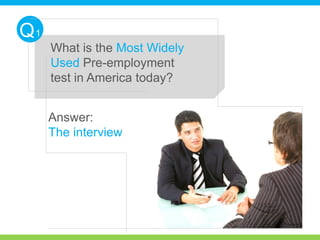
Answer:
The interview
What is the Most Widely
Used Pre-employment
test in America today?
Q1
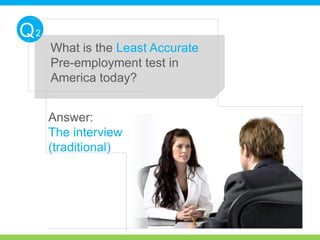
Answer:
The interview
(traditional)
What is the Least Accurate
Pre-employment test in
America today?
Q2
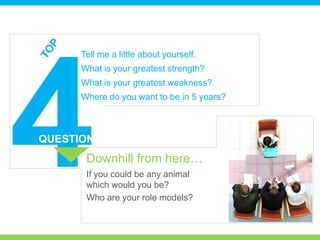
Tell me a little about yourself.
What is your greatest strength?
What is your greatest weakness?
Where do you want to be in 5 years?
Downhill from here…
If you could be any animal
which would you be?
Who are your role models?
QUESTION
S
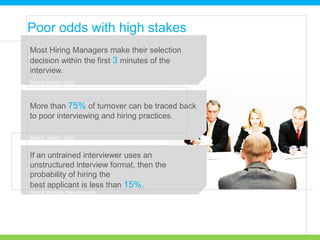
If an untrained interviewer uses an
unstructured interview format, then the
probability of hiring the
best applicant is less than 15%.
More than 75% of turnover can be traced back
to poor interviewing and hiring practices.
Most Hiring Managers make their selection
decision within the first 3 minutes of the
interview.
Poor odds with high stakes
Source: Harvard Study
Source: Michigan State University
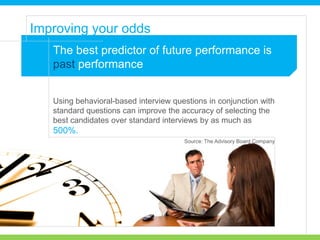
The best predictor of future performance is
past performance
Using behavioral-based interview questions in conjunction with
standard questions can improve the accuracy of selecting the
best candidates over standard interviews by as much as
500%.
Improving your odds
Source: The Advisory Board Company
Advantages to
using past behavior
Using behavior eliminates
misunderstandings about a candidate’s
past experiences.
Using behavior prevents
personal impressions from
affecting the evaluation.
Using behavior reduces
applicant “faking.”
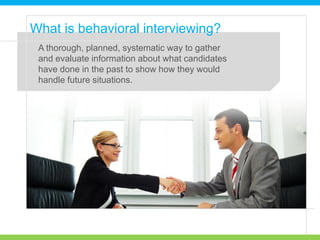
A thorough, planned, systematic way to gather
and evaluate information about what candidates
have done in the past to show how they would
handle future situations.
What is behavioral interviewing?
Lower the high direct and indirect
costs related to hiring the wrong
people
High-quality hires out-
produce poor ones by 25-
50%.
An estimated 80% of turnover is
due to hiring mistakes
A job that pays $48,000 can cost
up to $100,000
to replace.
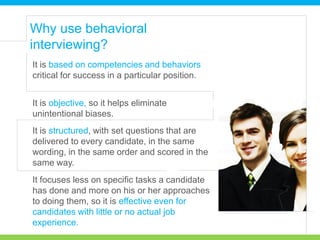
Why use behavioral
interviewing?
It is based on competencies and behaviors
critical for success in a particular position.
Why use behavioral
interviewing?
It is objective, so it helps eliminate
unintentional biases.
It is structured, with set questions that are
delivered to every candidate, in the same
wording, in the same order and scored in the
same way.
It focuses less on specific tasks a candidate
has done and more on his or her approaches
to doing them, so it is effective even for
candidates with little or no actual job
experience.
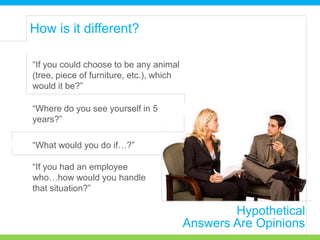
Hypothetical
Answers Are Opinions
How is it different?
“If you could choose to be any animal
(tree, piece of furniture, etc.), which
would it be?”
“Where do you see yourself in 5
years?”
“What would you do if…?”
“If you had an employee
who…how would you handle
that situation?”
How to structure a behavioral interviewing
program
Determine critical competencies.
Develop questions (and follow-up
questions) to address
each competency.
Create a structured note-taking sheet for
the interview, including a candidate
evaluation section.
Train interviewers.
Evaluate post-offer results.
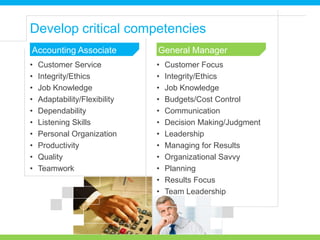
• Customer Service
• Integrity/Ethics
• Job Knowledge
• Adaptability/Flexibility
• Dependability
• Listening Skills
• Personal Organization
• Productivity
• Quality
• Teamwork
General Manager
• Customer Focus
• Integrity/Ethics
• Job Knowledge
• Budgets/Cost Control
• Communication
• Decision Making/Judgment
• Leadership
• Managing for Results
• Organizational Savvy
• Planning
• Results Focus
• Team Leadership
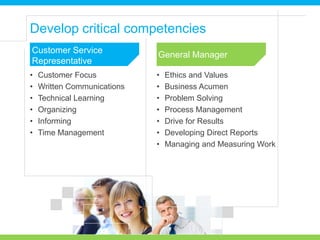
Develop critical competencies
Accounting Associate
• Customer Focus
• Written Communications
• Technical Learning
• Organizing
• Informing
• Time Management
General Manager
• Ethics and Values
• Business Acumen
• Problem Solving
• Process Management
• Drive for Results
• Developing Direct Reports
• Managing and Measuring Work
Develop critical competencies
Customer Service
Representative
• “Tell me about a time you
were part of a great team.”
• “What was your role in
making it great?”
• “What was the end
result?”
• “Tell me about a time you
were part of a great team.”
• “What was your role in
making it great?”
• “What was the end result?”
Develop behavioral-based questions to
address the competencies
Team LeadershipTeamwork
Deals with others in a straightforward and honest manner,
is accountable for actions, maintains confidentiality,
supports company values, conveys good news and bad.
Develop behavioral-based questions to
address the competencies
Integrity/Ethics
Recognizes problems and responds, systematically gathers
information, sorts through complex issues, seeks input from
others, addresses root cause of issues, makes timely
decisions, communicates decisions to others.
Develop behavioral-based questions to
address the competencies
Decision-Making/Judgment
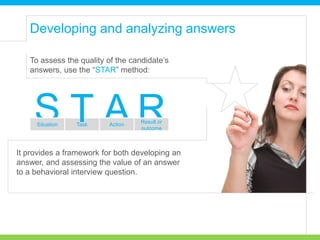
To assess the quality of the candidate’s
answers, use the “STAR” method:
It provides a framework for both developing an
answer, and assessing the value of an answer
to a behavioral interview question.
RAS Result or
outcome
Situation Task Action
T
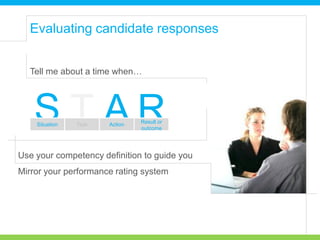
Developing and analyzing answers
Tell me about a time when…
Use your competency definition to guide you
Mirror your performance rating system
T RAS Result or
outcome
Situation Task Action
Evaluating candidate responses
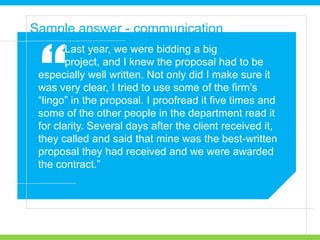
Last year, we were bidding a big
project, and I knew the proposal had to be
especially well written. Not only did I make sure it
was very clear, I tried to use some of the firm’s
“lingo” in the proposal. I proofread it five times and
some of the other people in the department read it
for clarity. Several days after the client received it,
they called and said that mine was the best-written
proposal they had received and we were awarded
the contract.”
Sample answer - communication
“
• I usually...
• I always...
• We all
participated...
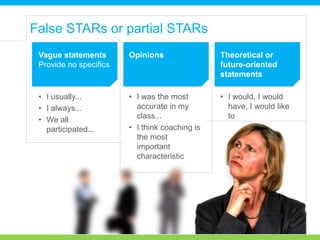
False STARs or partial STARs
Vague statements
Provide no specifics
Opinions Theoretical or
future-oriented
statements
• I was the most
accurate in my
class...
• I think coaching is
the most
important
characteristic
• I would, I would
have, I would like
to
Taking Notes
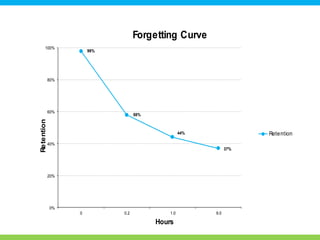
98%
58%
44%
37%
0%
20%
40%
60%
80%
100%
0 0.2 1.0 9.0
Retention
Hours
Forgetting Curve
Retention
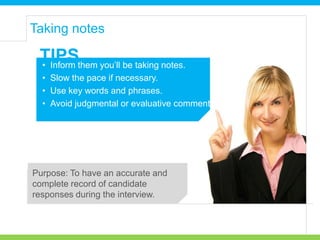
• Inform them you’ll be taking notes.
• Slow the pace if necessary.
• Use key words and phrases.
• Avoid judgmental or evaluative comments.
TIPS
Purpose: To have an accurate and
complete record of candidate
responses during the interview.
Taking notes
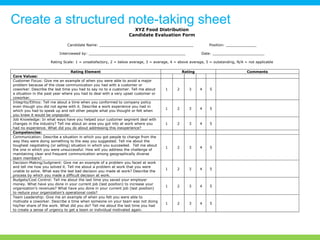
XYZ Food Distribution
Candidate Evaluation Form
Candidate Name: Position:
Interviewed by: Date:
Rating Scale: 1 = unsatisfactory, 2 = below average, 3 = average, 4 = above average, 5 = outstanding, N/A = not applicable
Rating Element Rating Comments
Core Values:
Customer Focus: Give me an example of when you were able to avoid a major
problem because of the close communication you had with a customer or
coworker. Describe the last time you had to say no to a customer. Tell me about
a situation in the past year where you had to deal with a very upset customer or
coworker.
1 2 3 4 5
Integrity/Ethics: Tell me about a time when you conformed to company policy
even though you did not agree with it. Describe a work experience you had in
which you had to speak up and tell other people what you thought or felt when
you knew it would be unpopular.
1 2 3 4 5
Job Knowledge: In what ways have you helped your customer segment deal with
changes in the industry? Tell me about an area you got into at work where you
had no experience. What did you do about addressing this inexperience?
1 2 3 4 5
Competencies:
Communication: Describe a situation in which you got people to change from the
way they were doing something to the way you suggested. Tell me about the
toughest negotiating (or selling) situation in which you succeeded. Tell me about
the one in which you were unsuccessful. How will you address the challenge of
maintaining clear and frequent communication among geographically diverse
team members?
1 2 3 4 5
Decision-Making/Judgment: Give me an example of a problem you faced at work
and tell me how you solved it. Tell me about a problem at work that you were
unable to solve. What was the last bad decision you made at work? Describe the
process by which you made a difficult decision at work.
1 2 3 4 5
Budgets/Cost Control: Tell me about the last time you saved your employer
money. What have you done in your current job (last position) to increase your
organization’s revenues? What have you done in your current job (last position)
to reduce your organization’s operational costs?
1 2 3 4 5
Team Leadership: Give me an example of when you felt you were able to
motivate a coworker. Describe a time when someone on your team was not doing
his/her share of the work. What did you do? Tell me about the last time you had
to create a sense of urgency to get a team or individual motivated again.
1 2 3 4 5
Create a structured note-taking sheet
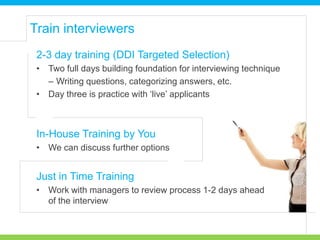
2-3 day training (DDI Targeted Selection)
• Two full days building foundation for interviewing technique
– Writing questions, categorizing answers, etc.
• Day three is practice with ‘live’ applicants
Train interviewers
In-House Training by You
• We can discuss further options
Just in Time Training
• Work with managers to review process 1-2 days ahead
of the interview
• Better retention rates?
• Better performance?
• Higher productivity?
• Other industry- or
organization-
specific benchmarks
Evaluate post-offer results
Connect With Me

Behavioral Interviewing

  • 1.
    Behavioral More Than aGut Feeling Interviewing Jonathan “JJ” Jarrell, PHR Regional Human Resource Manager Customized Distribution
  • 2.
  • 3.
    Answer: The interview What isthe Most Widely Used Pre-employment test in America today? Q1
  • 4.
    Answer: The interview (traditional) What isthe Least Accurate Pre-employment test in America today? Q2
  • 5.
    Tell me alittle about yourself. What is your greatest strength? What is your greatest weakness? Where do you want to be in 5 years? Downhill from here… If you could be any animal which would you be? Who are your role models? QUESTION S
  • 6.
    If an untrainedinterviewer uses an unstructured interview format, then the probability of hiring the best applicant is less than 15%. More than 75% of turnover can be traced back to poor interviewing and hiring practices. Most Hiring Managers make their selection decision within the first 3 minutes of the interview. Poor odds with high stakes Source: Harvard Study Source: Harvard Study Source: Michigan State University
  • 8.
    The best predictorof future performance is past performance Using behavioral-based interview questions in conjunction with standard questions can improve the accuracy of selecting the best candidates over standard interviews by as much as 500%. Improving your odds Source: The Advisory Board Company
  • 9.
    Advantages to using pastbehavior Using behavior eliminates misunderstandings about a candidate’s past experiences. Using behavior prevents personal impressions from affecting the evaluation. Using behavior reduces applicant “faking.”
  • 10.
    A thorough, planned,systematic way to gather and evaluate information about what candidates have done in the past to show how they would handle future situations. What is behavioral interviewing?
  • 11.
    Lower the highdirect and indirect costs related to hiring the wrong people High-quality hires out- produce poor ones by 25- 50%. An estimated 80% of turnover is due to hiring mistakes A job that pays $48,000 can cost up to $100,000 to replace. Why use behavioral interviewing?
  • 12.
    It is basedon competencies and behaviors critical for success in a particular position. Why use behavioral interviewing? It is objective, so it helps eliminate unintentional biases. It is structured, with set questions that are delivered to every candidate, in the same wording, in the same order and scored in the same way. It focuses less on specific tasks a candidate has done and more on his or her approaches to doing them, so it is effective even for candidates with little or no actual job experience.
  • 13.
    Hypothetical Answers Are Opinions Howis it different? “If you could choose to be any animal (tree, piece of furniture, etc.), which would it be?” “Where do you see yourself in 5 years?” “What would you do if…?” “If you had an employee who…how would you handle that situation?”
  • 14.
    How to structurea behavioral interviewing program Determine critical competencies. Develop questions (and follow-up questions) to address each competency. Create a structured note-taking sheet for the interview, including a candidate evaluation section. Train interviewers. Evaluate post-offer results.
  • 15.
    • Customer Service •Integrity/Ethics • Job Knowledge • Adaptability/Flexibility • Dependability • Listening Skills • Personal Organization • Productivity • Quality • Teamwork General Manager • Customer Focus • Integrity/Ethics • Job Knowledge • Budgets/Cost Control • Communication • Decision Making/Judgment • Leadership • Managing for Results • Organizational Savvy • Planning • Results Focus • Team Leadership Develop critical competencies Accounting Associate
  • 16.
    • Customer Focus •Written Communications • Technical Learning • Organizing • Informing • Time Management General Manager • Ethics and Values • Business Acumen • Problem Solving • Process Management • Drive for Results • Developing Direct Reports • Managing and Measuring Work Develop critical competencies Customer Service Representative
  • 17.
    • “Tell meabout a time you were part of a great team.” • “What was your role in making it great?” • “What was the end result?” • “Tell me about a time you were part of a great team.” • “What was your role in making it great?” • “What was the end result?” Develop behavioral-based questions to address the competencies Team LeadershipTeamwork
  • 18.
    Deals with othersin a straightforward and honest manner, is accountable for actions, maintains confidentiality, supports company values, conveys good news and bad. Develop behavioral-based questions to address the competencies Integrity/Ethics
  • 19.
    Recognizes problems andresponds, systematically gathers information, sorts through complex issues, seeks input from others, addresses root cause of issues, makes timely decisions, communicates decisions to others. Develop behavioral-based questions to address the competencies Decision-Making/Judgment
  • 20.
    To assess thequality of the candidate’s answers, use the “STAR” method: It provides a framework for both developing an answer, and assessing the value of an answer to a behavioral interview question. RAS Result or outcome Situation Task Action T Developing and analyzing answers
  • 21.
    Tell me abouta time when… Use your competency definition to guide you Mirror your performance rating system T RAS Result or outcome Situation Task Action Evaluating candidate responses
  • 22.
    Last year, wewere bidding a big project, and I knew the proposal had to be especially well written. Not only did I make sure it was very clear, I tried to use some of the firm’s “lingo” in the proposal. I proofread it five times and some of the other people in the department read it for clarity. Several days after the client received it, they called and said that mine was the best-written proposal they had received and we were awarded the contract.” Sample answer - communication “
  • 24.
    • I usually... •I always... • We all participated... False STARs or partial STARs Vague statements Provide no specifics Opinions Theoretical or future-oriented statements • I was the most accurate in my class... • I think coaching is the most important characteristic • I would, I would have, I would like to
  • 25.
  • 26.
    98% 58% 44% 37% 0% 20% 40% 60% 80% 100% 0 0.2 1.09.0 Retention Hours Forgetting Curve Retention
  • 27.
    • Inform themyou’ll be taking notes. • Slow the pace if necessary. • Use key words and phrases. • Avoid judgmental or evaluative comments. TIPS Purpose: To have an accurate and complete record of candidate responses during the interview. Taking notes
  • 28.
    XYZ Food Distribution CandidateEvaluation Form Candidate Name: Position: Interviewed by: Date: Rating Scale: 1 = unsatisfactory, 2 = below average, 3 = average, 4 = above average, 5 = outstanding, N/A = not applicable Rating Element Rating Comments Core Values: Customer Focus: Give me an example of when you were able to avoid a major problem because of the close communication you had with a customer or coworker. Describe the last time you had to say no to a customer. Tell me about a situation in the past year where you had to deal with a very upset customer or coworker. 1 2 3 4 5 Integrity/Ethics: Tell me about a time when you conformed to company policy even though you did not agree with it. Describe a work experience you had in which you had to speak up and tell other people what you thought or felt when you knew it would be unpopular. 1 2 3 4 5 Job Knowledge: In what ways have you helped your customer segment deal with changes in the industry? Tell me about an area you got into at work where you had no experience. What did you do about addressing this inexperience? 1 2 3 4 5 Competencies: Communication: Describe a situation in which you got people to change from the way they were doing something to the way you suggested. Tell me about the toughest negotiating (or selling) situation in which you succeeded. Tell me about the one in which you were unsuccessful. How will you address the challenge of maintaining clear and frequent communication among geographically diverse team members? 1 2 3 4 5 Decision-Making/Judgment: Give me an example of a problem you faced at work and tell me how you solved it. Tell me about a problem at work that you were unable to solve. What was the last bad decision you made at work? Describe the process by which you made a difficult decision at work. 1 2 3 4 5 Budgets/Cost Control: Tell me about the last time you saved your employer money. What have you done in your current job (last position) to increase your organization’s revenues? What have you done in your current job (last position) to reduce your organization’s operational costs? 1 2 3 4 5 Team Leadership: Give me an example of when you felt you were able to motivate a coworker. Describe a time when someone on your team was not doing his/her share of the work. What did you do? Tell me about the last time you had to create a sense of urgency to get a team or individual motivated again. 1 2 3 4 5 Create a structured note-taking sheet
  • 29.
    2-3 day training(DDI Targeted Selection) • Two full days building foundation for interviewing technique – Writing questions, categorizing answers, etc. • Day three is practice with ‘live’ applicants Train interviewers In-House Training by You • We can discuss further options Just in Time Training • Work with managers to review process 1-2 days ahead of the interview
  • 30.
    • Better retentionrates? • Better performance? • Higher productivity? • Other industry- or organization- specific benchmarks Evaluate post-offer results
  • 31.