Muhammad Abrar Tahir
January 24, 2014
SUCCESSFUL
INTERVIEW SKILLS
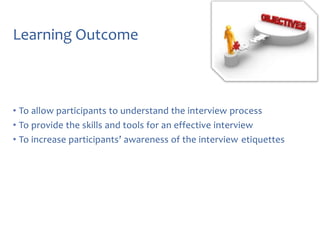
Learning Outcome

• To allow participants to understand the interview process
• To provide the skills and tools for an effective interview
• To increase participants’ awareness of the interview etiquettes
Outline
• What is an interview?
• Purpose of interviews
• Types of interviews
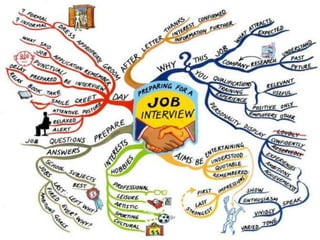
• Preparing for the interview
• The Interview Day
• Interview Etiquettes
• Common Interview Questions
• Follow up
• Useful Resources
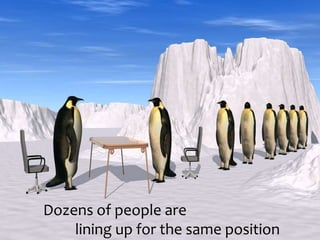
Dozens of people are
lining up for the same position
You need to stand out from the crowd
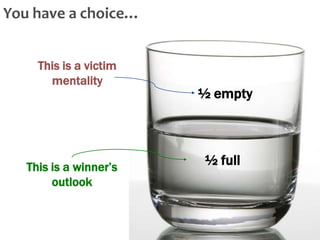
You have a choice…
This is a victim
mentality

This is a winner’s
outlook

½ empty

½ full
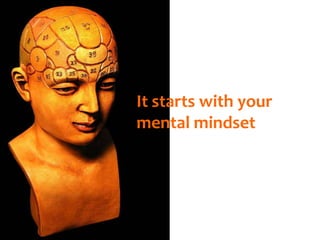
It starts with your
mental mindset
What is

?

• A job interview is a meeting aimed to assess a candidate for a
certain job position
• A job interview is a process in which a potential employee is
evaluated by an employer for prospective employment in their
company, organization, or firm.
 Employers
• Is the candidate qualified?
• Are they a good fit for the company?
• Determine if you be invited back for a second interview and
ultimately whether you are offered a job.
 Job Seekers
• Opportunity to meet and connect with the prospective employer.
• Sell your skills and abilities.
• Help you determine if you are a good fit for the company.
1.

One on One Interviews

2.

Telephone Interviews

3.

Group Interviews

4.

Panel Interviews

5.

The Auditions/Role Plays
•Research the company

•Practice for the interview
•Prepare your interview questions
•Assemble relevant information beforehand
•Re-read your resume and the job ad as a
refresher
•Check yourself in a full-length mirror before
the interview
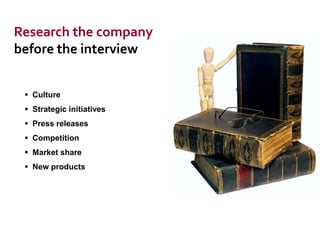
Research the company
before the interview
 Culture
 Strategic initiatives
 Press releases

 Competition
 Market share
 New products
Occupational Knowledge

 What do I know about this type of work?

 What attracts me to this type of work?
 What relevant work experience have I done?
 What kind of training/additional skills am I hoping to gain?
 What have I done to find out more about this kind of work?
Ask Yourself!
 Why do I want the job?
 Why am I a suitable candidate and what evidence do I have of this?
 What have I gained from my academic/employment/extra-curricular
activities?
 What are my career ambitions/what do I want to be doing in 5 years?
 What was my best/worst decision, my greatest achievement?

 When did I work in a team/solve a problem/use my initiative?
 What are my main strengths and weaknesses?
Interview Day
Interview Process –
Sample Structure

 Introductions – process explained by interviewer
 Warm up questions
 CV/application form questions
 Questions based on selection criteria – “probing”
 Questions from candidate
 Summing up – next steps
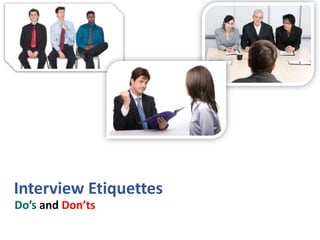
Interview Etiquettes
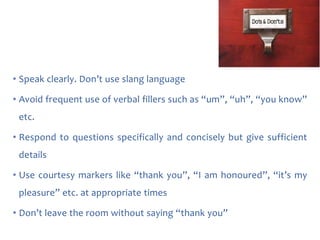
Do’s and Don’ts
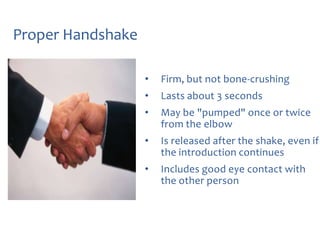
Proper Handshake
•

Firm, but not bone-crushing

•

Lasts about 3 seconds

•

May be "pumped" once or twice
from the elbow

•

Is released after the shake, even if
the introduction continues

•

Includes good eye contact with
the other person
Rule of Thumb – First Impressions last long
1.
2.
3.
4.

Brush your teeth and use a mouthwash.
Your hair should be clean and combed.
Nails should be clean and trimmed.
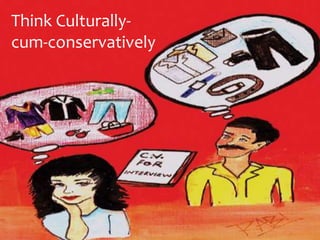
Be conservative and err on the side of caution. If the company
does not have a dress code, remember that it’s better to over
dress than under dress.
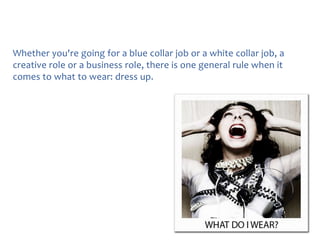
Whether you're going for a blue collar job or a white collar job, a
creative role or a business role, there is one general rule when it
comes to what to wear: dress up.
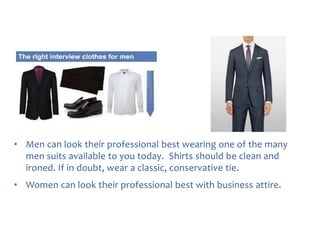
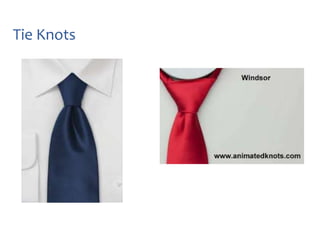
• Men can look their professional best wearing one of the many
men suits available to you today. Shirts should be clean and
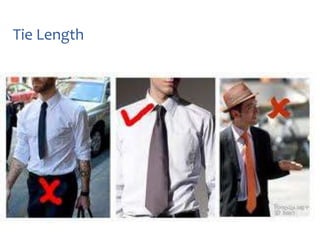
ironed. If in doubt, wear a classic, conservative tie.
• Women can look their professional best with business attire.
Tie Knots
Tie Length
Think Culturallycum-conservatively
• If you have your cell phone, turn it off. Do not put your cell phone
on vibrate.
• Bring extra copies of your resume along with a list of references
to offer the interviewer.
• Treat other people you encounter with courtesy and respect. Their
opinions of you might be solicited during hiring decisions.
• Enter the interviewer’s cabin with confidence.
• Sit up straight, and lean slightly forward in your chair.
• Show your enthusiasm by keeping an interested expression.

• Establish a comfortable amount of personal space between you
and the interviewer.
• Limit your application of colognes and perfumes.
• Make eye contact with the interviewer for a few seconds at a time
• Smile and nod (at appropriate times) when the interviewer is
talking, but, don't overdo it. Don't laugh unless the interviewer

does first
• Be polite and keep an even tone to your speech. Don't be too loud
or too quiet

• Do relax and lean forward a little towards the interviewer so you
appear interested and engaged
• Keep your feet on the floor and your back against the lower back
of the chair
• Pay attention, be attentive and interested
• Don't interrupt; Listen
• Stay calm. Keep your emotions to yourself and do not show anger
or frown
• Don’t put anything on your lap
• Don't slouch
• Speak clearly. Don’t use slang language
• Avoid frequent use of verbal fillers such as “um”, “uh”, “you know”
etc.
• Respond to questions specifically and concisely but give sufficient
details
• Use courtesy markers like “thank you”, “I am honoured”, “it’s my

pleasure” etc. at appropriate times
• Don’t leave the room without saying “thank you”
Common Interview

•
•
•
•
•
•
•
•
•
•

Tell me about yourself
What are your strengths?
What are your weaknesses?
Why did you leave your last job?
Why should we hire you?
Do you consider yourself successful?
What do you know about this organization?
Are you applying for other jobs?
Why do you want to work for this organization?
What are your salary expectations?
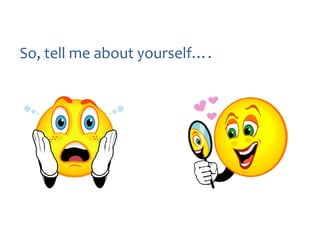
So, tell me about yourself….
What are your strengths?
What are your weaknesses?
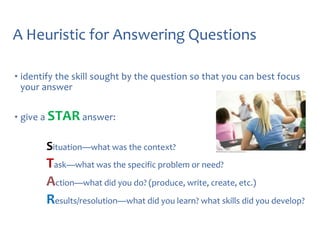
A Heuristic for Answering Questions
• identify the skill sought by the question so that you can best focus
your answer
• give a STAR answer:

Situation—what was the context?

Task—what was the specific problem or need?
Action—what did you do? (produce, write, create, etc.)
Results/resolution—what did you learn? what skills did you develop?
When the interview is
finished…
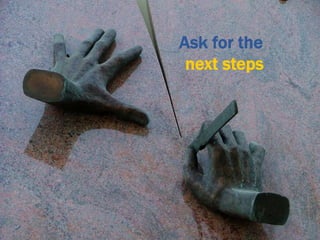
Ask for the
next steps
Ask for the
next steps

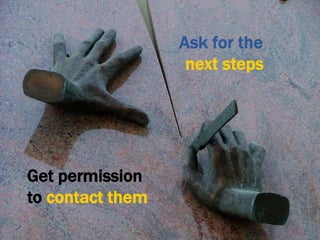
Get permission
to contact them
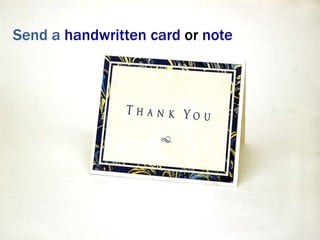
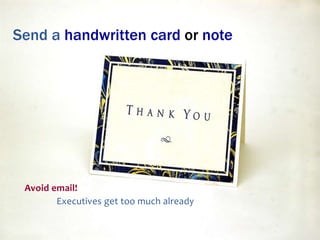
Send a handwritten card or note

Avoid email!
Executives get too much already
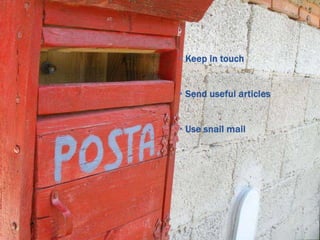
• Keep in touch
• Send useful articles
• Use snail mail
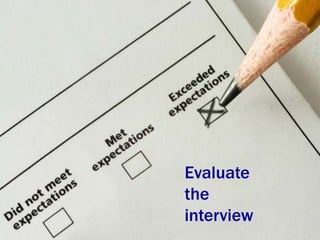
Evaluate
the
interview
What did I do well?
What did I do well?

What did I miss or forget?
What did I do well?

What did I miss or forget?

What will I do differently
next time?
BUT
Most importantly…
Books and websites for further
reading

1. The Interview Rehearsal Book – Deb Gottesman and Buzz
Mauro; Berkley Pub. Group
2. Power Interviews – Neil M. Yeager and Lee Hough
3. Basic Business Communication Skills – Lesikar R.V. and
Flatley M.E.; Tata McGraw Hill Pub. Company Ltd.
4. Effective Communication – Adair J.; Pan Macmillan
Thank you for being all
ears!

Successful interview skills seminar in NTU, FSD

  • 1.
  • 2.
  • 5.
    Learning Outcome • Toallow participants to understand the interview process • To provide the skills and tools for an effective interview • To increase participants’ awareness of the interview etiquettes
  • 6.
    Outline • What isan interview? • Purpose of interviews • Types of interviews • Preparing for the interview • The Interview Day • Interview Etiquettes • Common Interview Questions • Follow up • Useful Resources
  • 7.
    Dozens of peopleare lining up for the same position
  • 8.
    You need tostand out from the crowd
  • 9.
    You have achoice… This is a victim mentality This is a winner’s outlook ½ empty ½ full
  • 10.
    It starts withyour mental mindset
  • 11.
    What is ? • Ajob interview is a meeting aimed to assess a candidate for a certain job position • A job interview is a process in which a potential employee is evaluated by an employer for prospective employment in their company, organization, or firm.
  • 12.
     Employers • Isthe candidate qualified? • Are they a good fit for the company? • Determine if you be invited back for a second interview and ultimately whether you are offered a job.  Job Seekers • Opportunity to meet and connect with the prospective employer. • Sell your skills and abilities. • Help you determine if you are a good fit for the company.
  • 13.
    1. One on OneInterviews 2. Telephone Interviews 3. Group Interviews 4. Panel Interviews 5. The Auditions/Role Plays
  • 14.
    •Research the company •Practicefor the interview •Prepare your interview questions •Assemble relevant information beforehand •Re-read your resume and the job ad as a refresher •Check yourself in a full-length mirror before the interview
  • 15.
    Research the company beforethe interview  Culture  Strategic initiatives  Press releases  Competition  Market share  New products
  • 16.
    Occupational Knowledge  Whatdo I know about this type of work?  What attracts me to this type of work?  What relevant work experience have I done?  What kind of training/additional skills am I hoping to gain?  What have I done to find out more about this kind of work?
  • 18.
    Ask Yourself!  Whydo I want the job?  Why am I a suitable candidate and what evidence do I have of this?  What have I gained from my academic/employment/extra-curricular activities?  What are my career ambitions/what do I want to be doing in 5 years?  What was my best/worst decision, my greatest achievement?  When did I work in a team/solve a problem/use my initiative?  What are my main strengths and weaknesses?
  • 19.
  • 20.
    Interview Process – SampleStructure  Introductions – process explained by interviewer  Warm up questions  CV/application form questions  Questions based on selection criteria – “probing”  Questions from candidate  Summing up – next steps
  • 21.
  • 22.
    Proper Handshake • Firm, butnot bone-crushing • Lasts about 3 seconds • May be "pumped" once or twice from the elbow • Is released after the shake, even if the introduction continues • Includes good eye contact with the other person
  • 23.
    Rule of Thumb– First Impressions last long 1. 2. 3. 4. Brush your teeth and use a mouthwash. Your hair should be clean and combed. Nails should be clean and trimmed. Be conservative and err on the side of caution. If the company does not have a dress code, remember that it’s better to over dress than under dress.
  • 24.
    Whether you're goingfor a blue collar job or a white collar job, a creative role or a business role, there is one general rule when it comes to what to wear: dress up.
  • 25.
    • Men canlook their professional best wearing one of the many men suits available to you today. Shirts should be clean and ironed. If in doubt, wear a classic, conservative tie. • Women can look their professional best with business attire.
  • 26.
  • 27.
  • 28.
  • 30.
    • If youhave your cell phone, turn it off. Do not put your cell phone on vibrate. • Bring extra copies of your resume along with a list of references to offer the interviewer. • Treat other people you encounter with courtesy and respect. Their opinions of you might be solicited during hiring decisions. • Enter the interviewer’s cabin with confidence.
  • 32.
    • Sit upstraight, and lean slightly forward in your chair. • Show your enthusiasm by keeping an interested expression. • Establish a comfortable amount of personal space between you and the interviewer. • Limit your application of colognes and perfumes.
  • 33.
    • Make eyecontact with the interviewer for a few seconds at a time • Smile and nod (at appropriate times) when the interviewer is talking, but, don't overdo it. Don't laugh unless the interviewer does first • Be polite and keep an even tone to your speech. Don't be too loud or too quiet • Do relax and lean forward a little towards the interviewer so you appear interested and engaged
  • 34.
    • Keep yourfeet on the floor and your back against the lower back of the chair • Pay attention, be attentive and interested • Don't interrupt; Listen • Stay calm. Keep your emotions to yourself and do not show anger or frown • Don’t put anything on your lap • Don't slouch
  • 35.
    • Speak clearly.Don’t use slang language • Avoid frequent use of verbal fillers such as “um”, “uh”, “you know” etc. • Respond to questions specifically and concisely but give sufficient details • Use courtesy markers like “thank you”, “I am honoured”, “it’s my pleasure” etc. at appropriate times • Don’t leave the room without saying “thank you”
  • 36.
    Common Interview • • • • • • • • • • Tell meabout yourself What are your strengths? What are your weaknesses? Why did you leave your last job? Why should we hire you? Do you consider yourself successful? What do you know about this organization? Are you applying for other jobs? Why do you want to work for this organization? What are your salary expectations?
  • 37.
    So, tell meabout yourself….
  • 38.
    What are yourstrengths?
  • 39.
    What are yourweaknesses?
  • 40.
    A Heuristic forAnswering Questions • identify the skill sought by the question so that you can best focus your answer • give a STAR answer: Situation—what was the context? Task—what was the specific problem or need? Action—what did you do? (produce, write, create, etc.) Results/resolution—what did you learn? what skills did you develop?
  • 41.
    When the interviewis finished…
  • 42.
  • 43.
    Ask for the nextsteps Get permission to contact them
  • 44.
    Send a handwrittencard or note
  • 45.
    Send a handwrittencard or note Avoid email! Executives get too much already
  • 46.
    • Keep intouch • Send useful articles • Use snail mail
  • 47.
  • 48.
    What did Ido well?
  • 49.
    What did Ido well? What did I miss or forget?
  • 50.
    What did Ido well? What did I miss or forget? What will I do differently next time?
  • 52.
  • 55.
    Books and websitesfor further reading 1. The Interview Rehearsal Book – Deb Gottesman and Buzz Mauro; Berkley Pub. Group 2. Power Interviews – Neil M. Yeager and Lee Hough 3. Basic Business Communication Skills – Lesikar R.V. and Flatley M.E.; Tata McGraw Hill Pub. Company Ltd. 4. Effective Communication – Adair J.; Pan Macmillan
  • 56.
    Thank you forbeing all ears!

Editor's Notes

  • #2 Courtesy Presentation Kelley Robertson ~ Fearless Selling atwww.Fearless-Selling.ca