The Interview ProcessDePaul University
OverviewPhase 1: Before the interviewStep 1: Pick your top Candidates
Step 2: Conduct a Telephone Screen
Step 3 Create Interview Questions
Step 4 Create Interview Question CriteriaPhase 2: The In-Person InterviewStep 1: Before the Interview
Step 2: During the Interview
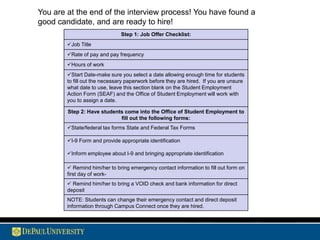
Step 3: After the InterviewPhase 3: Making the OfferStep 1: Offer Checklist
Step 2: Have students come into the Office of Student Employment to fill out paperworkClick on View, Headers and Footer to change text footer.
Phase 1: Before the Interview
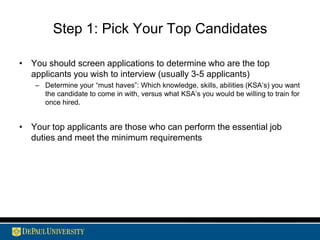
Step 1: Pick Your Top CandidatesYou should screen applications to determine who are the top applicants you wish to interview (usually 3-5 applicants)Determine your “must haves”: Which knowledge, skills, abilities (KSA’s) you want the candidate to come in with, versus what KSA’s you would be willing to train for once hired.Your top applicants are those who can perform the essential job duties and meet the minimum requirements
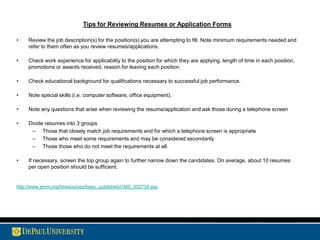
Tips for Reviewing Resumes or Application FormsReview the job description(s) for the position(s) you are attempting to fill. Note minimum requirements needed and refer to them often as you review resumes/applications. Check work experience for applicability to the position for which they are applying, length of time in each position, promotions or awards received, reason for leaving each position.Check educational background for qualifications necessary to successful job performance.Note special skills (i.e. computer software, office equipment).Note any questions that arise when reviewing the resume/application and ask those during a telephone screenDivide resumes into 3 groups Those that closely match job requirements and for which a telephone screen is appropriate Those who meet some requirements and may be considered secondarilyThose those who do not meet the requirements at all.If necessary, screen the top group again to further narrow down the candidates. On average, about 10 resumes per open position should be sufficient.http://www.shrm.org/hrresources/basic_published/CMS_002734.asp
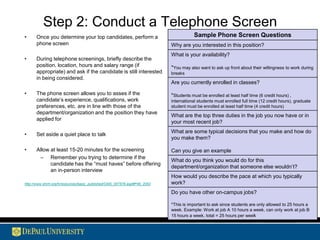
Step 2: Conduct a Telephone ScreenOnce you determine your top candidates, perform a phone screenDuring telephone screenings, briefly describe the position, location, hours and salary range (if appropriate) and ask if the candidate is still interested in being considered. The phone screen allows you to asses if the candidate’s experience, qualifications, work preferences, etc. are in line with those of the department/organization and the position they have applied forSet aside a quiet place to talkAllow at least 15-20 minutes for the screeningRemember you trying to determine if the candidate has the “must haves” before offering an in-person interviewhttp://www.shrm.org/hrresources/basic_published/CMS_007576.asp#P46_2053
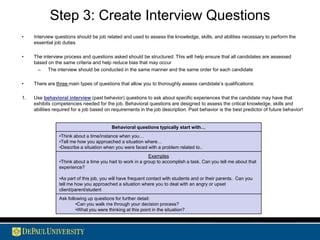
Step 3: Create Interview QuestionsInterview questions should be job related and used to assess the knowledge, skills, and abilities necessary to perform the essential job dutiesThe interview process and questions asked should be structured: This will help ensure that all candidates are assessed  based on the same criteria and help reduce bias that may occurThe interview should be conducted in the same manner and the same order for each candidateThere are three main types of questions that allow you to thoroughly assess candidate’s qualifications:Usebehavioral interview(past behavior) questions to ask about specific experiences that the candidate may have that exhibits competencies needed for the job. Behavioral questions are designed to assess the critical knowledge, skills and abilities required for a job based on requirements in the job description. Past behavior is the best predictor of future behavior!
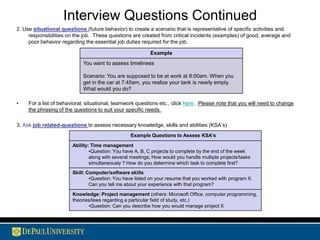
Interview Questions Continued2. Use situational questions (future behavior) to create a scenario that is representative of specific activities and responsibilities on the job.  These questions are created from critical incidents (examples) of good, average and poor behavior regarding the essential job duties required for the job.For a list of behavioral, situational, teamwork questions etc., click here . Please note that you will need to change the phrasing of the questions to suit your specific needs.3. Ask job related-questions to assess necessary knowledge, skills and abilities (KSA’s)
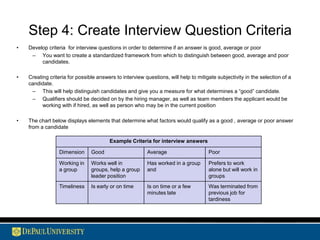
Step 4: Create Interview Question CriteriaDevelop criteria  for interview questions in order to determine if an answer is good, average or poorYou want to create a standardized framework from which to distinguish between good, average and poor candidates. Creating criteria for possible answers to interview questions, will help to mitigate subjectivity in the selection of a candidate.This will help distinguish candidates and give you a measure for what determines a “good” candidate.Qualifiers should be decided on by the hiring manager, as well as team members the applicant would be working with if hired, as well as person who may be in the current positionThe chart below displays elements that determine what factors would qualify as a good , average or poor answer from a candidate
Phase 2: The In-Person Interview
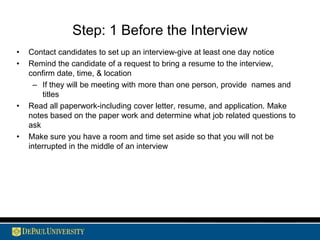
Step: 1 Before the InterviewContact candidates to set up an interview-give at least one day noticeRemind the candidate of a request to bring a resume to the interview, confirm date, time, & locationIf they will be meeting with more than one person, provide  names and titles Read all paperwork-including cover letter, resume, and application. Make notes based on the paper work and determine what job related questions to askMake sure you have a room and time set aside so that you will not be interrupted in the middle of an interview
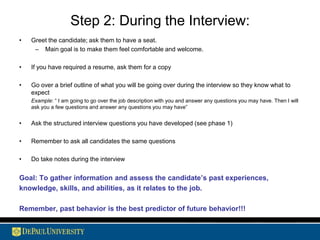
Step 2: During the Interview:Greet the candidate; ask them to have a seat.Main goal is to make them feel comfortable and welcome.If you have required a resume, ask them for a copyGo over a brief outline of what you will be going over during the interview so they know what to expect	Example: “ I am going to go over the job description with you and answer any questions you may have. Then I will ask you a few questions and answer any questions you may have”Ask the structured interview questions you have developed (see phase 1)Remember to ask all candidates the same questionsDo take notes during the interview Goal: To gather information and assess the candidate’s past experiences, knowledge, skills, and abilities, as it relates to the job.Remember, past behavior is the best predictor of future behavior!!!

Interview Process

  • 1.
  • 2.
    OverviewPhase 1: Beforethe interviewStep 1: Pick your top Candidates
  • 3.
    Step 2: Conducta Telephone Screen
  • 4.
    Step 3 CreateInterview Questions
  • 5.
    Step 4 CreateInterview Question CriteriaPhase 2: The In-Person InterviewStep 1: Before the Interview
  • 6.
    Step 2: Duringthe Interview
  • 7.
    Step 3: Afterthe InterviewPhase 3: Making the OfferStep 1: Offer Checklist
  • 8.
    Step 2: Havestudents come into the Office of Student Employment to fill out paperworkClick on View, Headers and Footer to change text footer.
  • 9.
    Phase 1: Beforethe Interview
  • 10.
    Step 1: PickYour Top CandidatesYou should screen applications to determine who are the top applicants you wish to interview (usually 3-5 applicants)Determine your “must haves”: Which knowledge, skills, abilities (KSA’s) you want the candidate to come in with, versus what KSA’s you would be willing to train for once hired.Your top applicants are those who can perform the essential job duties and meet the minimum requirements
  • 11.
    Tips for ReviewingResumes or Application FormsReview the job description(s) for the position(s) you are attempting to fill. Note minimum requirements needed and refer to them often as you review resumes/applications. Check work experience for applicability to the position for which they are applying, length of time in each position, promotions or awards received, reason for leaving each position.Check educational background for qualifications necessary to successful job performance.Note special skills (i.e. computer software, office equipment).Note any questions that arise when reviewing the resume/application and ask those during a telephone screenDivide resumes into 3 groups Those that closely match job requirements and for which a telephone screen is appropriate Those who meet some requirements and may be considered secondarilyThose those who do not meet the requirements at all.If necessary, screen the top group again to further narrow down the candidates. On average, about 10 resumes per open position should be sufficient.http://www.shrm.org/hrresources/basic_published/CMS_002734.asp
  • 12.
    Step 2: Conducta Telephone ScreenOnce you determine your top candidates, perform a phone screenDuring telephone screenings, briefly describe the position, location, hours and salary range (if appropriate) and ask if the candidate is still interested in being considered. The phone screen allows you to asses if the candidate’s experience, qualifications, work preferences, etc. are in line with those of the department/organization and the position they have applied forSet aside a quiet place to talkAllow at least 15-20 minutes for the screeningRemember you trying to determine if the candidate has the “must haves” before offering an in-person interviewhttp://www.shrm.org/hrresources/basic_published/CMS_007576.asp#P46_2053
  • 13.
    Step 3: CreateInterview QuestionsInterview questions should be job related and used to assess the knowledge, skills, and abilities necessary to perform the essential job dutiesThe interview process and questions asked should be structured: This will help ensure that all candidates are assessed based on the same criteria and help reduce bias that may occurThe interview should be conducted in the same manner and the same order for each candidateThere are three main types of questions that allow you to thoroughly assess candidate’s qualifications:Usebehavioral interview(past behavior) questions to ask about specific experiences that the candidate may have that exhibits competencies needed for the job. Behavioral questions are designed to assess the critical knowledge, skills and abilities required for a job based on requirements in the job description. Past behavior is the best predictor of future behavior!
  • 14.
    Interview Questions Continued2.Use situational questions (future behavior) to create a scenario that is representative of specific activities and responsibilities on the job. These questions are created from critical incidents (examples) of good, average and poor behavior regarding the essential job duties required for the job.For a list of behavioral, situational, teamwork questions etc., click here . Please note that you will need to change the phrasing of the questions to suit your specific needs.3. Ask job related-questions to assess necessary knowledge, skills and abilities (KSA’s)
  • 15.
    Step 4: CreateInterview Question CriteriaDevelop criteria for interview questions in order to determine if an answer is good, average or poorYou want to create a standardized framework from which to distinguish between good, average and poor candidates. Creating criteria for possible answers to interview questions, will help to mitigate subjectivity in the selection of a candidate.This will help distinguish candidates and give you a measure for what determines a “good” candidate.Qualifiers should be decided on by the hiring manager, as well as team members the applicant would be working with if hired, as well as person who may be in the current positionThe chart below displays elements that determine what factors would qualify as a good , average or poor answer from a candidate
  • 16.
    Phase 2: TheIn-Person Interview
  • 17.
    Step: 1 Beforethe InterviewContact candidates to set up an interview-give at least one day noticeRemind the candidate of a request to bring a resume to the interview, confirm date, time, & locationIf they will be meeting with more than one person, provide names and titles Read all paperwork-including cover letter, resume, and application. Make notes based on the paper work and determine what job related questions to askMake sure you have a room and time set aside so that you will not be interrupted in the middle of an interview
  • 18.
    Step 2: Duringthe Interview:Greet the candidate; ask them to have a seat.Main goal is to make them feel comfortable and welcome.If you have required a resume, ask them for a copyGo over a brief outline of what you will be going over during the interview so they know what to expect Example: “ I am going to go over the job description with you and answer any questions you may have. Then I will ask you a few questions and answer any questions you may have”Ask the structured interview questions you have developed (see phase 1)Remember to ask all candidates the same questionsDo take notes during the interview Goal: To gather information and assess the candidate’s past experiences, knowledge, skills, and abilities, as it relates to the job.Remember, past behavior is the best predictor of future behavior!!!
  • 19.
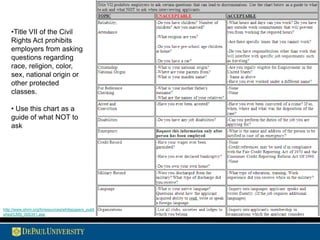
    Title VII ofthe Civil Rights Act prohibits employers from asking questions regarding race, religion, color, sex, national origin or other protected classes.
  • 20.
    Use thischart as a guide of what NOT to askhttp://www.shrm.org/hrresources/whitepapers_published/CMS_000341.asp
  • 21.
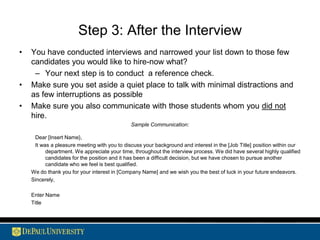
    Step 3: Afterthe InterviewYou have conducted interviews and narrowed your list down to those few candidates you would like to hire-now what?Your next step is to conduct a reference check.Make sure you set aside a quiet place to talk with minimal distractions and as few interruptions as possibleMake sure you also communicate with those students whom you did not hire.Sample Communication: Dear [Insert Name},It was a pleasure meeting with you to discuss your background and interest in the [Job Title]position within our department. We appreciate your time, throughout the interview process. We did have several highly qualified candidates for the position and it has been a difficult decision, but we have chosen to pursue another candidate who we feel is best qualified. We do thank you for your interest in [Company Name]and we wish you the best of luck in your future endeavors. Sincerely, Enter Name Title
  • 22.
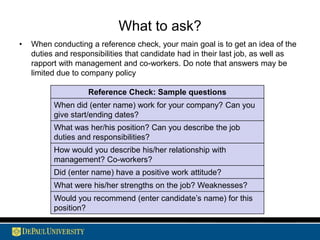
    What to ask?Whenconducting a reference check, your main goal is to get an idea of the duties and responsibilities that candidate had in their last job, as well as rapport with management and co-workers. Do note that answers may be limited due to company policy
  • 23.
  • 24.
    You are atthe end of the interview process! You have found a good candidate, and are ready to hire!
  • 25.
    Questions or Concerns?Pleasefeel free to contact the Office of Student Employment/Career Center at any time.Loop CampusDPC 94001 E. Jackson Blvd.Chicago, IL 60604Phone: 312-362-5599Hours:Mon. – Thur.: 8:30am – 6pmFri.: 8:30am – 5pmLincoln Park CampusSAC, Room 1922320 N. Kenmore Ave.Chicago, IL 60614Phone: 773-325-7431Hours:Mon. – Thur.: 8:30am – 6pmFri.: 8:30am – 5pm